Hamstring & Thigh Rehab Challenge · 46
Hamstring injuries in older athletes: masters sport and tendon health
In older athletes, hamstring problems span the familiar sprint-related muscle strain and, less commonly, injury to the proximal hamstring tendons at…
Key points
- Strengthen. Include the Nordic exercise and eccentric work to tolerance (Grade A and B guidance).
- Measure. Test knee-flexor strength with a dynamometer and track it over the season.
- Stay consistent. Choose a short routine that will actually be done; adherence decided the effect.
What it is
In older athletes, hamstring problems span the familiar sprint-related muscle strain and, less commonly, injury to the proximal hamstring tendons at the sitting bone, including tendon avulsion. Older age is a consistently reported risk factor for hamstring strain injury, although the reasons (strength, previous injury, tissue change) are not fully established (Green et al., 2020; Martin et al., 2022).
How we analysed the movement
Three movements relevant to this topic were analysed from illustrated reference figures. Joint centres were located with two-dimensional pose estimation; hip and knee angles, pelvis level, the whole-body centre of mass and, where relevant, the hip lever (the horizontal distance from the hip joint to the upper-body centre of mass) and the resulting static hip moment were then calculated from standard segment parameters. The figures are educational estimates that show how position changes mechanical demand; they are not measurements of a patient. Every research value quoted below comes from the published source cited beside it.
Movement A: Fast running (side view)
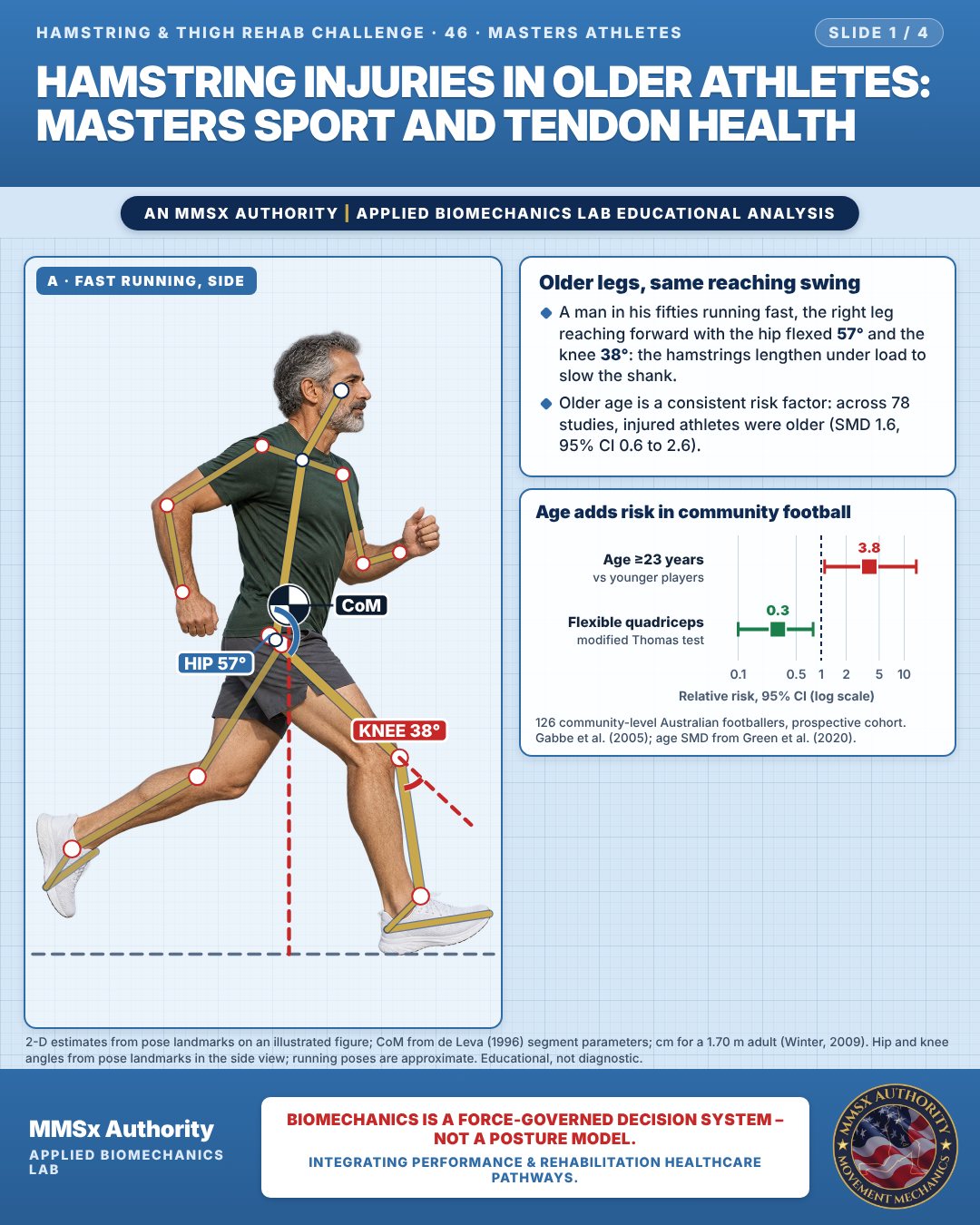
Older legs, same reaching swing
A man in his fifties running fast, the right leg reaching forward with the hip flexed 57° and the knee 38°: the hamstrings lengthen under load to slow the shank.
Older age is a consistent risk factor: across 78 studies, injured athletes were older (SMD 1.6, 95% CI 0.6 to 2.6).
Age adds risk in community football
Movement B: Dumbbell rdl (side view)
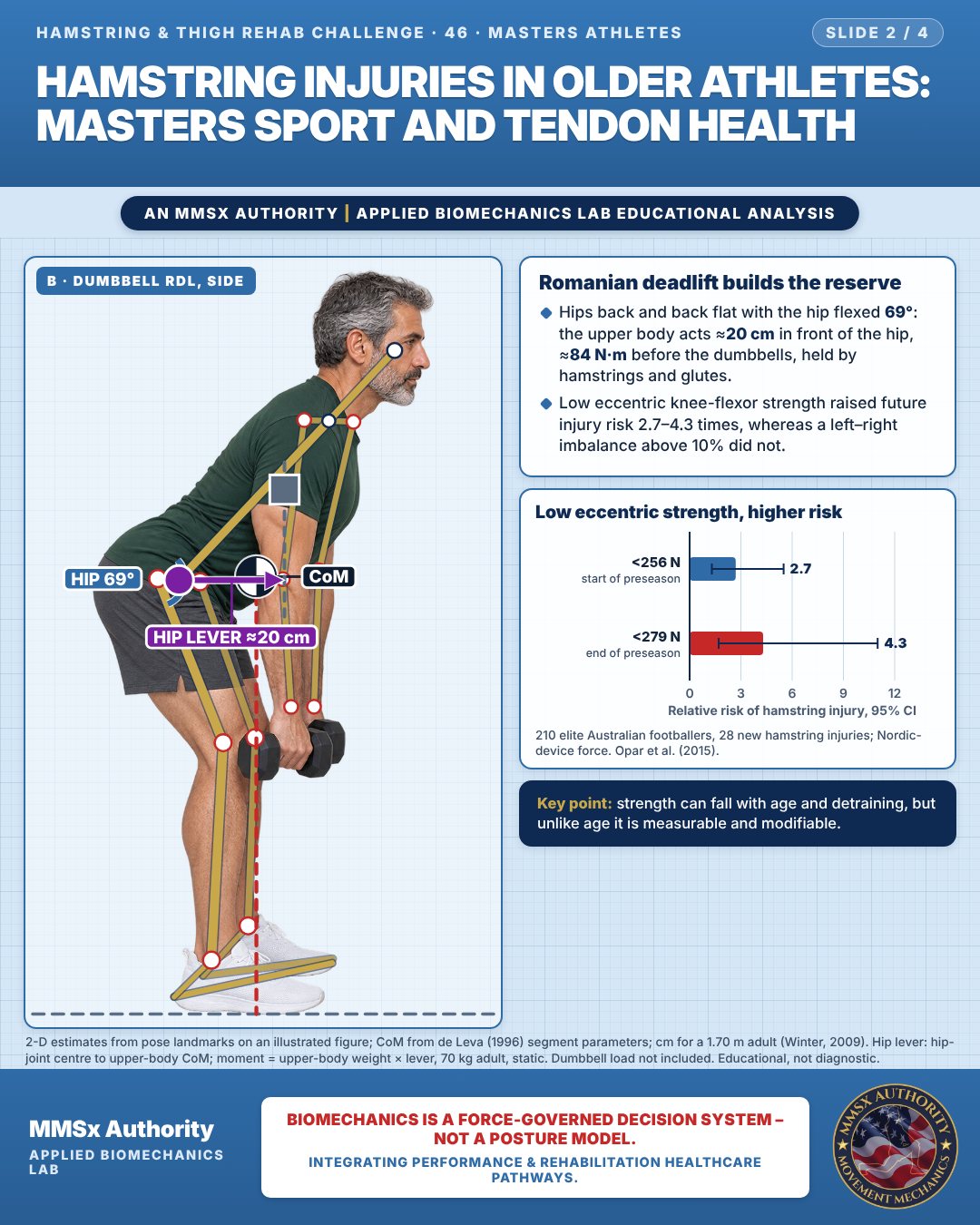
Romanian deadlift builds the reserve
Hips back and back flat with the hip flexed 69°: the upper body acts ≈20 cm in front of the hip, ≈84 N·m before the dumbbells, held by hamstrings and glutes.
Low eccentric knee-flexor strength raised future injury risk 2.7–4.3 times, whereas a left–right imbalance above 10% did not.
Low eccentric strength, higher risk
Movement C: Single-leg bridge (side view)
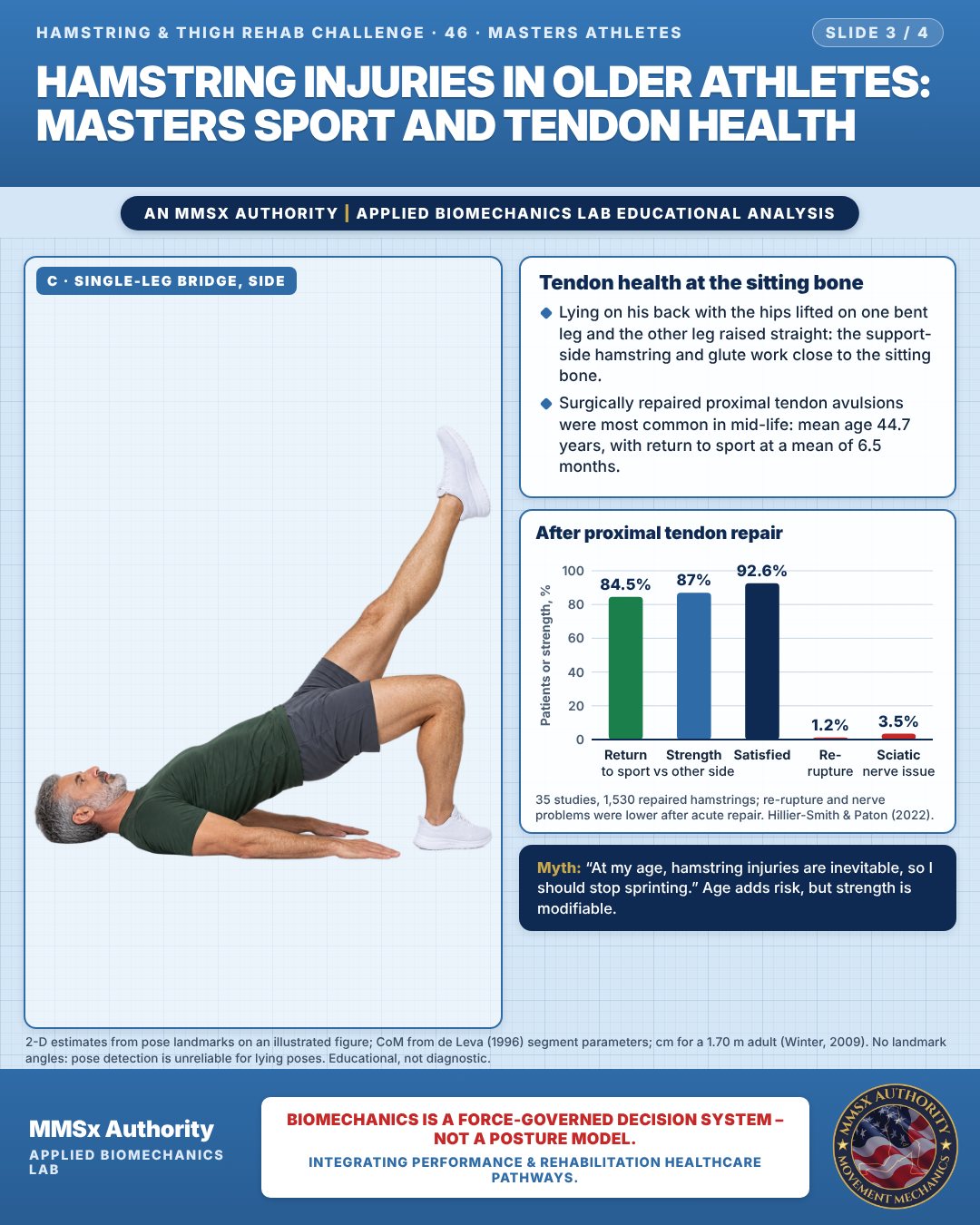
Tendon health at the sitting bone
Lying on his back with the hips lifted on one bent leg and the other leg raised straight: the support-side hamstring and glute work close to the sitting bone.
Surgically repaired proximal tendon avulsions were most common in mid-life: mean age 44.7 years, with return to sport at a mean of 6.5 months.
After proximal tendon repair
Decision pathway
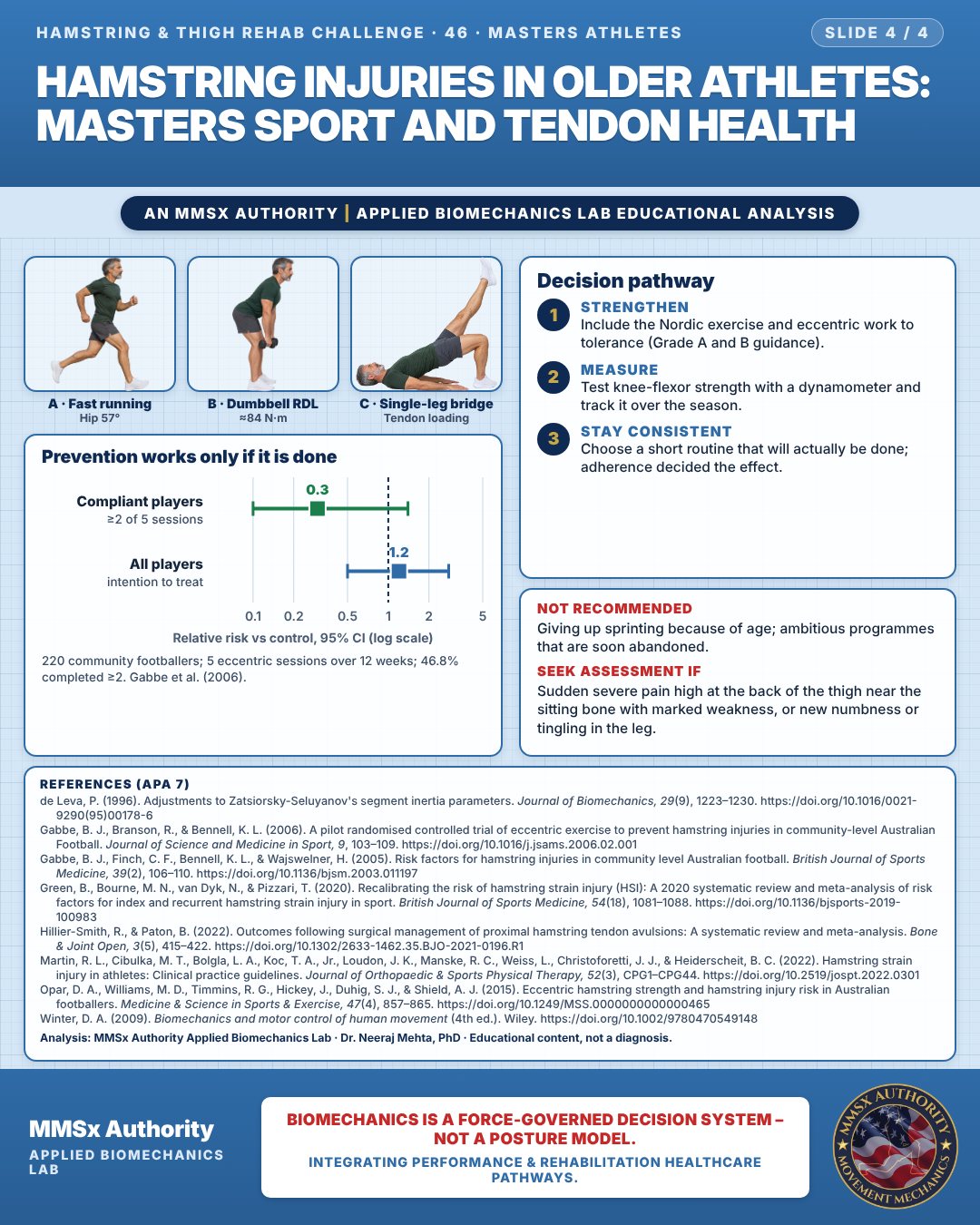
Prevention works only if it is done
Strengthen
Include the Nordic exercise and eccentric work to tolerance (Grade A and B guidance).
Measure
Test knee-flexor strength with a dynamometer and track it over the season.
Stay consistent
Choose a short routine that will actually be done; adherence decided the effect.
What the evidence supports
- JOSPT clinical practice guideline (Martin et al., 2022): quantify knee flexor strength with a handheld or isokinetic dynamometer (Grade A); measure hamstring length with the knee extension test at 90° hip flexion (Grade A); use eccentric training to the patient's tolerance, added to stretching, strengthening and stabilisation, to improve return-to-play time (Grade B); add progressive agility and trunk stabilisation to reduce reinjury (Grade B); include the Nordic hamstring exercise in prevention programmes (Grade A). The guideline notes age over 23 years as associated with greater risk in its evidence discussion, without a separate grade.
Myth and evidence
Myth“At my age, hamstring injuries are inevitable, so I should stop sprinting.”
EvidenceAge is a risk factor (Gabbe et al., 2005; Green et al., 2020), but eccentric strength is modifiable and low strength carried 2.7–4.3 times the risk (Opar et al., 2015), and the Nordic hamstring exercise is a Grade A prevention recommendation (Martin et al., 2022). Even after a surgically repaired tendon avulsion, 84.5% returned to sport (Hillier-Smith & Paton, 2022).
Cautions
Not recommended
Giving up sprinting because of age; ambitious programmes that are soon abandoned.
Seek assessment if
Sudden severe pain high at the back of the thigh near the sitting bone with marked weakness, or new numbness or tingling in the leg.
Methods note
2-D estimates from pose landmarks on an illustrated figure; CoM from de Leva (1996) segment parameters; cm for a 1.70 m adult (Winter, 2009). Hip and knee angles from pose landmarks in the side view; running poses are approximate. Hip lever: hip-joint centre to upper-body CoM; moment = upper-body weight × lever, 70 kg adult, static. Dumbbell load not included. No landmark angles: pose detection is unreliable for lying poses. These are educational estimates, not a diagnosis.
References
- de Leva, P. (1996). Adjustments to Zatsiorsky-Seluyanov's segment inertia parameters. Journal of Biomechanics, 29(9), 1223–1230. https://doi.org/10.1016/0021-9290(95)00178-6
- Gabbe, B. J., Branson, R., & Bennell, K. L. (2006). A pilot randomised controlled trial of eccentric exercise to prevent hamstring injuries in community-level Australian Football. Journal of Science and Medicine in Sport, 9, 103–109. https://doi.org/10.1016/j.jsams.2006.02.001
- Gabbe, B. J., Finch, C. F., Bennell, K. L., & Wajswelner, H. (2005). Risk factors for hamstring injuries in community level Australian football. British Journal of Sports Medicine, 39(2), 106–110. https://doi.org/10.1136/bjsm.2003.011197
- Green, B., Bourne, M. N., van Dyk, N., & Pizzari, T. (2020). Recalibrating the risk of hamstring strain injury (HSI): A 2020 systematic review and meta-analysis of risk factors for index and recurrent hamstring strain injury in sport. British Journal of Sports Medicine, 54(18), 1081–1088. https://doi.org/10.1136/bjsports-2019-100983
- Hillier-Smith, R., & Paton, B. (2022). Outcomes following surgical management of proximal hamstring tendon avulsions: A systematic review and meta-analysis. Bone & Joint Open, 3(5), 415–422. https://doi.org/10.1302/2633-1462.35.BJO-2021-0196.R1
- Martin, R. L., Cibulka, M. T., Bolgla, L. A., Koc, T. A., Jr., Loudon, J. K., Manske, R. C., Weiss, L., Christoforetti, J. J., & Heiderscheit, B. C. (2022). Hamstring strain injury in athletes: Clinical practice guidelines. Journal of Orthopaedic & Sports Physical Therapy, 52(3), CPG1–CPG44. https://doi.org/10.2519/jospt.2022.0301
- Opar, D. A., Williams, M. D., Timmins, R. G., Hickey, J., Duhig, S. J., & Shield, A. J. (2015). Eccentric hamstring strength and hamstring injury risk in Australian footballers. Medicine & Science in Sports & Exercise, 47(4), 857–865. https://doi.org/10.1249/MSS.0000000000000465
- Winter, D. A. (2009). Biomechanics and motor control of human movement (4th ed.). Wiley. https://doi.org/10.1002/9780470549148
Cite this article
Mehta, N. (2026, October 26). Hamstring injuries in older athletes: masters sport and tendon health. MMSx Authority Applied Biomechanics Lab. https://mmsxauthority.org/edu/analysis/hamstring-thigh/46-hamstring-injuries-in-older-athletes-masters-sport-and-tendon-health/
Part of the collection
Mehta, N. (2026). Hamstring and Thigh Rehabilitation: 50 Evidence-Based Biomechanics Analyses [Collection]. MMSx Authority Applied Biomechanics Lab. Zenodo. https://doi.org/10.5281/zenodo.23735792
All Hamstring & Thigh Rehab Challenge articles · Rehabilitation Library