Hamstring & Thigh Rehab Challenge · 45
Glute weakness and hamstring overload: the shared hip-extension job
The gluteus maximus and the hamstrings share the job of extending the hip. Movement analysis, verified research data and a decision pathway.
Key points
- Train both. Load the glutes (hip thrust, step-up) alongside specific hamstring strengthening.
- Use it at speed. Carry hip-extension work into sprint drills; gluteal activity while sprinting was linked to lower risk.
- Keep priorities. Previous hamstring injury remains the strongest risk factor; glute work complements, not replaces.
What it is
The gluteus maximus and the hamstrings share the job of extending the hip. If the gluteal contribution is reduced, musculoskeletal modelling predicts that the hamstrings take a larger share of the work and that forces at the hip change. "Glute weakness causes hamstring strain" is a plausible mechanical hypothesis supported by modelling and prospective association data, not a proven cause (Lewis et al., 2007; Schuermans, Danneels, et al., 2017).
How we analysed the movement
Three movements relevant to this topic were analysed from illustrated reference figures. Joint centres were located with two-dimensional pose estimation; hip and knee angles, pelvis level, the whole-body centre of mass and, where relevant, the hip lever (the horizontal distance from the hip joint to the upper-body centre of mass) and the resulting static hip moment were then calculated from standard segment parameters. The figures are educational estimates that show how position changes mechanical demand; they are not measurements of a patient. Every research value quoted below comes from the published source cited beside it.
Movement A: Barbell hip thrust (side view)
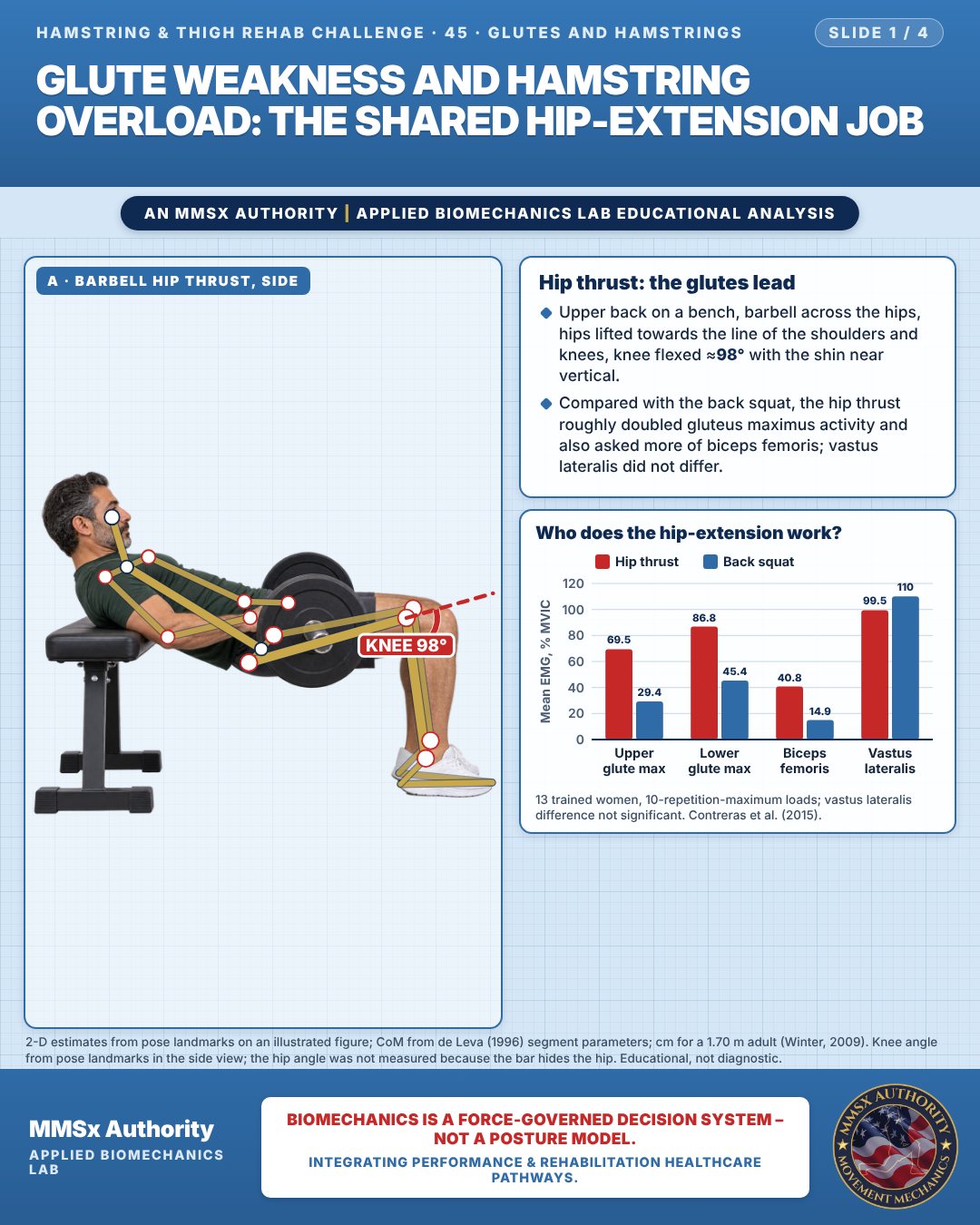
Hip thrust: the glutes lead
Upper back on a bench, barbell across the hips, hips lifted towards the line of the shoulders and knees, knee flexed ≈98° with the shin near vertical.
Compared with the back squat, the hip thrust roughly doubled gluteus maximus activity and also asked more of biceps femoris; vastus lateralis did not differ.
Who does the hip-extension work?
Movement B: Glute bridge (side view)
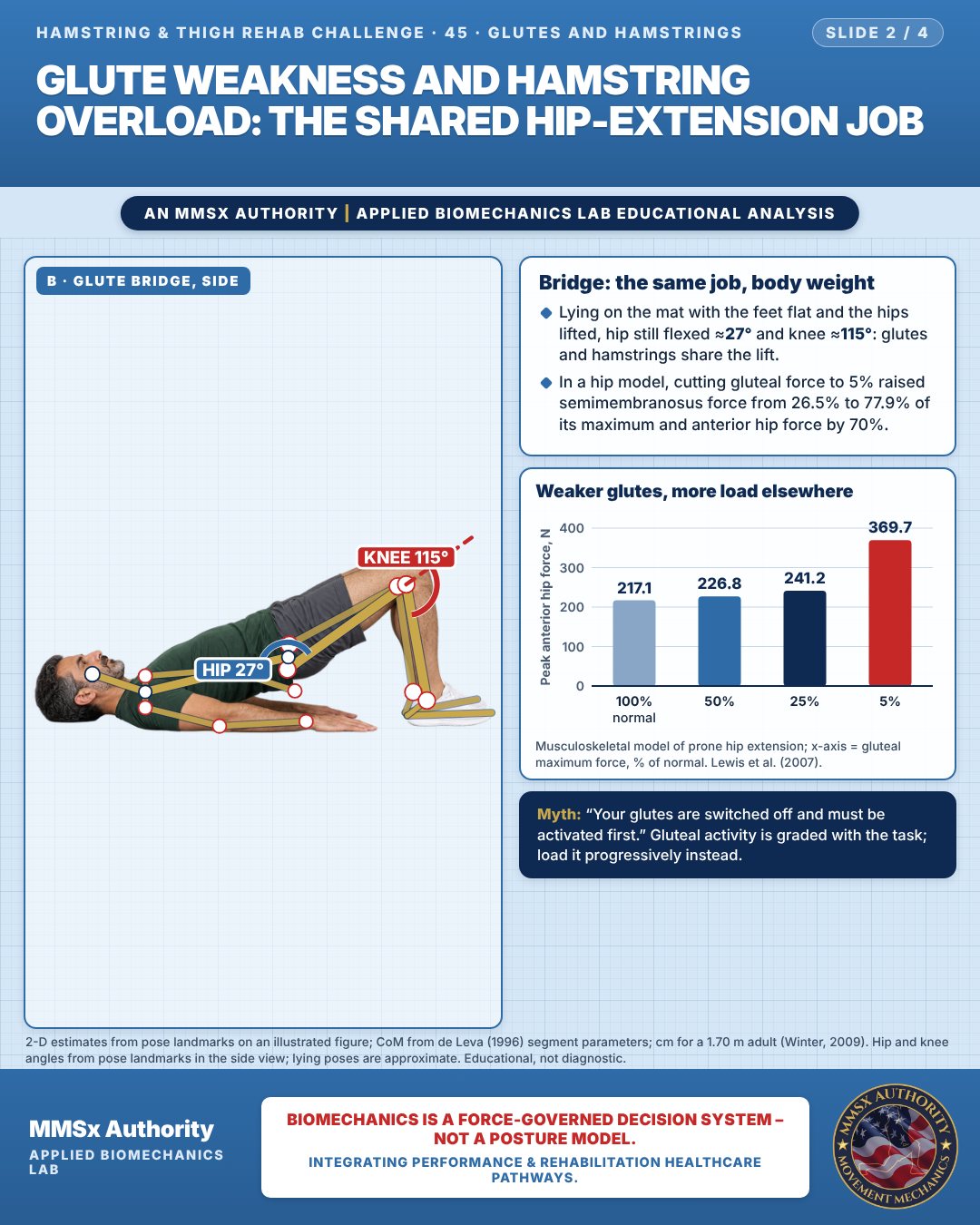
Bridge: the same job, body weight
Lying on the mat with the feet flat and the hips lifted, hip still flexed ≈27° and knee ≈115°: glutes and hamstrings share the lift.
In a hip model, cutting gluteal force to 5% raised semimembranosus force from 26.5% to 77.9% of its maximum and anterior hip force by 70%.
Weaker glutes, more load elsewhere
Movement C: Step-up (rear view)
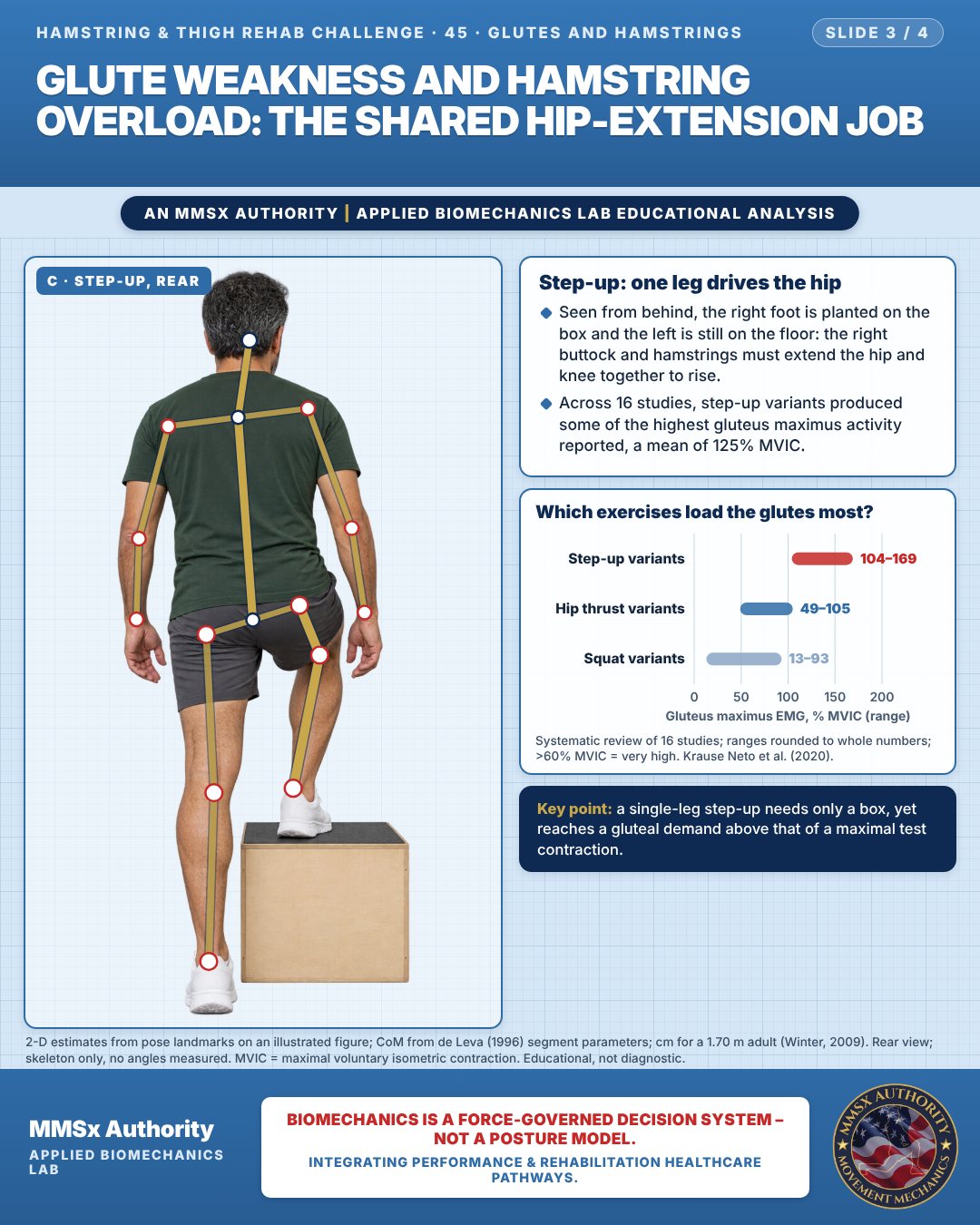
Step-up: one leg drives the hip
Seen from behind, the right foot is planted on the box and the left is still on the floor: the right buttock and hamstrings must extend the hip and knee together to rise.
Across 16 studies, step-up variants produced some of the highest gluteus maximus activity reported, a mean of 125% MVIC.
Which exercises load the glutes most?
Decision pathway
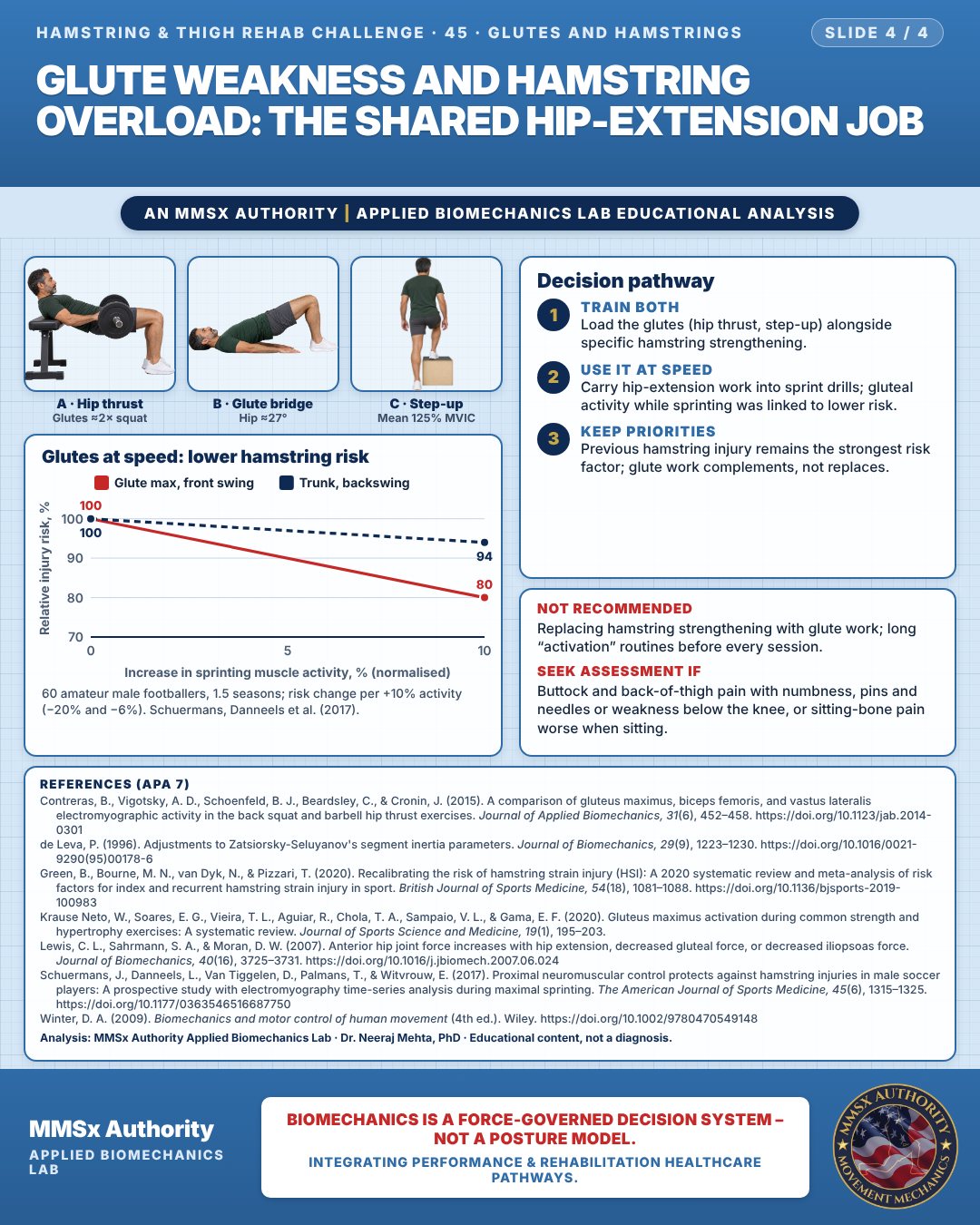
Glutes at speed: lower hamstring risk
Train both
Load the glutes (hip thrust, step-up) alongside specific hamstring strengthening.
Use it at speed
Carry hip-extension work into sprint drills; gluteal activity while sprinting was linked to lower risk.
Keep priorities
Previous hamstring injury remains the strongest risk factor; glute work complements, not replaces.
What the evidence supports
- Train both hip-extension partners: hip-dominant exercises such as the hip thrust load the gluteus maximus about twice as much as a squat and also load biceps femoris (Contreras et al., 2015); step-ups and lunges reach very high gluteal activity (Krause Neto et al., 2020).
- Gluteal training complements, and does not replace, specific hamstring strengthening; previous injury remains the main risk factor (Green et al., 2020).
Cautions
Not recommended
Replacing hamstring strengthening with glute work; long “activation” routines before every session.
Seek assessment if
Buttock and back-of-thigh pain with numbness, pins and needles or weakness below the knee, or sitting-bone pain worse when sitting.
Methods note
2-D estimates from pose landmarks on an illustrated figure; CoM from de Leva (1996) segment parameters; cm for a 1.70 m adult (Winter, 2009). Knee angle from pose landmarks in the side view; the hip angle was not measured because the bar hides the hip. Hip and knee angles from pose landmarks in the side view; lying poses are approximate. Rear view; skeleton only, no angles measured. MVIC = maximal voluntary isometric contraction. These are educational estimates, not a diagnosis.
References
- Contreras, B., Vigotsky, A. D., Schoenfeld, B. J., Beardsley, C., & Cronin, J. (2015). A comparison of gluteus maximus, biceps femoris, and vastus lateralis electromyographic activity in the back squat and barbell hip thrust exercises. Journal of Applied Biomechanics, 31(6), 452–458. https://doi.org/10.1123/jab.2014-0301
- de Leva, P. (1996). Adjustments to Zatsiorsky-Seluyanov's segment inertia parameters. Journal of Biomechanics, 29(9), 1223–1230. https://doi.org/10.1016/0021-9290(95)00178-6
- Green, B., Bourne, M. N., van Dyk, N., & Pizzari, T. (2020). Recalibrating the risk of hamstring strain injury (HSI): A 2020 systematic review and meta-analysis of risk factors for index and recurrent hamstring strain injury in sport. British Journal of Sports Medicine, 54(18), 1081–1088. https://doi.org/10.1136/bjsports-2019-100983
- Krause Neto, W., Soares, E. G., Vieira, T. L., Aguiar, R., Chola, T. A., Sampaio, V. L., & Gama, E. F. (2020). Gluteus maximus activation during common strength and hypertrophy exercises: A systematic review. Journal of Sports Science and Medicine, 19(1), 195–203.
- Lewis, C. L., Sahrmann, S. A., & Moran, D. W. (2007). Anterior hip joint force increases with hip extension, decreased gluteal force, or decreased iliopsoas force. Journal of Biomechanics, 40(16), 3725–3731. https://doi.org/10.1016/j.jbiomech.2007.06.024
- Schuermans, J., Danneels, L., Van Tiggelen, D., Palmans, T., & Witvrouw, E. (2017). Proximal neuromuscular control protects against hamstring injuries in male soccer players: A prospective study with electromyography time-series analysis during maximal sprinting. The American Journal of Sports Medicine, 45(6), 1315–1325. https://doi.org/10.1177/0363546516687750
- Winter, D. A. (2009). Biomechanics and motor control of human movement (4th ed.). Wiley. https://doi.org/10.1002/9780470549148
Cite this article
Mehta, N. (2026, October 26). Glute weakness and hamstring overload: the shared hip-extension job. MMSx Authority Applied Biomechanics Lab. https://mmsxauthority.org/edu/analysis/hamstring-thigh/45-glute-weakness-and-hamstring-overload-the-shared-hip-extension-job/
Part of the collection
Mehta, N. (2026). Hamstring and Thigh Rehabilitation: 50 Evidence-Based Biomechanics Analyses [Collection]. MMSx Authority Applied Biomechanics Lab. Zenodo. https://doi.org/10.5281/zenodo.23735792
All Hamstring & Thigh Rehab Challenge articles · Rehabilitation Library