Hamstring & Thigh Rehab Challenge · 44
Pelvic tilt and hamstring strain: does the pelvis matter?
Anterior pelvic tilt is a forward rotation of the pelvis in the sagittal plane. Movement analysis, verified research data and a decision pathway.
Key points
- Screen. Ask about previous hamstring injury first; a recent injury carried the highest risk.
- Train. Train pelvic and trunk control at speed; a 6-week programme reduced pelvic tilt in gait.
- Keep perspective. Forward tilt in sprint swing was linked to later injury; standing posture was not shown to be.
What it is
Anterior pelvic tilt is a forward rotation of the pelvis in the sagittal plane. Because the hamstrings arise from the ischial tuberosity, more anterior tilt places their origin further from their insertion and may lengthen them. In standing, some anterior tilt is normal. During sprinting, greater anterior tilt in the swing phases has been associated with later hamstring injury in one prospective study, but a causal role is not proven.
How we analysed the movement
Three movements relevant to this topic were analysed from illustrated reference figures. Joint centres were located with two-dimensional pose estimation; hip and knee angles, pelvis level, the whole-body centre of mass and, where relevant, the hip lever (the horizontal distance from the hip joint to the upper-body centre of mass) and the resulting static hip moment were then calculated from standard segment parameters. The figures are educational estimates that show how position changes mechanical demand; they are not measurements of a patient. Every research value quoted below comes from the published source cited beside it.
Movement A: Arched low back (side view)
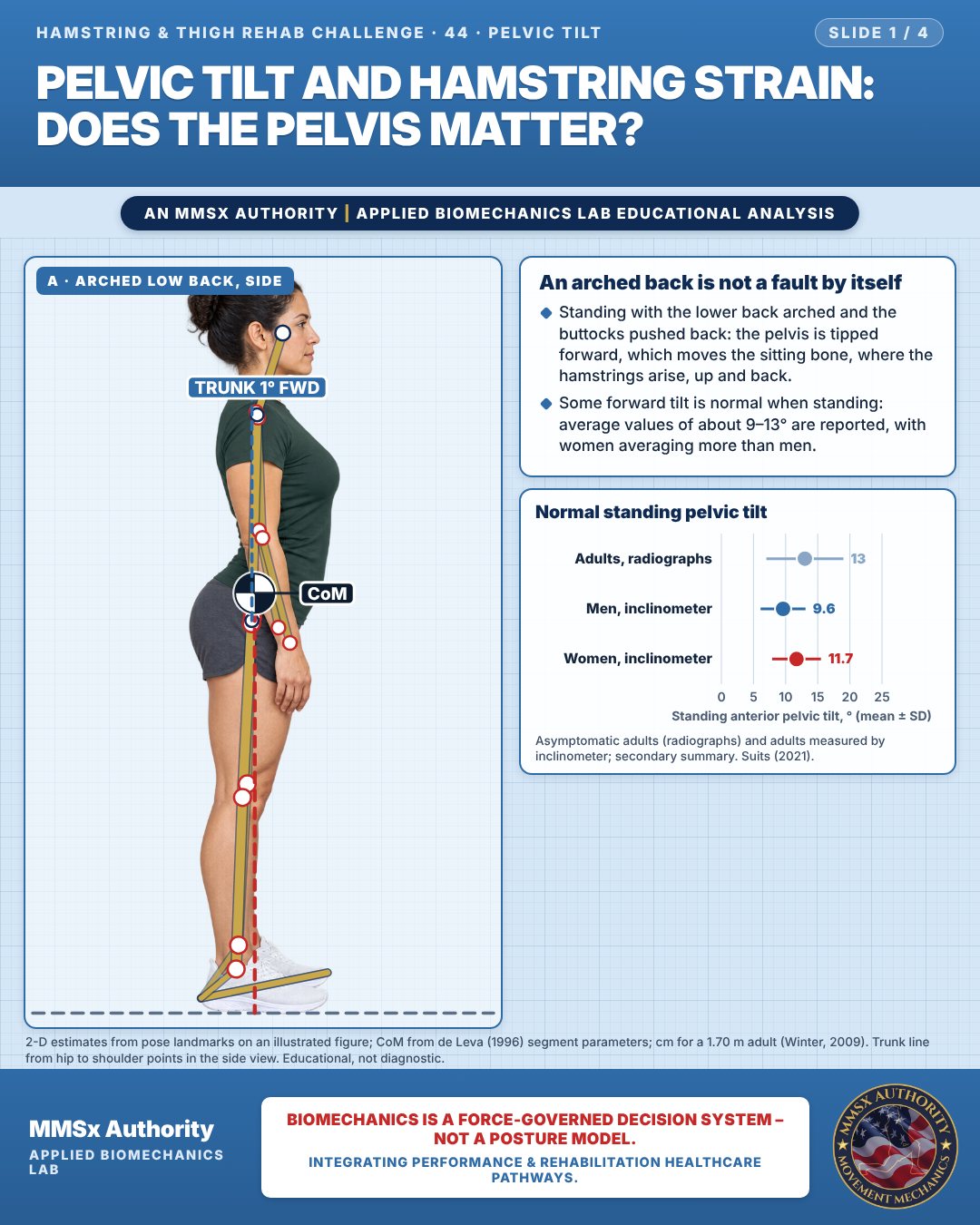
An arched back is not a fault by itself
Standing with the lower back arched and the buttocks pushed back: the pelvis is tipped forward, which moves the sitting bone, where the hamstrings arise, up and back.
Some forward tilt is normal when standing: average values of about 9–13° are reported, with women averaging more than men.
Normal standing pelvic tilt
Movement B: Neutral pelvis (side view)
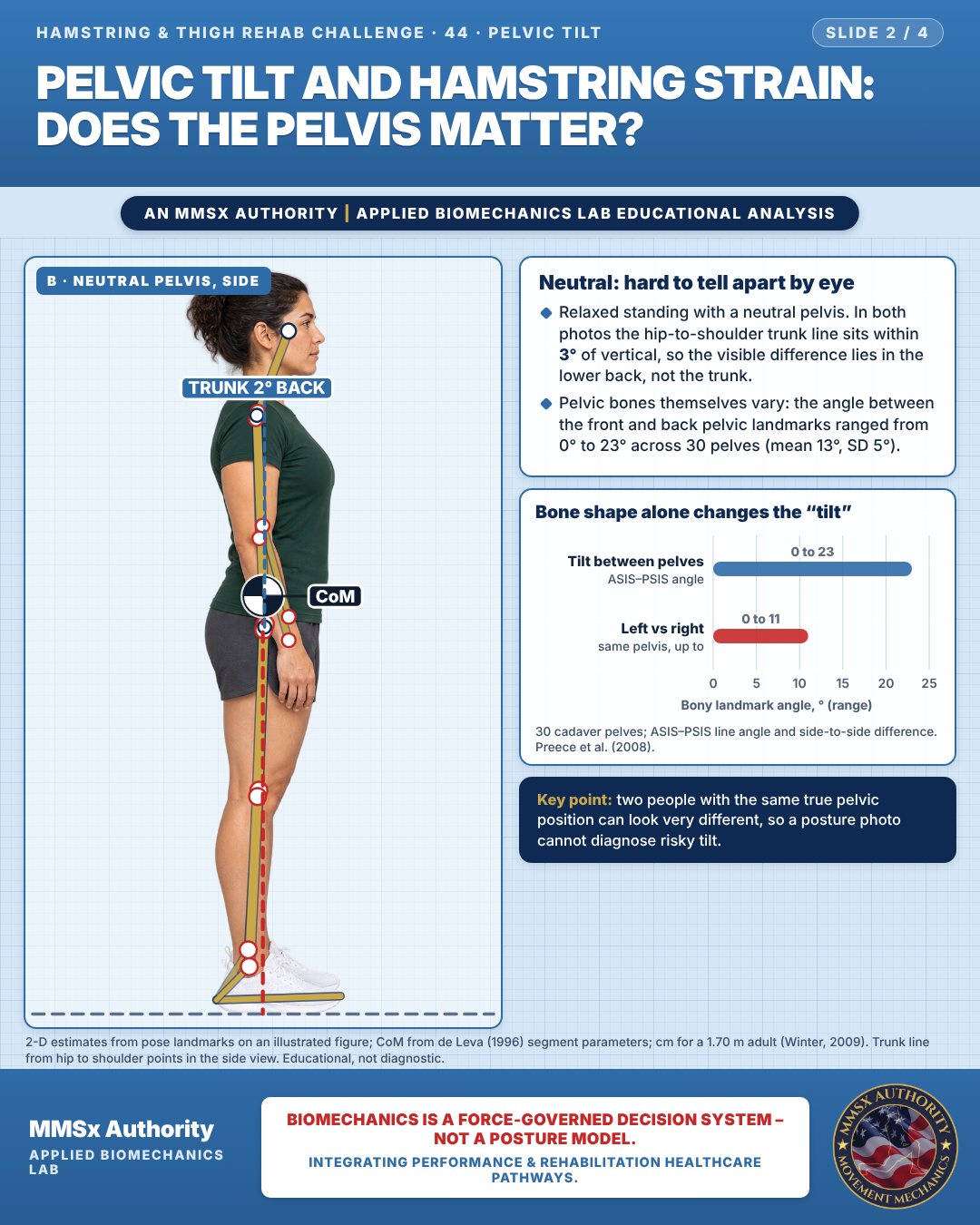
Neutral: hard to tell apart by eye
Relaxed standing with a neutral pelvis. In both photos the hip-to-shoulder trunk line sits within 3° of vertical, so the visible difference lies in the lower back, not the trunk.
Pelvic bones themselves vary: the angle between the front and back pelvic landmarks ranged from 0° to 23° across 30 pelves (mean 13°, SD 5°).
Bone shape alone changes the “tilt”
Movement C: Dead bug (side view)
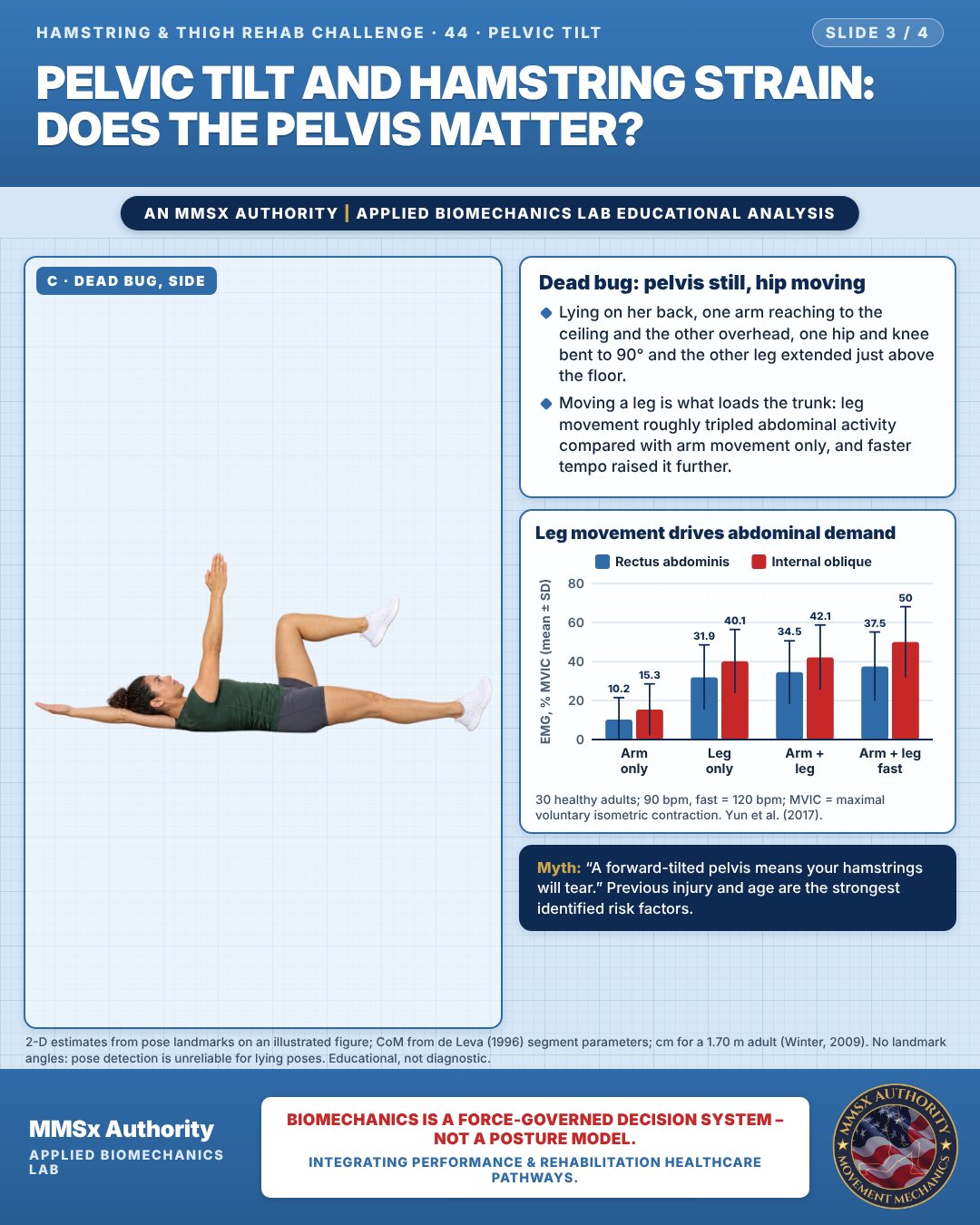
Dead bug: pelvis still, hip moving
Lying on her back, one arm reaching to the ceiling and the other overhead, one hip and knee bent to 90° and the other leg extended just above the floor.
Moving a leg is what loads the trunk: leg movement roughly tripled abdominal activity compared with arm movement only, and faster tempo raised it further.
Leg movement drives abdominal demand
Decision pathway
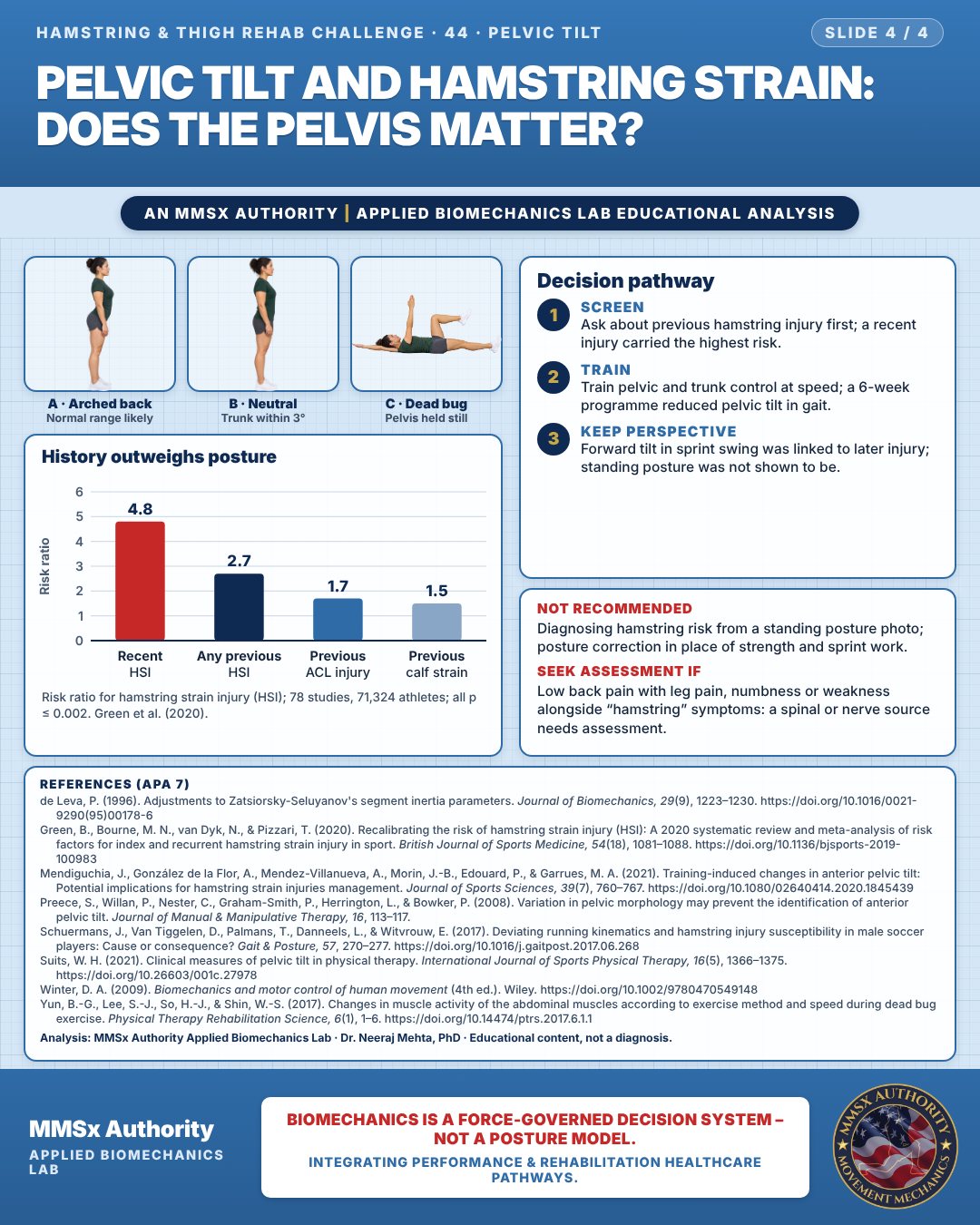
History outweighs posture
Screen
Ask about previous hamstring injury first; a recent injury carried the highest risk.
Train
Train pelvic and trunk control at speed; a 6-week programme reduced pelvic tilt in gait.
Keep perspective
Forward tilt in sprint swing was linked to later injury; standing posture was not shown to be.
Myth and evidence
Myth“Your pelvis is tilted forward, so your hamstrings are bound to tear.”
EvidenceStanding anterior tilt of roughly 9–13° is normal (Suits, 2021), pelvic bone shape alone varies from 0° to 23° (Preece et al., 2008), and the strongest identified predictors of hamstring injury are previous injury and age (Green et al., 2020). What has been associated with injury is pelvic and trunk motion during sprinting, not static standing posture (Schuermans, Van Tiggelen, et al., 2017).
Cautions
Not recommended
Diagnosing hamstring risk from a standing posture photo; posture correction in place of strength and sprint work.
Seek assessment if
Low back pain with leg pain, numbness or weakness alongside “hamstring” symptoms: a spinal or nerve source needs assessment.
Methods note
2-D estimates from pose landmarks on an illustrated figure; CoM from de Leva (1996) segment parameters; cm for a 1.70 m adult (Winter, 2009). Trunk line from hip to shoulder points in the side view. No landmark angles: pose detection is unreliable for lying poses. These are educational estimates, not a diagnosis.
References
- de Leva, P. (1996). Adjustments to Zatsiorsky-Seluyanov's segment inertia parameters. Journal of Biomechanics, 29(9), 1223–1230. https://doi.org/10.1016/0021-9290(95)00178-6
- Green, B., Bourne, M. N., van Dyk, N., & Pizzari, T. (2020). Recalibrating the risk of hamstring strain injury (HSI): A 2020 systematic review and meta-analysis of risk factors for index and recurrent hamstring strain injury in sport. British Journal of Sports Medicine, 54(18), 1081–1088. https://doi.org/10.1136/bjsports-2019-100983
- Mendiguchia, J., González de la Flor, A., Mendez-Villanueva, A., Morin, J.-B., Edouard, P., & Garrues, M. A. (2021). Training-induced changes in anterior pelvic tilt: Potential implications for hamstring strain injuries management. Journal of Sports Sciences, 39(7), 760–767. https://doi.org/10.1080/02640414.2020.1845439
- Preece, S., Willan, P., Nester, C., Graham-Smith, P., Herrington, L., & Bowker, P. (2008). Variation in pelvic morphology may prevent the identification of anterior pelvic tilt. Journal of Manual & Manipulative Therapy, 16, 113–117.
- Schuermans, J., Van Tiggelen, D., Palmans, T., Danneels, L., & Witvrouw, E. (2017). Deviating running kinematics and hamstring injury susceptibility in male soccer players: Cause or consequence? Gait & Posture, 57, 270–277. https://doi.org/10.1016/j.gaitpost.2017.06.268
- Suits, W. H. (2021). Clinical measures of pelvic tilt in physical therapy. International Journal of Sports Physical Therapy, 16(5), 1366–1375. https://doi.org/10.26603/001c.27978
- Winter, D. A. (2009). Biomechanics and motor control of human movement (4th ed.). Wiley. https://doi.org/10.1002/9780470549148
- Yun, B.-G., Lee, S.-J., So, H.-J., & Shin, W.-S. (2017). Changes in muscle activity of the abdominal muscles according to exercise method and speed during dead bug exercise. Physical Therapy Rehabilitation Science, 6(1), 1–6. https://doi.org/10.14474/ptrs.2017.6.1.1
Cite this article
Mehta, N. (2026, October 26). Pelvic tilt and hamstring strain: does the pelvis matter? MMSx Authority Applied Biomechanics Lab. https://mmsxauthority.org/edu/analysis/hamstring-thigh/44-pelvic-tilt-and-hamstring-strain-does-the-pelvis-matter/
Part of the collection
Mehta, N. (2026). Hamstring and Thigh Rehabilitation: 50 Evidence-Based Biomechanics Analyses [Collection]. MMSx Authority Applied Biomechanics Lab. Zenodo. https://doi.org/10.5281/zenodo.23735792
All Hamstring & Thigh Rehab Challenge articles · Rehabilitation Library