Hamstring & Thigh Rehab Challenge · 43
Sprinting technique and hamstring load: posture, stride and pelvis
Sprinting places the hamstrings under their highest functional demand: in late swing they lengthen while producing force to decelerate the…
Key points
- Posture. Coach a tall trunk and level pelvis at speed; pelvis and trunk motion in swing were linked to later injury.
- Stride. Cue the foot to land closer under the hips; a 6-week programme changed sprint kinematics.
- Expose. Plan regular, progressive running at near-maximal speed rather than avoiding it.
What it is
Sprinting places the hamstrings under their highest functional demand: in late swing they lengthen while producing force to decelerate the forward-swinging shank. Technique factors that change pelvis and trunk control, such as excessive anterior pelvic tilt and trunk side bending during the airborne phases, have been associated with higher hamstring injury susceptibility in prospective work, though cause and effect is not proven (Chumanov et al., 2011; Schuermans, Van Tiggelen, et al., 2017).
How we analysed the movement
Three movements relevant to this topic were analysed from illustrated reference figures. Joint centres were located with two-dimensional pose estimation; hip and knee angles, pelvis level, the whole-body centre of mass and, where relevant, the hip lever (the horizontal distance from the hip joint to the upper-body centre of mass) and the resulting static hip moment were then calculated from standard segment parameters. The figures are educational estimates that show how position changes mechanical demand; they are not measurements of a patient. Every research value quoted below comes from the published source cited beside it.
Movement A: Top-speed sprint (side view)
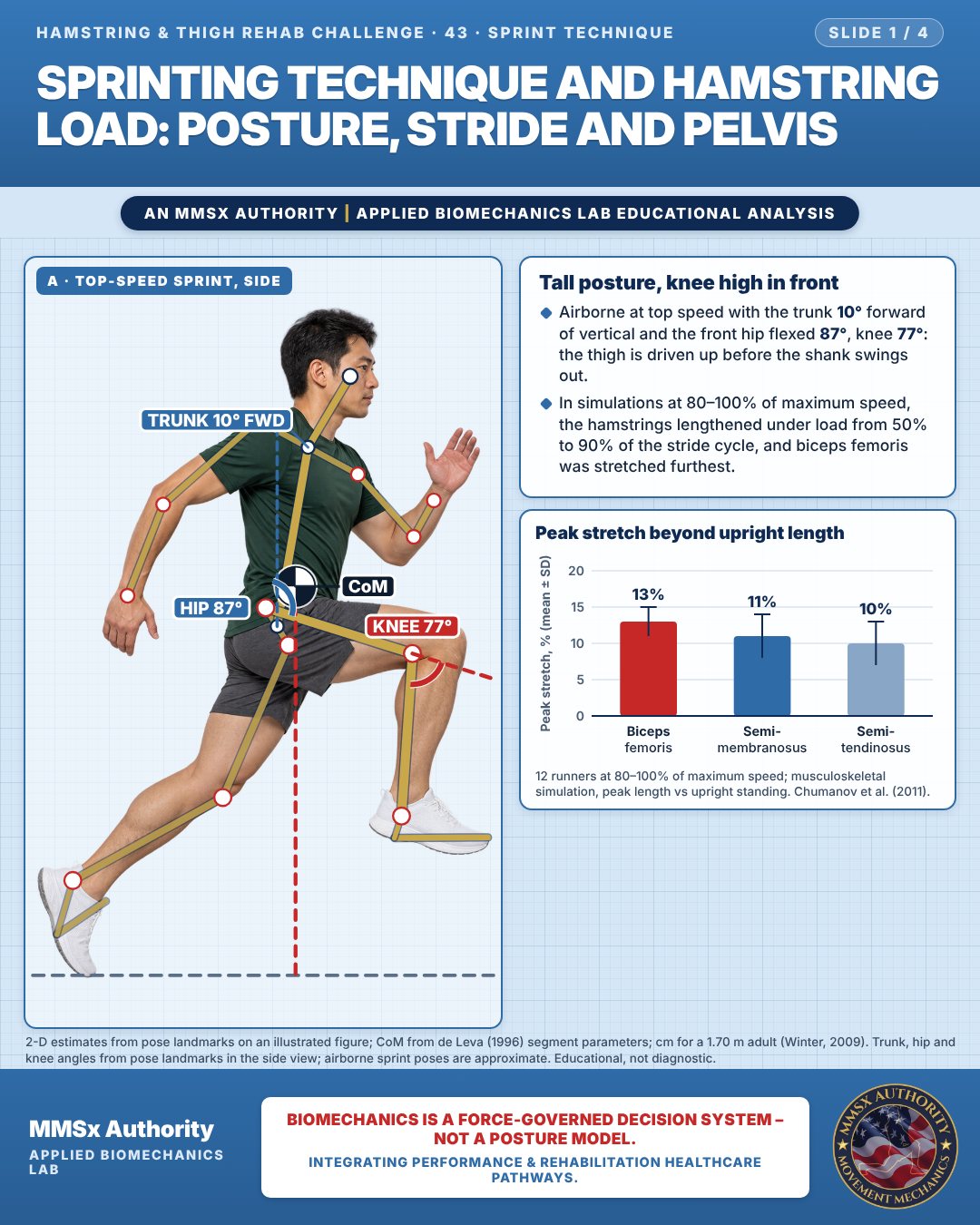
Tall posture, knee high in front
Airborne at top speed with the trunk 10° forward of vertical and the front hip flexed 87°, knee 77°: the thigh is driven up before the shank swings out.
In simulations at 80–100% of maximum speed, the hamstrings lengthened under load from 50% to 90% of the stride cycle, and biceps femoris was stretched furthest.
Peak stretch beyond upright length
Movement B: Overstride (side view)
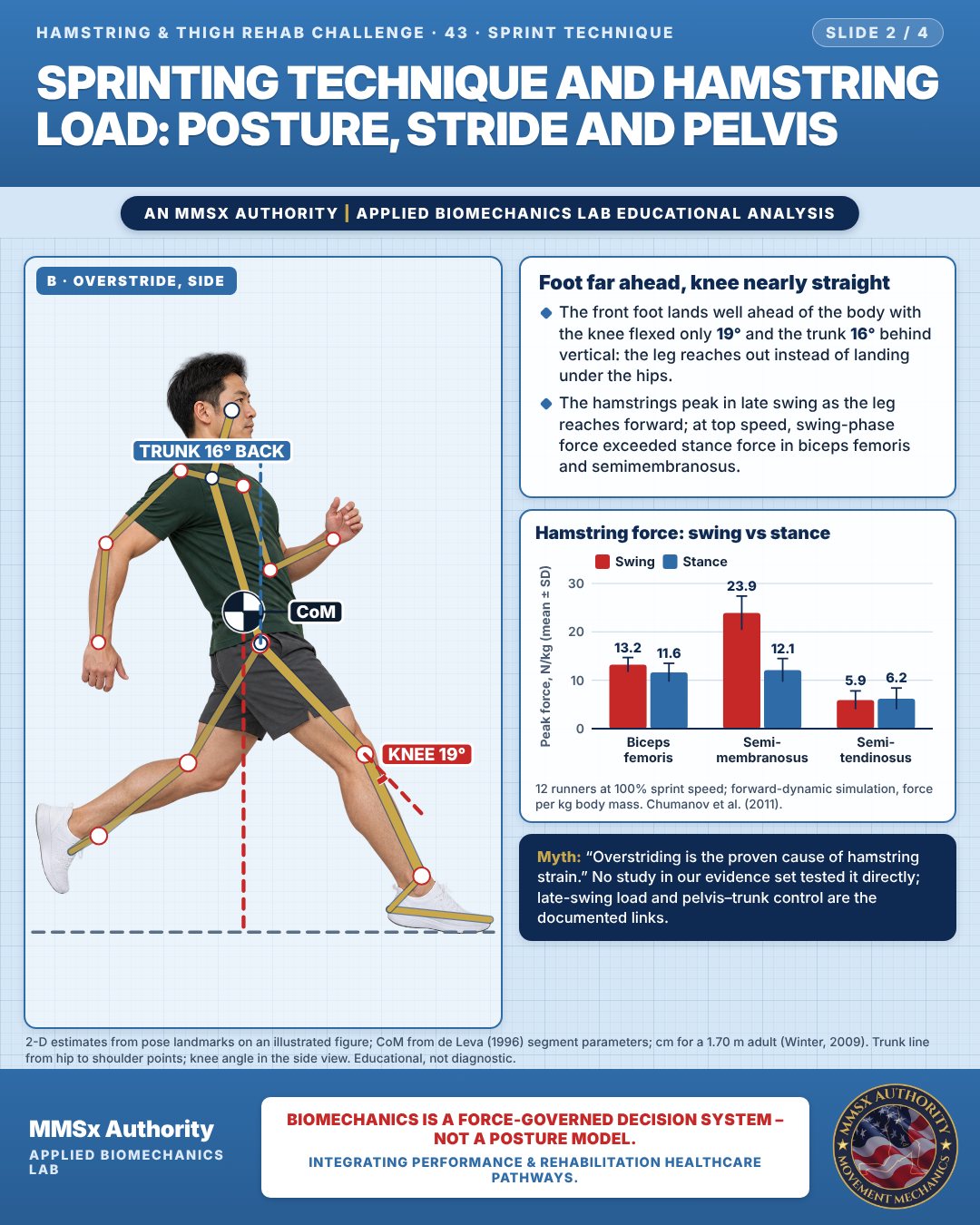
Foot far ahead, knee nearly straight
The front foot lands well ahead of the body with the knee flexed only 19° and the trunk 16° behind vertical: the leg reaches out instead of landing under the hips.
The hamstrings peak in late swing as the leg reaches forward; at top speed, swing-phase force exceeded stance force in biceps femoris and semimembranosus.
Hamstring force: swing vs stance
Movement C: Wall-drive drill (side view)
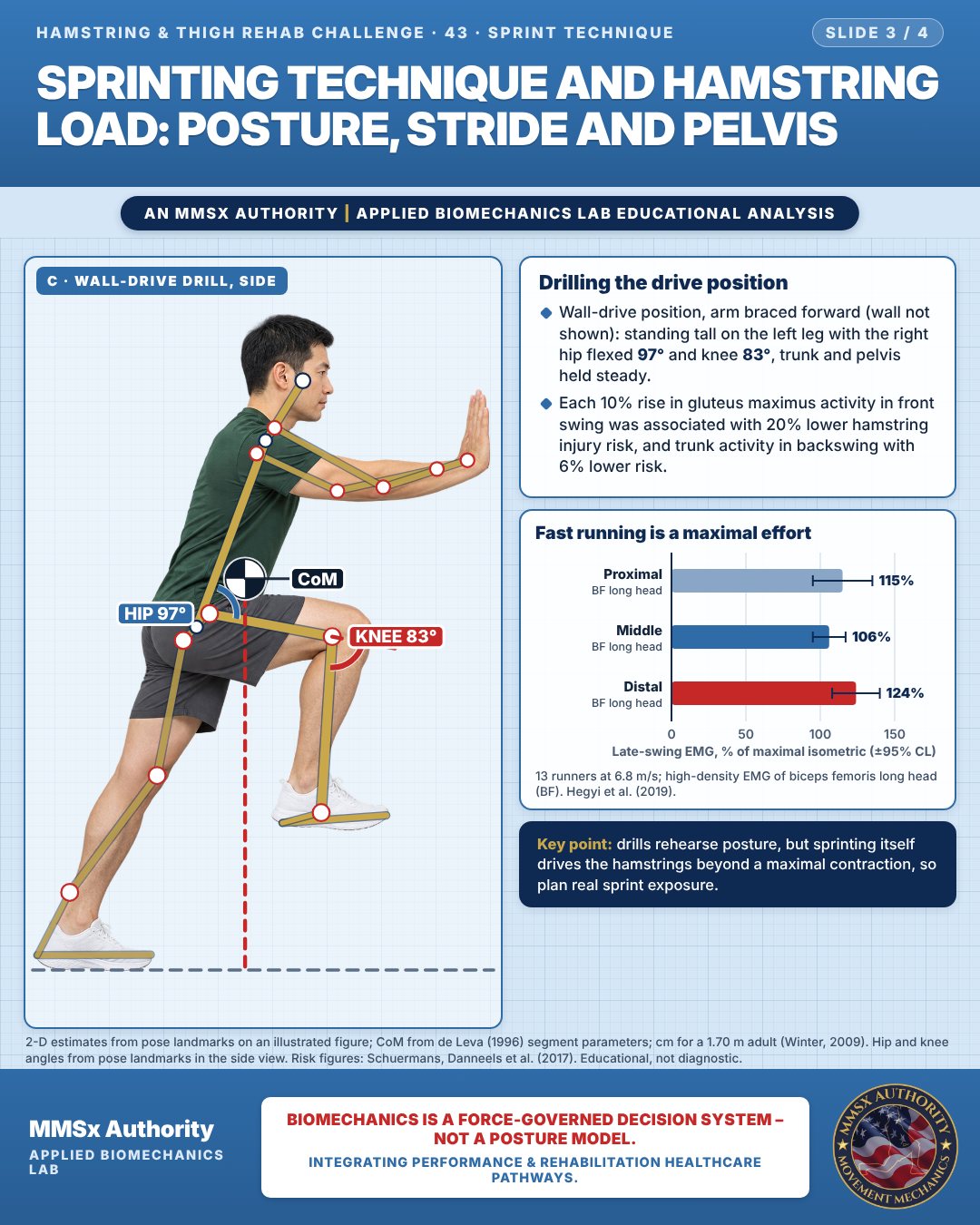
Drilling the drive position
Wall-drive position, arm braced forward (wall not shown): standing tall on the left leg with the right hip flexed 97° and knee 83°, trunk and pelvis held steady.
Each 10% rise in gluteus maximus activity in front swing was associated with 20% lower hamstring injury risk, and trunk activity in backswing with 6% lower risk.
Fast running is a maximal effort
Decision pathway
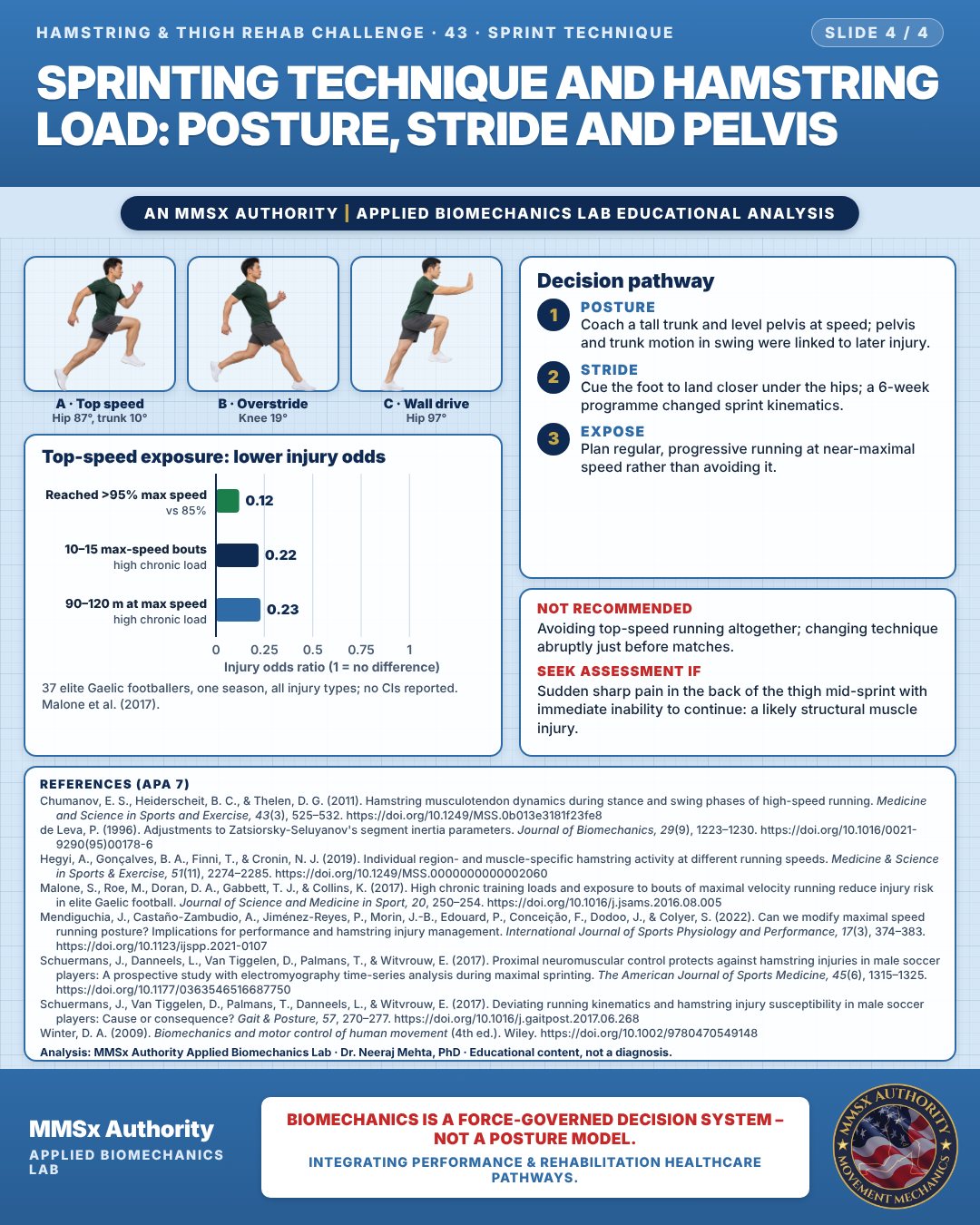
Top-speed exposure: lower injury odds
Posture
Coach a tall trunk and level pelvis at speed; pelvis and trunk motion in swing were linked to later injury.
Stride
Cue the foot to land closer under the hips; a 6-week programme changed sprint kinematics.
Expose
Plan regular, progressive running at near-maximal speed rather than avoiding it.
What the evidence supports
- Planned, progressive exposure to high-speed running, rather than avoidance, was associated with lower injury odds (Malone et al., 2017).
Cautions
Not recommended
Avoiding top-speed running altogether; changing technique abruptly just before matches.
Seek assessment if
Sudden sharp pain in the back of the thigh mid-sprint with immediate inability to continue: a likely structural muscle injury.
Methods note
2-D estimates from pose landmarks on an illustrated figure; CoM from de Leva (1996) segment parameters; cm for a 1.70 m adult (Winter, 2009). Trunk, hip and knee angles from pose landmarks in the side view; airborne sprint poses are approximate. Trunk line from hip to shoulder points; knee angle in the side view. Hip and knee angles from pose landmarks in the side view. Risk figures: Schuermans, Danneels et al. (2017). These are educational estimates, not a diagnosis.
References
- Chumanov, E. S., Heiderscheit, B. C., & Thelen, D. G. (2011). Hamstring musculotendon dynamics during stance and swing phases of high-speed running. Medicine and Science in Sports and Exercise, 43(3), 525–532. https://doi.org/10.1249/MSS.0b013e3181f23fe8
- de Leva, P. (1996). Adjustments to Zatsiorsky-Seluyanov's segment inertia parameters. Journal of Biomechanics, 29(9), 1223–1230. https://doi.org/10.1016/0021-9290(95)00178-6
- Hegyi, A., Gonçalves, B. A., Finni, T., & Cronin, N. J. (2019). Individual region- and muscle-specific hamstring activity at different running speeds. Medicine & Science in Sports & Exercise, 51(11), 2274–2285. https://doi.org/10.1249/MSS.0000000000002060
- Malone, S., Roe, M., Doran, D. A., Gabbett, T. J., & Collins, K. (2017). High chronic training loads and exposure to bouts of maximal velocity running reduce injury risk in elite Gaelic football. Journal of Science and Medicine in Sport, 20, 250–254. https://doi.org/10.1016/j.jsams.2016.08.005
- Mendiguchia, J., Castaño-Zambudio, A., Jiménez-Reyes, P., Morin, J.-B., Edouard, P., Conceição, F., Dodoo, J., & Colyer, S. (2022). Can we modify maximal speed running posture? Implications for performance and hamstring injury management. International Journal of Sports Physiology and Performance, 17(3), 374–383. https://doi.org/10.1123/ijspp.2021-0107
- Schuermans, J., Danneels, L., Van Tiggelen, D., Palmans, T., & Witvrouw, E. (2017). Proximal neuromuscular control protects against hamstring injuries in male soccer players: A prospective study with electromyography time-series analysis during maximal sprinting. The American Journal of Sports Medicine, 45(6), 1315–1325. https://doi.org/10.1177/0363546516687750
- Schuermans, J., Van Tiggelen, D., Palmans, T., Danneels, L., & Witvrouw, E. (2017). Deviating running kinematics and hamstring injury susceptibility in male soccer players: Cause or consequence? Gait & Posture, 57, 270–277. https://doi.org/10.1016/j.gaitpost.2017.06.268
- Winter, D. A. (2009). Biomechanics and motor control of human movement (4th ed.). Wiley. https://doi.org/10.1002/9780470549148
Cite this article
Mehta, N. (2026, October 26). Sprinting technique and hamstring load: posture, stride and pelvis. MMSx Authority Applied Biomechanics Lab. https://mmsxauthority.org/edu/analysis/hamstring-thigh/43-sprinting-technique-and-hamstring-load-posture-stride-and-pelvis/
Part of the collection
Mehta, N. (2026). Hamstring and Thigh Rehabilitation: 50 Evidence-Based Biomechanics Analyses [Collection]. MMSx Authority Applied Biomechanics Lab. Zenodo. https://doi.org/10.5281/zenodo.23735792
All Hamstring & Thigh Rehab Challenge articles · Rehabilitation Library