Hamstring & Thigh Rehab Challenge · 42
DOMS in the thighs: why eccentric work hurts days later
Delayed-onset muscle soreness (DOMS) is a generalised muscle pain that follows unaccustomed, eccentric (lengthening, decelerating) movements,…
Key points
- Dose. Introduce lunges, squats and Nordics at a low eccentric dose; the repeated-bout effect makes the next session hurt less.
- Recover. Use massage, easy movement or compression; stretching did not reduce soreness.
- Plan. Avoid maximal or high-speed work at the 48–72 h peak, when strength and range are down.
What it is
Delayed-onset muscle soreness (DOMS) is a generalised muscle pain that follows unaccustomed, eccentric (lengthening, decelerating) movements, beginning hours after activity. In the Munich classification it is a functional muscle disorder (type 1B), without macroscopic evidence of fibre tear (Mueller-Wohlfahrt et al., 2013).
How we analysed the movement
Three movements relevant to this topic were analysed from illustrated reference figures. Joint centres were located with two-dimensional pose estimation; hip and knee angles, pelvis level, the whole-body centre of mass and, where relevant, the hip lever (the horizontal distance from the hip joint to the upper-body centre of mass) and the resulting static hip moment were then calculated from standard segment parameters. The figures are educational estimates that show how position changes mechanical demand; they are not measurements of a patient. Every research value quoted below comes from the published source cited beside it.
Movement A: Lowering into lunge (side view)
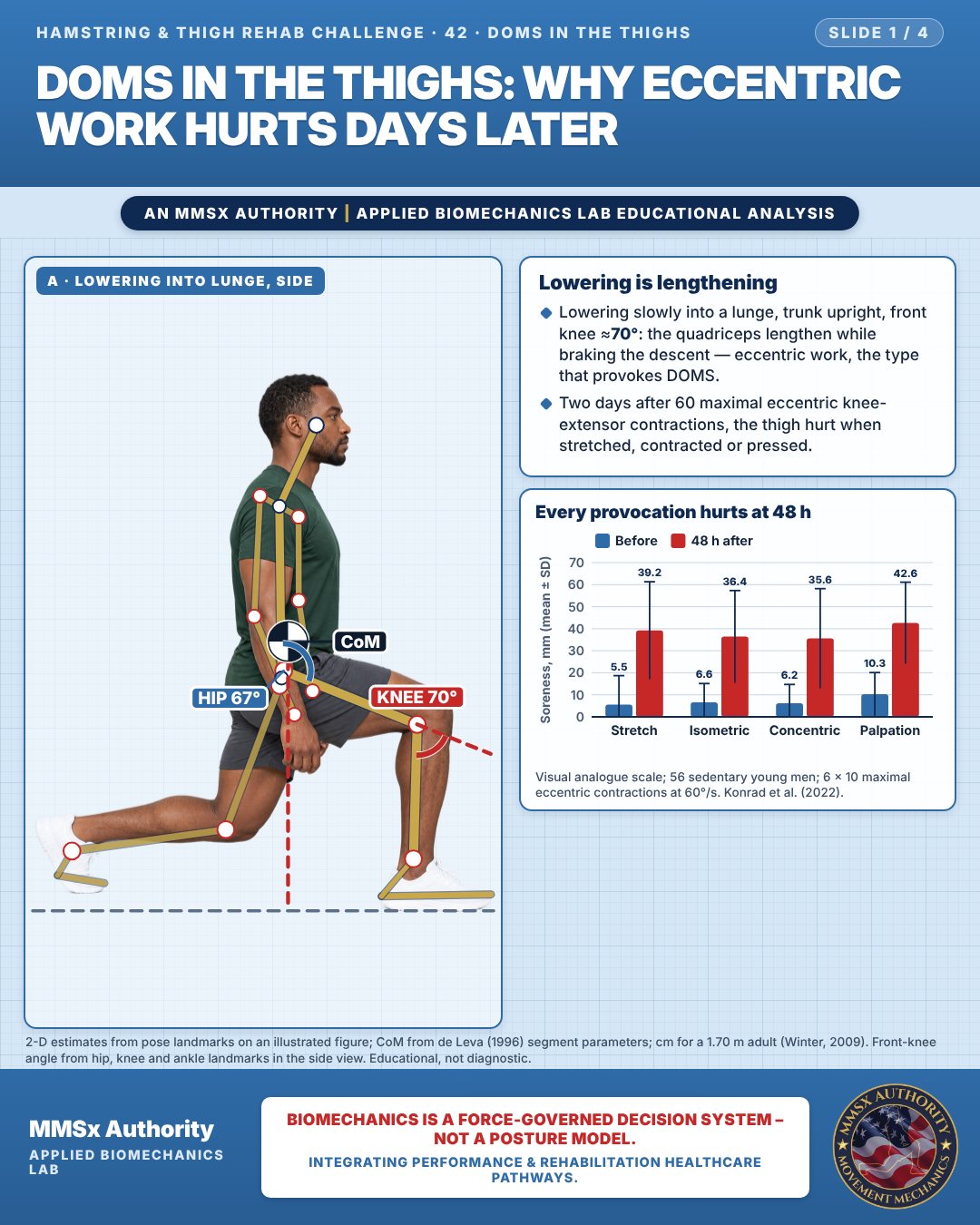
Lowering is lengthening
Lowering slowly into a lunge, trunk upright, front knee ≈70°: the quadriceps lengthen while braking the descent — eccentric work, the type that provokes DOMS.
Two days after 60 maximal eccentric knee-extensor contractions, the thigh hurt when stretched, contracted or pressed.
Every provocation hurts at 48 h
Movement B: Slow squat descent (side view)
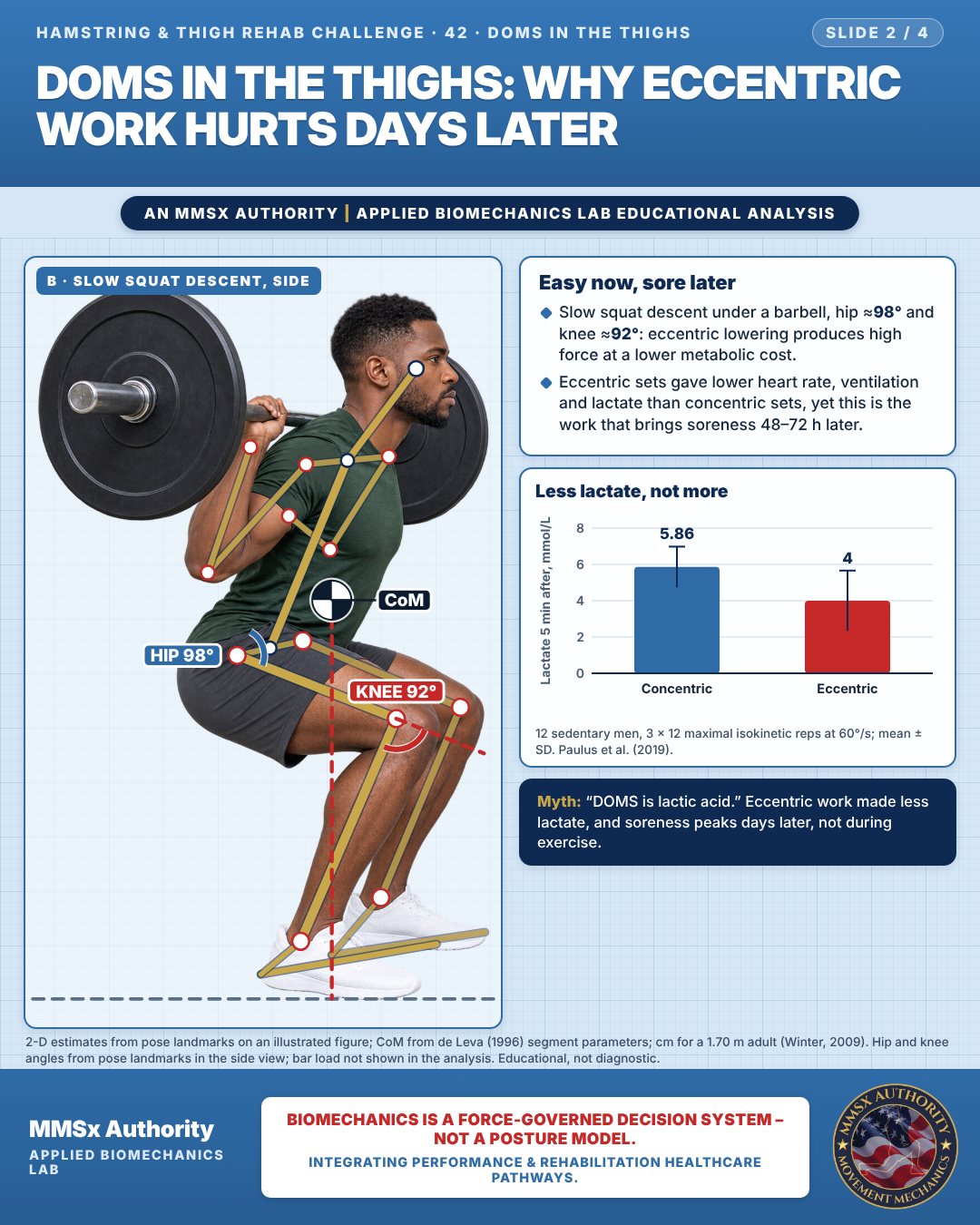
Easy now, sore later
Slow squat descent under a barbell, hip ≈98° and knee ≈92°: eccentric lowering produces high force at a lower metabolic cost.
Eccentric sets gave lower heart rate, ventilation and lactate than concentric sets, yet this is the work that brings soreness 48–72 h later.
Less lactate, not more
Movement C: Sitting down (side view)
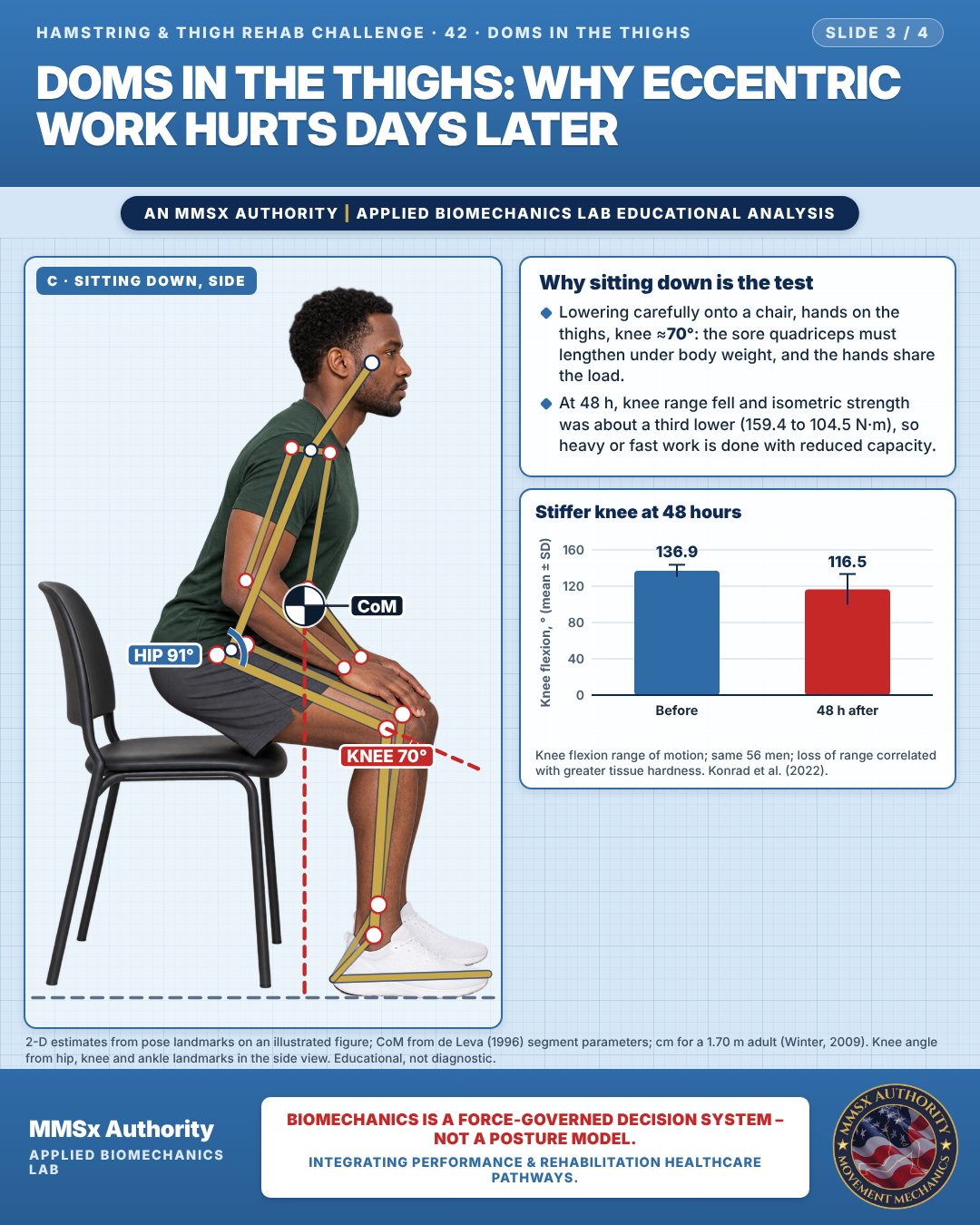
Why sitting down is the test
Lowering carefully onto a chair, hands on the thighs, knee ≈70°: the sore quadriceps must lengthen under body weight, and the hands share the load.
At 48 h, knee range fell and isometric strength was about a third lower (159.4 to 104.5 N·m), so heavy or fast work is done with reduced capacity.
Stiffer knee at 48 hours
Decision pathway
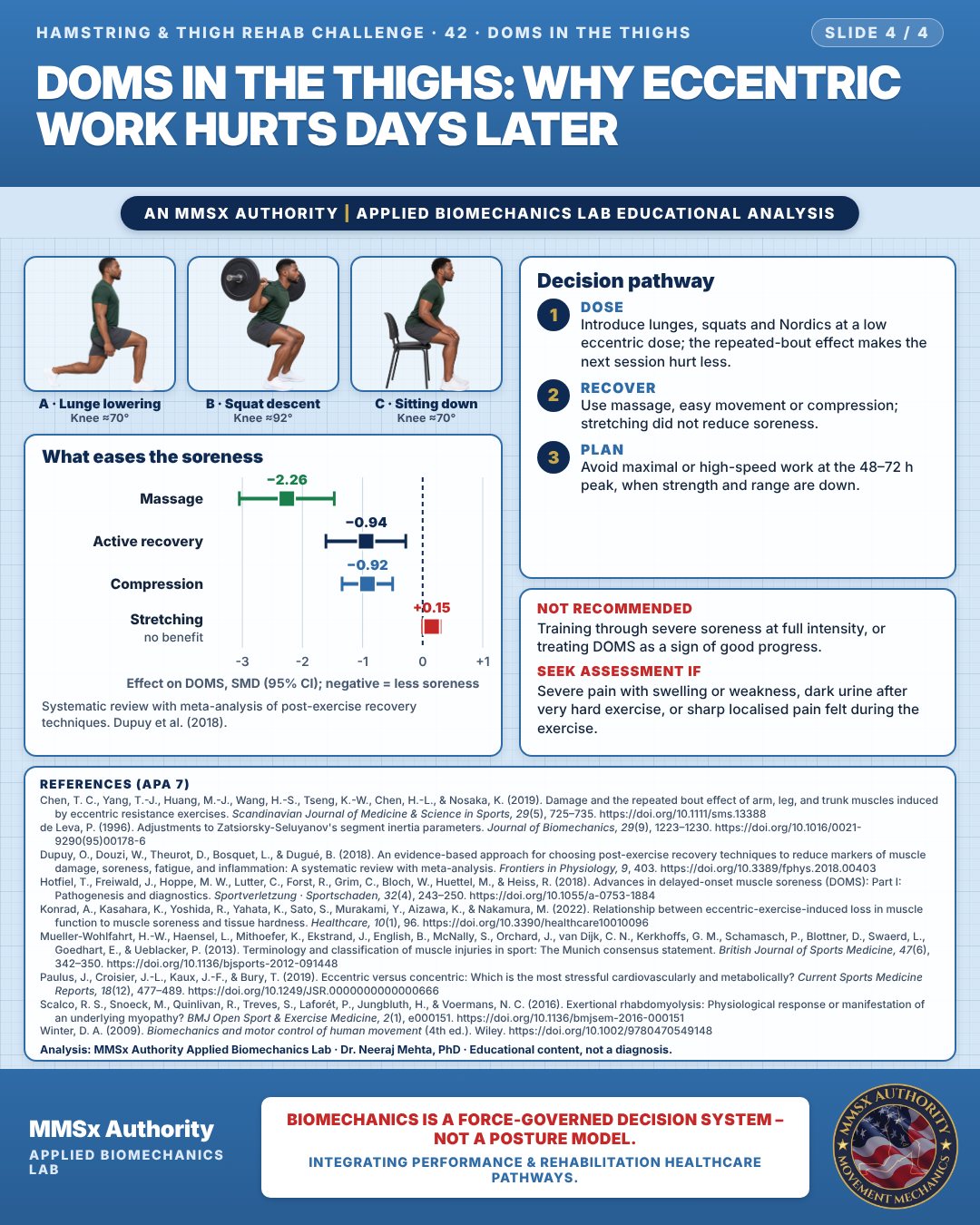
What eases the soreness
Dose
Introduce lunges, squats and Nordics at a low eccentric dose; the repeated-bout effect makes the next session hurt less.
Recover
Use massage, easy movement or compression; stretching did not reduce soreness.
Plan
Avoid maximal or high-speed work at the 48–72 h peak, when strength and range are down.
What the evidence supports
- Massage, active recovery and compression garments reduced DOMS in pooled analyses; stretching did not (Dupuy et al., 2018; Table 1). See 41-D.
- Exposure is the most dependable protection: a prior bout substantially attenuates damage and soreness after the next one (Chen et al., 2019).
- Plan hard or high-speed work around the 48–72 h soreness peak (Hotfiel et al., 2018), since strength and range are temporarily reduced (Konrad et al., 2022).
Myth and evidence
Myth“DOMS is lactic acid building up in the muscle.”
EvidenceEccentric work, the type that causes DOMS, produced lower blood lactate than concentric work of the same kind (4.00 vs 5.86 mmol/L 5 min after) (Paulus et al., 2019), and soreness peaks 48–72 h after exercise, not during it (Hotfiel et al., 2018). A second myth is that "no soreness means no progress": the repeated-bout effect means soreness falls with repeated exposure even as training continues (Chen et al., 2019).
Cautions
Not recommended
Training through severe soreness at full intensity, or treating DOMS as a sign of good progress.
Seek assessment if
Severe pain with swelling or weakness, dark urine after very hard exercise, or sharp localised pain felt during the exercise.
Methods note
2-D estimates from pose landmarks on an illustrated figure; CoM from de Leva (1996) segment parameters; cm for a 1.70 m adult (Winter, 2009). Front-knee angle from hip, knee and ankle landmarks in the side view. Hip and knee angles from pose landmarks in the side view; bar load not shown in the analysis. Knee angle from hip, knee and ankle landmarks in the side view. These are educational estimates, not a diagnosis.
References
- Chen, T. C., Yang, T.-J., Huang, M.-J., Wang, H.-S., Tseng, K.-W., Chen, H.-L., & Nosaka, K. (2019). Damage and the repeated bout effect of arm, leg, and trunk muscles induced by eccentric resistance exercises. Scandinavian Journal of Medicine & Science in Sports, 29(5), 725–735. https://doi.org/10.1111/sms.13388
- de Leva, P. (1996). Adjustments to Zatsiorsky-Seluyanov's segment inertia parameters. Journal of Biomechanics, 29(9), 1223–1230. https://doi.org/10.1016/0021-9290(95)00178-6
- Dupuy, O., Douzi, W., Theurot, D., Bosquet, L., & Dugué, B. (2018). An evidence-based approach for choosing post-exercise recovery techniques to reduce markers of muscle damage, soreness, fatigue, and inflammation: A systematic review with meta-analysis. Frontiers in Physiology, 9, 403. https://doi.org/10.3389/fphys.2018.00403
- Hotfiel, T., Freiwald, J., Hoppe, M. W., Lutter, C., Forst, R., Grim, C., Bloch, W., Huettel, M., & Heiss, R. (2018). Advances in delayed-onset muscle soreness (DOMS): Part I: Pathogenesis and diagnostics. Sportverletzung · Sportschaden, 32(4), 243–250. https://doi.org/10.1055/a-0753-1884
- Konrad, A., Kasahara, K., Yoshida, R., Yahata, K., Sato, S., Murakami, Y., Aizawa, K., & Nakamura, M. (2022). Relationship between eccentric-exercise-induced loss in muscle function to muscle soreness and tissue hardness. Healthcare, 10(1), 96. https://doi.org/10.3390/healthcare10010096
- Mueller-Wohlfahrt, H.-W., Haensel, L., Mithoefer, K., Ekstrand, J., English, B., McNally, S., Orchard, J., van Dijk, C. N., Kerkhoffs, G. M., Schamasch, P., Blottner, D., Swaerd, L., Goedhart, E., & Ueblacker, P. (2013). Terminology and classification of muscle injuries in sport: The Munich consensus statement. British Journal of Sports Medicine, 47(6), 342–350. https://doi.org/10.1136/bjsports-2012-091448
- Paulus, J., Croisier, J.-L., Kaux, J.-F., & Bury, T. (2019). Eccentric versus concentric: Which is the most stressful cardiovascularly and metabolically? Current Sports Medicine Reports, 18(12), 477–489. https://doi.org/10.1249/JSR.0000000000000666
- Scalco, R. S., Snoeck, M., Quinlivan, R., Treves, S., Laforét, P., Jungbluth, H., & Voermans, N. C. (2016). Exertional rhabdomyolysis: Physiological response or manifestation of an underlying myopathy? BMJ Open Sport & Exercise Medicine, 2(1), e000151. https://doi.org/10.1136/bmjsem-2016-000151
- Winter, D. A. (2009). Biomechanics and motor control of human movement (4th ed.). Wiley. https://doi.org/10.1002/9780470549148
Cite this article
Mehta, N. (2026, October 26). DOMS in the thighs: why eccentric work hurts days later. MMSx Authority Applied Biomechanics Lab. https://mmsxauthority.org/edu/analysis/hamstring-thigh/42-doms-in-the-thighs-why-eccentric-work-hurts-days-later/
Part of the collection
Mehta, N. (2026). Hamstring and Thigh Rehabilitation: 50 Evidence-Based Biomechanics Analyses [Collection]. MMSx Authority Applied Biomechanics Lab. Zenodo. https://doi.org/10.5281/zenodo.23735792
All Hamstring & Thigh Rehab Challenge articles · Rehabilitation Library