Hamstring & Thigh Rehab Challenge · 41
Thigh pain after a long run: soreness or injury?
Thigh pain after a long run is most often exercise-induced muscle soreness: a generalised ache that builds over the following hours and days after…
Key points
- Check. Generalised ache, slow onset, peak at 48–72 h: likely soreness. Sharp, local, sudden: assess for injury.
- Recover. Use easy walking or cycling, massage or compression; stretching did not reduce soreness.
- Return. Resume hard running once strength and spring return; expect several days after a marathon.
What it is
Thigh pain after a long run is most often exercise-induced muscle soreness: a generalised ache that builds over the following hours and days after unaccustomed or eccentric-heavy running (for example downhill sections), classified as a functional muscle disorder (type 1B, DOMS) without macroscopic fibre tear. It should be distinguished from a structural muscle injury (a partial or complete tear), which has macroscopic evidence of fibre damage (Mueller-Wohlfahrt et al., 2013).
How we analysed the movement
Three movements relevant to this topic were analysed from illustrated reference figures. Joint centres were located with two-dimensional pose estimation; hip and knee angles, pelvis level, the whole-body centre of mass and, where relevant, the hip lever (the horizontal distance from the hip joint to the upper-body centre of mass) and the resulting static hip moment were then calculated from standard segment parameters. The figures are educational estimates that show how position changes mechanical demand; they are not measurements of a patient. Every research value quoted below comes from the published source cited beside it.
Movement A: Stair descent (side view)
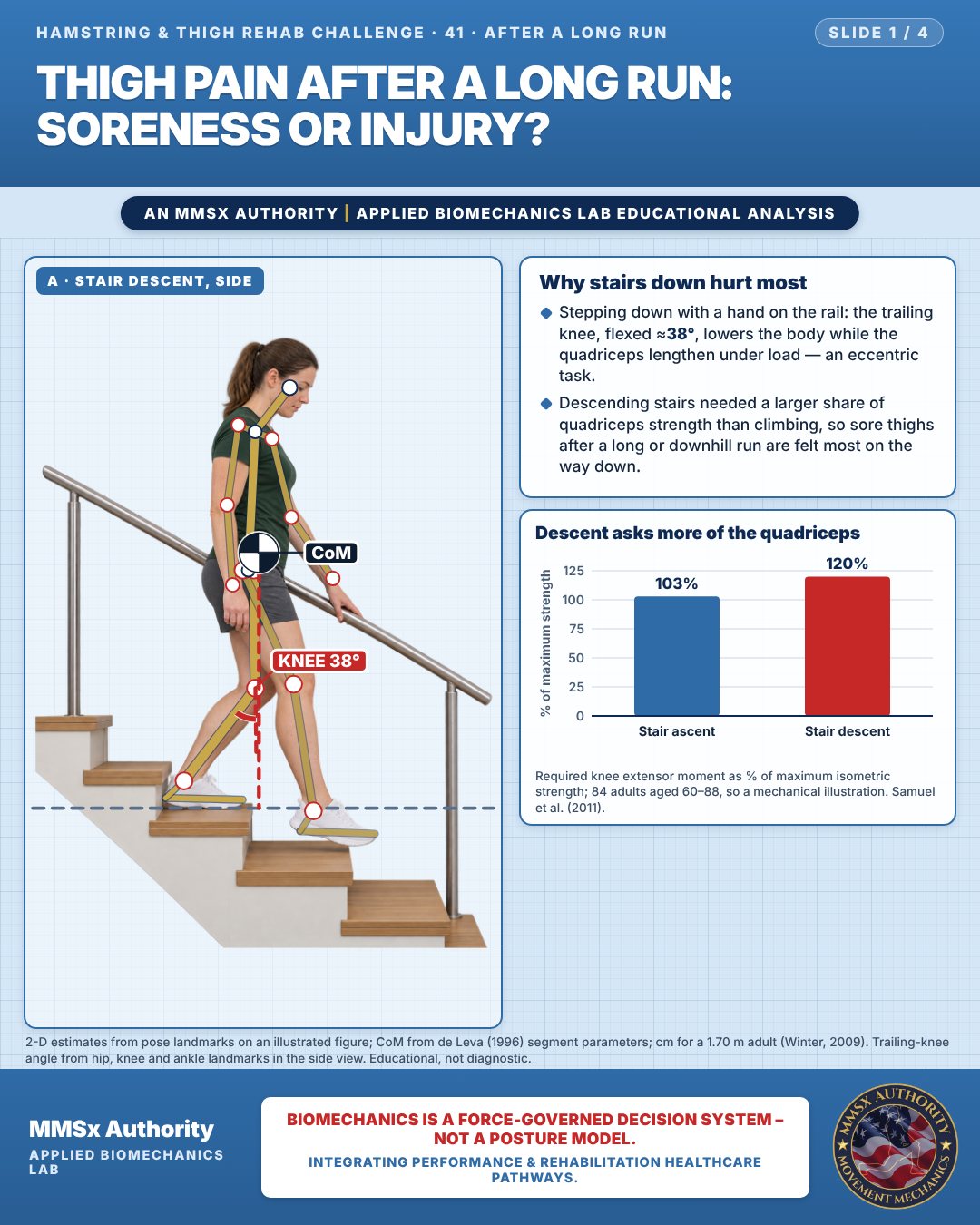
Why stairs down hurt most
Stepping down with a hand on the rail: the trailing knee, flexed ≈38°, lowers the body while the quadriceps lengthen under load — an eccentric task.
Descending stairs needed a larger share of quadriceps strength than climbing, so sore thighs after a long or downhill run are felt most on the way down.
Descent asks more of the quadriceps
Movement B: Easy walk (side view)
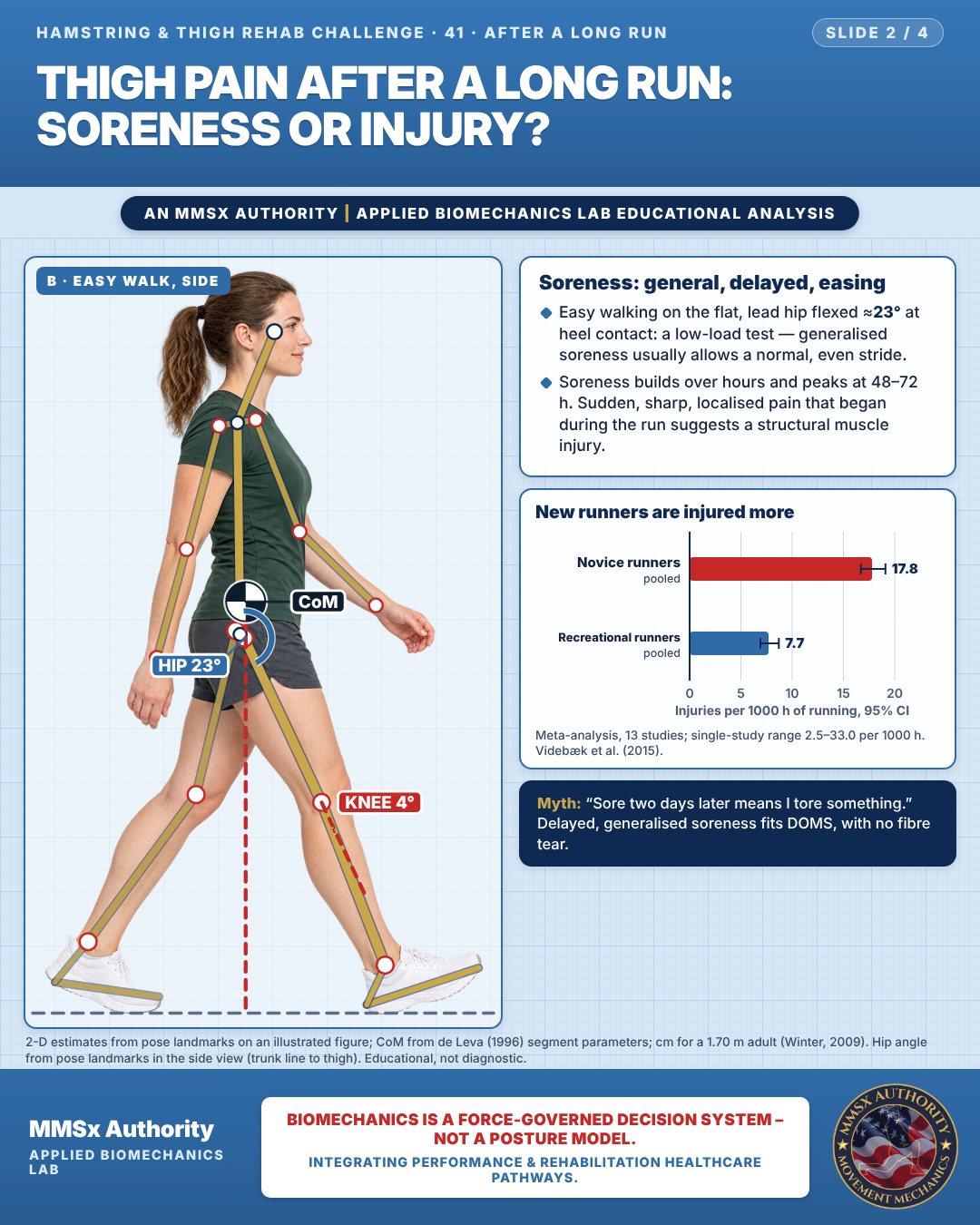
Soreness: general, delayed, easing
Easy walking on the flat, lead hip flexed ≈23° at heel contact: a low-load test — generalised soreness usually allows a normal, even stride.
Soreness builds over hours and peaks at 48–72 h. Sudden, sharp, localised pain that began during the run suggests a structural muscle injury.
New runners are injured more
Movement C: Easy cycling (side view)
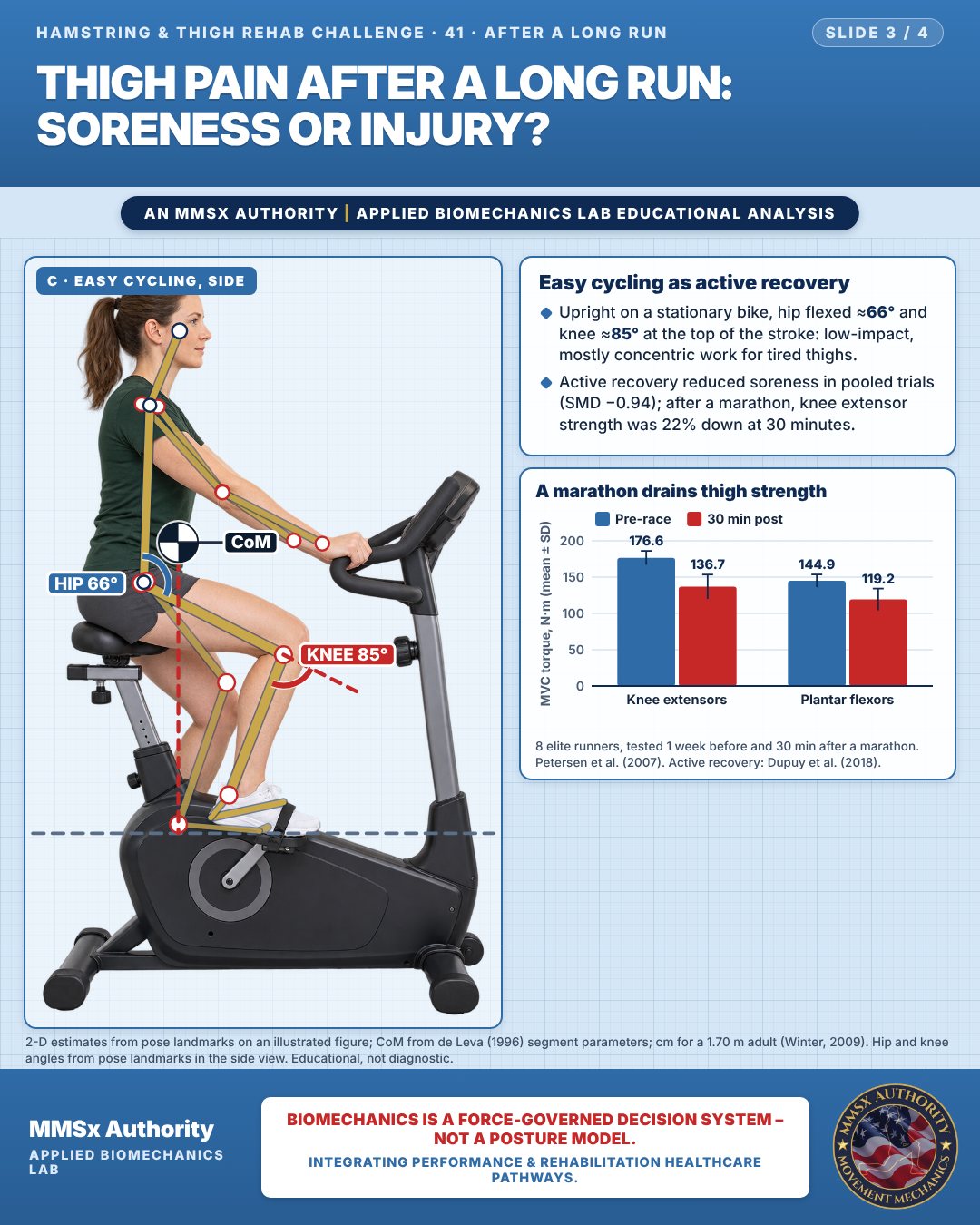
Easy cycling as active recovery
Upright on a stationary bike, hip flexed ≈66° and knee ≈85° at the top of the stroke: low-impact, mostly concentric work for tired thighs.
Active recovery reduced soreness in pooled trials (SMD −0.94); after a marathon, knee extensor strength was 22% down at 30 minutes.
A marathon drains thigh strength
Decision pathway
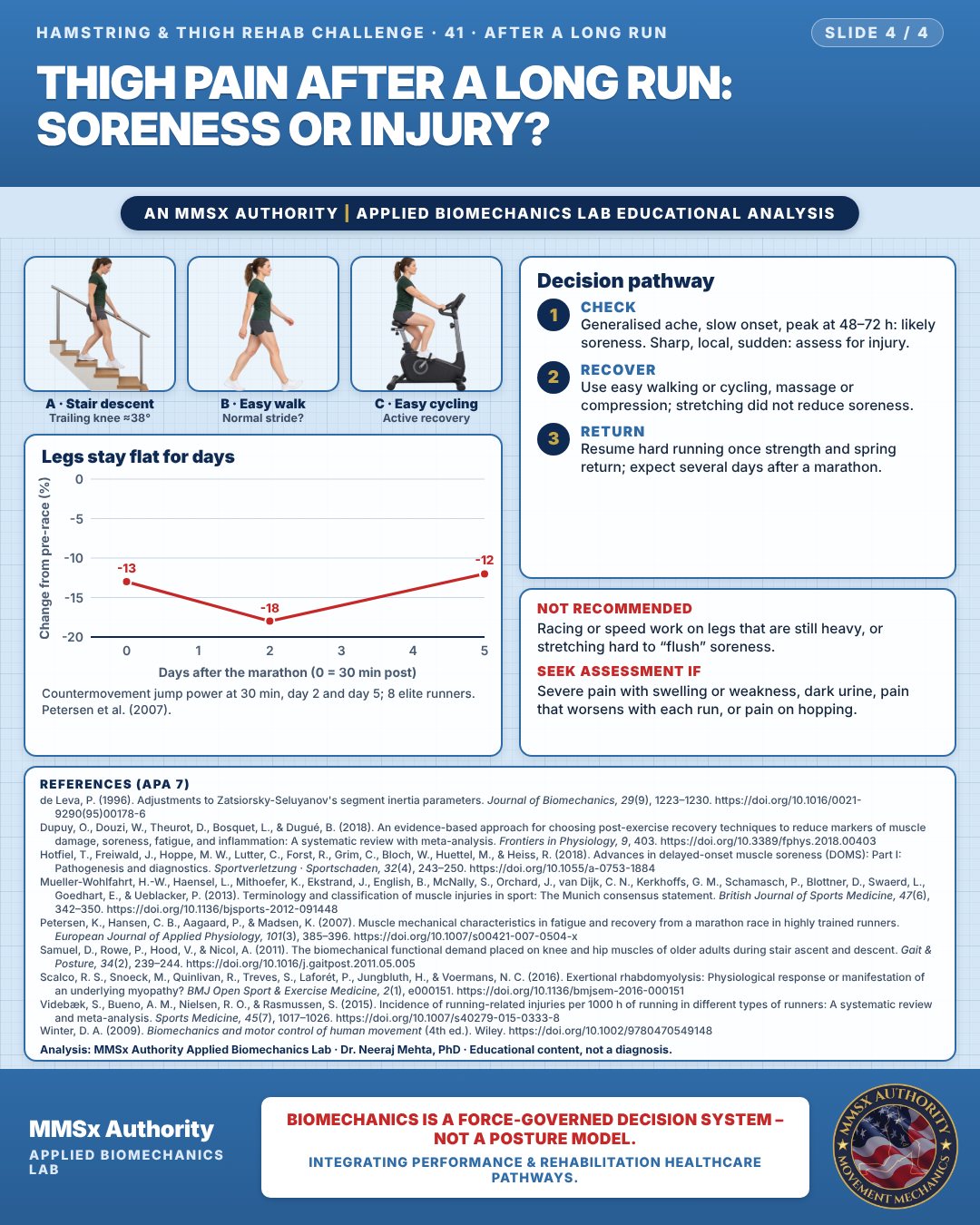
Legs stay flat for days
Check
Generalised ache, slow onset, peak at 48–72 h: likely soreness. Sharp, local, sudden: assess for injury.
Recover
Use easy walking or cycling, massage or compression; stretching did not reduce soreness.
Return
Resume hard running once strength and spring return; expect several days after a marathon.
What the evidence supports
- For DOMS (functional type 1B disorder), no specific treatment guideline exists. Pooled evidence favours massage, active recovery and compression for reducing soreness; stretching was not effective (Dupuy et al., 2018).
- Soreness is expected to peak around 48–72 h and then ease (Hotfiel et al., 2018). Easy walking or cycling is a reasonable option in the days after a long run (Dupuy et al., 2018).
Myth and evidence
Myth“If my thighs are sore two days later, I must have torn something.”
EvidenceSoreness that is generalised, builds over hours and peaks at 48–72 h fits DOMS, a functional disorder without macroscopic fibre tear (Hotfiel et al., 2018; Mueller-Wohlfahrt et al., 2013). A second myth is that stretching speeds recovery from soreness; pooled data show no benefit (Dupuy et al., 2018).
Cautions
Not recommended
Racing or speed work on legs that are still heavy, or stretching hard to “flush” soreness.
Seek assessment if
Severe pain with swelling or weakness, dark urine, pain that worsens with each run, or pain on hopping.
Methods note
2-D estimates from pose landmarks on an illustrated figure; CoM from de Leva (1996) segment parameters; cm for a 1.70 m adult (Winter, 2009). Trailing-knee angle from hip, knee and ankle landmarks in the side view. Hip angle from pose landmarks in the side view (trunk line to thigh). Hip and knee angles from pose landmarks in the side view. These are educational estimates, not a diagnosis.
References
- de Leva, P. (1996). Adjustments to Zatsiorsky-Seluyanov's segment inertia parameters. Journal of Biomechanics, 29(9), 1223–1230. https://doi.org/10.1016/0021-9290(95)00178-6
- Dupuy, O., Douzi, W., Theurot, D., Bosquet, L., & Dugué, B. (2018). An evidence-based approach for choosing post-exercise recovery techniques to reduce markers of muscle damage, soreness, fatigue, and inflammation: A systematic review with meta-analysis. Frontiers in Physiology, 9, 403. https://doi.org/10.3389/fphys.2018.00403
- Hotfiel, T., Freiwald, J., Hoppe, M. W., Lutter, C., Forst, R., Grim, C., Bloch, W., Huettel, M., & Heiss, R. (2018). Advances in delayed-onset muscle soreness (DOMS): Part I: Pathogenesis and diagnostics. Sportverletzung · Sportschaden, 32(4), 243–250. https://doi.org/10.1055/a-0753-1884
- Mueller-Wohlfahrt, H.-W., Haensel, L., Mithoefer, K., Ekstrand, J., English, B., McNally, S., Orchard, J., van Dijk, C. N., Kerkhoffs, G. M., Schamasch, P., Blottner, D., Swaerd, L., Goedhart, E., & Ueblacker, P. (2013). Terminology and classification of muscle injuries in sport: The Munich consensus statement. British Journal of Sports Medicine, 47(6), 342–350. https://doi.org/10.1136/bjsports-2012-091448
- Petersen, K., Hansen, C. B., Aagaard, P., & Madsen, K. (2007). Muscle mechanical characteristics in fatigue and recovery from a marathon race in highly trained runners. European Journal of Applied Physiology, 101(3), 385–396. https://doi.org/10.1007/s00421-007-0504-x
- Samuel, D., Rowe, P., Hood, V., & Nicol, A. (2011). The biomechanical functional demand placed on knee and hip muscles of older adults during stair ascent and descent. Gait & Posture, 34(2), 239–244. https://doi.org/10.1016/j.gaitpost.2011.05.005
- Scalco, R. S., Snoeck, M., Quinlivan, R., Treves, S., Laforét, P., Jungbluth, H., & Voermans, N. C. (2016). Exertional rhabdomyolysis: Physiological response or manifestation of an underlying myopathy? BMJ Open Sport & Exercise Medicine, 2(1), e000151. https://doi.org/10.1136/bmjsem-2016-000151
- Videbæk, S., Bueno, A. M., Nielsen, R. O., & Rasmussen, S. (2015). Incidence of running-related injuries per 1000 h of running in different types of runners: A systematic review and meta-analysis. Sports Medicine, 45(7), 1017–1026. https://doi.org/10.1007/s40279-015-0333-8
- Winter, D. A. (2009). Biomechanics and motor control of human movement (4th ed.). Wiley. https://doi.org/10.1002/9780470549148
Cite this article
Mehta, N. (2026, October 26). Thigh pain after a long run: soreness or injury? MMSx Authority Applied Biomechanics Lab. https://mmsxauthority.org/edu/analysis/hamstring-thigh/41-thigh-pain-after-a-long-run-soreness-or-injury/
Part of the collection
Mehta, N. (2026). Hamstring and Thigh Rehabilitation: 50 Evidence-Based Biomechanics Analyses [Collection]. MMSx Authority Applied Biomechanics Lab. Zenodo. https://doi.org/10.5281/zenodo.23735792
All Hamstring & Thigh Rehab Challenge articles · Rehabilitation Library