Hamstring & Thigh Rehab Challenge · 40
Femoral stress fracture: deep thigh pain that should not be ignored
A femoral stress fracture is a bone stress injury of the femoral neck or shaft caused by repetitive loading that exceeds the bone's capacity to remodel.
Key points
- Suspect. Deep thigh, hip or groin pain that builds with running needs early assessment.
- Image. Seek MRI when pain persists; a normal X-ray does not rule out a stress fracture.
- Address. Review training volume, energy intake, menstrual health and bone density.
What it is
A femoral stress fracture is a bone stress injury of the femoral neck or shaft caused by repetitive loading that exceeds the bone's capacity to remodel. It presents as deep, poorly localised thigh, hip or groin pain that worsens with running and impact. The femoral neck is treated as a high-risk site and has among the longest return-to-sport times of any bone stress injury (Hoenig et al., 2023).
How we analysed the movement
Three movements relevant to this topic were analysed from illustrated reference figures. Joint centres were located with two-dimensional pose estimation; hip and knee angles, pelvis level, the whole-body centre of mass and, where relevant, the hip lever (the horizontal distance from the hip joint to the upper-body centre of mass) and the resulting static hip moment were then calculated from standard segment parameters. The figures are educational estimates that show how position changes mechanical demand; they are not measurements of a patient. Every research value quoted below comes from the published source cited beside it.
Movement A: One-leg stance (side view)
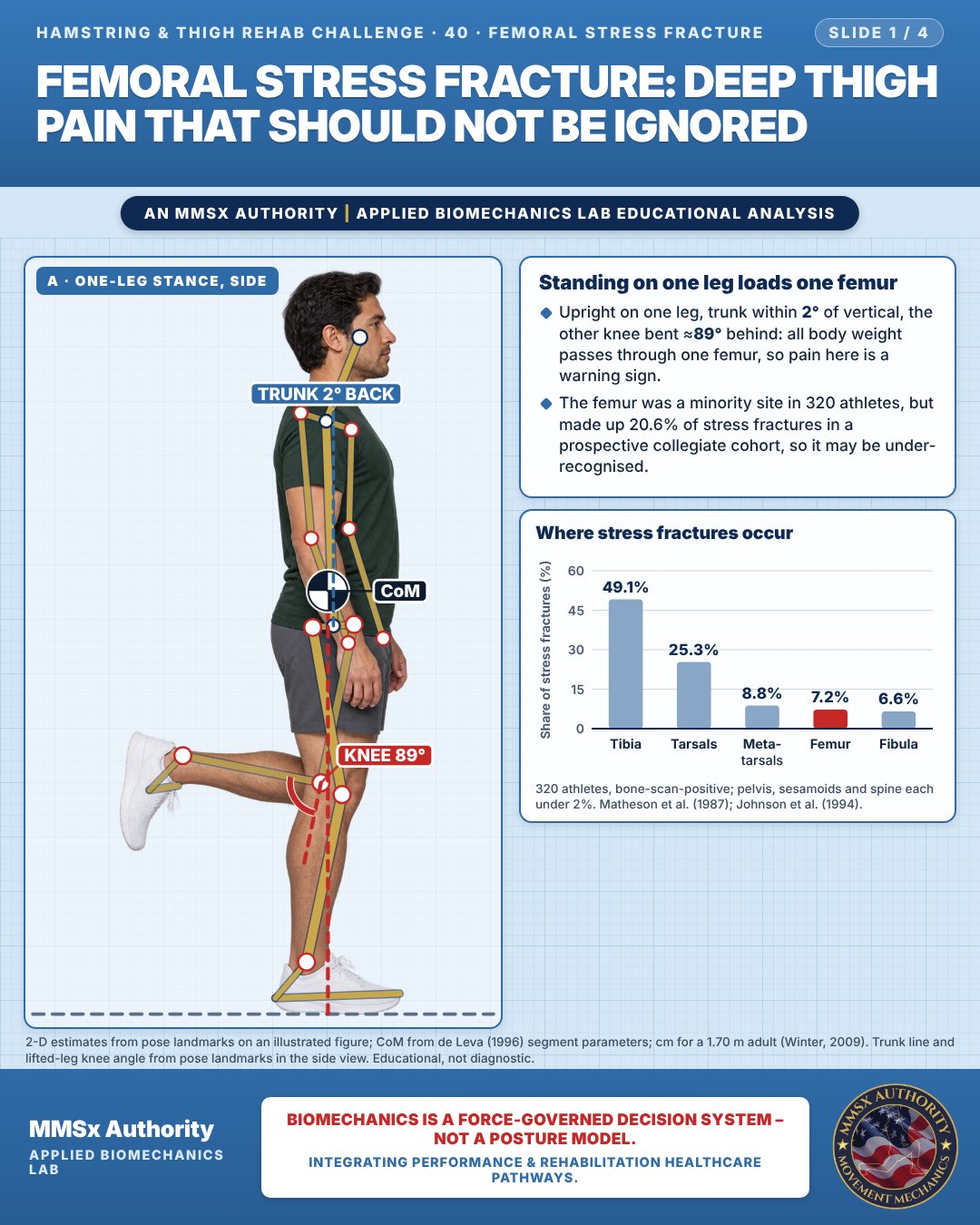
Standing on one leg loads one femur
Upright on one leg, trunk within 2° of vertical, the other knee bent ≈89° behind: all body weight passes through one femur, so pain here is a warning sign.
The femur was a minority site in 320 athletes, but made up 20.6% of stress fractures in a prospective collegiate cohort, so it may be under-recognised.
Where stress fractures occur
Movement B: Endurance run (side view)
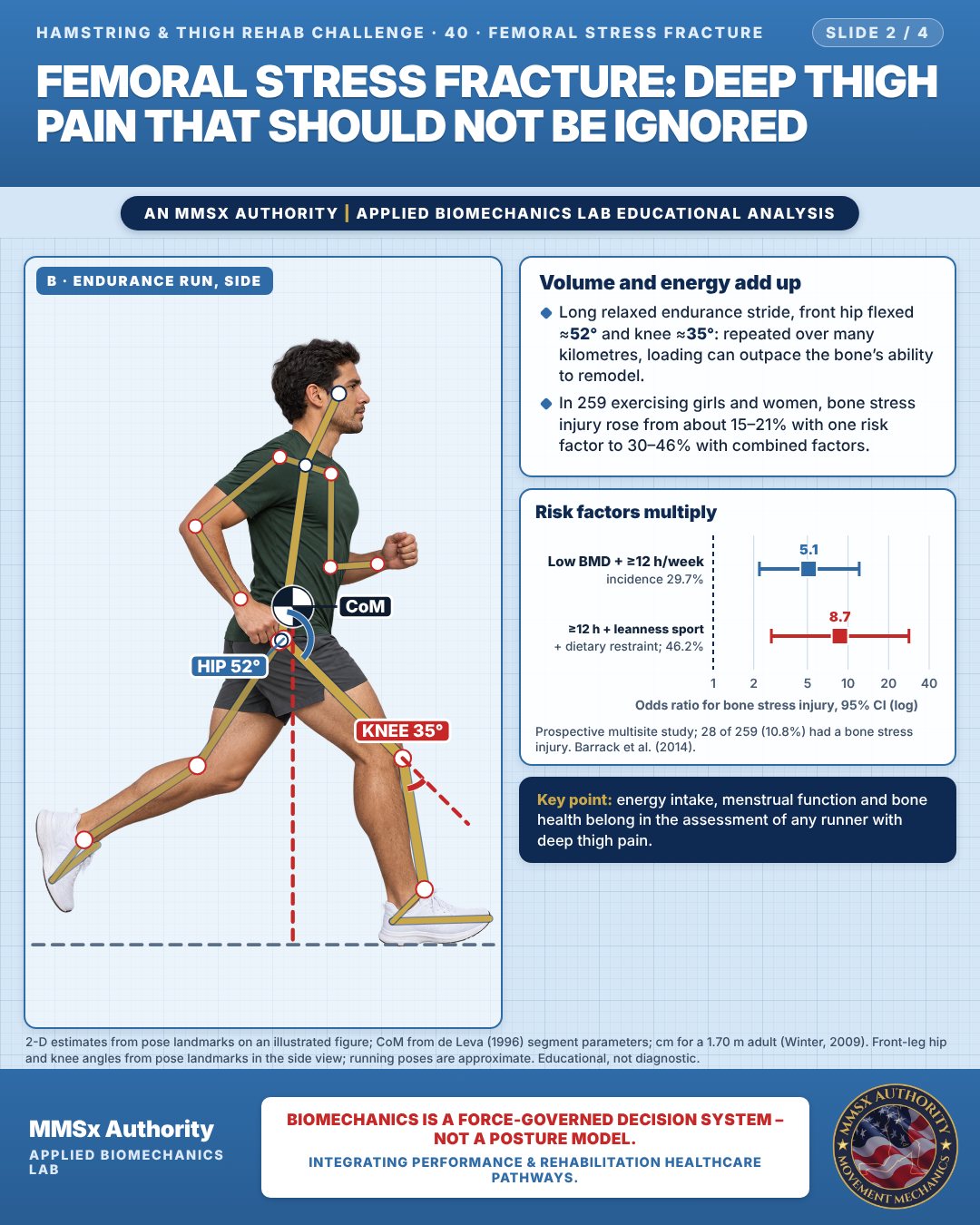
Volume and energy add up
Long relaxed endurance stride, front hip flexed ≈52° and knee ≈35°: repeated over many kilometres, loading can outpace the bone’s ability to remodel.
In 259 exercising girls and women, bone stress injury rose from about 15–21% with one risk factor to 30–46% with combined factors.
Risk factors multiply
Movement C: Crutch walking (side view)
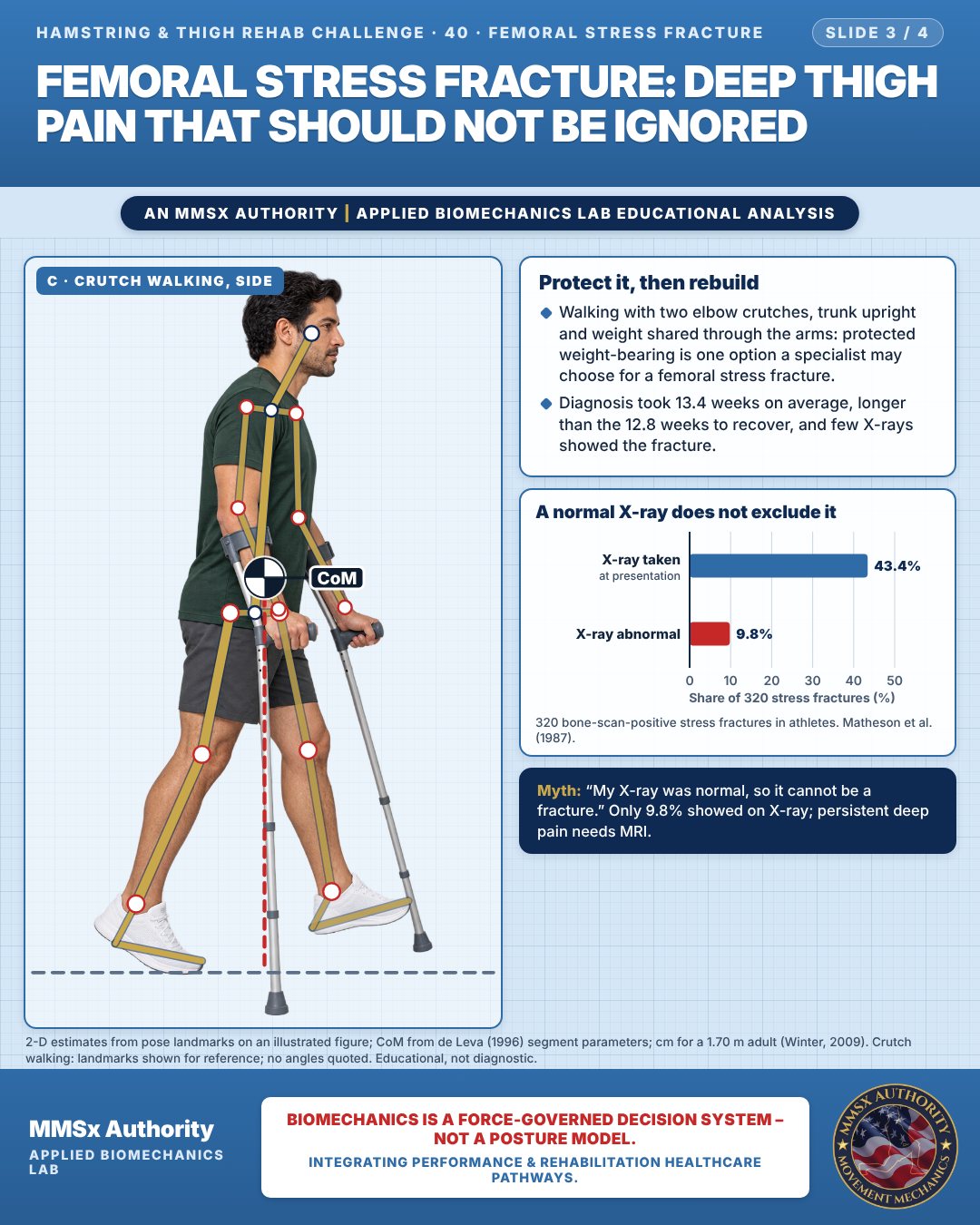
Protect it, then rebuild
Walking with two elbow crutches, trunk upright and weight shared through the arms: protected weight-bearing is one option a specialist may choose for a femoral stress fracture.
Diagnosis took 13.4 weeks on average, longer than the 12.8 weeks to recover, and few X-rays showed the fracture.
A normal X-ray does not exclude it
Decision pathway
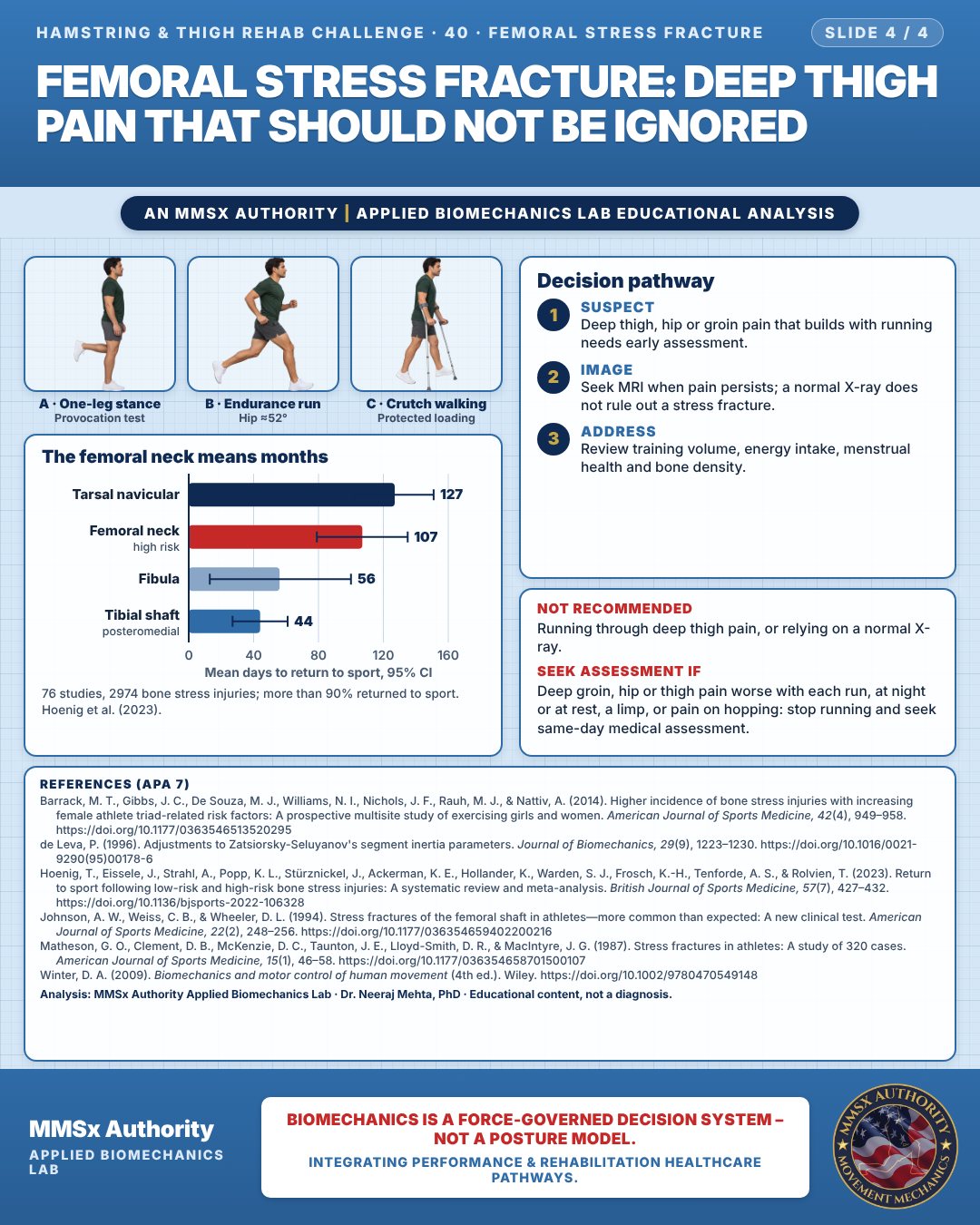
The femoral neck means months
Suspect
Deep thigh, hip or groin pain that builds with running needs early assessment.
Image
Seek MRI when pain persists; a normal X-ray does not rule out a stress fracture.
Address
Review training volume, energy intake, menstrual health and bone density.
What the evidence supports
- Treat femoral neck injuries as high risk: they have among the longest return-to-sport times (107 days) (Hoenig et al., 2023). Management (protected weight-bearing or surgical fixation) is decided by a specialist according to fracture side and extent.
- Assess and address triad-related risk factors (exercise volume, low BMI, low bone mass, dietary restraint) to reduce recurrence (Barrack et al., 2014).
Myth and evidence
Myth“My X-ray was normal, so it cannot be a fracture.”
EvidenceOnly 9.8% of stress fractures showed on X-ray in a 320-case series, and diagnosis took an average of 13.4 weeks (Matheson et al., 1987). Persistent deep thigh pain needs MRI, not reassurance.
Cautions
Not recommended
Running through deep thigh pain, or relying on a normal X-ray.
Seek assessment if
Deep groin, hip or thigh pain worse with each run, at night or at rest, a limp, or pain on hopping: stop running and seek same-day medical assessment.
Methods note
2-D estimates from pose landmarks on an illustrated figure; CoM from de Leva (1996) segment parameters; cm for a 1.70 m adult (Winter, 2009). Trunk line and lifted-leg knee angle from pose landmarks in the side view. Front-leg hip and knee angles from pose landmarks in the side view; running poses are approximate. Crutch walking: landmarks shown for reference; no angles quoted. These are educational estimates, not a diagnosis.
References
- Barrack, M. T., Gibbs, J. C., De Souza, M. J., Williams, N. I., Nichols, J. F., Rauh, M. J., & Nattiv, A. (2014). Higher incidence of bone stress injuries with increasing female athlete triad-related risk factors: A prospective multisite study of exercising girls and women. American Journal of Sports Medicine, 42(4), 949–958. https://doi.org/10.1177/0363546513520295
- de Leva, P. (1996). Adjustments to Zatsiorsky-Seluyanov's segment inertia parameters. Journal of Biomechanics, 29(9), 1223–1230. https://doi.org/10.1016/0021-9290(95)00178-6
- Hoenig, T., Eissele, J., Strahl, A., Popp, K. L., Stürznickel, J., Ackerman, K. E., Hollander, K., Warden, S. J., Frosch, K.-H., Tenforde, A. S., & Rolvien, T. (2023). Return to sport following low-risk and high-risk bone stress injuries: A systematic review and meta-analysis. British Journal of Sports Medicine, 57(7), 427–432. https://doi.org/10.1136/bjsports-2022-106328
- Johnson, A. W., Weiss, C. B., & Wheeler, D. L. (1994). Stress fractures of the femoral shaft in athletes—more common than expected: A new clinical test. American Journal of Sports Medicine, 22(2), 248–256. https://doi.org/10.1177/036354659402200216
- Matheson, G. O., Clement, D. B., McKenzie, D. C., Taunton, J. E., Lloyd-Smith, D. R., & MacIntyre, J. G. (1987). Stress fractures in athletes: A study of 320 cases. American Journal of Sports Medicine, 15(1), 46–58. https://doi.org/10.1177/036354658701500107
- Winter, D. A. (2009). Biomechanics and motor control of human movement (4th ed.). Wiley. https://doi.org/10.1002/9780470549148
Cite this article
Mehta, N. (2026, October 26). Femoral stress fracture: deep thigh pain that should not be ignored. MMSx Authority Applied Biomechanics Lab. https://mmsxauthority.org/edu/analysis/hamstring-thigh/40-femoral-stress-fracture-deep-thigh-pain-that-should-not-be-ignored/
Part of the collection
Mehta, N. (2026). Hamstring and Thigh Rehabilitation: 50 Evidence-Based Biomechanics Analyses [Collection]. MMSx Authority Applied Biomechanics Lab. Zenodo. https://doi.org/10.5281/zenodo.23735792
All Hamstring & Thigh Rehab Challenge articles · Rehabilitation Library