Hamstring & Thigh Rehab Challenge · 39
Thigh pain in runners: stress reaction, strain or overload?
Thigh pain in runners usually reflects one of three processes: a muscle strain (sudden onset during fast running, focal muscle pain on contraction…
Key points
- Sort. Sudden onset in sprinting: strain. Gradual focal pain with impact: suspect bone stress.
- Image. Refer focal bone pain for MRI; the grade guides time out.
- Load. Cut weekly distance and downhill running, then rebuild gradually.
What it is
Thigh pain in runners usually reflects one of three processes: a muscle strain (sudden onset during fast running, focal muscle pain on contraction and stretch); tissue overload (gradual, activity-related ache that settles with reduced load); or a bone stress injury, a continuum from stress reaction to stress fracture caused by repetitive loading exceeding bone's capacity to adapt, typically with progressive, localised pain on impact. MRI grades bone stress injuries by severity (Hoenig et al., 2022).
How we analysed the movement
Three movements relevant to this topic were analysed from illustrated reference figures. Joint centres were located with two-dimensional pose estimation; hip and knee angles, pelvis level, the whole-body centre of mass and, where relevant, the hip lever (the horizontal distance from the hip joint to the upper-body centre of mass) and the resulting static hip moment were then calculated from standard segment parameters. The figures are educational estimates that show how position changes mechanical demand; they are not measurements of a patient. Every research value quoted below comes from the published source cited beside it.
Movement A: Running (side view)
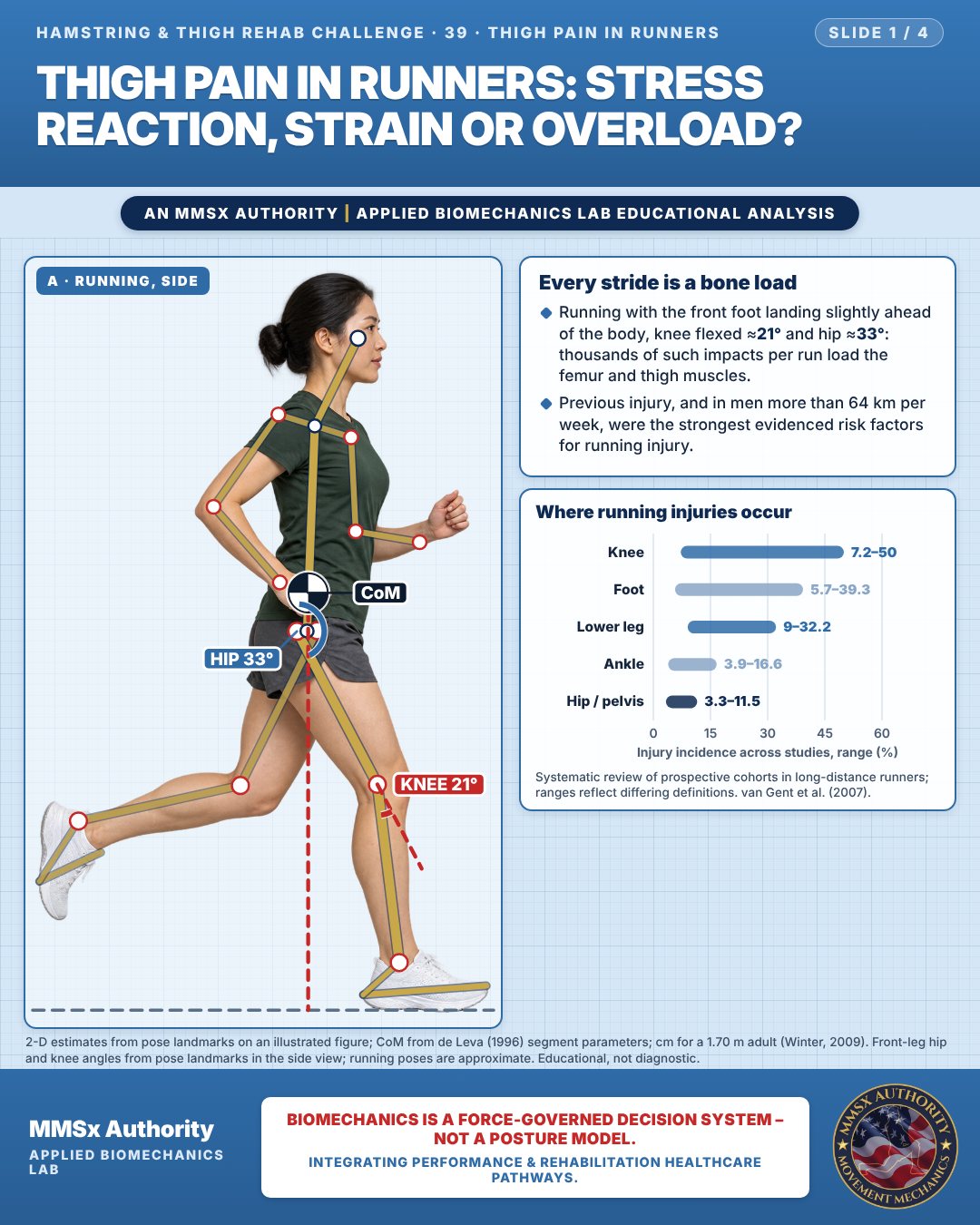
Every stride is a bone load
Running with the front foot landing slightly ahead of the body, knee flexed ≈21° and hip ≈33°: thousands of such impacts per run load the femur and thigh muscles.
Previous injury, and in men more than 64 km per week, were the strongest evidenced risk factors for running injury.
Where running injuries occur
Movement B: Single-leg hop (side view)
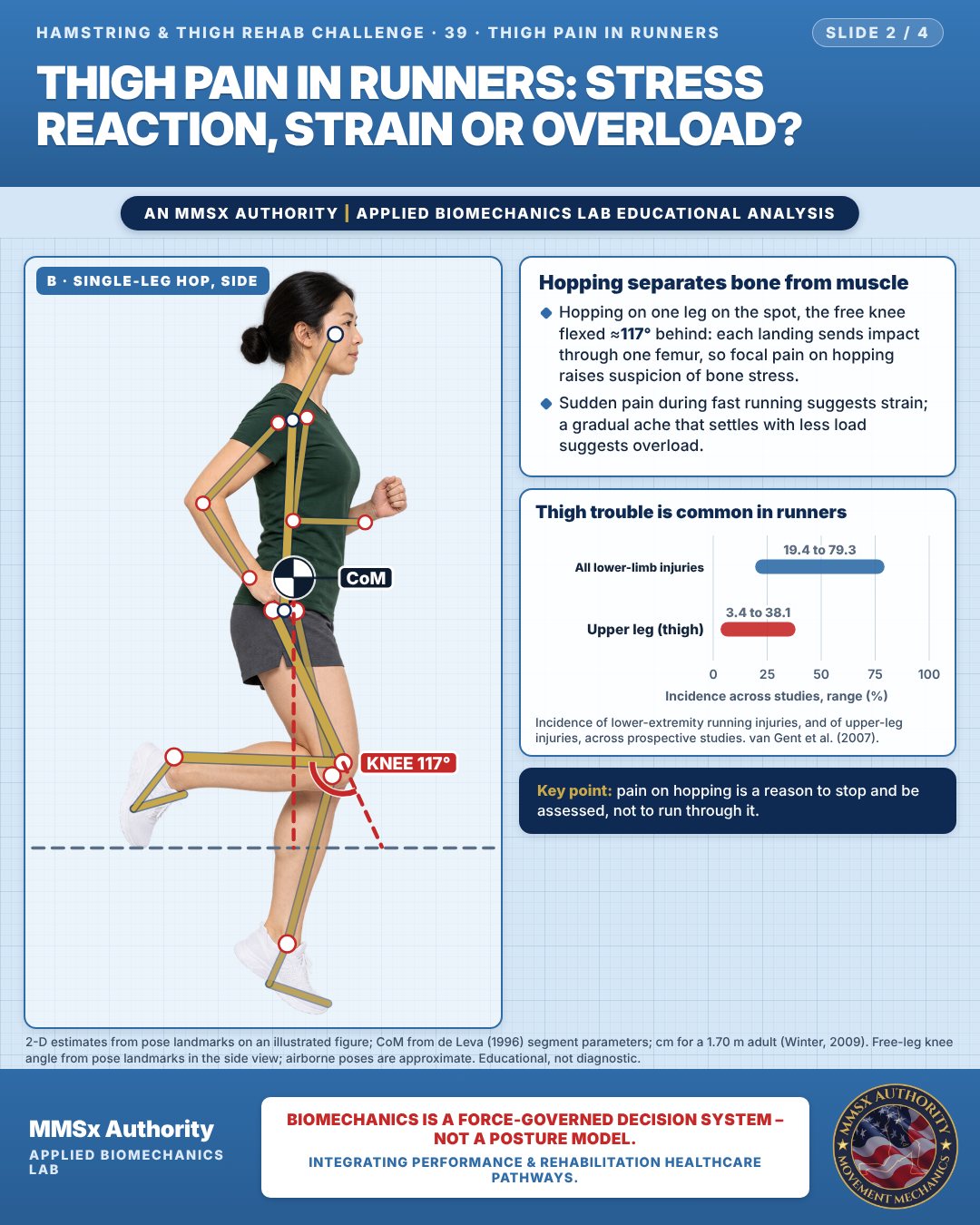
Hopping separates bone from muscle
Hopping on one leg on the spot, the free knee flexed ≈117° behind: each landing sends impact through one femur, so focal pain on hopping raises suspicion of bone stress.
Sudden pain during fast running suggests strain; a gradual ache that settles with less load suggests overload.
Thigh trouble is common in runners
Movement C: Short-stride run (side view)
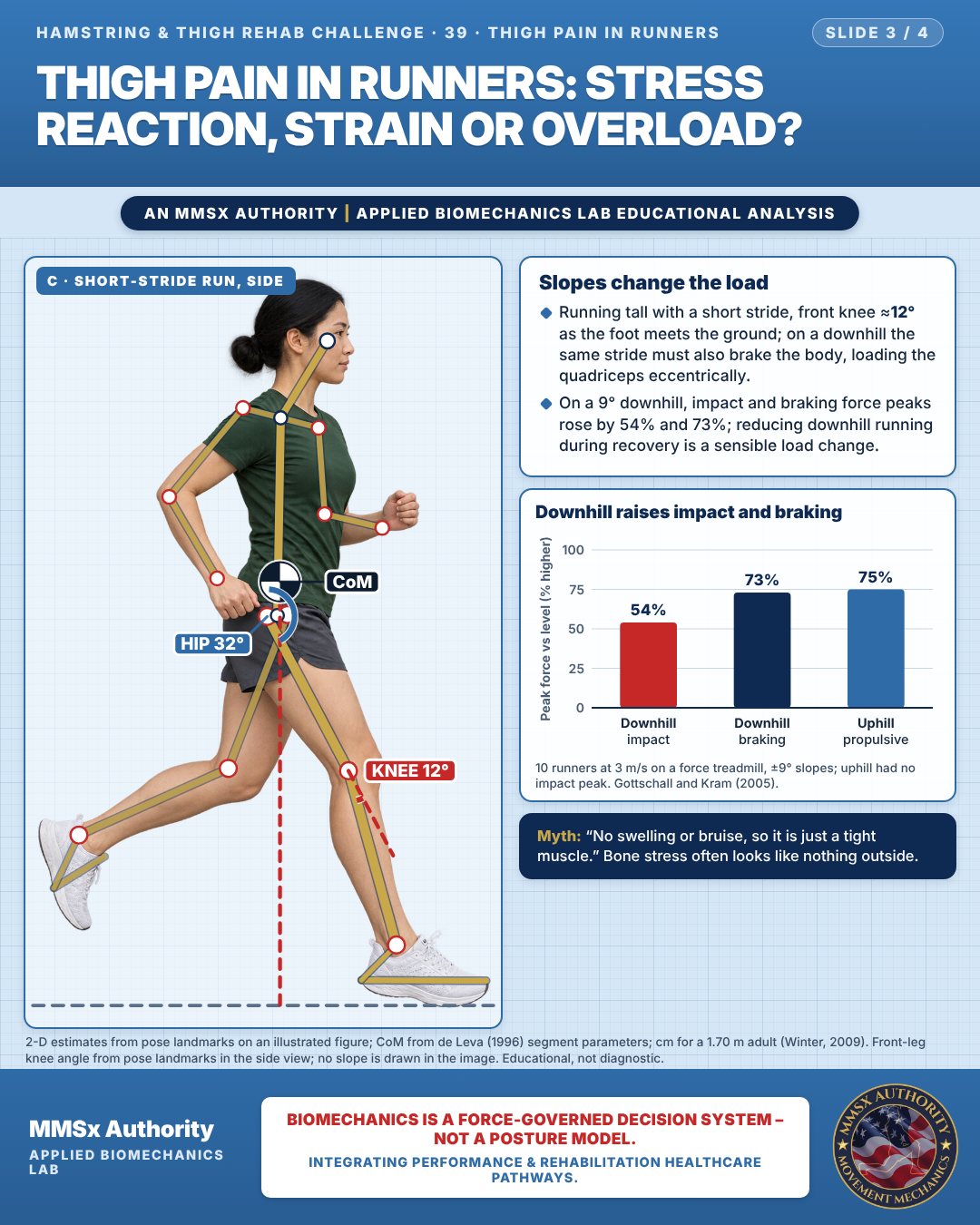
Slopes change the load
Running tall with a short stride, front knee ≈12° as the foot meets the ground; on a downhill the same stride must also brake the body, loading the quadriceps eccentrically.
On a 9° downhill, impact and braking force peaks rose by 54% and 73%; reducing downhill running during recovery is a sensible load change.
Downhill raises impact and braking
Decision pathway
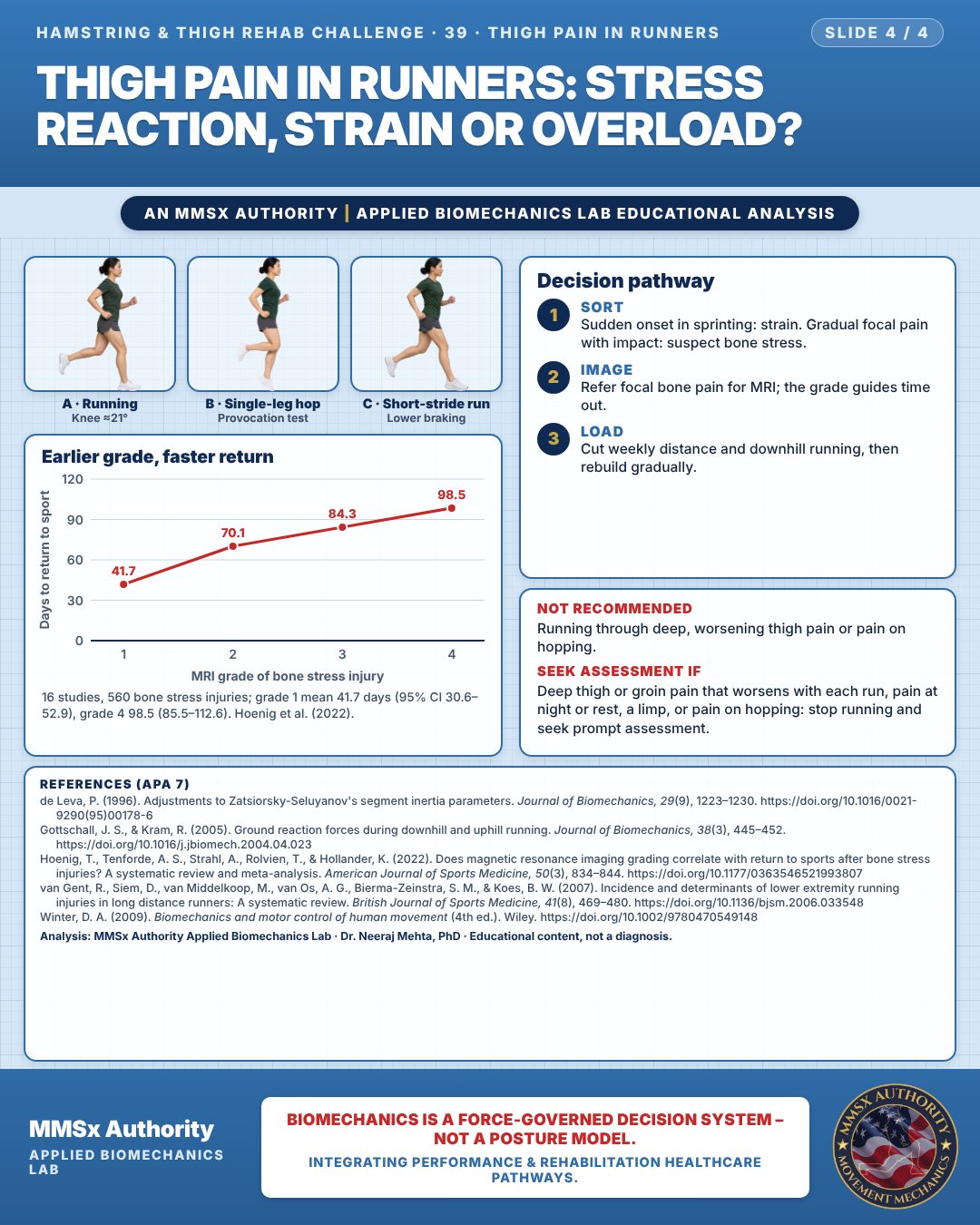
Earlier grade, faster return
Sort
Sudden onset in sprinting: strain. Gradual focal pain with impact: suspect bone stress.
Image
Refer focal bone pain for MRI; the grade guides time out.
Load
Cut weekly distance and downhill running, then rebuild gradually.
What the evidence supports
- Differentiate the mechanism: sudden onset during sprinting suggests strain; gradual, impact-related, focal bone pain suggests a bone stress injury and warrants imaging (MRI grades severity and informs return time) (Hoenig et al., 2022).
- Modify load: weekly distance and previous injury are the strongest evidenced risk factors (van Gent et al., 2007); reduce downhill running during recovery, as it raises impact and braking forces (Gottschall & Kram, 2005).
- Return to running by graded progression; expect longer timelines for higher MRI grades (Hoenig et al., 2022).
Myth and evidence
Myth“If it is not swollen or bruised, it is just a tight muscle; run through it.”
EvidenceBone stress injuries often look like nothing on the outside, and earlier-grade injuries return far faster (about 42 days for grade 1 vs about 99 days for grade 4) (Hoenig et al., 2022).
Cautions
Not recommended
Running through deep, worsening thigh pain or pain on hopping.
Seek assessment if
Deep thigh or groin pain that worsens with each run, pain at night or rest, a limp, or pain on hopping: stop running and seek prompt assessment.
Methods note
2-D estimates from pose landmarks on an illustrated figure; CoM from de Leva (1996) segment parameters; cm for a 1.70 m adult (Winter, 2009). Front-leg hip and knee angles from pose landmarks in the side view; running poses are approximate. Free-leg knee angle from pose landmarks in the side view; airborne poses are approximate. Front-leg knee angle from pose landmarks in the side view; no slope is drawn in the image. These are educational estimates, not a diagnosis.
References
- de Leva, P. (1996). Adjustments to Zatsiorsky-Seluyanov's segment inertia parameters. Journal of Biomechanics, 29(9), 1223–1230. https://doi.org/10.1016/0021-9290(95)00178-6
- Gottschall, J. S., & Kram, R. (2005). Ground reaction forces during downhill and uphill running. Journal of Biomechanics, 38(3), 445–452. https://doi.org/10.1016/j.jbiomech.2004.04.023
- Hoenig, T., Tenforde, A. S., Strahl, A., Rolvien, T., & Hollander, K. (2022). Does magnetic resonance imaging grading correlate with return to sports after bone stress injuries? A systematic review and meta-analysis. American Journal of Sports Medicine, 50(3), 834–844. https://doi.org/10.1177/0363546521993807
- van Gent, R., Siem, D., van Middelkoop, M., van Os, A. G., Bierma-Zeinstra, S. M., & Koes, B. W. (2007). Incidence and determinants of lower extremity running injuries in long distance runners: A systematic review. British Journal of Sports Medicine, 41(8), 469–480. https://doi.org/10.1136/bjsm.2006.033548
- Winter, D. A. (2009). Biomechanics and motor control of human movement (4th ed.). Wiley. https://doi.org/10.1002/9780470549148
Cite this article
Mehta, N. (2026, October 26). Thigh pain in runners: stress reaction, strain or overload? MMSx Authority Applied Biomechanics Lab. https://mmsxauthority.org/edu/analysis/hamstring-thigh/39-thigh-pain-in-runners-stress-reaction-strain-or-overload/
Part of the collection
Mehta, N. (2026). Hamstring and Thigh Rehabilitation: 50 Evidence-Based Biomechanics Analyses [Collection]. MMSx Authority Applied Biomechanics Lab. Zenodo. https://doi.org/10.5281/zenodo.23735792
All Hamstring & Thigh Rehab Challenge articles · Rehabilitation Library