Hamstring & Thigh Rehab Challenge · 38
Thigh muscle loss with age: sarcopenia, strength and falls
Sarcopenia is "a muscle disease (muscle failure) rooted in adverse muscle changes that accrue across a lifetime".
Key points
- Screen. Test strength first with grip strength or five chair rises.
- Confirm. Confirm with muscle quantity; grade severity with gait speed or similar tests.
- Train. Prescribe progressive resistance training, with chair rising and step-ups.
What it is
Sarcopenia is "a muscle disease (muscle failure) rooted in adverse muscle changes that accrue across a lifetime". The revised European consensus (EWGSOP2) makes low muscle strength the key characteristic: sarcopenia is probable when low strength is found, confirmed by low muscle quantity or quality, and severe when low physical performance is also present (Cruz-Jentoft et al., 2019).
How we analysed the movement
Three movements relevant to this topic were analysed from illustrated reference figures. Joint centres were located with two-dimensional pose estimation; hip and knee angles, pelvis level, the whole-body centre of mass and, where relevant, the hip lever (the horizontal distance from the hip joint to the upper-body centre of mass) and the resulting static hip moment were then calculated from standard segment parameters. The figures are educational estimates that show how position changes mechanical demand; they are not measurements of a patient. Every research value quoted below comes from the published source cited beside it.
Movement A: Sit to stand (side view)
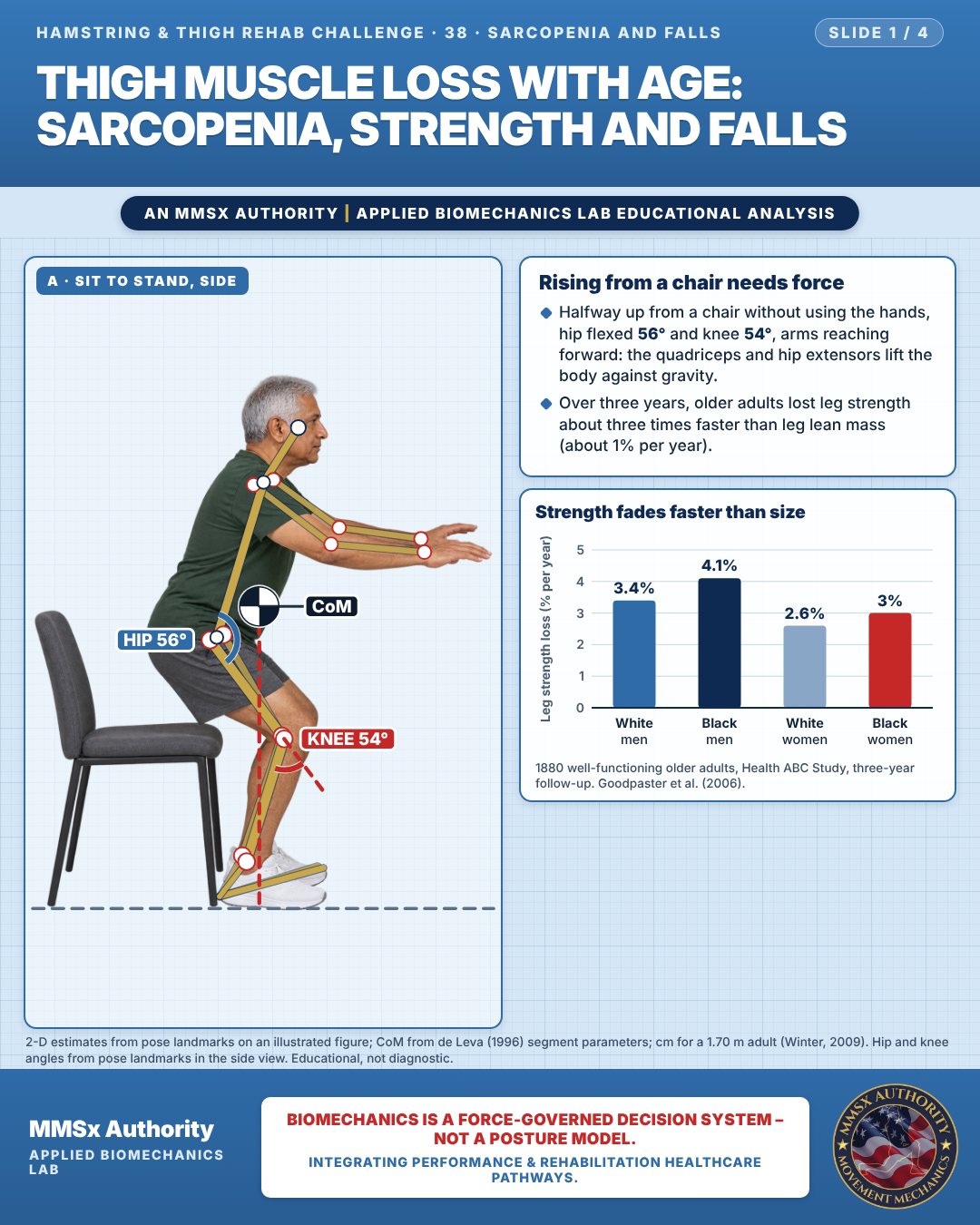
Rising from a chair needs force
Halfway up from a chair without using the hands, hip flexed 56° and knee 54°, arms reaching forward: the quadriceps and hip extensors lift the body against gravity.
Over three years, older adults lost leg strength about three times faster than leg lean mass (about 1% per year).
Strength fades faster than size
Movement B: Walking (side view)
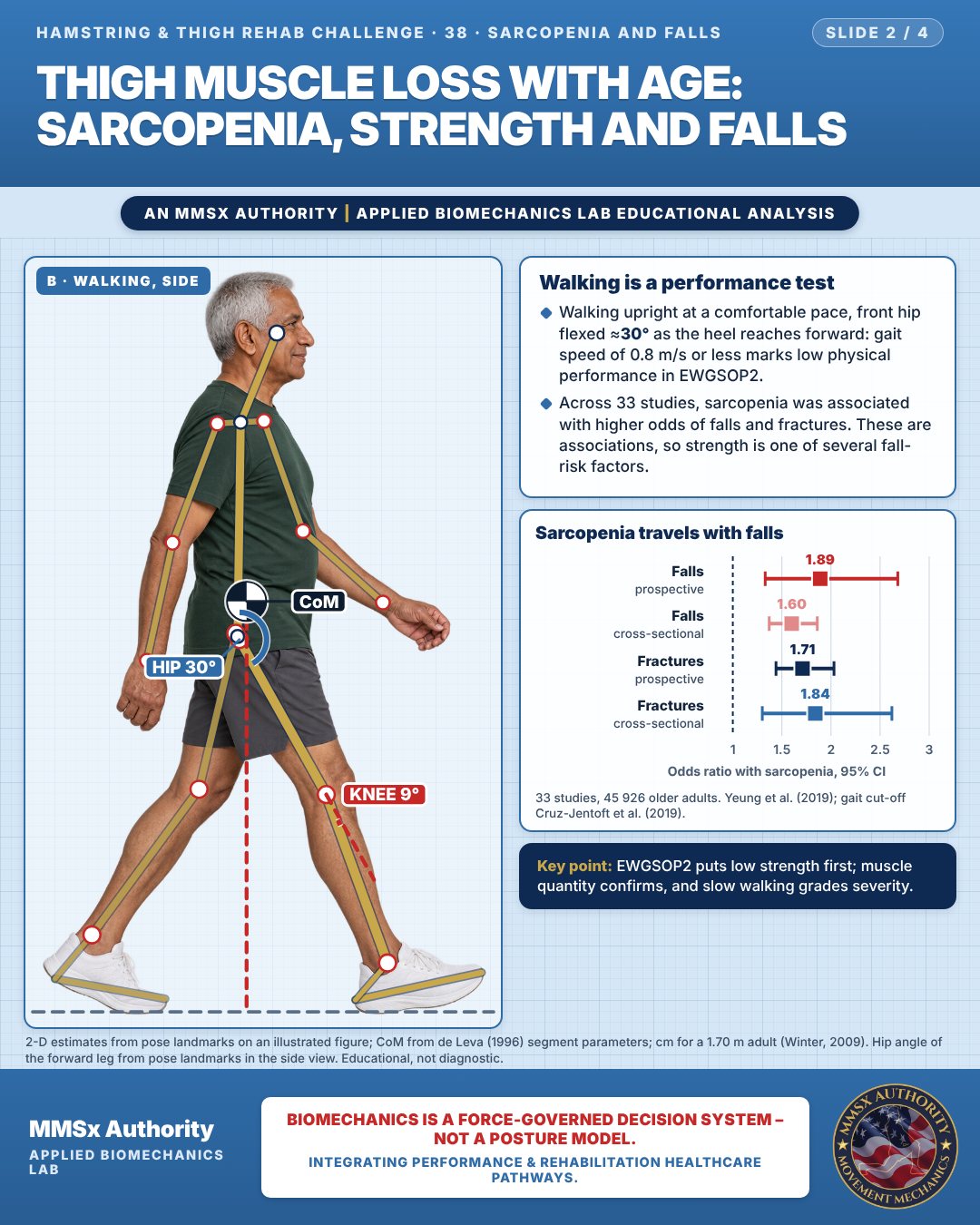
Walking is a performance test
Walking upright at a comfortable pace, front hip flexed ≈30° as the heel reaches forward: gait speed of 0.8 m/s or less marks low physical performance in EWGSOP2.
Across 33 studies, sarcopenia was associated with higher odds of falls and fractures. These are associations, so strength is one of several fall-risk factors.
Sarcopenia travels with falls
Movement C: Step-up with rail (side view)
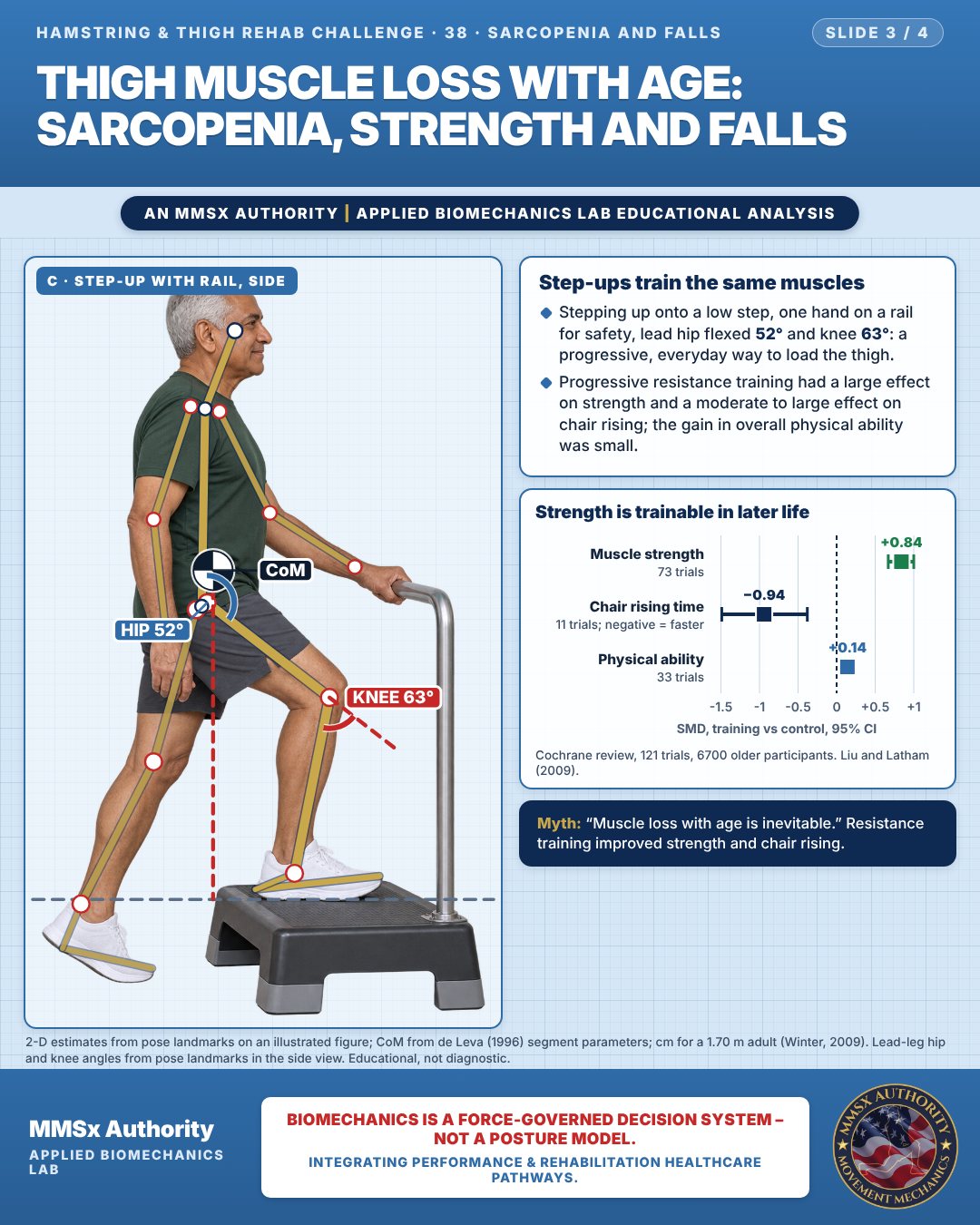
Step-ups train the same muscles
Stepping up onto a low step, one hand on a rail for safety, lead hip flexed 52° and knee 63°: a progressive, everyday way to load the thigh.
Progressive resistance training had a large effect on strength and a moderate to large effect on chair rising; the gain in overall physical ability was small.
Strength is trainable in later life
Decision pathway
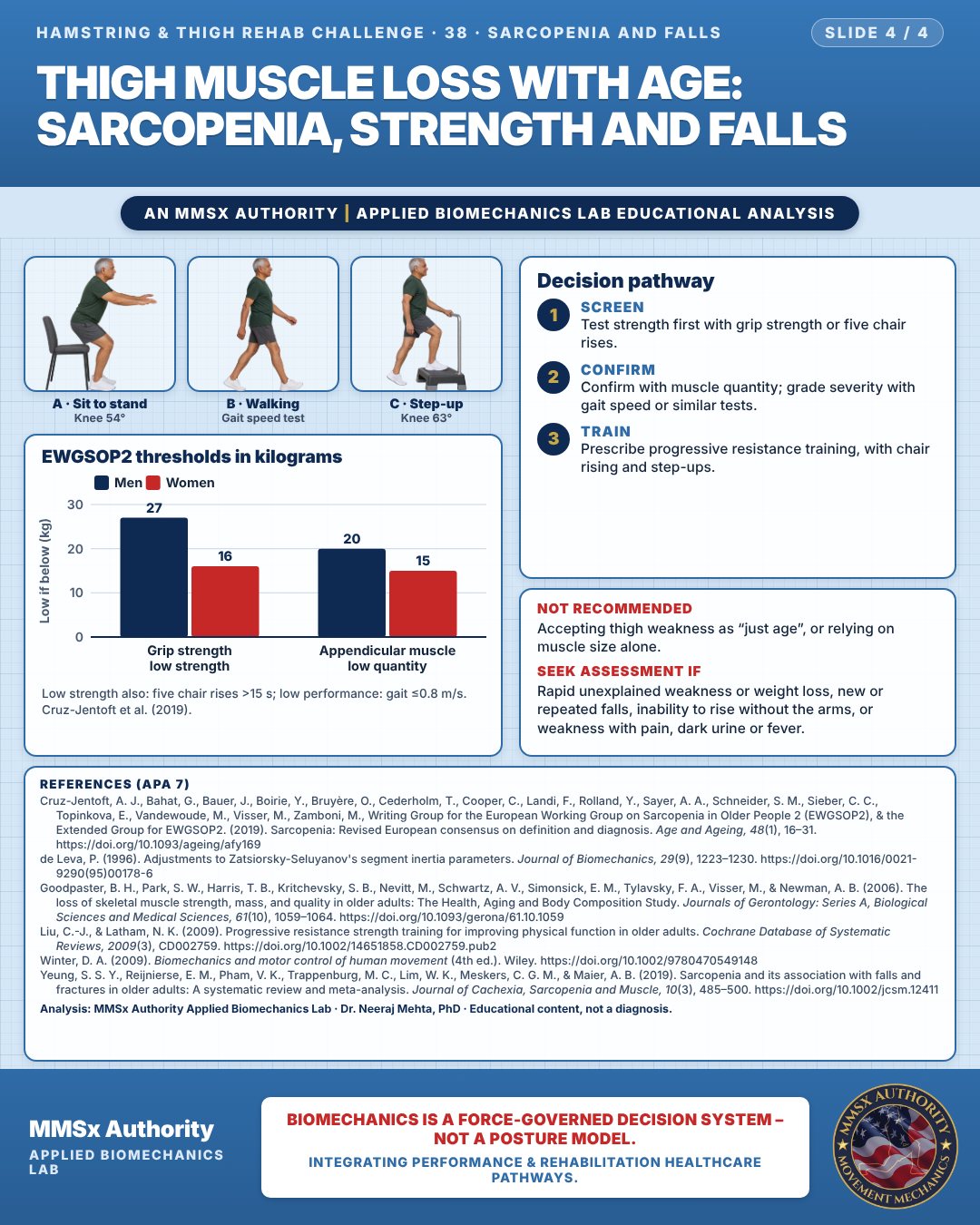
EWGSOP2 thresholds in kilograms
Screen
Test strength first with grip strength or five chair rises.
Confirm
Confirm with muscle quantity; grade severity with gait speed or similar tests.
Train
Prescribe progressive resistance training, with chair rising and step-ups.
What the evidence supports
- Use progressive resistance training: it has a large effect on strength and a moderate to large effect on chair rising in older adults (Liu & Latham, 2009).
- Include sarcopenia assessment in falls and fracture risk work-ups, given its association with both (Yeung et al., 2019).
Myth and evidence
Myth“Muscle loss with age is inevitable and nothing can be done.”
EvidenceStrength declines about three times faster than muscle mass (Goodpaster et al., 2006), but resistance training produces a large improvement in strength and in getting out of a chair in older adults (Liu & Latham, 2009).
Cautions
Not recommended
Accepting thigh weakness as “just age”, or relying on muscle size alone.
Seek assessment if
Rapid unexplained weakness or weight loss, new or repeated falls, inability to rise without the arms, or weakness with pain, dark urine or fever.
Methods note
2-D estimates from pose landmarks on an illustrated figure; CoM from de Leva (1996) segment parameters; cm for a 1.70 m adult (Winter, 2009). Hip and knee angles from pose landmarks in the side view. Hip angle of the forward leg from pose landmarks in the side view. Lead-leg hip and knee angles from pose landmarks in the side view. These are educational estimates, not a diagnosis.
References
- Cruz-Jentoft, A. J., Bahat, G., Bauer, J., Boirie, Y., Bruyère, O., Cederholm, T., Cooper, C., Landi, F., Rolland, Y., Sayer, A. A., Schneider, S. M., Sieber, C. C., Topinkova, E., Vandewoude, M., Visser, M., Zamboni, M., Writing Group for the European Working Group on Sarcopenia in Older People 2 (EWGSOP2), & the Extended Group for EWGSOP2. (2019). Sarcopenia: Revised European consensus on definition and diagnosis. Age and Ageing, 48(1), 16–31. https://doi.org/10.1093/ageing/afy169
- de Leva, P. (1996). Adjustments to Zatsiorsky-Seluyanov's segment inertia parameters. Journal of Biomechanics, 29(9), 1223–1230. https://doi.org/10.1016/0021-9290(95)00178-6
- Goodpaster, B. H., Park, S. W., Harris, T. B., Kritchevsky, S. B., Nevitt, M., Schwartz, A. V., Simonsick, E. M., Tylavsky, F. A., Visser, M., & Newman, A. B. (2006). The loss of skeletal muscle strength, mass, and quality in older adults: The Health, Aging and Body Composition Study. Journals of Gerontology: Series A, Biological Sciences and Medical Sciences, 61(10), 1059–1064. https://doi.org/10.1093/gerona/61.10.1059
- Liu, C.-J., & Latham, N. K. (2009). Progressive resistance strength training for improving physical function in older adults. Cochrane Database of Systematic Reviews, 2009(3), CD002759. https://doi.org/10.1002/14651858.CD002759.pub2
- Winter, D. A. (2009). Biomechanics and motor control of human movement (4th ed.). Wiley. https://doi.org/10.1002/9780470549148
- Yeung, S. S. Y., Reijnierse, E. M., Pham, V. K., Trappenburg, M. C., Lim, W. K., Meskers, C. G. M., & Maier, A. B. (2019). Sarcopenia and its association with falls and fractures in older adults: A systematic review and meta-analysis. Journal of Cachexia, Sarcopenia and Muscle, 10(3), 485–500. https://doi.org/10.1002/jcsm.12411
Cite this article
Mehta, N. (2026, October 26). Thigh muscle loss with age: sarcopenia, strength and falls. MMSx Authority Applied Biomechanics Lab. https://mmsxauthority.org/edu/analysis/hamstring-thigh/38-thigh-muscle-loss-with-age-sarcopenia-strength-and-falls/
Part of the collection
Mehta, N. (2026). Hamstring and Thigh Rehabilitation: 50 Evidence-Based Biomechanics Analyses [Collection]. MMSx Authority Applied Biomechanics Lab. Zenodo. https://doi.org/10.5281/zenodo.23735792
All Hamstring & Thigh Rehab Challenge articles · Rehabilitation Library