Hamstring & Thigh Rehab Challenge · 37
Single-leg strength differences: when thigh asymmetry matters
The limb symmetry index (LSI) expresses the involved limb's result as a percentage of the uninvolved limb (for example quadriceps strength or…
Key points
- Battery. Test quadriceps strength and several hops, each at least 90%.
- Compare. Where possible, compare the injured leg with pre-injury values, not only the other leg.
- Time. Delay pivoting sport to at least 9 months after ACL reconstruction.
What it is
The limb symmetry index (LSI) expresses the involved limb's result as a percentage of the uninvolved limb (for example quadriceps strength or single-leg hop distance). It is widely used in return-to-sport decisions after knee injury, commonly with a 90% threshold (Grindem et al., 2016; Wellsandt et al., 2017). An LSI only describes the gap between legs; it does not show whether either leg has regained its pre-injury capacity.
How we analysed the movement
Three movements relevant to this topic were analysed from illustrated reference figures. Joint centres were located with two-dimensional pose estimation; hip and knee angles, pelvis level, the whole-body centre of mass and, where relevant, the hip lever (the horizontal distance from the hip joint to the upper-body centre of mass) and the resulting static hip moment were then calculated from standard segment parameters. The figures are educational estimates that show how position changes mechanical demand; they are not measurements of a patient. Every research value quoted below comes from the published source cited beside it.
Movement A: Single-leg squat (front view)
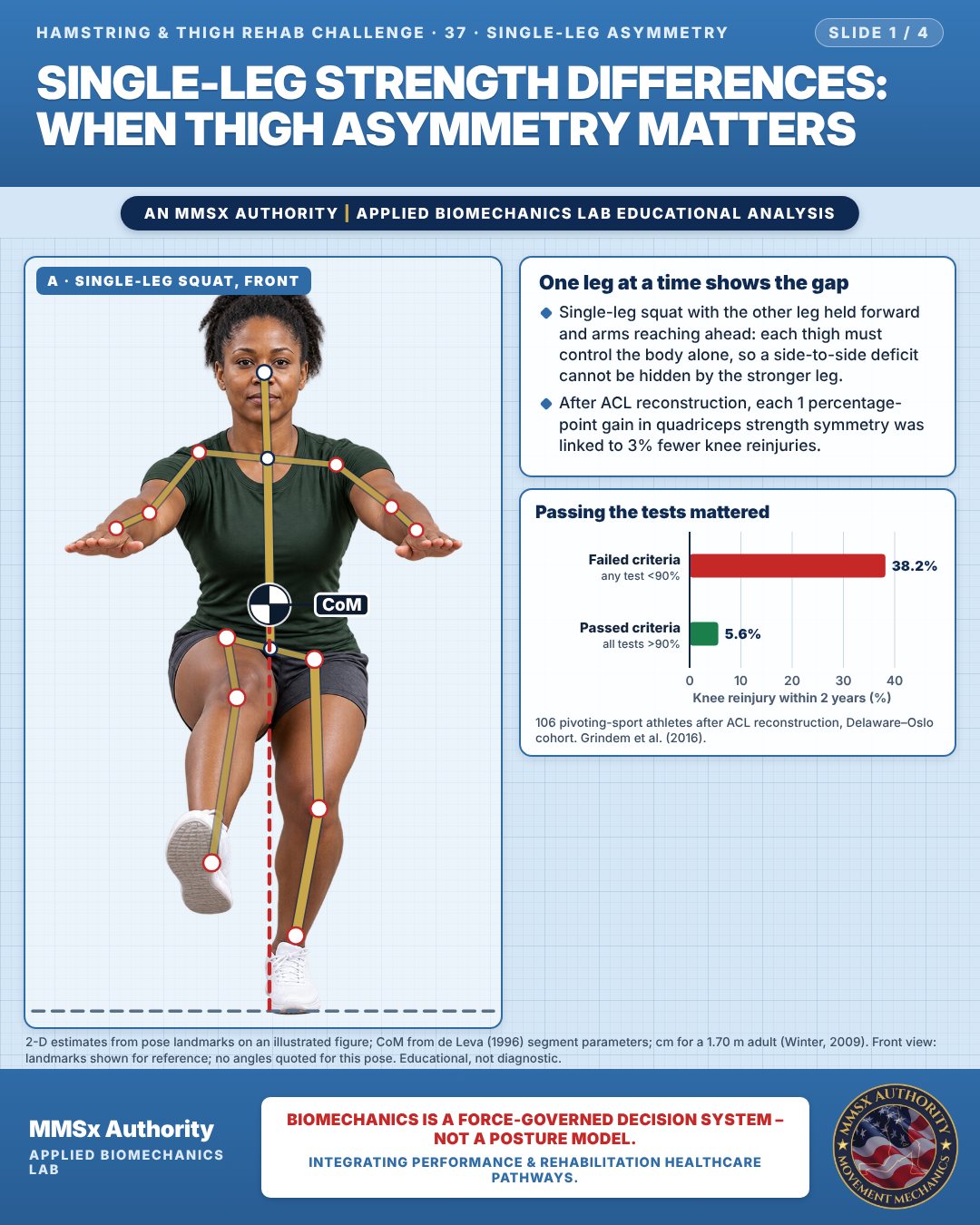
One leg at a time shows the gap
Single-leg squat with the other leg held forward and arms reaching ahead: each thigh must control the body alone, so a side-to-side deficit cannot be hidden by the stronger leg.
After ACL reconstruction, each 1 percentage-point gain in quadriceps strength symmetry was linked to 3% fewer knee reinjuries.
Passing the tests mattered
Movement B: Single-leg hop (side view)
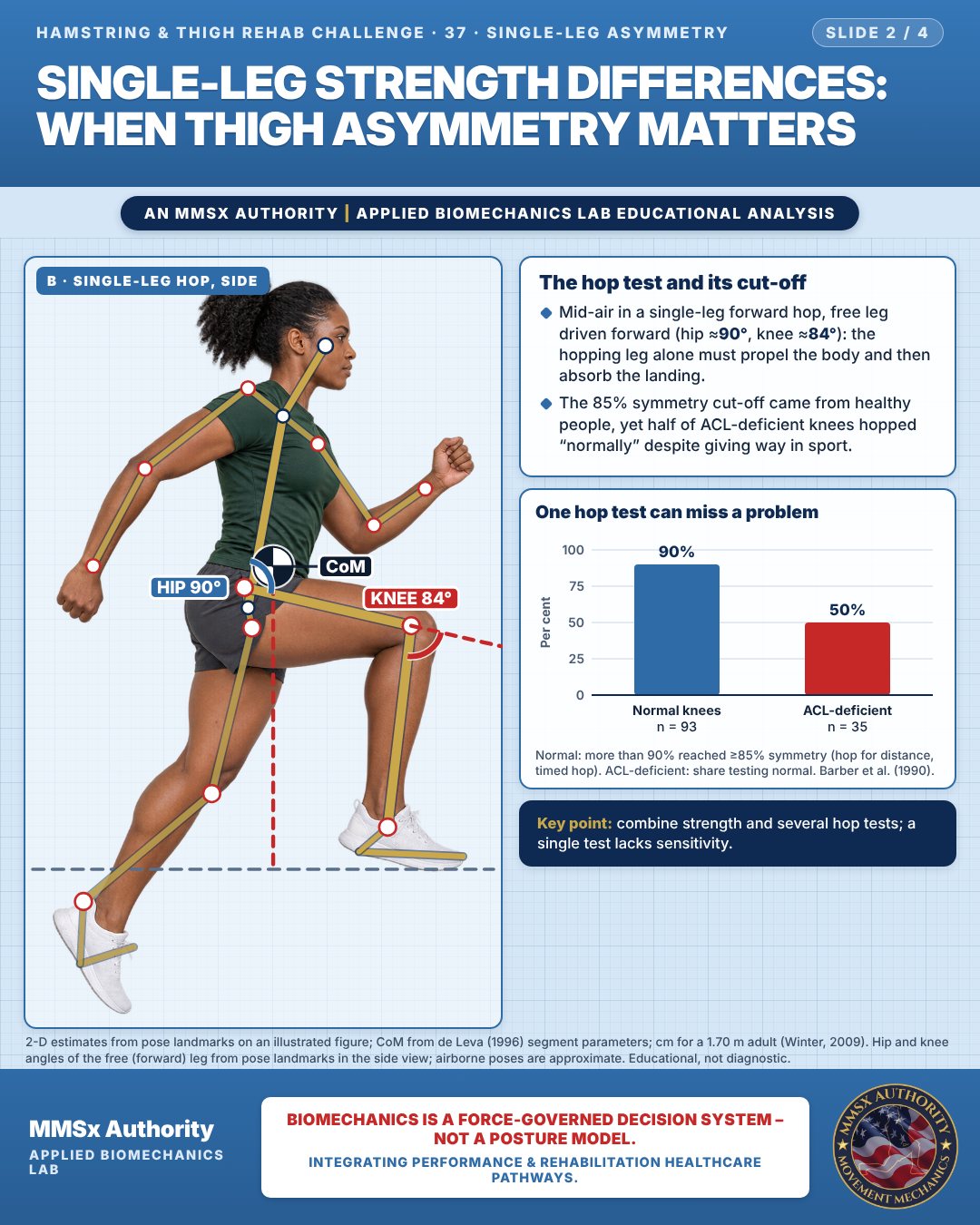
The hop test and its cut-off
Mid-air in a single-leg forward hop, free leg driven forward (hip ≈90°, knee ≈84°): the hopping leg alone must propel the body and then absorb the landing.
The 85% symmetry cut-off came from healthy people, yet half of ACL-deficient knees hopped “normally” despite giving way in sport.
One hop test can miss a problem
Movement C: Hop landing (side view)
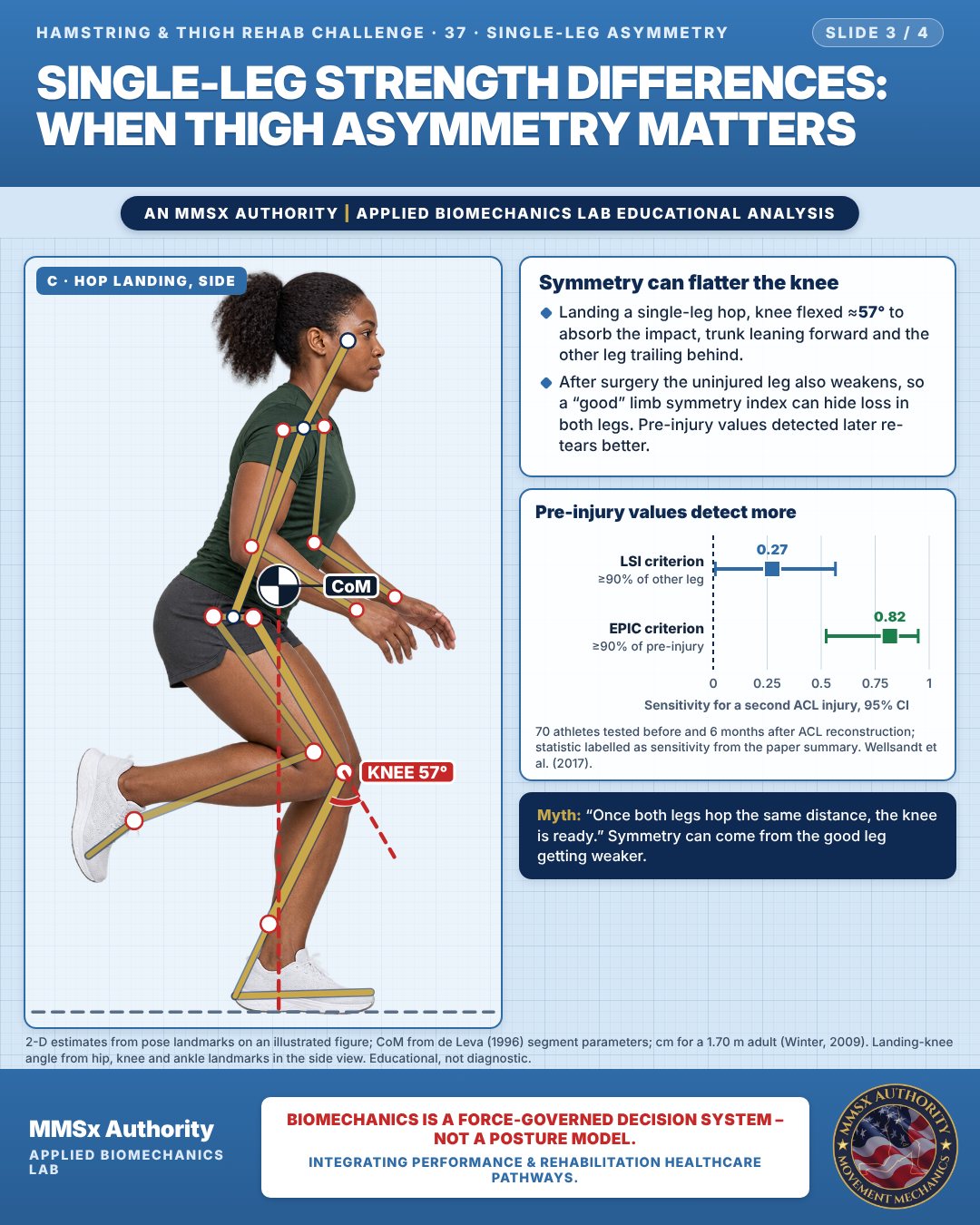
Symmetry can flatter the knee
Landing a single-leg hop, knee flexed ≈57° to absorb the impact, trunk leaning forward and the other leg trailing behind.
After surgery the uninjured leg also weakens, so a “good” limb symmetry index can hide loss in both legs. Pre-injury values detected later re-tears better.
Pre-injury values detect more
Decision pathway
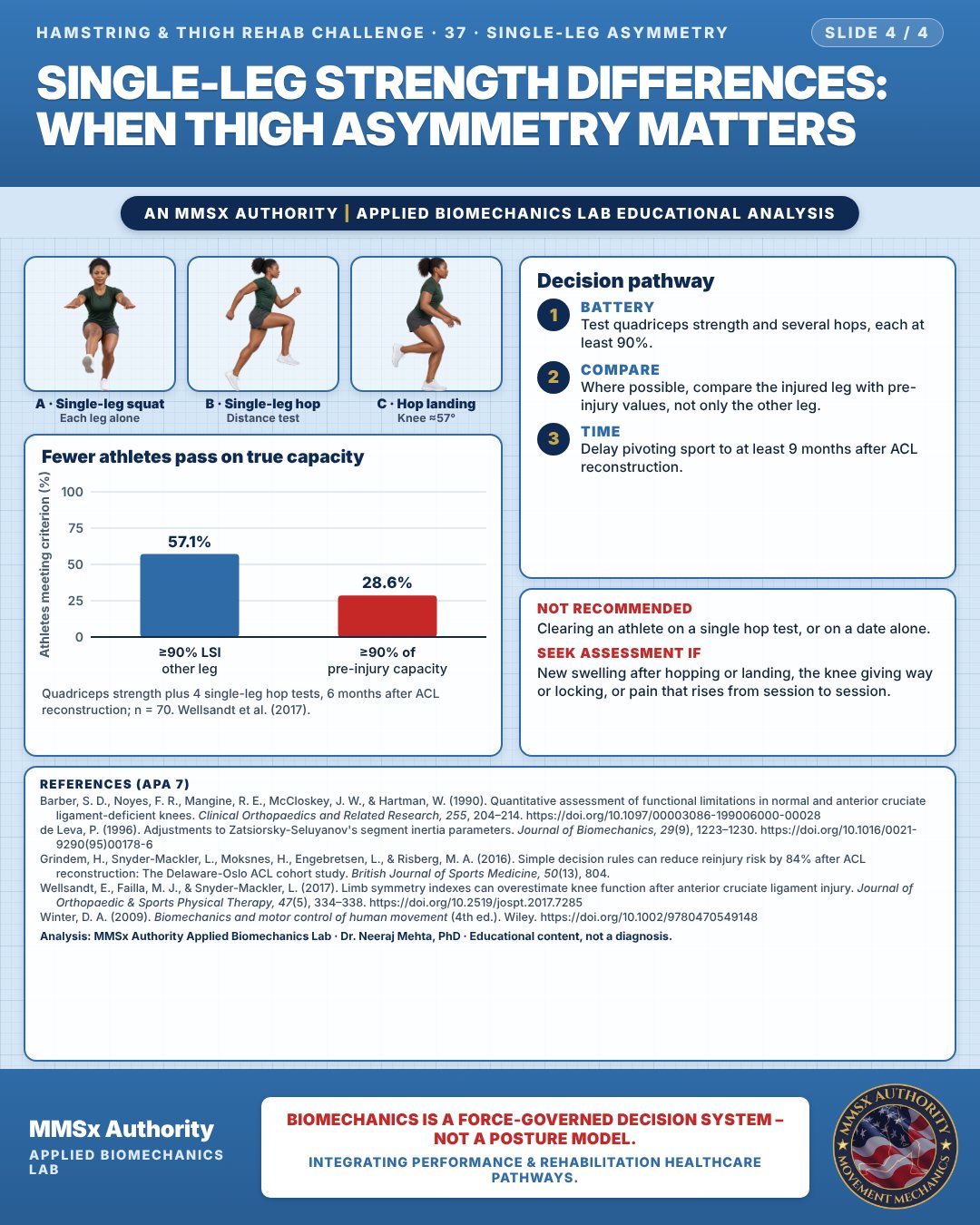
Fewer athletes pass on true capacity
Battery
Test quadriceps strength and several hops, each at least 90%.
Compare
Where possible, compare the injured leg with pre-injury values, not only the other leg.
Time
Delay pivoting sport to at least 9 months after ACL reconstruction.
What the evidence supports
- Use a battery of tests (quadriceps strength plus several hop tests) with a ≥90% threshold, and delay return to pivoting sport until at least 9 months after ACL reconstruction (Grindem et al., 2016).
- Where possible, compare with pre-injury or pre-operative values of the uninjured leg rather than relying on LSI alone (Wellsandt et al., 2017).
- Do not rely on a single hop test to clear an athlete, because single tests lack sensitivity (Barber et al., 1990).
Myth and evidence
Myth“Once both legs hop the same distance, the knee is ready.”
EvidenceSymmetry can be reached by the uninjured leg getting weaker: only 28.6% of athletes reached 90% of pre-injury capacity, against 57.1% on LSI (Wellsandt et al., 2017), and timing and quadriceps symmetry independently influence reinjury (Grindem et al., 2016).
Cautions
Not recommended
Clearing an athlete on a single hop test, or on a date alone.
Seek assessment if
New swelling after hopping or landing, the knee giving way or locking, or pain that rises from session to session.
Methods note
2-D estimates from pose landmarks on an illustrated figure; CoM from de Leva (1996) segment parameters; cm for a 1.70 m adult (Winter, 2009). Front view: landmarks shown for reference; no angles quoted for this pose. Hip and knee angles of the free (forward) leg from pose landmarks in the side view; airborne poses are approximate. Landing-knee angle from hip, knee and ankle landmarks in the side view. These are educational estimates, not a diagnosis.
References
- Barber, S. D., Noyes, F. R., Mangine, R. E., McCloskey, J. W., & Hartman, W. (1990). Quantitative assessment of functional limitations in normal and anterior cruciate ligament-deficient knees. Clinical Orthopaedics and Related Research, 255, 204–214. https://doi.org/10.1097/00003086-199006000-00028
- de Leva, P. (1996). Adjustments to Zatsiorsky-Seluyanov's segment inertia parameters. Journal of Biomechanics, 29(9), 1223–1230. https://doi.org/10.1016/0021-9290(95)00178-6
- Grindem, H., Snyder-Mackler, L., Moksnes, H., Engebretsen, L., & Risberg, M. A. (2016). Simple decision rules can reduce reinjury risk by 84% after ACL reconstruction: The Delaware-Oslo ACL cohort study. British Journal of Sports Medicine, 50(13), 804.
- Wellsandt, E., Failla, M. J., & Snyder-Mackler, L. (2017). Limb symmetry indexes can overestimate knee function after anterior cruciate ligament injury. Journal of Orthopaedic & Sports Physical Therapy, 47(5), 334–338. https://doi.org/10.2519/jospt.2017.7285
- Winter, D. A. (2009). Biomechanics and motor control of human movement (4th ed.). Wiley. https://doi.org/10.1002/9780470549148
Cite this article
Mehta, N. (2026, October 26). Single-leg strength differences: when thigh asymmetry matters. MMSx Authority Applied Biomechanics Lab. https://mmsxauthority.org/edu/analysis/hamstring-thigh/37-single-leg-strength-differences-when-thigh-asymmetry-matters/
Part of the collection
Mehta, N. (2026). Hamstring and Thigh Rehabilitation: 50 Evidence-Based Biomechanics Analyses [Collection]. MMSx Authority Applied Biomechanics Lab. Zenodo. https://doi.org/10.5281/zenodo.23735792
All Hamstring & Thigh Rehab Challenge articles · Rehabilitation Library