Hamstring & Thigh Rehab Challenge · 36
Hamstring-to-quadriceps ratio and ACL risk: what is proven
The anterior cruciate ligament (ACL) restrains forward translation and rotation of the tibia.
Key points
- Train. Use multi-component programmes: landing, strength and balance, not one ratio.
- Coach. Cue soft landings with the knee over the foot; limit inward knee collapse.
- Return. After reconstruction, check H:Q ratio and all discharge criteria; missing any was linked to 4 times the graft rupture risk.
What it is
The anterior cruciate ligament (ACL) restrains forward translation and rotation of the tibia. The hamstrings can resist anterior tibial shear, so a low hamstring-to-quadriceps (H:Q) strength ratio has been proposed as an ACL risk factor. The evidence below separates what is measured prospectively (landing mechanics, strength deficits, graft rupture after reconstruction) from what is assumed.
How we analysed the movement
Three movements relevant to this topic were analysed from illustrated reference figures. Joint centres were located with two-dimensional pose estimation; hip and knee angles, pelvis level, the whole-body centre of mass and, where relevant, the hip lever (the horizontal distance from the hip joint to the upper-body centre of mass) and the resulting static hip moment were then calculated from standard segment parameters. The figures are educational estimates that show how position changes mechanical demand; they are not measurements of a patient. Every research value quoted below comes from the published source cited beside it.
Movement A: Drop landing (front view)
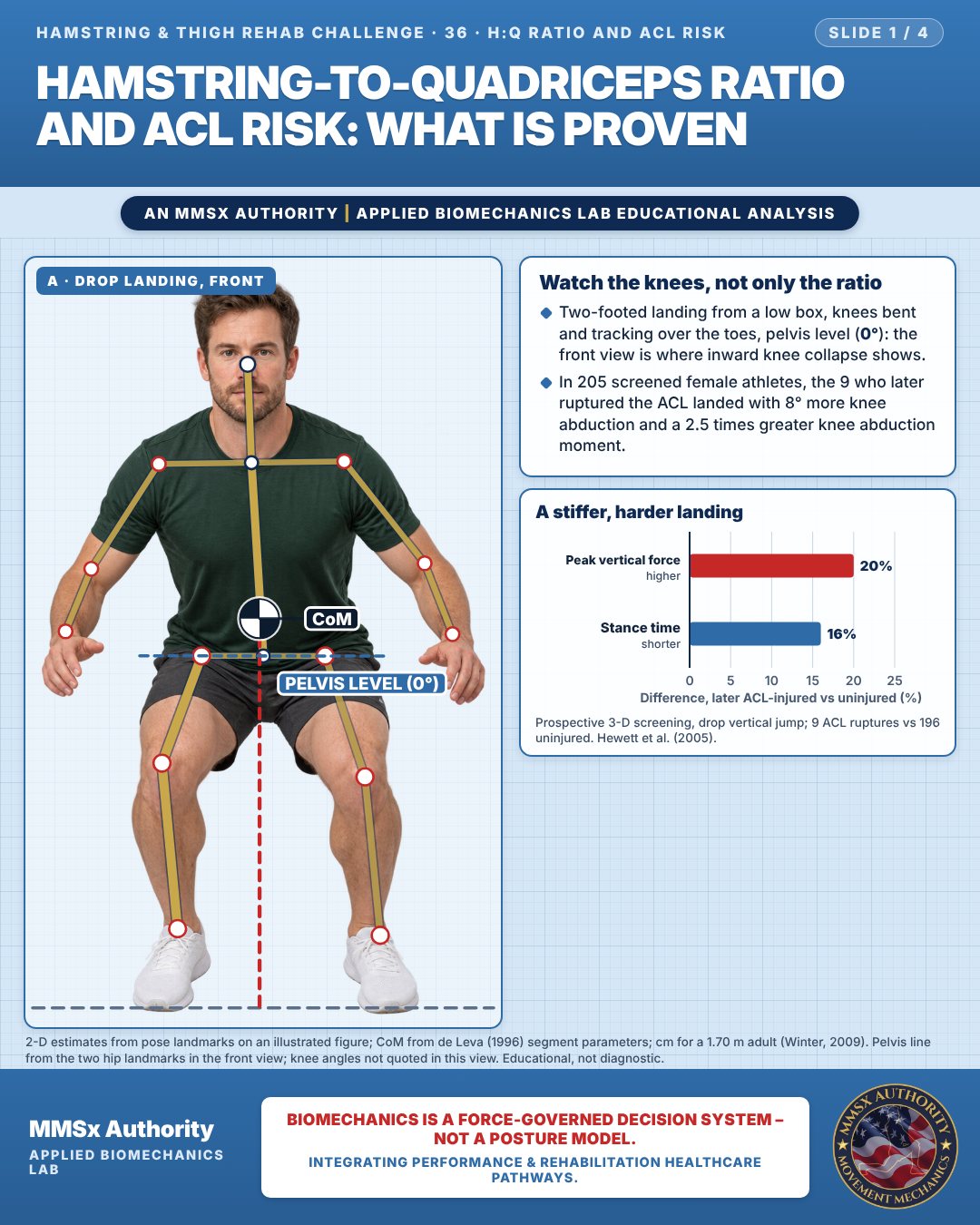
Watch the knees, not only the ratio
Two-footed landing from a low box, knees bent and tracking over the toes, pelvis level (0°): the front view is where inward knee collapse shows.
In 205 screened female athletes, the 9 who later ruptured the ACL landed with 8° more knee abduction and a 2.5 times greater knee abduction moment.
A stiffer, harder landing
Movement B: Drop landing (side view)
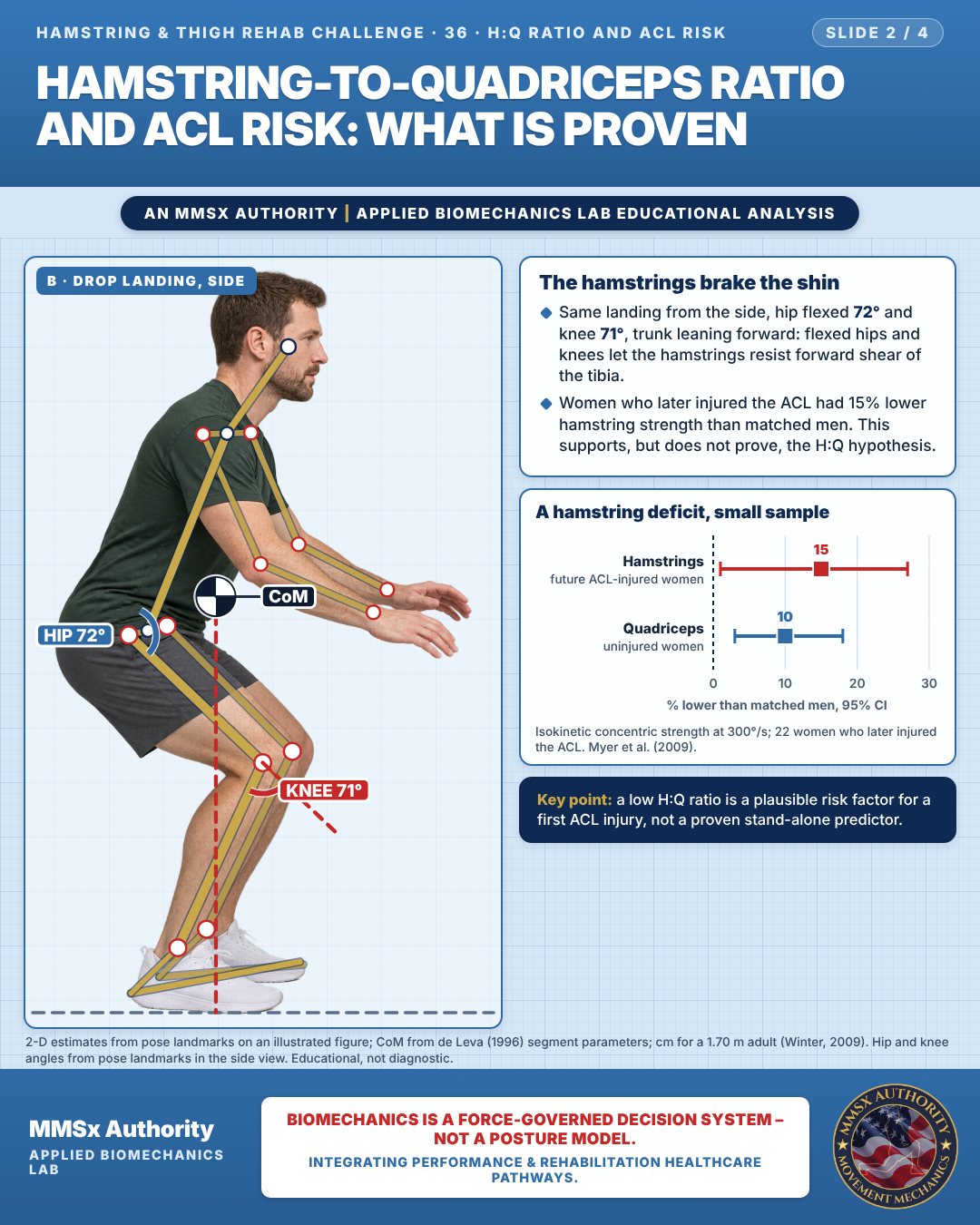
The hamstrings brake the shin
Same landing from the side, hip flexed 72° and knee 71°, trunk leaning forward: flexed hips and knees let the hamstrings resist forward shear of the tibia.
Women who later injured the ACL had 15% lower hamstring strength than matched men. This supports, but does not prove, the H:Q hypothesis.
A hamstring deficit, small sample
Movement C: Single-leg landing (front view)
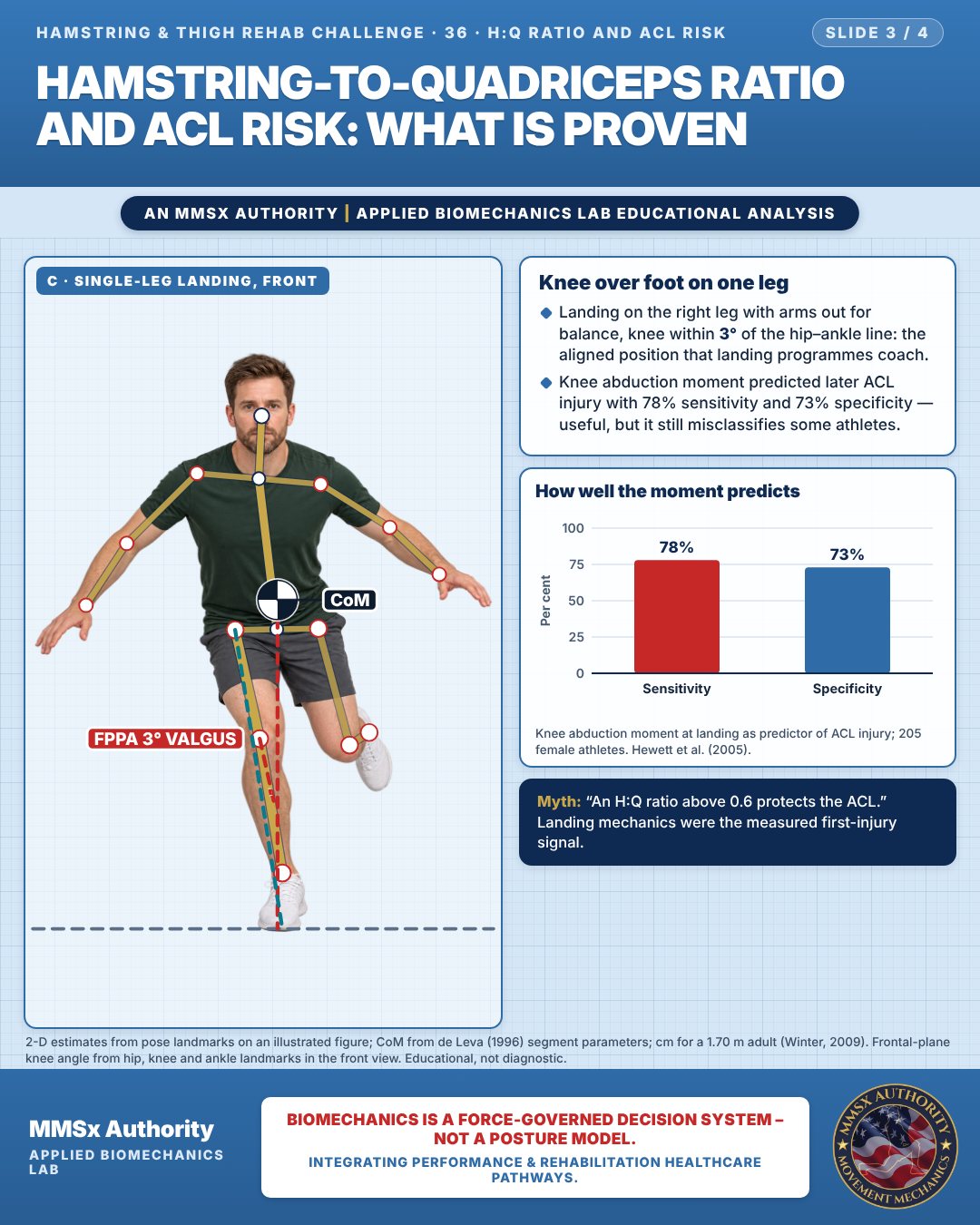
Knee over foot on one leg
Landing on the right leg with arms out for balance, knee within 3° of the hip–ankle line: the aligned position that landing programmes coach.
Knee abduction moment predicted later ACL injury with 78% sensitivity and 73% specificity — useful, but it still misclassifies some athletes.
How well the moment predicts
Decision pathway
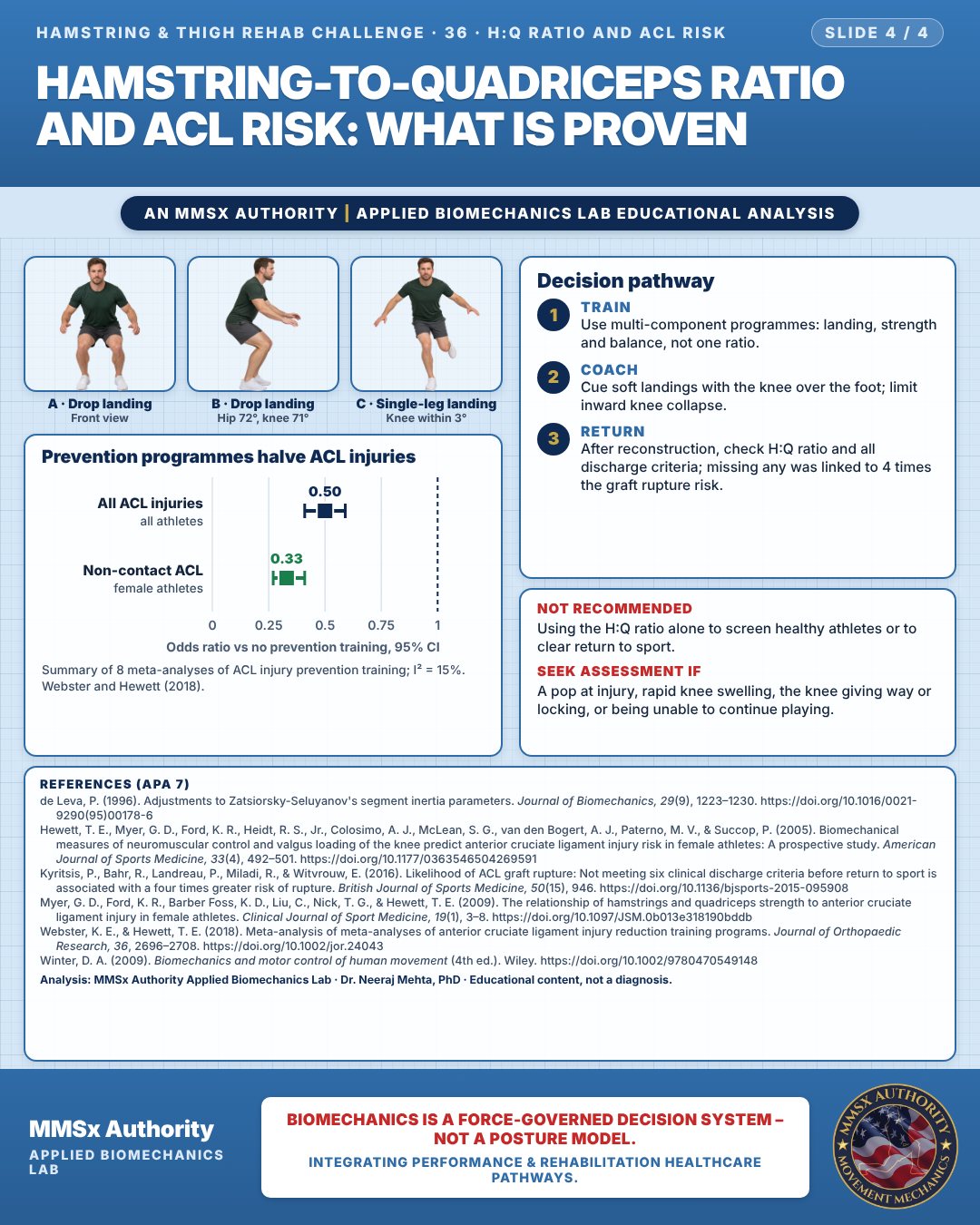
Prevention programmes halve ACL injuries
Train
Use multi-component programmes: landing, strength and balance, not one ratio.
Coach
Cue soft landings with the knee over the foot; limit inward knee collapse.
Return
After reconstruction, check H:Q ratio and all discharge criteria; missing any was linked to 4 times the graft rupture risk.
What the evidence supports
- Implement ACL injury prevention training programmes, which reduce all ACL injuries by about half and non-contact ACL injuries in females by about two-thirds (Webster & Hewett, 2018).
- Coach landing mechanics: limit knee abduction (valgus) and high-impact, stiff landings, the prospective markers of risk (Hewett et al., 2005).
- Include hamstring strengthening, and after ACL reconstruction check the H:Q ratio and all discharge criteria before return to team training (Myer et al., 2009; Kyritsis et al., 2016).
- Do not use the H:Q ratio alone as a screening test for first-time ACL injury in healthy athletes; prospective evidence for it as a stand-alone predictor is limited (Myer et al., 2009, small sample).
Myth and evidence
Myth“If your H:Q ratio is above 0.6 you are protected from ACL injury.”
EvidenceProspectively, the strongest first-injury signals were landing mechanics (knee abduction angle and moment), and the largest proven risk reduction comes from multi-component prevention programmes (Hewett et al., 2005; Webster & Hewett, 2018). The H:Q ratio matters most clearly after reconstruction, as part of a full set of return-to-sport criteria (Kyritsis et al., 2016).
Cautions
Not recommended
Using the H:Q ratio alone to screen healthy athletes or to clear return to sport.
Seek assessment if
A pop at injury, rapid knee swelling, the knee giving way or locking, or being unable to continue playing.
Methods note
2-D estimates from pose landmarks on an illustrated figure; CoM from de Leva (1996) segment parameters; cm for a 1.70 m adult (Winter, 2009). Pelvis line from the two hip landmarks in the front view; knee angles not quoted in this view. Hip and knee angles from pose landmarks in the side view. Frontal-plane knee angle from hip, knee and ankle landmarks in the front view. These are educational estimates, not a diagnosis.
References
- de Leva, P. (1996). Adjustments to Zatsiorsky-Seluyanov's segment inertia parameters. Journal of Biomechanics, 29(9), 1223–1230. https://doi.org/10.1016/0021-9290(95)00178-6
- Hewett, T. E., Myer, G. D., Ford, K. R., Heidt, R. S., Jr., Colosimo, A. J., McLean, S. G., van den Bogert, A. J., Paterno, M. V., & Succop, P. (2005). Biomechanical measures of neuromuscular control and valgus loading of the knee predict anterior cruciate ligament injury risk in female athletes: A prospective study. American Journal of Sports Medicine, 33(4), 492–501. https://doi.org/10.1177/0363546504269591
- Kyritsis, P., Bahr, R., Landreau, P., Miladi, R., & Witvrouw, E. (2016). Likelihood of ACL graft rupture: Not meeting six clinical discharge criteria before return to sport is associated with a four times greater risk of rupture. British Journal of Sports Medicine, 50(15), 946. https://doi.org/10.1136/bjsports-2015-095908
- Myer, G. D., Ford, K. R., Barber Foss, K. D., Liu, C., Nick, T. G., & Hewett, T. E. (2009). The relationship of hamstrings and quadriceps strength to anterior cruciate ligament injury in female athletes. Clinical Journal of Sport Medicine, 19(1), 3–8. https://doi.org/10.1097/JSM.0b013e318190bddb
- Webster, K. E., & Hewett, T. E. (2018). Meta-analysis of meta-analyses of anterior cruciate ligament injury reduction training programs. Journal of Orthopaedic Research, 36, 2696–2708. https://doi.org/10.1002/jor.24043
- Winter, D. A. (2009). Biomechanics and motor control of human movement (4th ed.). Wiley. https://doi.org/10.1002/9780470549148
Cite this article
Mehta, N. (2026, October 26). Hamstring-to-quadriceps ratio and ACL risk: what is proven. MMSx Authority Applied Biomechanics Lab. https://mmsxauthority.org/edu/analysis/hamstring-thigh/36-hamstring-to-quadriceps-ratio-and-acl-risk-what-is-proven/
Part of the collection
Mehta, N. (2026). Hamstring and Thigh Rehabilitation: 50 Evidence-Based Biomechanics Analyses [Collection]. MMSx Authority Applied Biomechanics Lab. Zenodo. https://doi.org/10.5281/zenodo.23735792
All Hamstring & Thigh Rehab Challenge articles · Rehabilitation Library