Hamstring & Thigh Rehab Challenge · 35
Thigh muscle imbalance: what the hamstring-to-quadriceps ratio means
The hamstring-to-quadriceps (H:Q) ratio compares knee flexor with knee extensor strength, usually on an isokinetic dynamometer.
Key points
- Profile. Test conventional and functional ratios at more than one speed, alongside injury history and age.
- Train. Target a clear deficit with eccentric hamstring and quadriceps work.
- Retest. Confirm the imbalance is corrected; never clear or bar an athlete on one ratio.
What it is
The hamstring-to-quadriceps (H:Q) ratio compares knee flexor with knee extensor strength, usually on an isokinetic dynamometer. The conventional ratio divides concentric hamstring by concentric quadriceps torque; the functional ratio divides eccentric hamstring torque by concentric quadriceps torque, mirroring the hamstrings braking knee extension (Aagaard et al., 1998). It is a description of strength balance at a given speed and joint angle, not a diagnosis.
How we analysed the movement
Three movements relevant to this topic were analysed from illustrated reference figures. Joint centres were located with two-dimensional pose estimation; hip and knee angles, pelvis level, the whole-body centre of mass and, where relevant, the hip lever (the horizontal distance from the hip joint to the upper-body centre of mass) and the resulting static hip moment were then calculated from standard segment parameters. The figures are educational estimates that show how position changes mechanical demand; they are not measurements of a patient. Every research value quoted below comes from the published source cited beside it.
Movement A: Seated leg curl (side view)
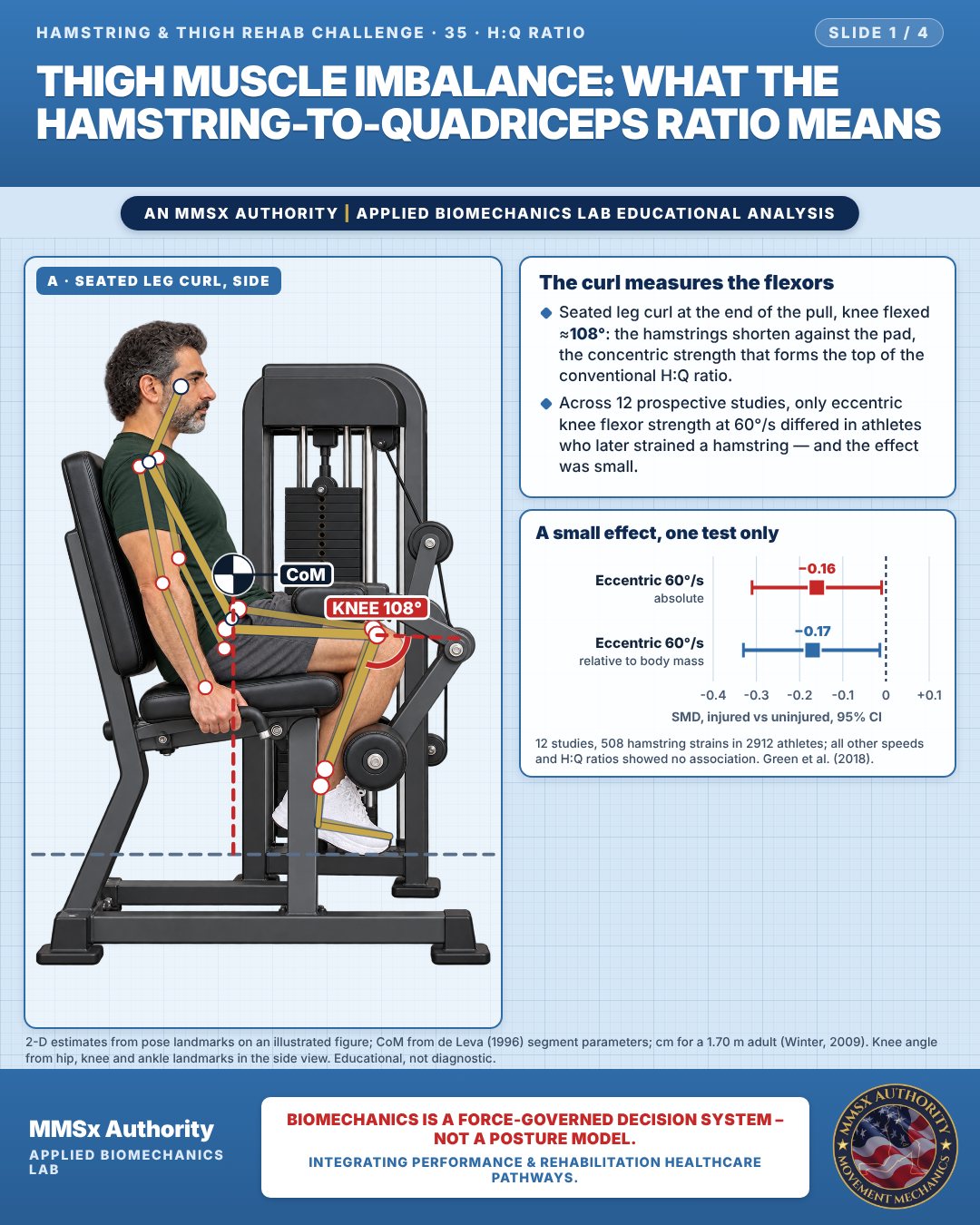
The curl measures the flexors
Seated leg curl at the end of the pull, knee flexed ≈108°: the hamstrings shorten against the pad, the concentric strength that forms the top of the conventional H:Q ratio.
Across 12 prospective studies, only eccentric knee flexor strength at 60°/s differed in athletes who later strained a hamstring — and the effect was small.
A small effect, one test only
Movement B: Leg extension (side view)
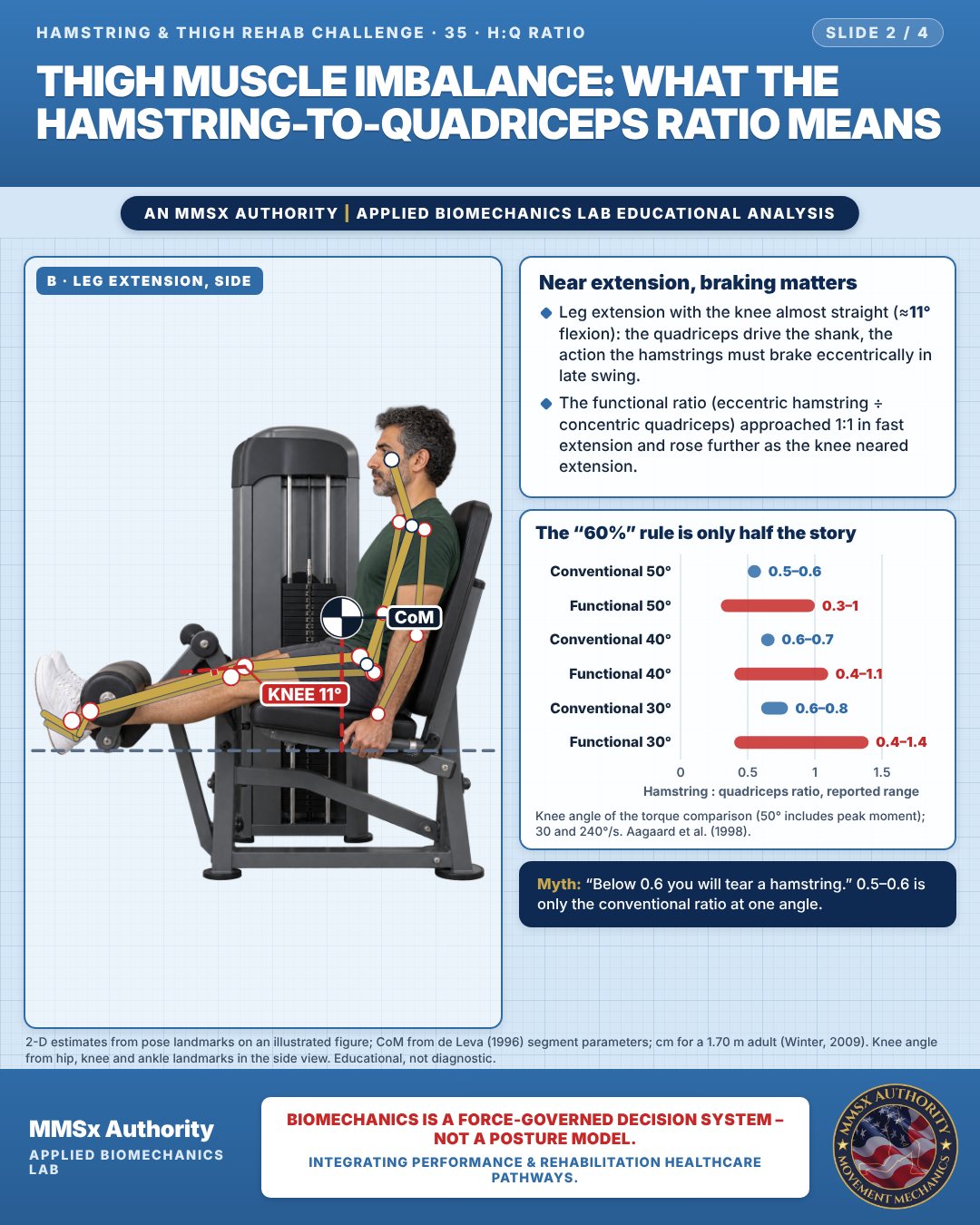
Near extension, braking matters
Leg extension with the knee almost straight (≈11° flexion): the quadriceps drive the shank, the action the hamstrings must brake eccentrically in late swing.
The functional ratio (eccentric hamstring ÷ concentric quadriceps) approached 1:1 in fast extension and rose further as the knee neared extension.
The “60%” rule is only half the story
Movement C: Split squat (side view)
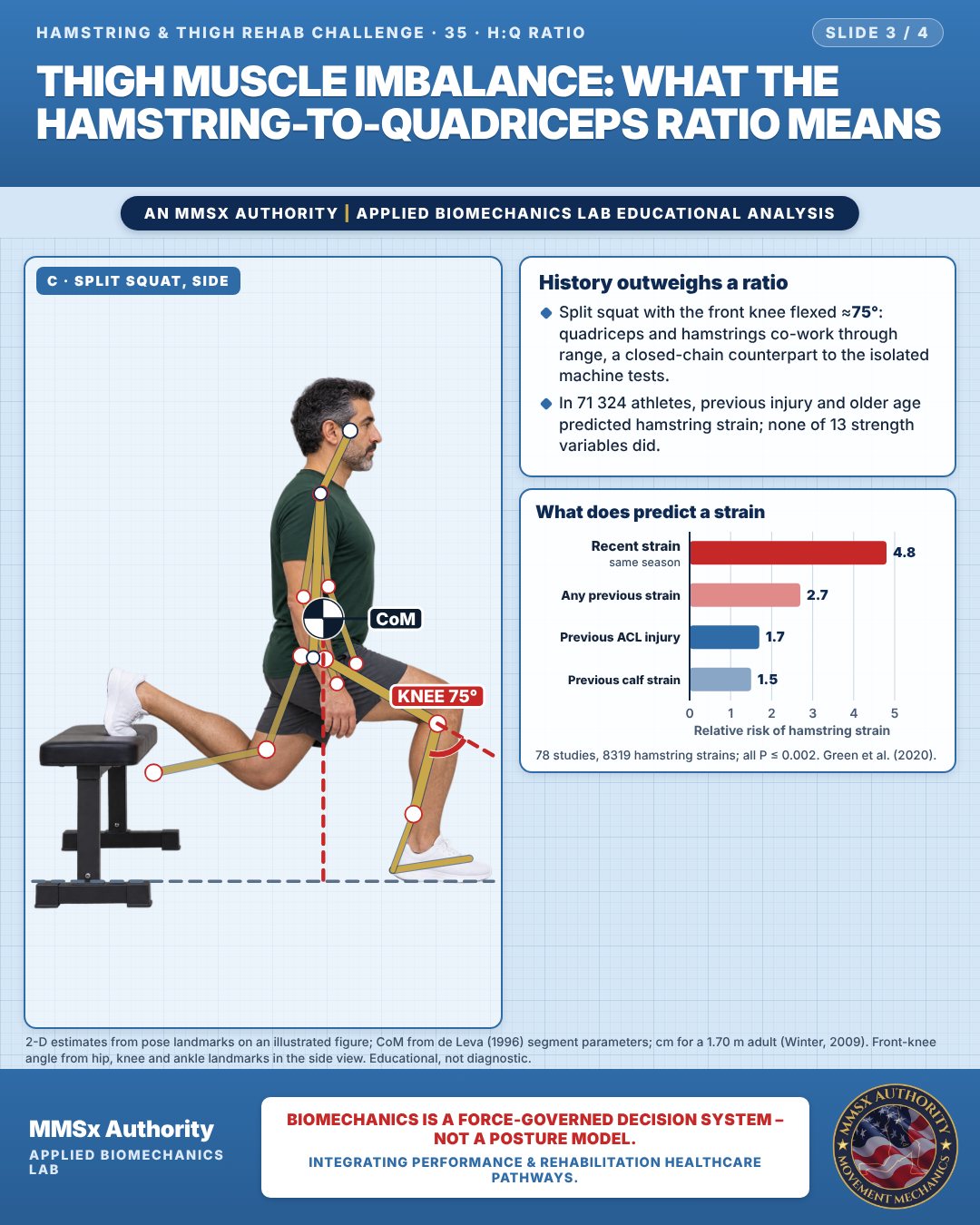
History outweighs a ratio
Split squat with the front knee flexed ≈75°: quadriceps and hamstrings co-work through range, a closed-chain counterpart to the isolated machine tests.
In 71 324 athletes, previous injury and older age predicted hamstring strain; none of 13 strength variables did.
What does predict a strain
Decision pathway
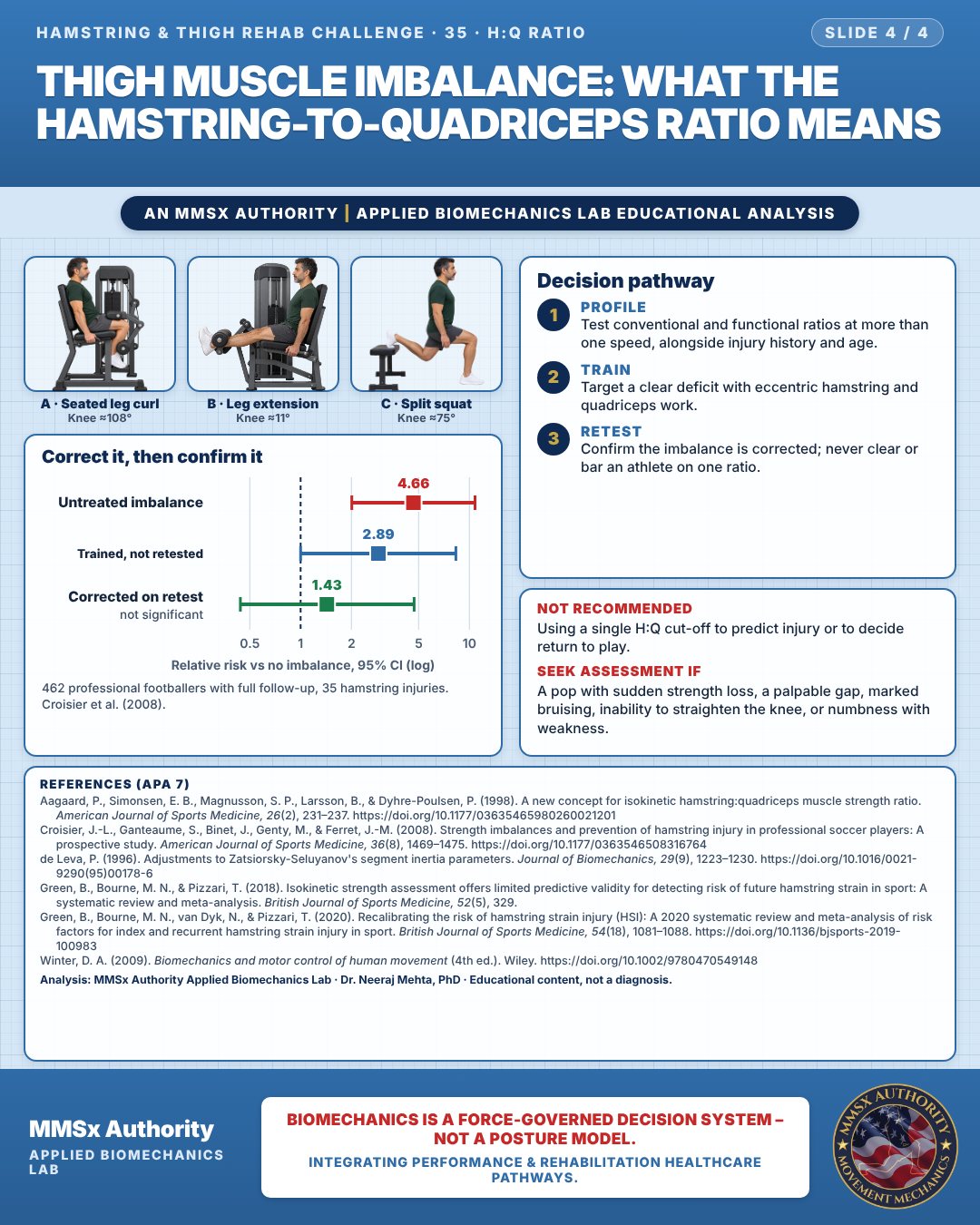
Correct it, then confirm it
Profile
Test conventional and functional ratios at more than one speed, alongside injury history and age.
Train
Target a clear deficit with eccentric hamstring and quadriceps work.
Retest
Confirm the imbalance is corrected; never clear or bar an athlete on one ratio.
What the evidence supports
- Test both the conventional and the functional ratio, at more than one speed and angle, and interpret them with injury history; the functional ratio better reflects the hamstrings' braking role (Aagaard et al., 1998).
- Do not use the H:Q ratio alone to predict or clear an athlete; pooled data show little predictive value for isokinetic ratios, while previous injury and age are stronger risk factors (Green et al., 2018, 2020).
Myth and evidence
Myth“A hamstring-to-quadriceps ratio under 0.6 means you will tear your hamstring.”
EvidenceThe 0.5–0.6 figure is only the conventional ratio at one angle; the functional ratio reaches about 1:1 in fast extension (Aagaard et al., 1998), and meta-analyses show that strength ratios add little to prediction (Green et al., 2018, 2020).
Cautions
Not recommended
Using a single H:Q cut-off to predict injury or to decide return to play.
Seek assessment if
A pop with sudden strength loss, a palpable gap, marked bruising, inability to straighten the knee, or numbness with weakness.
Methods note
2-D estimates from pose landmarks on an illustrated figure; CoM from de Leva (1996) segment parameters; cm for a 1.70 m adult (Winter, 2009). Knee angle from hip, knee and ankle landmarks in the side view. Front-knee angle from hip, knee and ankle landmarks in the side view. These are educational estimates, not a diagnosis.
References
- Aagaard, P., Simonsen, E. B., Magnusson, S. P., Larsson, B., & Dyhre-Poulsen, P. (1998). A new concept for isokinetic hamstring:quadriceps muscle strength ratio. American Journal of Sports Medicine, 26(2), 231–237. https://doi.org/10.1177/03635465980260021201
- Croisier, J.-L., Ganteaume, S., Binet, J., Genty, M., & Ferret, J.-M. (2008). Strength imbalances and prevention of hamstring injury in professional soccer players: A prospective study. American Journal of Sports Medicine, 36(8), 1469–1475. https://doi.org/10.1177/0363546508316764
- de Leva, P. (1996). Adjustments to Zatsiorsky-Seluyanov's segment inertia parameters. Journal of Biomechanics, 29(9), 1223–1230. https://doi.org/10.1016/0021-9290(95)00178-6
- Green, B., Bourne, M. N., & Pizzari, T. (2018). Isokinetic strength assessment offers limited predictive validity for detecting risk of future hamstring strain in sport: A systematic review and meta-analysis. British Journal of Sports Medicine, 52(5), 329.
- Green, B., Bourne, M. N., van Dyk, N., & Pizzari, T. (2020). Recalibrating the risk of hamstring strain injury (HSI): A 2020 systematic review and meta-analysis of risk factors for index and recurrent hamstring strain injury in sport. British Journal of Sports Medicine, 54(18), 1081–1088. https://doi.org/10.1136/bjsports-2019-100983
- Winter, D. A. (2009). Biomechanics and motor control of human movement (4th ed.). Wiley. https://doi.org/10.1002/9780470549148
Cite this article
Mehta, N. (2026, October 26). Thigh muscle imbalance: what the hamstring-to-quadriceps ratio means. MMSx Authority Applied Biomechanics Lab. https://mmsxauthority.org/edu/analysis/hamstring-thigh/35-thigh-muscle-imbalance-what-the-hamstring-to-quadriceps-ratio-means/
Part of the collection
Mehta, N. (2026). Hamstring and Thigh Rehabilitation: 50 Evidence-Based Biomechanics Analyses [Collection]. MMSx Authority Applied Biomechanics Lab. Zenodo. https://doi.org/10.5281/zenodo.23735792
All Hamstring & Thigh Rehab Challenge articles · Rehabilitation Library