Hamstring & Thigh Rehab Challenge · 34
Meralgia paraesthetica: burning outer-thigh pain from a nerve
Meralgia paraesthetica (MP) is a mononeuropathy of the lateral femoral cutaneous nerve (LFCN), usually from entrapment where the nerve passes under…
Key points
- Unload. Loosen belts and waistbands, manage weight and avoid prolonged pressure at the front of the hip.
- Confirm. Check that strength and reflexes are normal; ultrasound or nerve tests if the picture is unclear.
- Escalate. Injection may give short-term relief; surgery is for persistent, disabling cases.
What it is
Meralgia paraesthetica (MP) is a mononeuropathy of the lateral femoral cutaneous nerve (LFCN), usually from entrapment where the nerve passes under or through the inguinal ligament. Typical symptoms are burning or stabbing pain and numbness on the front-outer (ventrolateral) thigh; the LFCN is purely sensory, so there is no motor weakness (Scholz et al., 2023).
How we analysed the movement
Three movements relevant to this topic were analysed from illustrated reference figures. Joint centres were located with two-dimensional pose estimation; hip and knee angles, pelvis level, the whole-body centre of mass and, where relevant, the hip lever (the horizontal distance from the hip joint to the upper-body centre of mass) and the resulting static hip moment were then calculated from standard segment parameters. The figures are educational estimates that show how position changes mechanical demand; they are not measurements of a patient. Every research value quoted below comes from the published source cited beside it.
Movement A: Belt at the hips (front view)
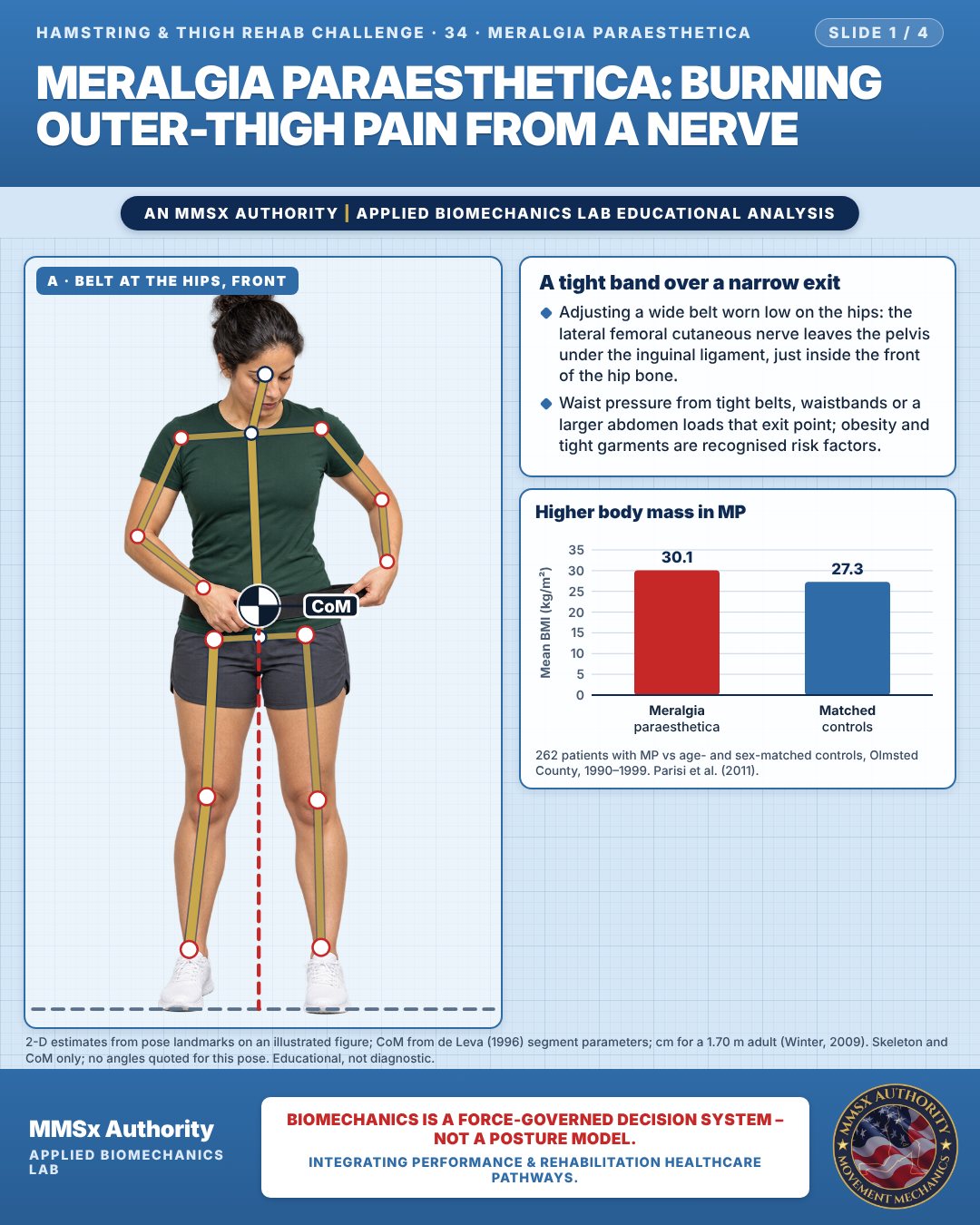
A tight band over a narrow exit
Adjusting a wide belt worn low on the hips: the lateral femoral cutaneous nerve leaves the pelvis under the inguinal ligament, just inside the front of the hip bone.
Waist pressure from tight belts, waistbands or a larger abdomen loads that exit point; obesity and tight garments are recognised risk factors.
Higher body mass in MP
Movement B: Seated lean (side view)
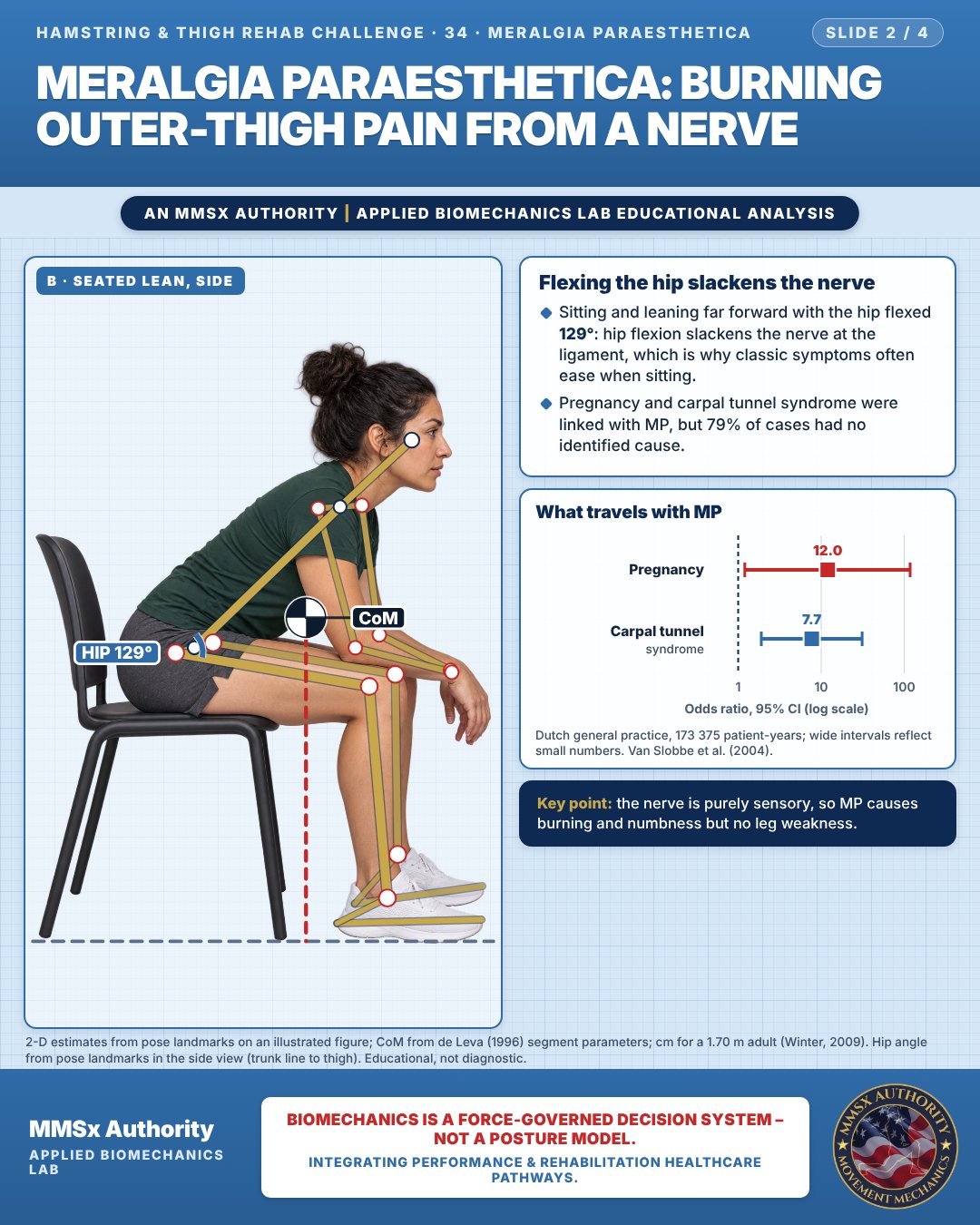
Flexing the hip slackens the nerve
Sitting and leaning far forward with the hip flexed 129°: hip flexion slackens the nerve at the ligament, which is why classic symptoms often ease when sitting.
Pregnancy and carpal tunnel syndrome were linked with MP, but 79% of cases had no identified cause.
What travels with MP
Movement C: Rubbing outer thigh (front view)
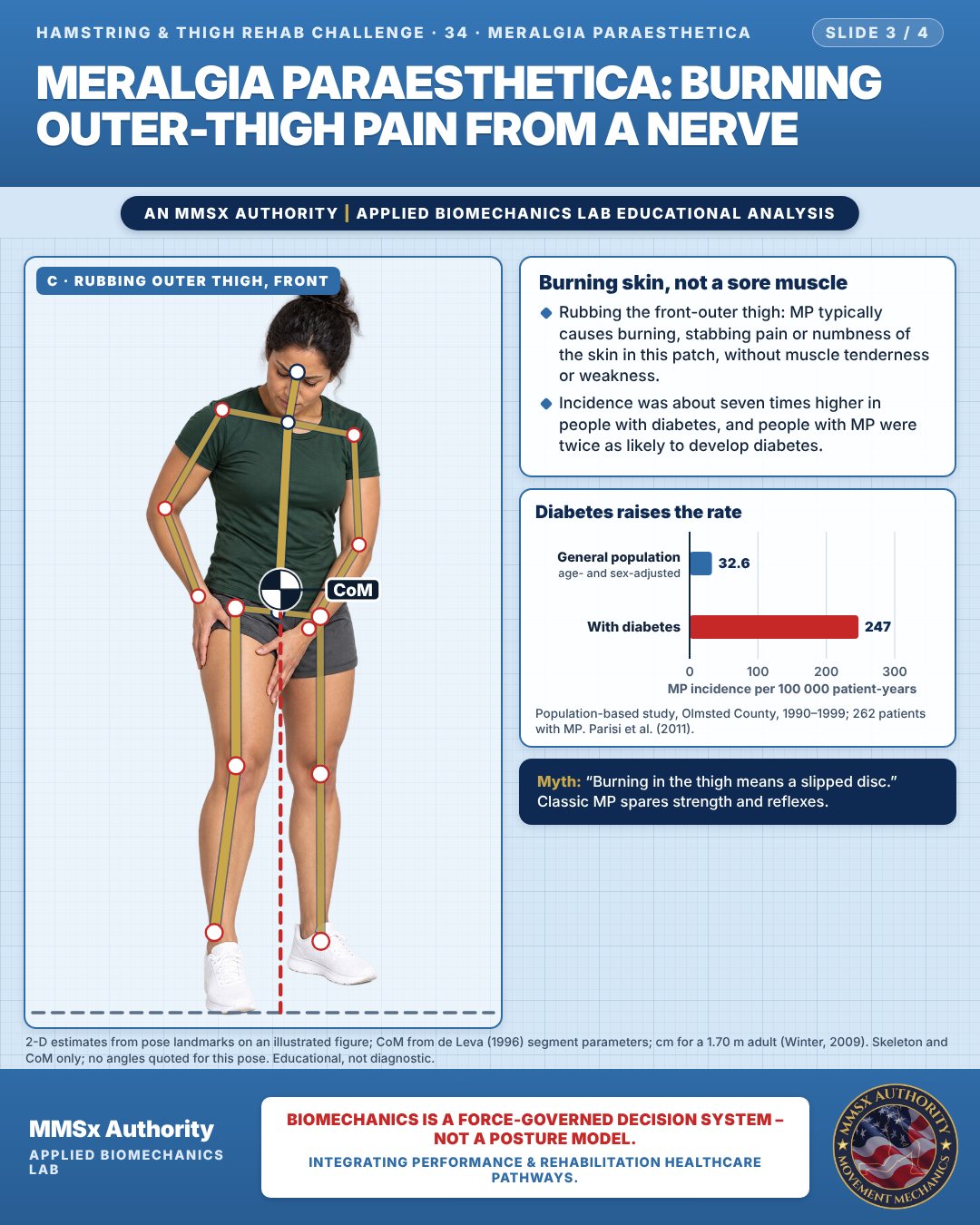
Burning skin, not a sore muscle
Rubbing the front-outer thigh: MP typically causes burning, stabbing pain or numbness of the skin in this patch, without muscle tenderness or weakness.
Incidence was about seven times higher in people with diabetes, and people with MP were twice as likely to develop diabetes.
Diabetes raises the rate
Decision pathway
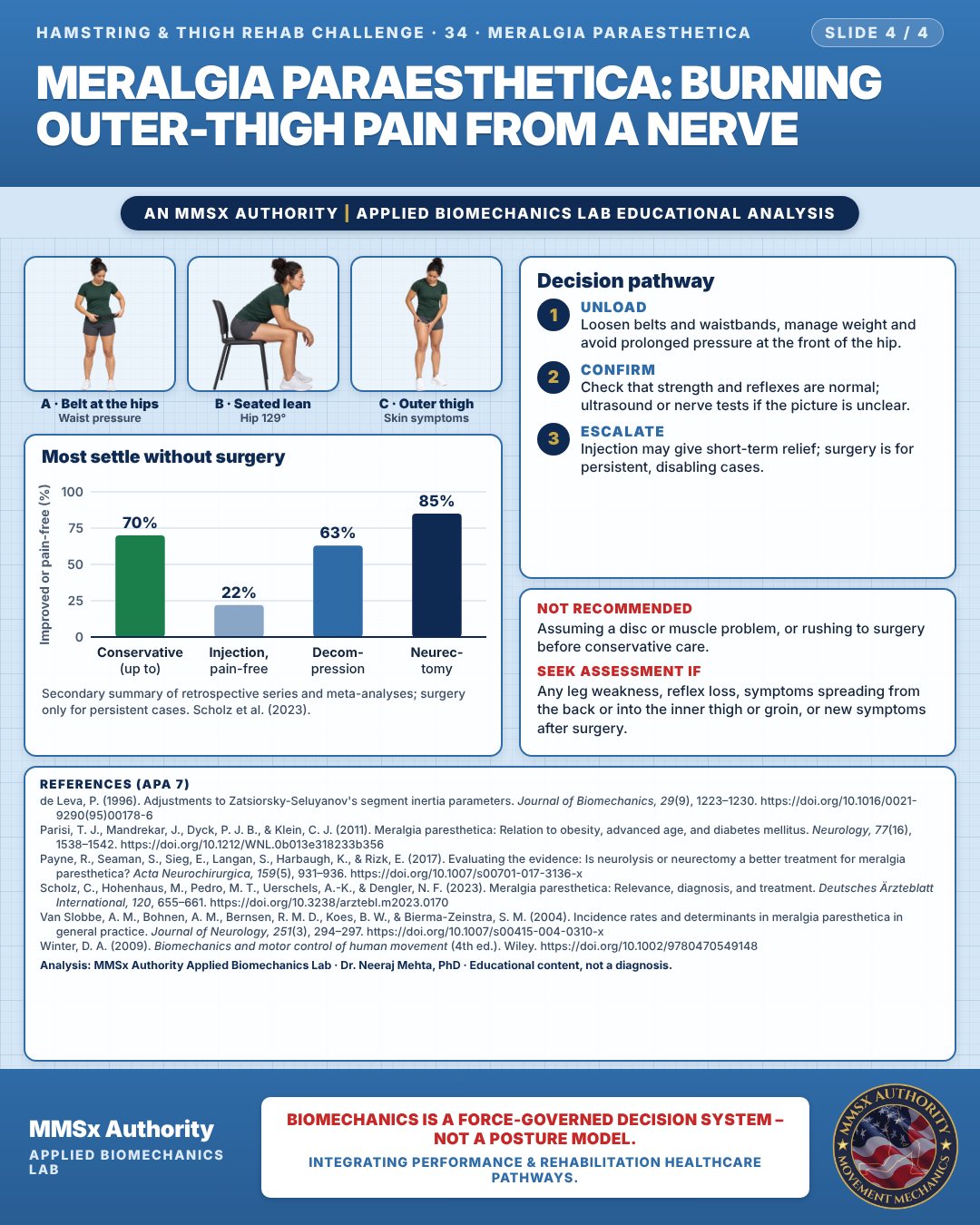
Most settle without surgery
Unload
Loosen belts and waistbands, manage weight and avoid prolonged pressure at the front of the hip.
Confirm
Check that strength and reflexes are normal; ultrasound or nerve tests if the picture is unclear.
Escalate
Injection may give short-term relief; surgery is for persistent, disabling cases.
What the evidence supports
- Conservative first: avoid tight clothing and constrictive belts around the waist, manage weight, and allow time; symptoms improve with conservative treatment in up to 70% (Scholz et al., 2023).
- Ultrasound can show enlargement of the nerve's cross-sectional area (some authors use >5 mm² as pathological); nerve conduction studies are technically difficult and not always conclusive (Scholz et al., 2023).
- Diagnostic or therapeutic infiltration can give short-term relief; surgery (decompression or neurectomy) is reserved for persistent cases, and there is insufficient evidence to favour one technique (Payne et al., 2017; Scholz et al., 2023).
Myth and evidence
Myth“Burning in the thigh means a slipped disc or a muscle problem.”
EvidenceClassic MP affects the skin of the front-outer thigh without weakness, is linked to tight waistbands, obesity, diabetes and pregnancy, and typically eases when sitting or flexing the hip, which slackens the nerve (Scholz et al., 2023; Parisi et al., 2011; Van Slobbe et al., 2004).
Cautions
Not recommended
Assuming a disc or muscle problem, or rushing to surgery before conservative care.
Seek assessment if
Any leg weakness, reflex loss, symptoms spreading from the back or into the inner thigh or groin, or new symptoms after surgery.
Methods note
2-D estimates from pose landmarks on an illustrated figure; CoM from de Leva (1996) segment parameters; cm for a 1.70 m adult (Winter, 2009). Skeleton and CoM only; no angles quoted for this pose. Hip angle from pose landmarks in the side view (trunk line to thigh). These are educational estimates, not a diagnosis.
References
- de Leva, P. (1996). Adjustments to Zatsiorsky-Seluyanov's segment inertia parameters. Journal of Biomechanics, 29(9), 1223–1230. https://doi.org/10.1016/0021-9290(95)00178-6
- Parisi, T. J., Mandrekar, J., Dyck, P. J. B., & Klein, C. J. (2011). Meralgia paresthetica: Relation to obesity, advanced age, and diabetes mellitus. Neurology, 77(16), 1538–1542. https://doi.org/10.1212/WNL.0b013e318233b356
- Payne, R., Seaman, S., Sieg, E., Langan, S., Harbaugh, K., & Rizk, E. (2017). Evaluating the evidence: Is neurolysis or neurectomy a better treatment for meralgia paresthetica? Acta Neurochirurgica, 159(5), 931–936. https://doi.org/10.1007/s00701-017-3136-x
- Scholz, C., Hohenhaus, M., Pedro, M. T., Uerschels, A.-K., & Dengler, N. F. (2023). Meralgia paresthetica: Relevance, diagnosis, and treatment. Deutsches Ärzteblatt International, 120, 655–661. https://doi.org/10.3238/arztebl.m2023.0170
- Van Slobbe, A. M., Bohnen, A. M., Bernsen, R. M. D., Koes, B. W., & Bierma-Zeinstra, S. M. (2004). Incidence rates and determinants in meralgia paresthetica in general practice. Journal of Neurology, 251(3), 294–297. https://doi.org/10.1007/s00415-004-0310-x
- Winter, D. A. (2009). Biomechanics and motor control of human movement (4th ed.). Wiley. https://doi.org/10.1002/9780470549148
Cite this article
Mehta, N. (2026, October 26). Meralgia paraesthetica: burning outer-thigh pain from a nerve. MMSx Authority Applied Biomechanics Lab. https://mmsxauthority.org/edu/analysis/hamstring-thigh/34-meralgia-paraesthetica-burning-outer-thigh-pain-from-a-nerve/
Part of the collection
Mehta, N. (2026). Hamstring and Thigh Rehabilitation: 50 Evidence-Based Biomechanics Analyses [Collection]. MMSx Authority Applied Biomechanics Lab. Zenodo. https://doi.org/10.5281/zenodo.23735792
All Hamstring & Thigh Rehab Challenge articles · Rehabilitation Library