Hamstring & Thigh Rehab Challenge · 33
Outer thigh pain: gluteal tendon, IT band or referred pain?
Greater trochanteric pain syndrome (GTPS) is pain and tenderness over the lateral hip at the greater trochanter, most often associated with gluteus…
Key points
- Locate. Palpate the trochanter and time single-leg stance; screen the lumbar spine and the knee.
- Offload. Limit crossing the legs, hanging on one hip and side-lying with the top knee dropped.
- Load. Progress hip abductor strength with education; injection eases pain only in the short term.
What it is
Greater trochanteric pain syndrome (GTPS) is pain and tenderness over the lateral hip at the greater trochanter, most often associated with gluteus medius and minimus tendinopathy (gluteal tendinopathy), with or without bursal changes. Outer-thigh pain can also arise from the iliotibial band region or be referred from the lumbar spine or the hip and knee joints, so the label is a clinical one.
How we analysed the movement
Three movements relevant to this topic were analysed from illustrated reference figures. Joint centres were located with two-dimensional pose estimation; hip and knee angles, pelvis level, the whole-body centre of mass and, where relevant, the hip lever (the horizontal distance from the hip joint to the upper-body centre of mass) and the resulting static hip moment were then calculated from standard segment parameters. The figures are educational estimates that show how position changes mechanical demand; they are not measurements of a patient. Every research value quoted below comes from the published source cited beside it.
Movement A: Single-leg stance (front view)
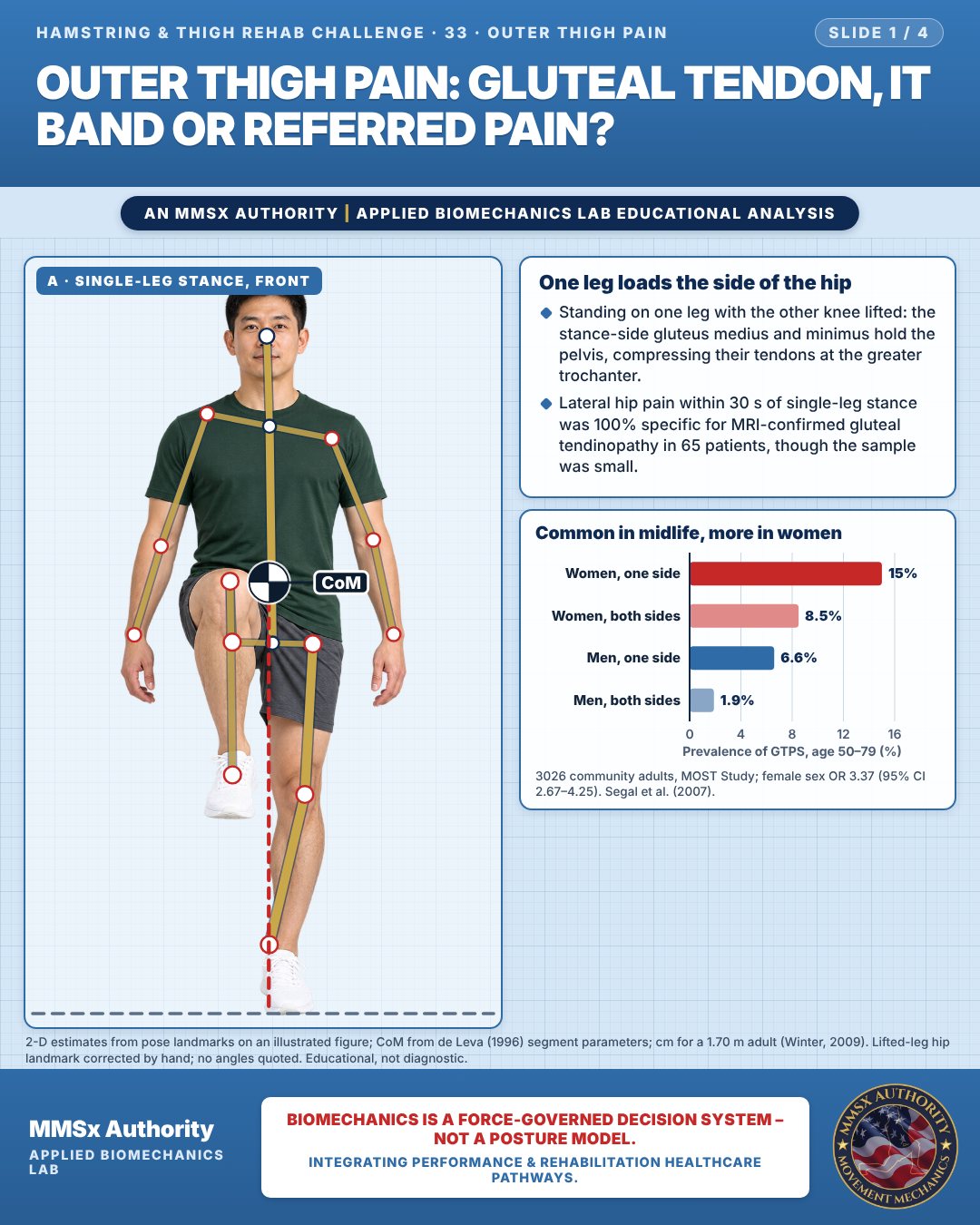
One leg loads the side of the hip
Standing on one leg with the other knee lifted: the stance-side gluteus medius and minimus hold the pelvis, compressing their tendons at the greater trochanter.
Lateral hip pain within 30 s of single-leg stance was 100% specific for MRI-confirmed gluteal tendinopathy in 65 patients, though the sample was small.
Common in midlife, more in women
Movement B: Legs crossed (front view)
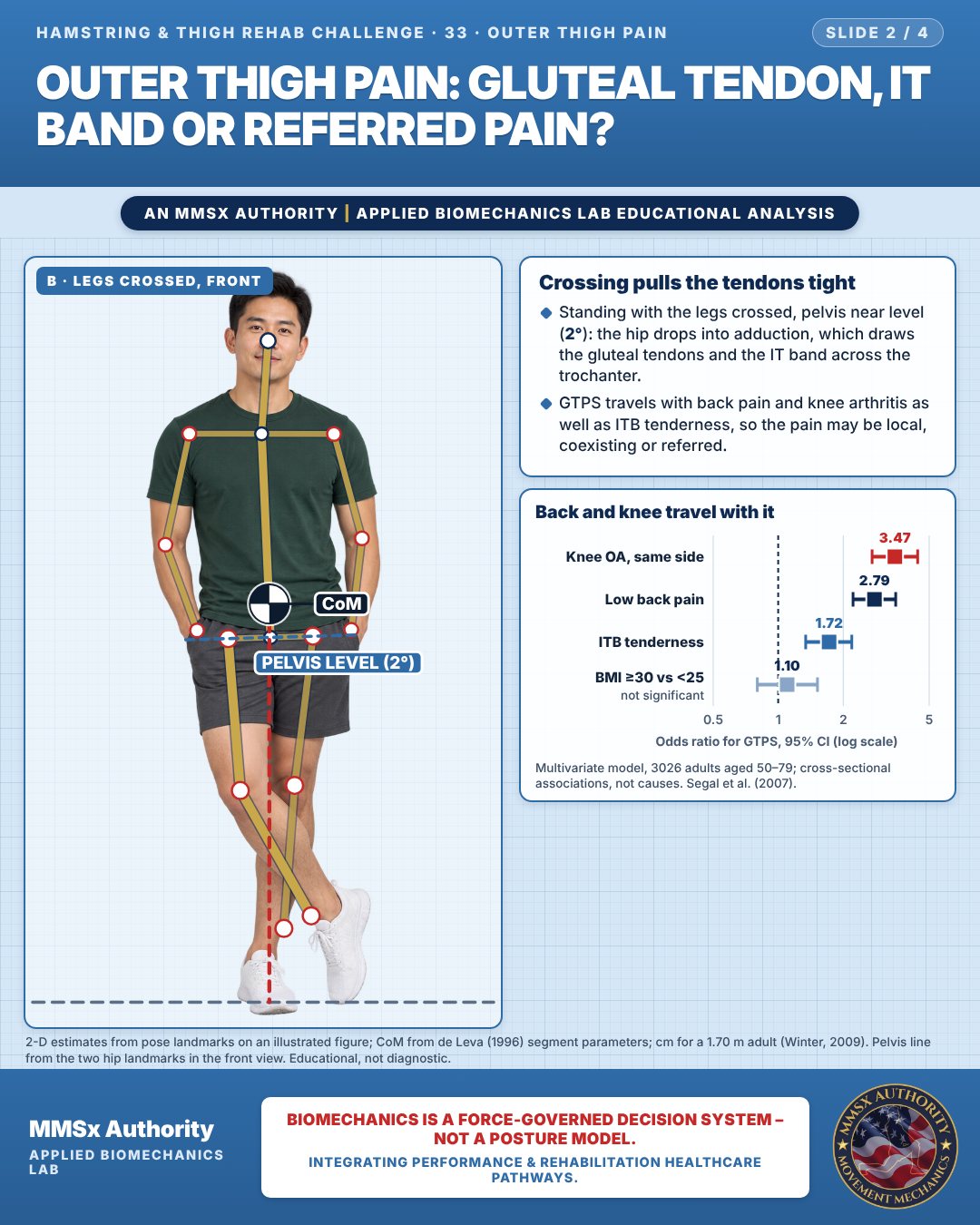
Crossing pulls the tendons tight
Standing with the legs crossed, pelvis near level (2°): the hip drops into adduction, which draws the gluteal tendons and the IT band across the trochanter.
GTPS travels with back pain and knee arthritis as well as ITB tenderness, so the pain may be local, coexisting or referred.
Back and knee travel with it
Movement C: Side-lying (front view)
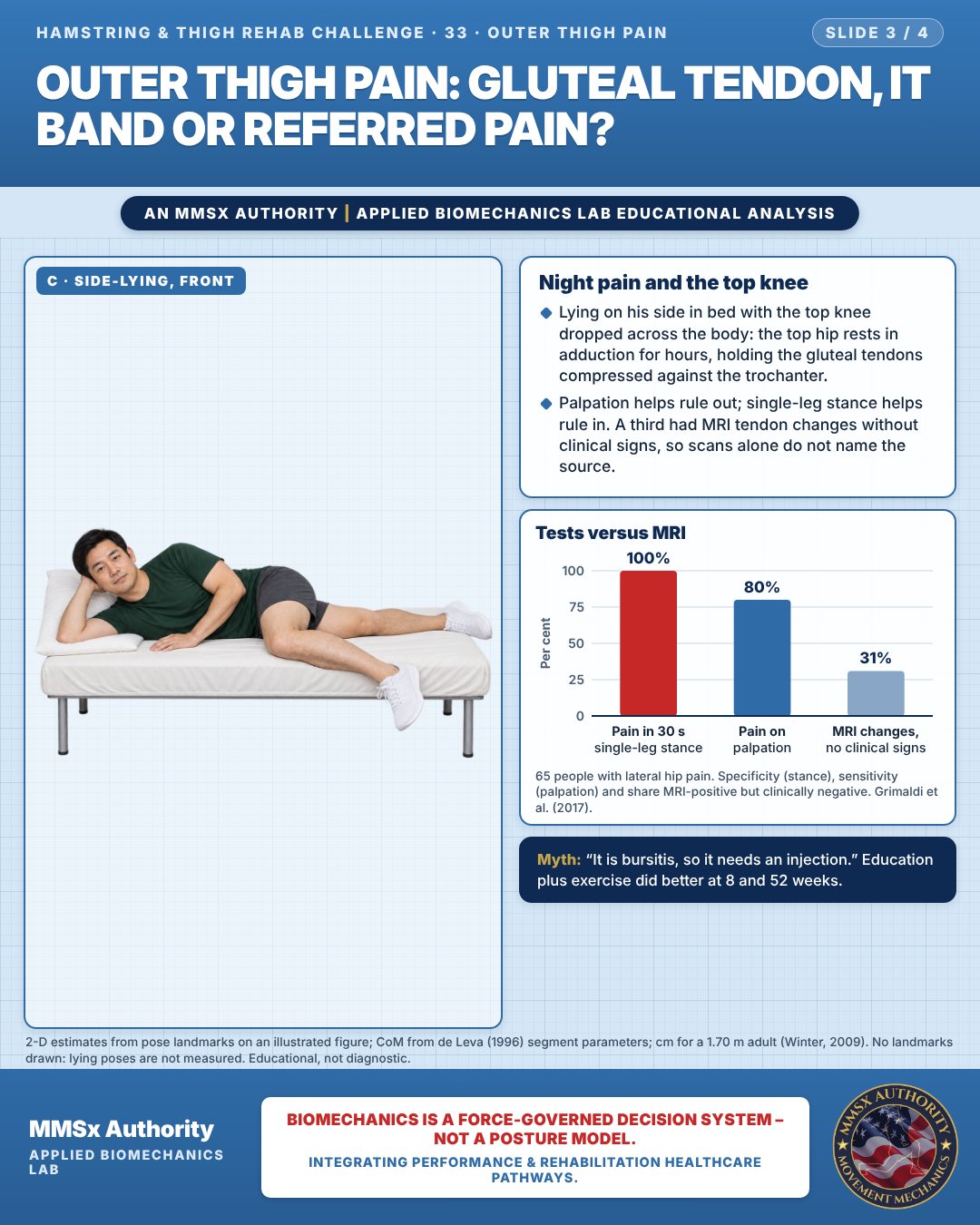
Night pain and the top knee
Lying on his side in bed with the top knee dropped across the body: the top hip rests in adduction for hours, holding the gluteal tendons compressed against the trochanter.
Palpation helps rule out; single-leg stance helps rule in. A third had MRI tendon changes without clinical signs, so scans alone do not name the source.
Tests versus MRI
Decision pathway
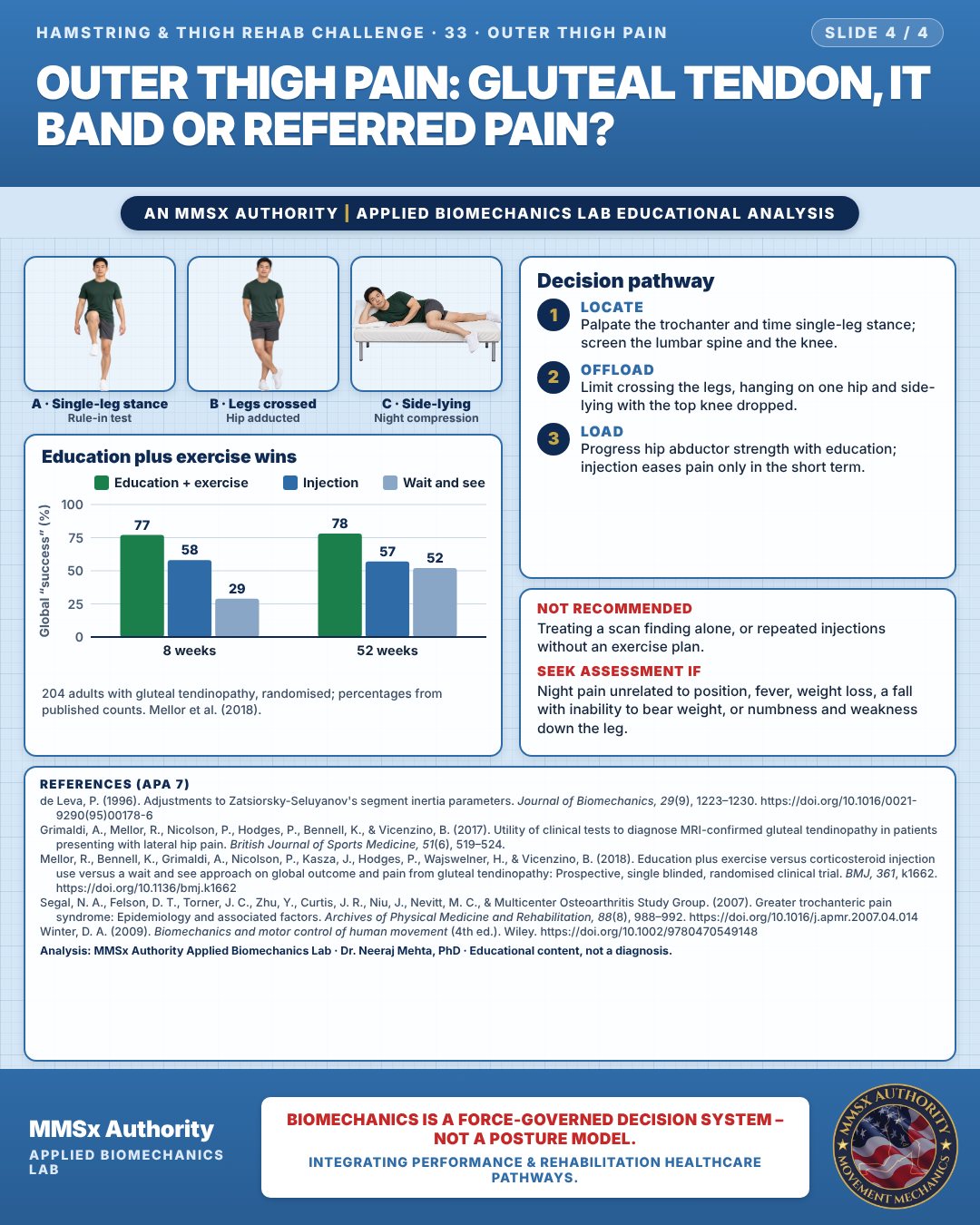
Education plus exercise wins
Locate
Palpate the trochanter and time single-leg stance; screen the lumbar spine and the knee.
Offload
Limit crossing the legs, hanging on one hip and side-lying with the top knee dropped.
Load
Progress hip abductor strength with education; injection eases pain only in the short term.
What the evidence supports
- Education (about the condition and managing tendon load) plus a progressive exercise programme produced better global outcomes than corticosteroid injection or wait and see at 8 and 52 weeks (Mellor et al., 2018).
- Corticosteroid injection gives short-term relief, but at 52 weeks it was no better than education plus exercise for pain and was worse on global improvement (Mellor et al., 2018).
- Use the clinical examination (palpation, 30-second single-leg stance) rather than imaging alone to identify gluteal tendinopathy; MRI changes are common without clinical signs (Grimaldi et al., 2017).
- Screen the lumbar spine and the knee, given their strong association with GTPS (Segal et al., 2007).
Myth and evidence
Myth“It is bursitis, so it needs an injection.”
EvidenceLateral hip pain is usually linked to gluteal tendinopathy, and in a randomised trial education plus exercise outperformed injection at both 8 and 52 weeks (Mellor et al., 2018). It is also not simply "a tight IT band": ITB tenderness was only one of several associated factors (Segal et al., 2007).
Cautions
Not recommended
Treating a scan finding alone, or repeated injections without an exercise plan.
Seek assessment if
Night pain unrelated to position, fever, weight loss, a fall with inability to bear weight, or numbness and weakness down the leg.
Methods note
2-D estimates from pose landmarks on an illustrated figure; CoM from de Leva (1996) segment parameters; cm for a 1.70 m adult (Winter, 2009). Lifted-leg hip landmark corrected by hand; no angles quoted. Pelvis line from the two hip landmarks in the front view. No landmarks drawn: lying poses are not measured. These are educational estimates, not a diagnosis.
References
- de Leva, P. (1996). Adjustments to Zatsiorsky-Seluyanov's segment inertia parameters. Journal of Biomechanics, 29(9), 1223–1230. https://doi.org/10.1016/0021-9290(95)00178-6
- Grimaldi, A., Mellor, R., Nicolson, P., Hodges, P., Bennell, K., & Vicenzino, B. (2017). Utility of clinical tests to diagnose MRI-confirmed gluteal tendinopathy in patients presenting with lateral hip pain. British Journal of Sports Medicine, 51(6), 519–524.
- Mellor, R., Bennell, K., Grimaldi, A., Nicolson, P., Kasza, J., Hodges, P., Wajswelner, H., & Vicenzino, B. (2018). Education plus exercise versus corticosteroid injection use versus a wait and see approach on global outcome and pain from gluteal tendinopathy: Prospective, single blinded, randomised clinical trial. BMJ, 361, k1662. https://doi.org/10.1136/bmj.k1662
- Segal, N. A., Felson, D. T., Torner, J. C., Zhu, Y., Curtis, J. R., Niu, J., Nevitt, M. C., & Multicenter Osteoarthritis Study Group. (2007). Greater trochanteric pain syndrome: Epidemiology and associated factors. Archives of Physical Medicine and Rehabilitation, 88(8), 988–992. https://doi.org/10.1016/j.apmr.2007.04.014
- Winter, D. A. (2009). Biomechanics and motor control of human movement (4th ed.). Wiley. https://doi.org/10.1002/9780470549148
Cite this article
Mehta, N. (2026, October 26). Outer thigh pain: gluteal tendon, IT band or referred pain? MMSx Authority Applied Biomechanics Lab. https://mmsxauthority.org/edu/analysis/hamstring-thigh/33-outer-thigh-pain-gluteal-tendon-it-band-or-referred-pain/
Part of the collection
Mehta, N. (2026). Hamstring and Thigh Rehabilitation: 50 Evidence-Based Biomechanics Analyses [Collection]. MMSx Authority Applied Biomechanics Lab. Zenodo. https://doi.org/10.5281/zenodo.23735792
All Hamstring & Thigh Rehab Challenge articles · Rehabilitation Library