Hamstring & Thigh Rehab Challenge · 32
IT band pain: why stretching the band rarely fixes it
Iliotibial band syndrome (ITBS) is an overuse condition causing lateral knee pain in runners and cyclists, felt over the lateral femoral epicondyle.
Key points
- Calm. Reduce the running volume and downhill work that provoke outer-knee pain, without stopping all activity.
- Strengthen. Progress hip abductor work such as side planks and single-leg control.
- Retrain. Review gait: greater hip adduction and knee internal rotation are linked with ITBS.
What it is
Iliotibial band syndrome (ITBS) is an overuse condition causing lateral knee pain in runners and cyclists, felt over the lateral femoral epicondyle. Anatomical work suggests the band is anchored to the distal femur by fibrous strands and does not roll over the epicondyle; symptoms may relate to compression of a richly innervated fat layer beneath the band, around 30° of knee flexion, rather than friction (Fairclough et al., 2006).
How we analysed the movement
Three movements relevant to this topic were analysed from illustrated reference figures. Joint centres were located with two-dimensional pose estimation; hip and knee angles, pelvis level, the whole-body centre of mass and, where relevant, the hip lever (the horizontal distance from the hip joint to the upper-body centre of mass) and the resulting static hip moment were then calculated from standard segment parameters. The figures are educational estimates that show how position changes mechanical demand; they are not measurements of a patient. Every research value quoted below comes from the published source cited beside it.
Movement A: Running (front view)
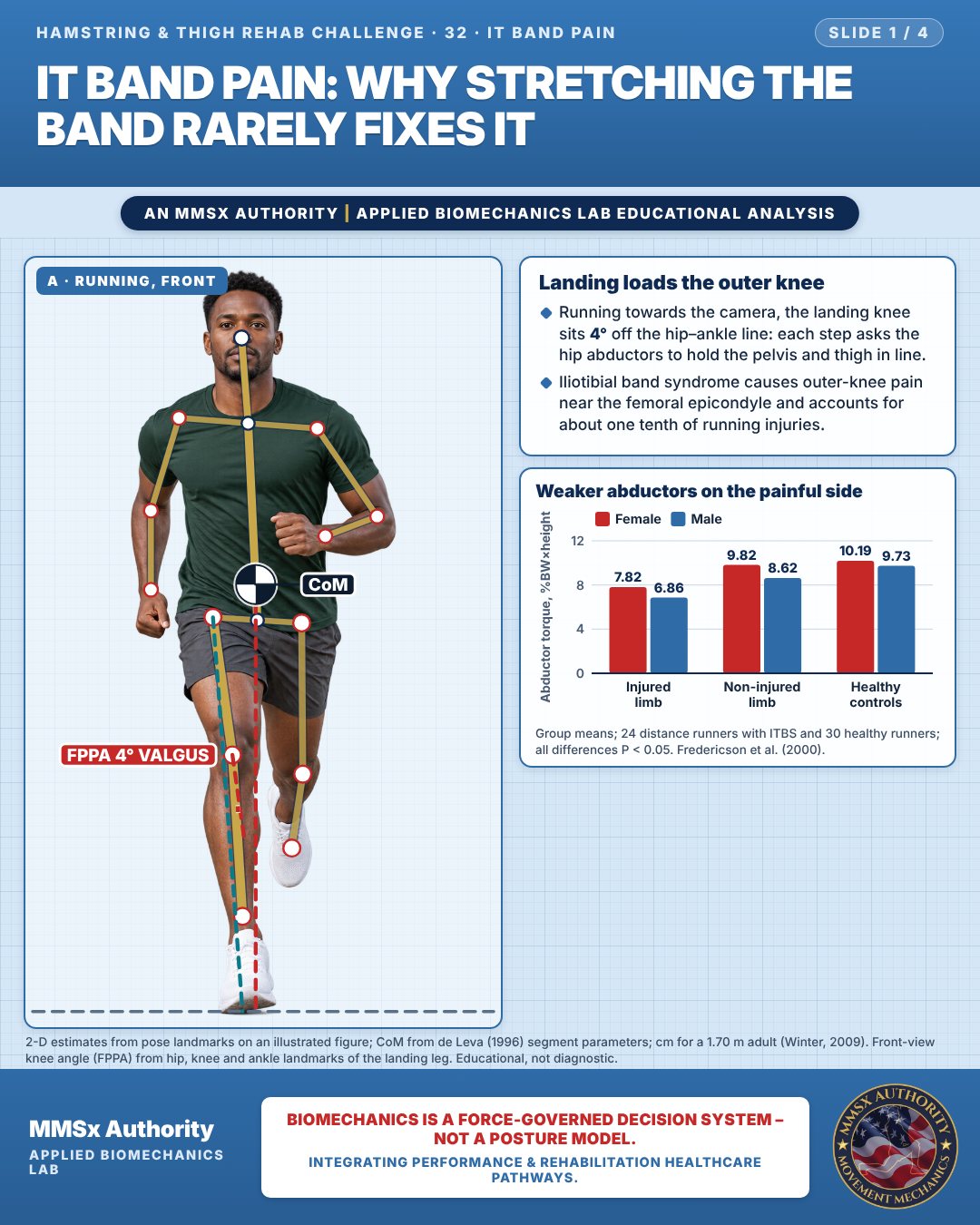
Landing loads the outer knee
Running towards the camera, the landing knee sits 4° off the hip–ankle line: each step asks the hip abductors to hold the pelvis and thigh in line.
Iliotibial band syndrome causes outer-knee pain near the femoral epicondyle and accounts for about one tenth of running injuries.
Weaker abductors on the painful side
Movement B: Foam rolling (side view)
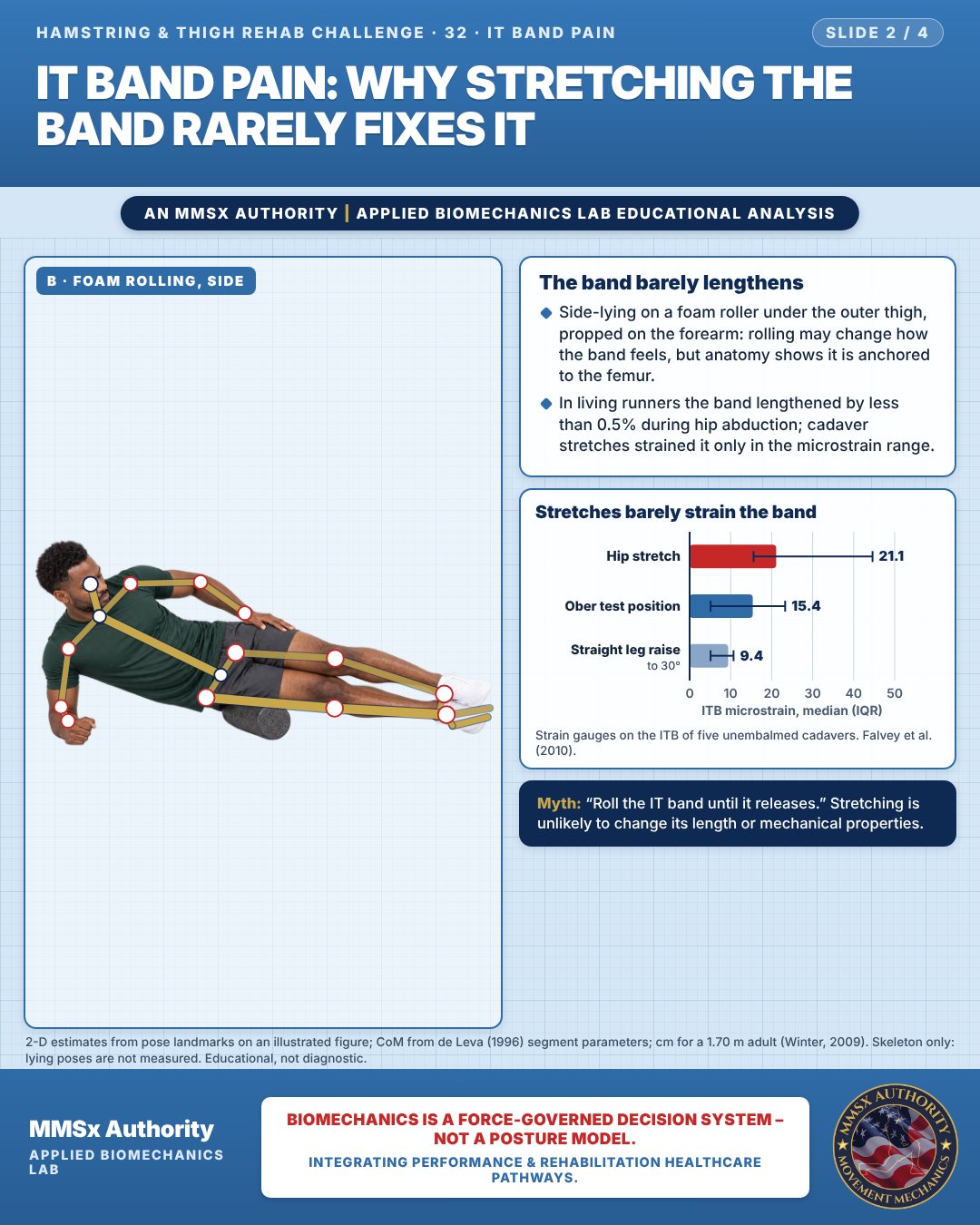
The band barely lengthens
Side-lying on a foam roller under the outer thigh, propped on the forearm: rolling may change how the band feels, but anatomy shows it is anchored to the femur.
In living runners the band lengthened by less than 0.5% during hip abduction; cadaver stretches strained it only in the microstrain range.
Stretches barely strain the band
Movement C: Side plank leg lift (front view)
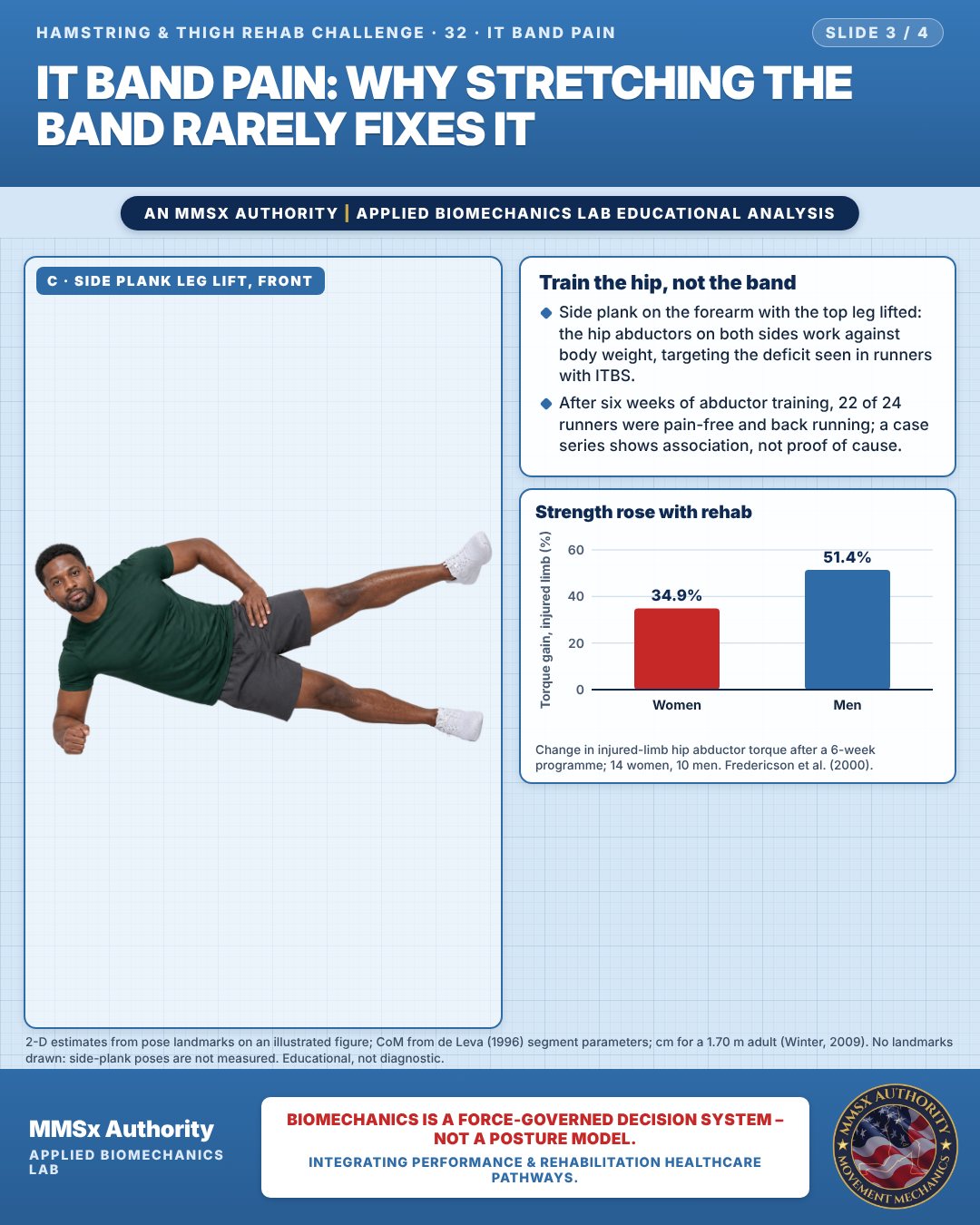
Train the hip, not the band
Side plank on the forearm with the top leg lifted: the hip abductors on both sides work against body weight, targeting the deficit seen in runners with ITBS.
After six weeks of abductor training, 22 of 24 runners were pain-free and back running; a case series shows association, not proof of cause.
Strength rose with rehab
Decision pathway
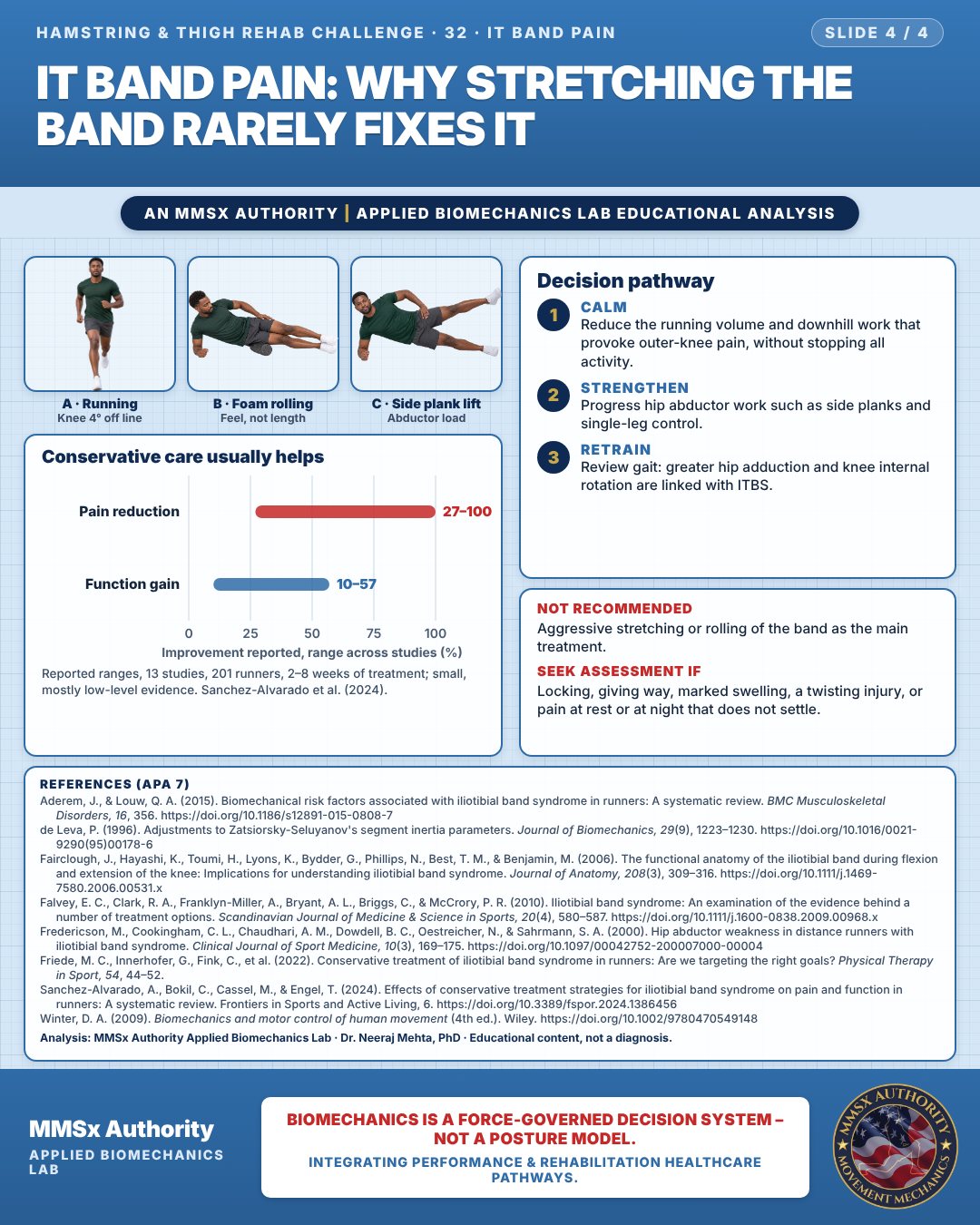
Conservative care usually helps
Calm
Reduce the running volume and downhill work that provoke outer-knee pain, without stopping all activity.
Strengthen
Progress hip abductor work such as side planks and single-leg control.
Retrain
Review gait: greater hip adduction and knee internal rotation are linked with ITBS.
What the evidence supports
- Conservative care is the norm. A narrative review concludes that "intermittent stretching interventions are unlikely to change the ITB's length or mechanical properties", that hip abductor strengthening may correct excessive hip adduction (but may also increase ITB strain), and that running retraining is "promising yet understudied" (Friede et al., 2022).
- Hip abductor strengthening was associated with return to pain-free running in a case series (Fredericson et al., 2000). Pooled kinematic data link ITBS with greater peak hip adduction (prospective, female runners) and peak knee internal rotation during stance, so gait load management is a reasonable target (Aderem & Louw, 2015).
- High-quality randomised trials comparing approaches are still needed (Friede et al., 2022; Sanchez-Alvarado et al., 2024).
Myth and evidence
Myth“The IT band is tight, so stretch it or roll it until it releases.”
EvidenceThe band is anchored to the femur (Fairclough et al., 2006), lengthens by less than 0.5% under load and shows only microstrain during typical stretches (Falvey et al., 2010), and stretching is unlikely to change its length or properties (Friede et al., 2022). Rolling may change how it feels; it does not change its length.
Cautions
Not recommended
Aggressive stretching or rolling of the band as the main treatment.
Seek assessment if
Locking, giving way, marked swelling, a twisting injury, or pain at rest or at night that does not settle.
Methods note
2-D estimates from pose landmarks on an illustrated figure; CoM from de Leva (1996) segment parameters; cm for a 1.70 m adult (Winter, 2009). Front-view knee angle (FPPA) from hip, knee and ankle landmarks of the landing leg. Skeleton only: lying poses are not measured. No landmarks drawn: side-plank poses are not measured. These are educational estimates, not a diagnosis.
References
- Aderem, J., & Louw, Q. A. (2015). Biomechanical risk factors associated with iliotibial band syndrome in runners: A systematic review. BMC Musculoskeletal Disorders, 16, 356. https://doi.org/10.1186/s12891-015-0808-7
- de Leva, P. (1996). Adjustments to Zatsiorsky-Seluyanov's segment inertia parameters. Journal of Biomechanics, 29(9), 1223–1230. https://doi.org/10.1016/0021-9290(95)00178-6
- Fairclough, J., Hayashi, K., Toumi, H., Lyons, K., Bydder, G., Phillips, N., Best, T. M., & Benjamin, M. (2006). The functional anatomy of the iliotibial band during flexion and extension of the knee: Implications for understanding iliotibial band syndrome. Journal of Anatomy, 208(3), 309–316. https://doi.org/10.1111/j.1469-7580.2006.00531.x
- Falvey, E. C., Clark, R. A., Franklyn-Miller, A., Bryant, A. L., Briggs, C., & McCrory, P. R. (2010). Iliotibial band syndrome: An examination of the evidence behind a number of treatment options. Scandinavian Journal of Medicine & Science in Sports, 20(4), 580–587. https://doi.org/10.1111/j.1600-0838.2009.00968.x
- Fredericson, M., Cookingham, C. L., Chaudhari, A. M., Dowdell, B. C., Oestreicher, N., & Sahrmann, S. A. (2000). Hip abductor weakness in distance runners with iliotibial band syndrome. Clinical Journal of Sport Medicine, 10(3), 169–175. https://doi.org/10.1097/00042752-200007000-00004
- Friede, M. C., Innerhofer, G., Fink, C., et al. (2022). Conservative treatment of iliotibial band syndrome in runners: Are we targeting the right goals? Physical Therapy in Sport, 54, 44–52.
- Sanchez-Alvarado, A., Bokil, C., Cassel, M., & Engel, T. (2024). Effects of conservative treatment strategies for iliotibial band syndrome on pain and function in runners: A systematic review. Frontiers in Sports and Active Living, 6. https://doi.org/10.3389/fspor.2024.1386456
- Winter, D. A. (2009). Biomechanics and motor control of human movement (4th ed.). Wiley. https://doi.org/10.1002/9780470549148
Cite this article
Mehta, N. (2026, October 26). IT band pain: why stretching the band rarely fixes it. MMSx Authority Applied Biomechanics Lab. https://mmsxauthority.org/edu/analysis/hamstring-thigh/32-it-band-pain-why-stretching-the-band-rarely-fixes-it/
Part of the collection
Mehta, N. (2026). Hamstring and Thigh Rehabilitation: 50 Evidence-Based Biomechanics Analyses [Collection]. MMSx Authority Applied Biomechanics Lab. Zenodo. https://doi.org/10.5281/zenodo.23735792
All Hamstring & Thigh Rehab Challenge articles · Rehabilitation Library