Hamstring & Thigh Rehab Challenge · 31
Inner thigh pain: muscle, tendon, hip joint or hernia?
Inner thigh (groin) pain in athletes is classified clinically, not by imaging, into defined clinical entities: adductor-related, iliopsoas-related,…
Key points
- Examine. Classify by history and examination: adductor, iliopsoas, inguinal, pubic or hip-related, plus other causes.
- Screen the hip. Check passive range, FABER and FADIR; use a pain-free test to rule hip pathology out.
- Treat the entity. Load the structure found; a minimally symptomatic hernia in a man can be watched safely.
What it is
Inner thigh (groin) pain in athletes is classified clinically, not by imaging, into defined clinical entities: adductor-related, iliopsoas-related, inguinal-related and pubic-related groin pain, plus hip-related groin pain and "other causes" (Weir et al., 2015). Adductor-related groin pain is defined as adductor tenderness and pain on resisted adduction testing; inguinal-related groin pain as pain in the inguinal canal region with tenderness of the canal and no palpable hernia (Weir et al., 2015).
How we analysed the movement
Three movements relevant to this topic were analysed from illustrated reference figures. Joint centres were located with two-dimensional pose estimation; hip and knee angles, pelvis level, the whole-body centre of mass and, where relevant, the hip lever (the horizontal distance from the hip joint to the upper-body centre of mass) and the resulting static hip moment were then calculated from standard segment parameters. The figures are educational estimates that show how position changes mechanical demand; they are not measurements of a patient. Every research value quoted below comes from the published source cited beside it.
Movement A: Standing (front view)
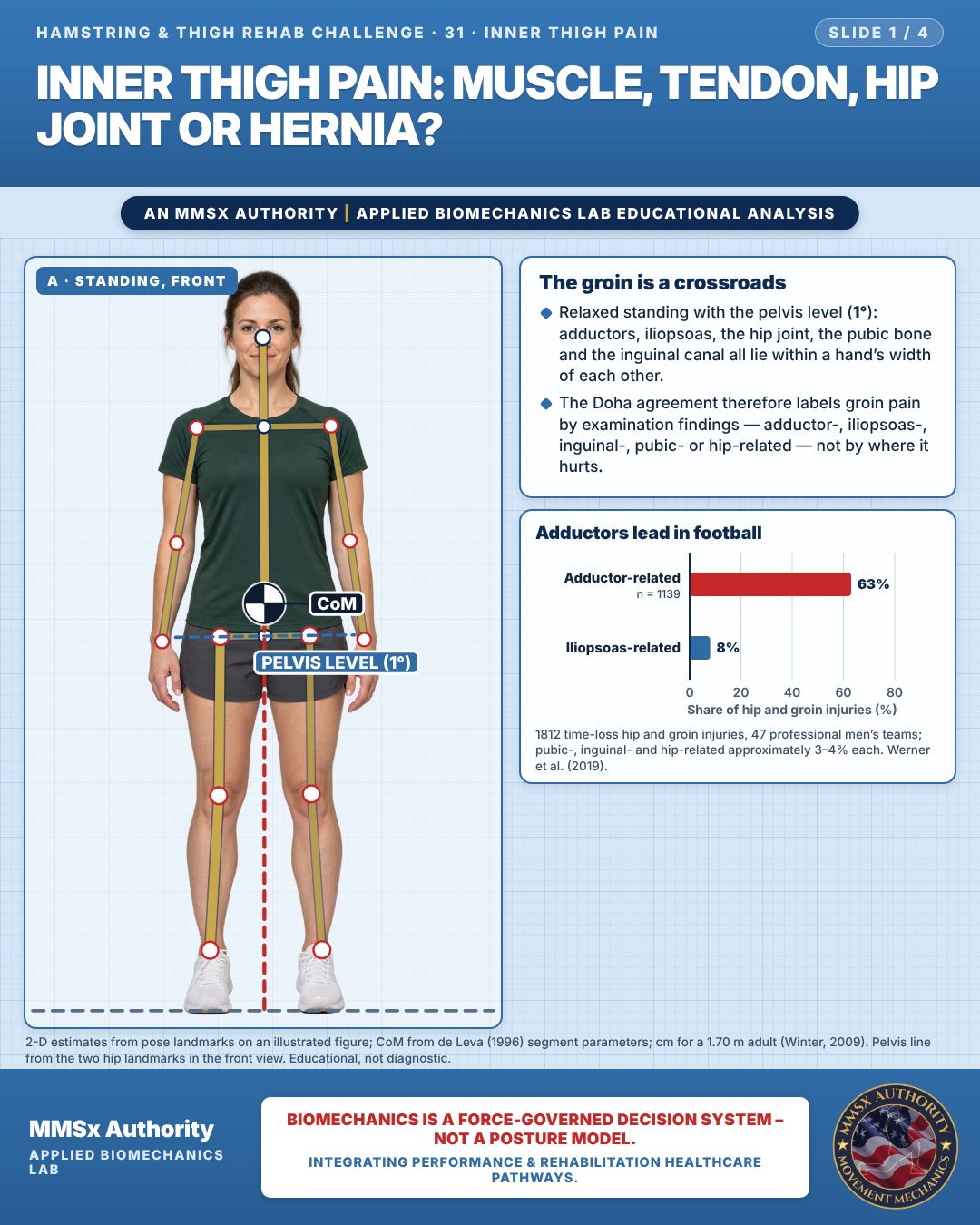
The groin is a crossroads
Relaxed standing with the pelvis level (1°): adductors, iliopsoas, the hip joint, the pubic bone and the inguinal canal all lie within a hand’s width of each other.
The Doha agreement therefore labels groin pain by examination findings — adductor-, iliopsoas-, inguinal-, pubic- or hip-related — not by where it hurts.
Adductors lead in football
Movement B: Knee across body (front view)
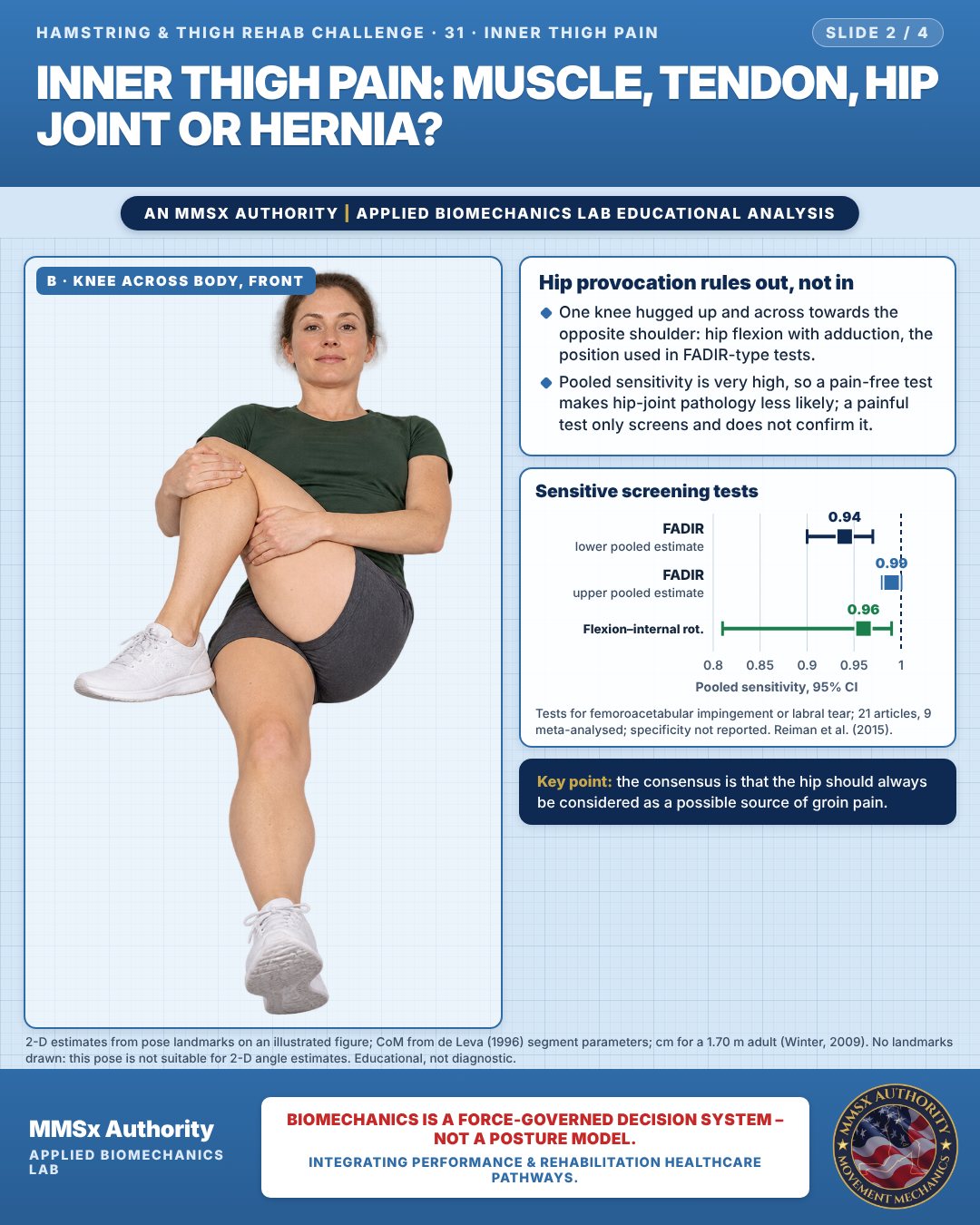
Hip provocation rules out, not in
One knee hugged up and across towards the opposite shoulder: hip flexion with adduction, the position used in FADIR-type tests.
Pooled sensitivity is very high, so a pain-free test makes hip-joint pathology less likely; a painful test only screens and does not confirm it.
Sensitive screening tests
Movement C: Cough test (front view)
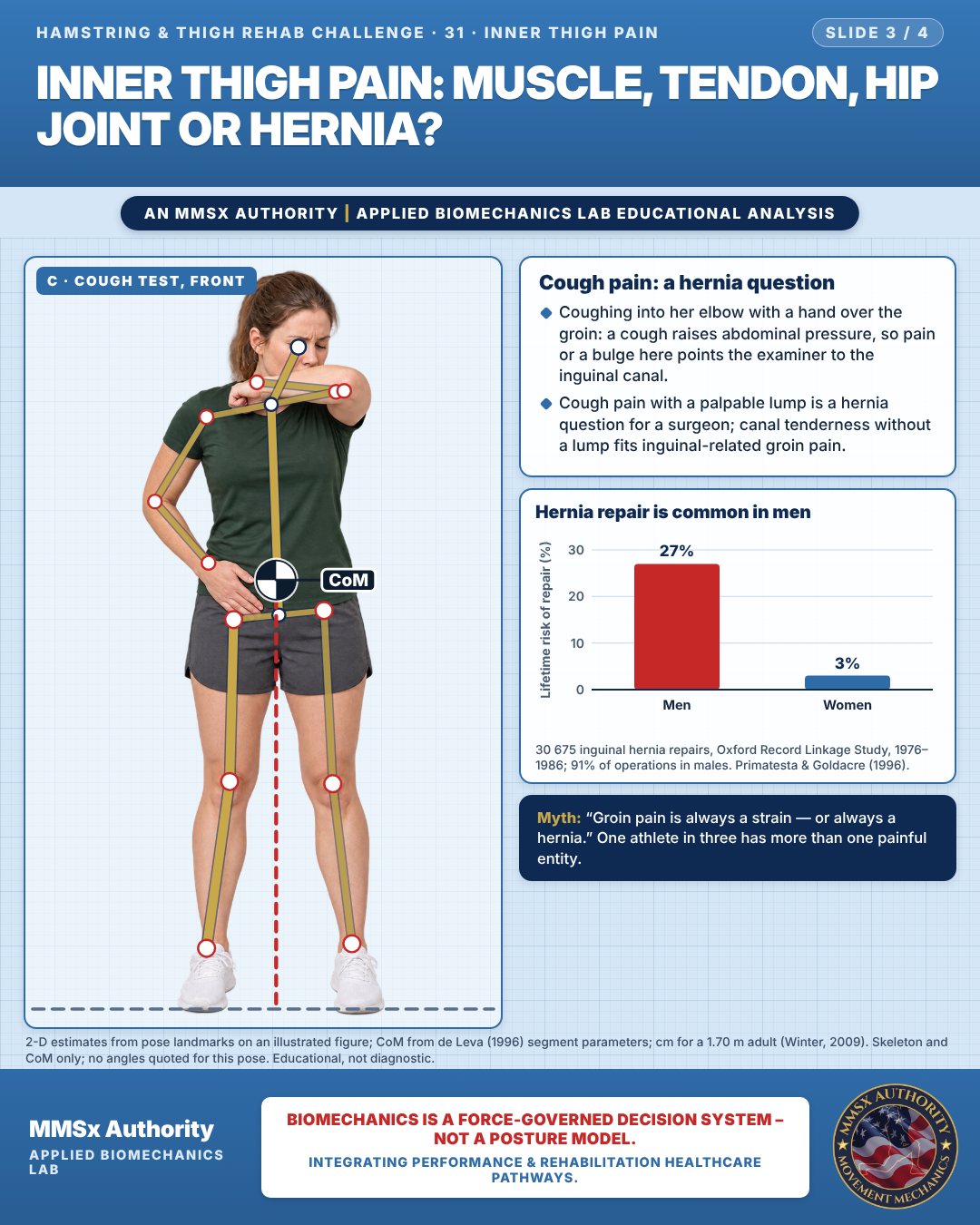
Cough pain: a hernia question
Coughing into her elbow with a hand over the groin: a cough raises abdominal pressure, so pain or a bulge here points the examiner to the inguinal canal.
Cough pain with a palpable lump is a hernia question for a surgeon; canal tenderness without a lump fits inguinal-related groin pain.
Hernia repair is common in men
Decision pathway
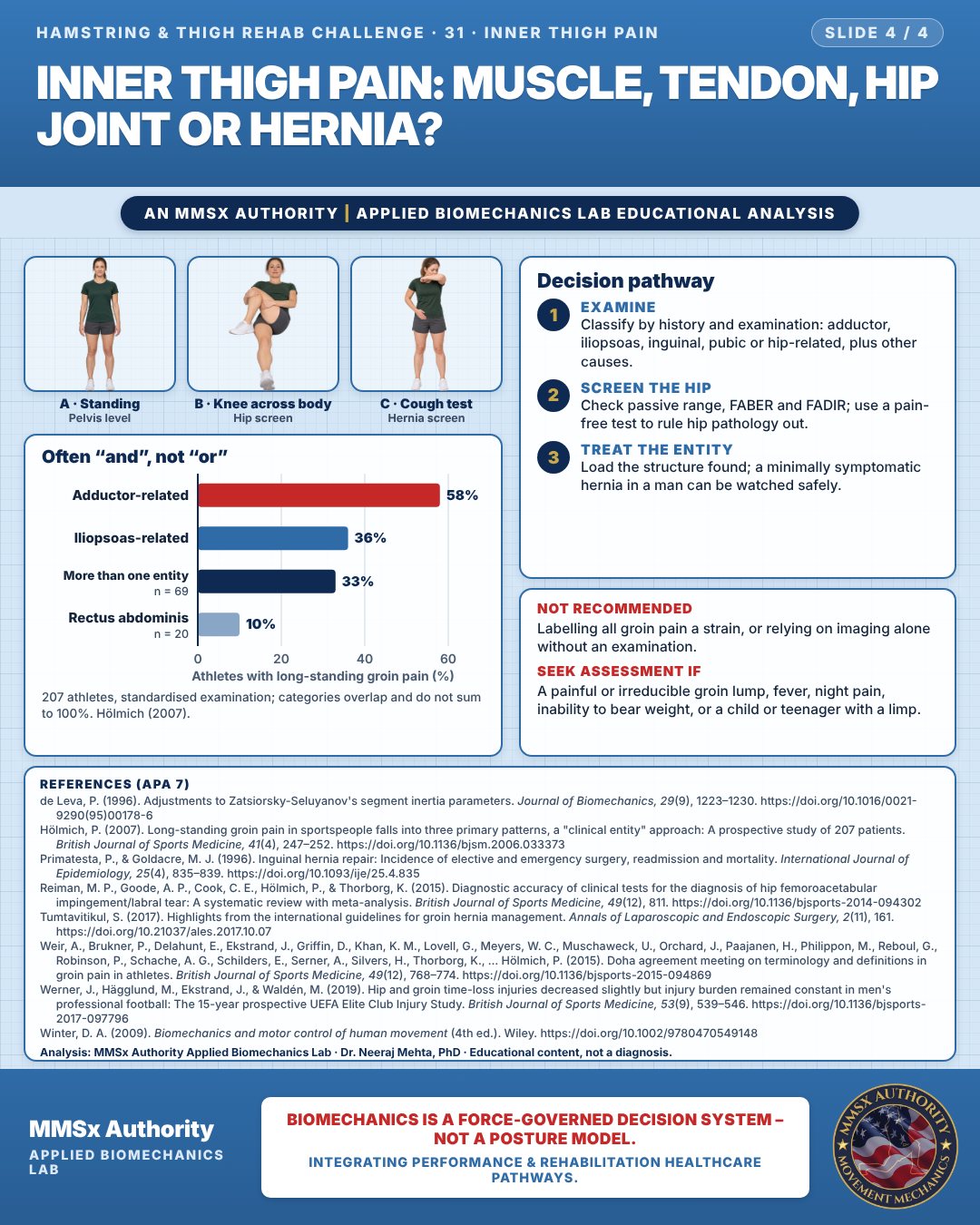
Often “and”, not “or”
Examine
Classify by history and examination: adductor, iliopsoas, inguinal, pubic or hip-related, plus other causes.
Screen the hip
Check passive range, FABER and FADIR; use a pain-free test to rule hip pathology out.
Treat the entity
Load the structure found; a minimally symptomatic hernia in a man can be watched safely.
What the evidence supports
- Classify first: the Doha agreement recommends a clinical history and examination to place the athlete in a defined clinical entity, hip-related groin pain or "other causes"; hip pain "should always be considered as a possible cause of groin pain", with passive range of motion and the FABER and FADIR tests in all athletes with groin pain (Weir et al., 2015).
- For an asymptomatic or minimally symptomatic inguinal hernia in a man, watchful waiting is described as safe (high-quality evidence); imaging (ultrasound, dynamic MRI or CT) is needed only rarely when the diagnosis is in doubt (Tumtavitikul, 2017, summarising the international guidelines).
Cautions
Not recommended
Labelling all groin pain a strain, or relying on imaging alone without an examination.
Seek assessment if
A painful or irreducible groin lump, fever, night pain, inability to bear weight, or a child or teenager with a limp.
Methods note
2-D estimates from pose landmarks on an illustrated figure; CoM from de Leva (1996) segment parameters; cm for a 1.70 m adult (Winter, 2009). Pelvis line from the two hip landmarks in the front view. No landmarks drawn: this pose is not suitable for 2-D angle estimates. Skeleton and CoM only; no angles quoted for this pose. These are educational estimates, not a diagnosis.
References
- de Leva, P. (1996). Adjustments to Zatsiorsky-Seluyanov's segment inertia parameters. Journal of Biomechanics, 29(9), 1223–1230. https://doi.org/10.1016/0021-9290(95)00178-6
- Hölmich, P. (2007). Long-standing groin pain in sportspeople falls into three primary patterns, a "clinical entity" approach: A prospective study of 207 patients. British Journal of Sports Medicine, 41(4), 247–252. https://doi.org/10.1136/bjsm.2006.033373
- Primatesta, P., & Goldacre, M. J. (1996). Inguinal hernia repair: Incidence of elective and emergency surgery, readmission and mortality. International Journal of Epidemiology, 25(4), 835–839. https://doi.org/10.1093/ije/25.4.835
- Reiman, M. P., Goode, A. P., Cook, C. E., Hölmich, P., & Thorborg, K. (2015). Diagnostic accuracy of clinical tests for the diagnosis of hip femoroacetabular impingement/labral tear: A systematic review with meta-analysis. British Journal of Sports Medicine, 49(12), 811. https://doi.org/10.1136/bjsports-2014-094302
- Tumtavitikul, S. (2017). Highlights from the international guidelines for groin hernia management. Annals of Laparoscopic and Endoscopic Surgery, 2(11), 161. https://doi.org/10.21037/ales.2017.10.07
- Weir, A., Brukner, P., Delahunt, E., Ekstrand, J., Griffin, D., Khan, K. M., Lovell, G., Meyers, W. C., Muschaweck, U., Orchard, J., Paajanen, H., Philippon, M., Reboul, G., Robinson, P., Schache, A. G., Schilders, E., Serner, A., Silvers, H., Thorborg, K., … Hölmich, P. (2015). Doha agreement meeting on terminology and definitions in groin pain in athletes. British Journal of Sports Medicine, 49(12), 768–774. https://doi.org/10.1136/bjsports-2015-094869
- Werner, J., Hägglund, M., Ekstrand, J., & Waldén, M. (2019). Hip and groin time-loss injuries decreased slightly but injury burden remained constant in men's professional football: The 15-year prospective UEFA Elite Club Injury Study. British Journal of Sports Medicine, 53(9), 539–546. https://doi.org/10.1136/bjsports-2017-097796
- Winter, D. A. (2009). Biomechanics and motor control of human movement (4th ed.). Wiley. https://doi.org/10.1002/9780470549148
Cite this article
Mehta, N. (2026, October 26). Inner thigh pain: muscle, tendon, hip joint or hernia? MMSx Authority Applied Biomechanics Lab. https://mmsxauthority.org/edu/analysis/hamstring-thigh/31-inner-thigh-pain-muscle-tendon-hip-joint-or-hernia/
Part of the collection
Mehta, N. (2026). Hamstring and Thigh Rehabilitation: 50 Evidence-Based Biomechanics Analyses [Collection]. MMSx Authority Applied Biomechanics Lab. Zenodo. https://doi.org/10.5281/zenodo.23735792
All Hamstring & Thigh Rehab Challenge articles · Rehabilitation Library