Hamstring & Thigh Rehab Challenge · 30
Copenhagen adduction exercise: preventing groin injury
The Copenhagen adduction exercise is a side-lying bodyweight exercise in which the upper leg rests on a bench (at the knee for the short-lever…
Key points
- Start low. Begin with side-lying adduction, then the short-lever plank with the knee on the bench.
- Lengthen. Move to the long lever over weeks as the effort becomes manageable.
- Keep it up. Run it within the warm-up through the season, alongside a programme such as the FIFA 11+.
What it is
The Copenhagen adduction exercise is a side-lying bodyweight exercise in which the upper leg rests on a bench (at the knee for the short-lever version, at the ankle for the long-lever version) and the body is lifted by contracting the hip adductors. It loads the adductors through a range that includes lengthened, eccentric work, and its difficulty is graded by lever length.
How we analysed the movement
Three movements relevant to this topic were analysed from illustrated reference figures. Joint centres were located with two-dimensional pose estimation; hip and knee angles, pelvis level, the whole-body centre of mass and, where relevant, the hip lever (the horizontal distance from the hip joint to the upper-body centre of mass) and the resulting static hip moment were then calculated from standard segment parameters. The figures are educational estimates that show how position changes mechanical demand; they are not measurements of a patient. Every research value quoted below comes from the published source cited beside it.
Movement A: Bench side plank (front view)
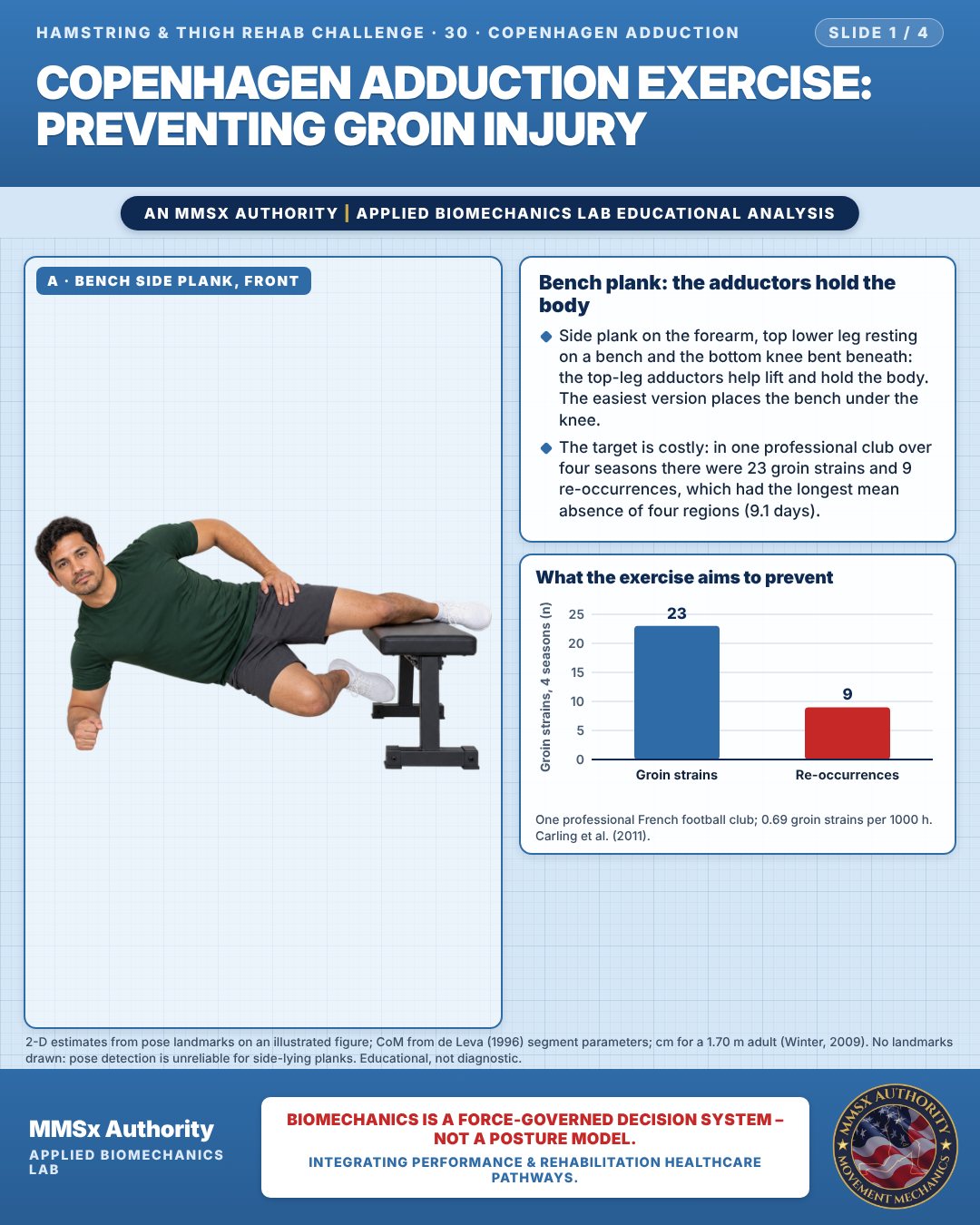
Bench plank: the adductors hold the body
Side plank on the forearm, top lower leg resting on a bench and the bottom knee bent beneath: the top-leg adductors help lift and hold the body. The easiest version places the bench under the knee.
The target is costly: in one professional club over four seasons there were 23 groin strains and 9 re-occurrences, which had the longest mean absence of four regions (9.1 days).
What the exercise aims to prevent
Movement B: Long-lever plank (front view)
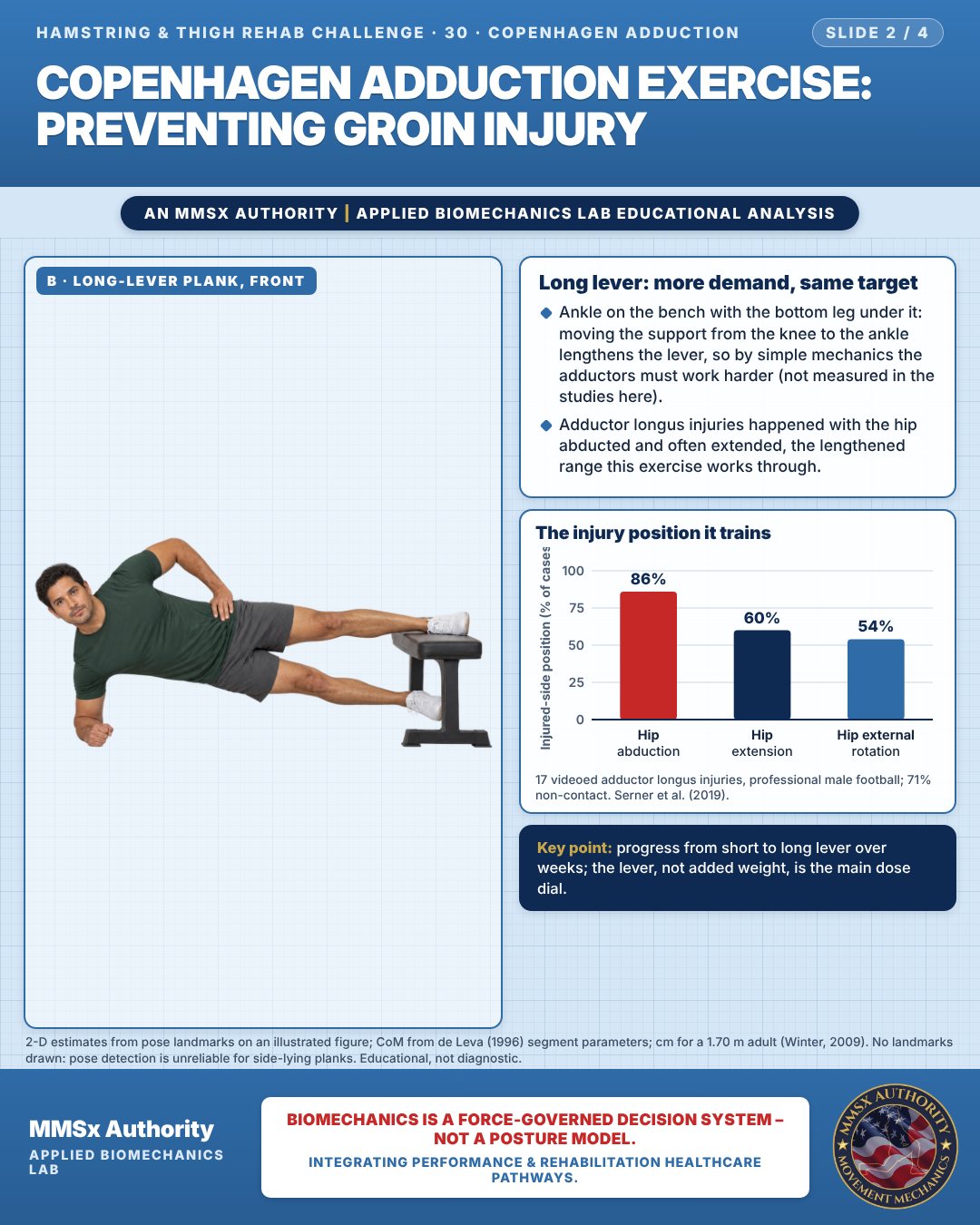
Long lever: more demand, same target
Ankle on the bench with the bottom leg under it: moving the support from the knee to the ankle lengthens the lever, so by simple mechanics the adductors must work harder (not measured in the studies here).
Adductor longus injuries happened with the hip abducted and often extended, the lengthened range this exercise works through.
The injury position it trains
Movement C: Side-lying adduction
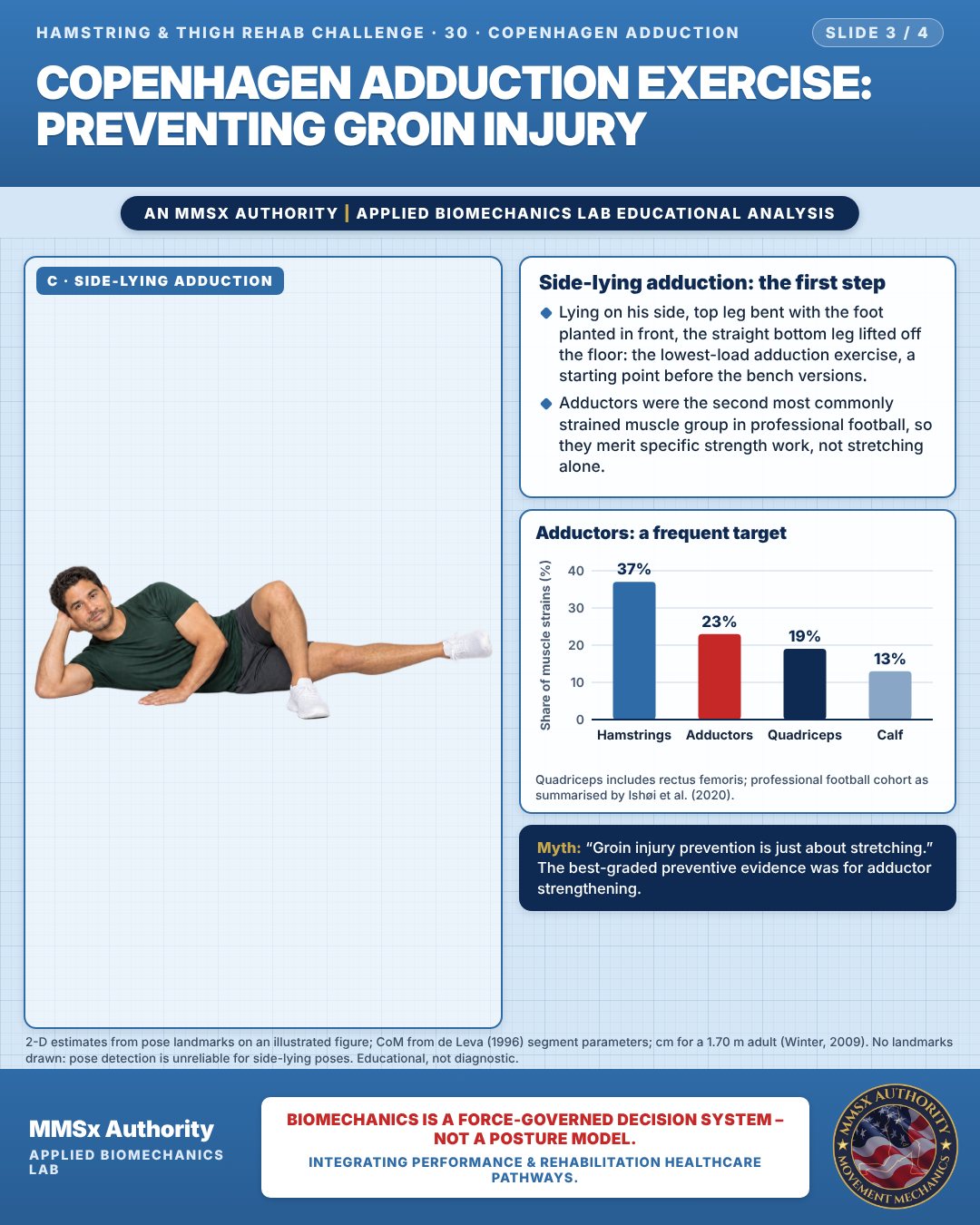
Side-lying adduction: the first step
Lying on his side, top leg bent with the foot planted in front, the straight bottom leg lifted off the floor: the lowest-load adduction exercise, a starting point before the bench versions.
Adductors were the second most commonly strained muscle group in professional football, so they merit specific strength work, not stretching alone.
Adductors: a frequent target
Decision pathway
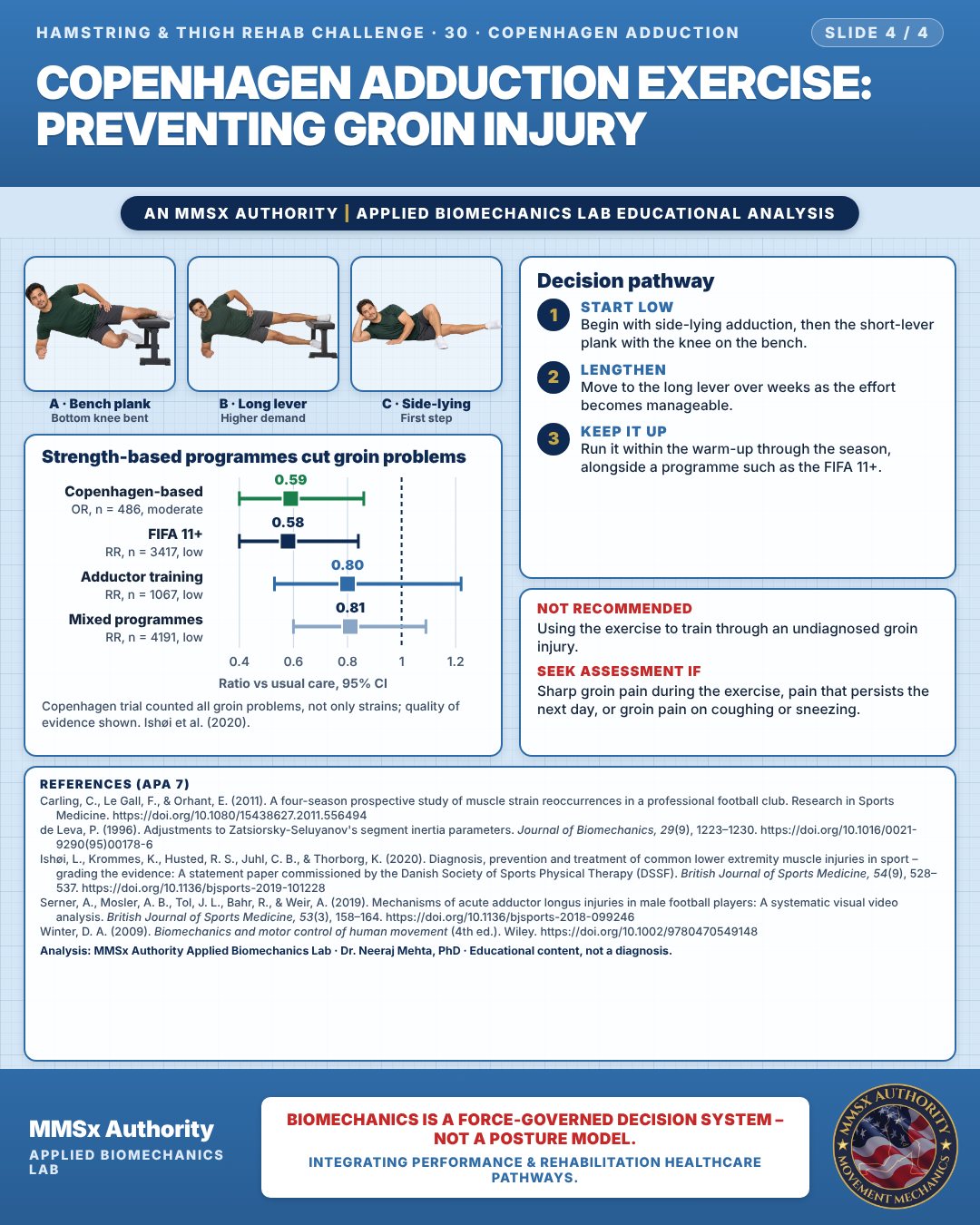
Strength-based programmes cut groin problems
Start low
Begin with side-lying adduction, then the short-lever plank with the knee on the bench.
Lengthen
Move to the long lever over weeks as the effort becomes manageable.
Keep it up
Run it within the warm-up through the season, alongside a programme such as the FIFA 11+.
What the evidence supports
- Prevention: adductor strengthening based on the Copenhagen adduction exercise, performed at different intensity levels, and the FIFA 11+ programme are both supported for groin injury prevention in football (Ishøi et al., 2020).
- The preventive effect points to the importance of hip adduction strength gains (Ishøi et al., 2020).
Myth and evidence
Myth“Groin injury prevention is just about stretching.”
EvidenceThe highest-quality preventive evidence was for an adductor strengthening programme using the Copenhagen adduction exercise (OR 0.59) (Ishøi et al., 2020), not for stretching.
Cautions
Not recommended
Using the exercise to train through an undiagnosed groin injury.
Seek assessment if
Sharp groin pain during the exercise, pain that persists the next day, or groin pain on coughing or sneezing.
Methods note
2-D estimates from pose landmarks on an illustrated figure; CoM from de Leva (1996) segment parameters; cm for a 1.70 m adult (Winter, 2009). No landmarks drawn: pose detection is unreliable for side-lying planks. No landmarks drawn: pose detection is unreliable for side-lying poses. These are educational estimates, not a diagnosis.
References
- Carling, C., Le Gall, F., & Orhant, E. (2011). A four-season prospective study of muscle strain reoccurrences in a professional football club. Research in Sports Medicine. https://doi.org/10.1080/15438627.2011.556494
- de Leva, P. (1996). Adjustments to Zatsiorsky-Seluyanov's segment inertia parameters. Journal of Biomechanics, 29(9), 1223–1230. https://doi.org/10.1016/0021-9290(95)00178-6
- Ishøi, L., Krommes, K., Husted, R. S., Juhl, C. B., & Thorborg, K. (2020). Diagnosis, prevention and treatment of common lower extremity muscle injuries in sport – grading the evidence: A statement paper commissioned by the Danish Society of Sports Physical Therapy (DSSF). British Journal of Sports Medicine, 54(9), 528–537. https://doi.org/10.1136/bjsports-2019-101228
- Serner, A., Mosler, A. B., Tol, J. L., Bahr, R., & Weir, A. (2019). Mechanisms of acute adductor longus injuries in male football players: A systematic visual video analysis. British Journal of Sports Medicine, 53(3), 158–164. https://doi.org/10.1136/bjsports-2018-099246
- Winter, D. A. (2009). Biomechanics and motor control of human movement (4th ed.). Wiley. https://doi.org/10.1002/9780470549148
Cite this article
Mehta, N. (2026, October 26). Copenhagen adduction exercise: preventing groin injury. MMSx Authority Applied Biomechanics Lab. https://mmsxauthority.org/edu/analysis/hamstring-thigh/30-copenhagen-adduction-exercise-preventing-groin-injury/
Part of the collection
Mehta, N. (2026). Hamstring and Thigh Rehabilitation: 50 Evidence-Based Biomechanics Analyses [Collection]. MMSx Authority Applied Biomechanics Lab. Zenodo. https://doi.org/10.5281/zenodo.23735792
All Hamstring & Thigh Rehab Challenge articles · Rehabilitation Library