Hamstring & Thigh Rehab Challenge · 29
Adductor longus pain: the most commonly injured groin muscle
Adductor longus injury is an acute strain of the adductor longus, the most superficial and anterior of the adductor muscles, which runs from the…
Key points
- Palpate. If the adductors are not tender to touch, an acute adductor injury is unlikely.
- Squeeze. Start with graded isometric squeezes, then load the muscle in wider, longer positions.
- Speed up. Progress to faster, multi-plane work before cutting and kicking.
What it is
Adductor longus injury is an acute strain of the adductor longus, the most superficial and anterior of the adductor muscles, which runs from the pubic bone to the middle of the thigh. It gives sudden pain and tenderness at the inner groin, pain on resisted hip adduction (for example a squeeze test) and pain on adductor stretching.
How we analysed the movement
Three movements relevant to this topic were analysed from illustrated reference figures. Joint centres were located with two-dimensional pose estimation; hip and knee angles, pelvis level, the whole-body centre of mass and, where relevant, the hip lever (the horizontal distance from the hip joint to the upper-body centre of mass) and the resulting static hip moment were then calculated from standard segment parameters. The figures are educational estimates that show how position changes mechanical demand; they are not measurements of a patient. Every research value quoted below comes from the published source cited beside it.
Movement A: Ball squeeze (front view)
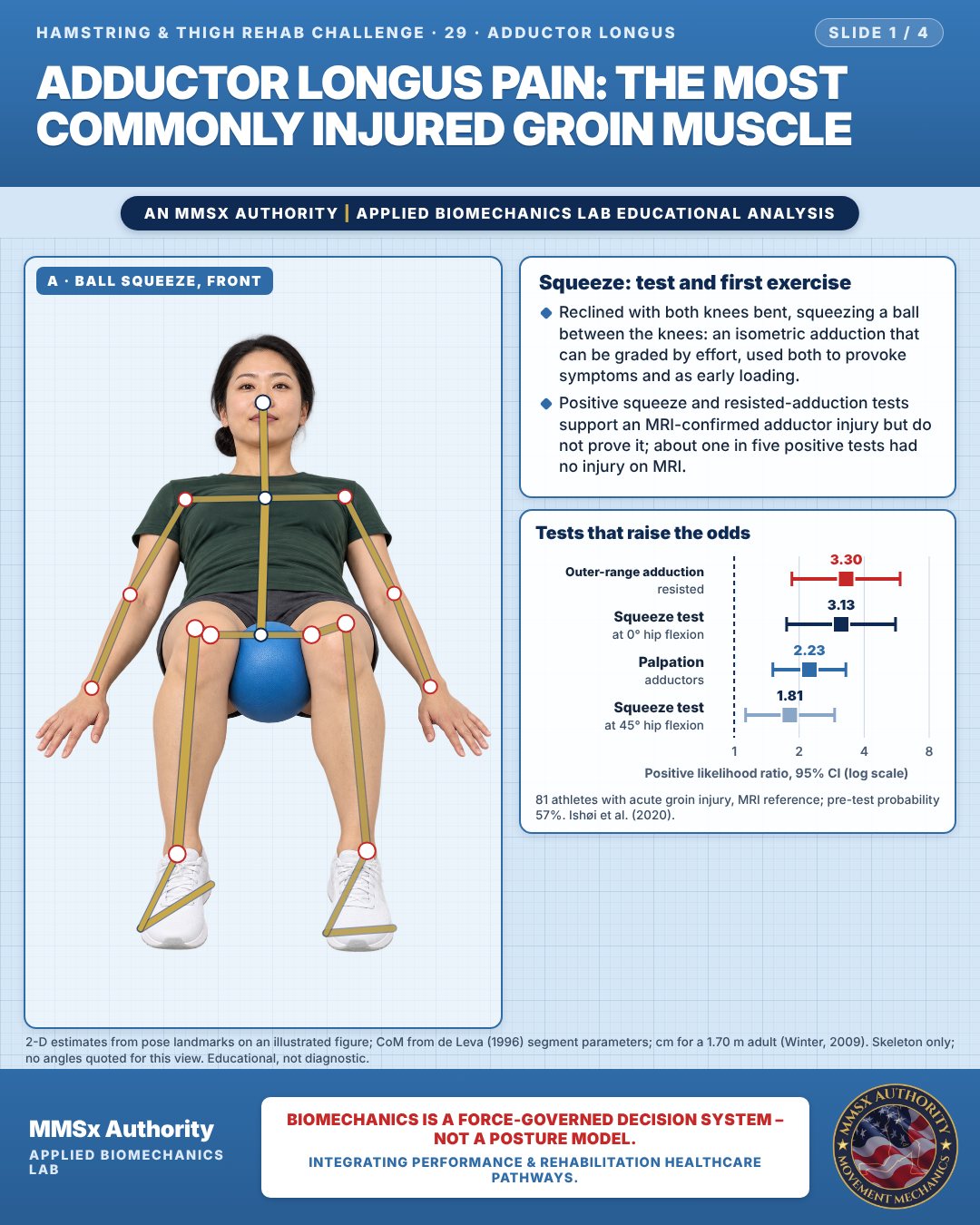
Squeeze: test and first exercise
Reclined with both knees bent, squeezing a ball between the knees: an isometric adduction that can be graded by effort, used both to provoke symptoms and as early loading.
Positive squeeze and resisted-adduction tests support an MRI-confirmed adductor injury but do not prove it; about one in five positive tests had no injury on MRI.
Tests that raise the odds
Movement B: Sumo squat (front view)
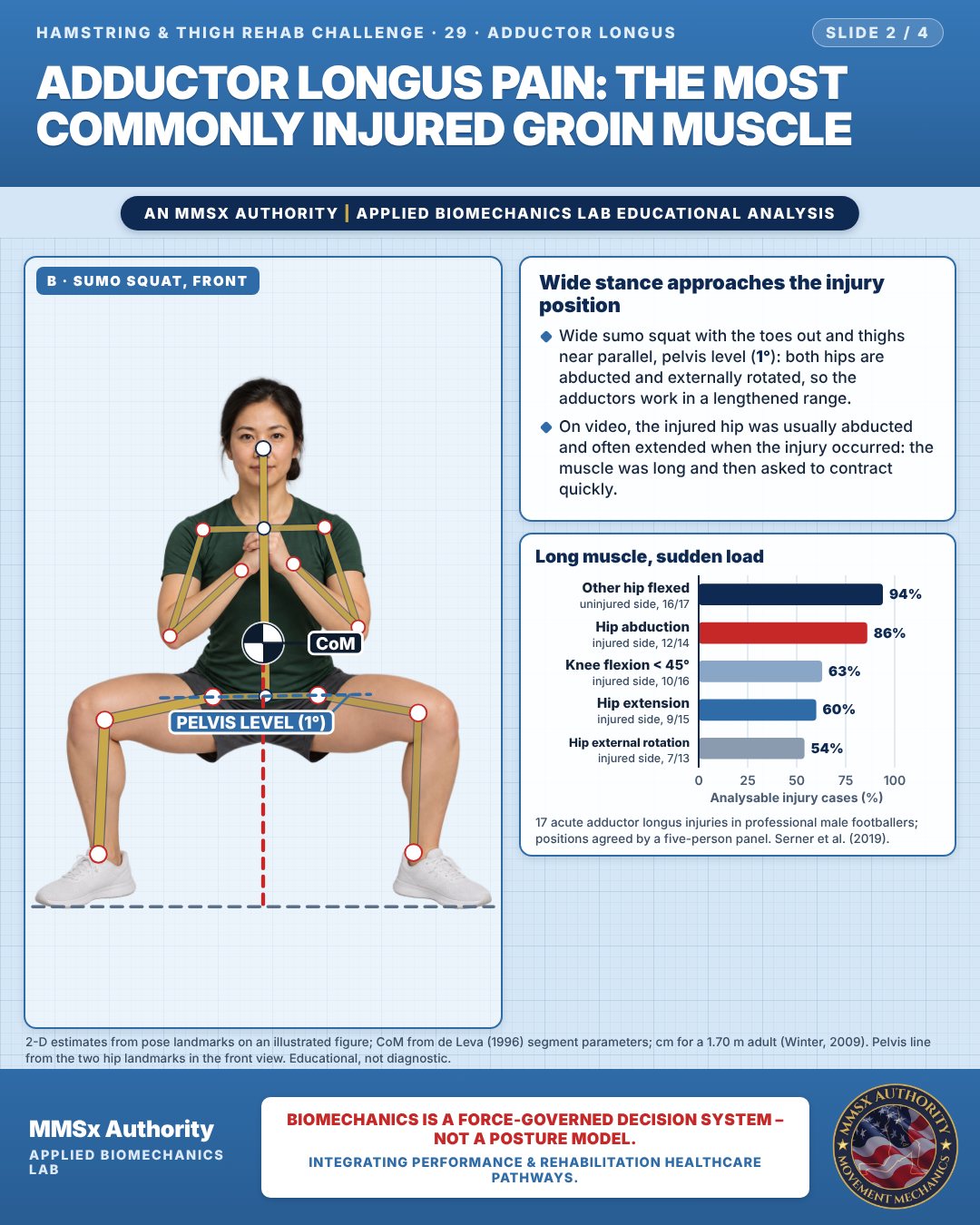
Wide stance approaches the injury position
Wide sumo squat with the toes out and thighs near parallel, pelvis level (1°): both hips are abducted and externally rotated, so the adductors work in a lengthened range.
On video, the injured hip was usually abducted and often extended when the injury occurred: the muscle was long and then asked to contract quickly.
Long muscle, sudden load
Movement C: Butterfly sit (front view)
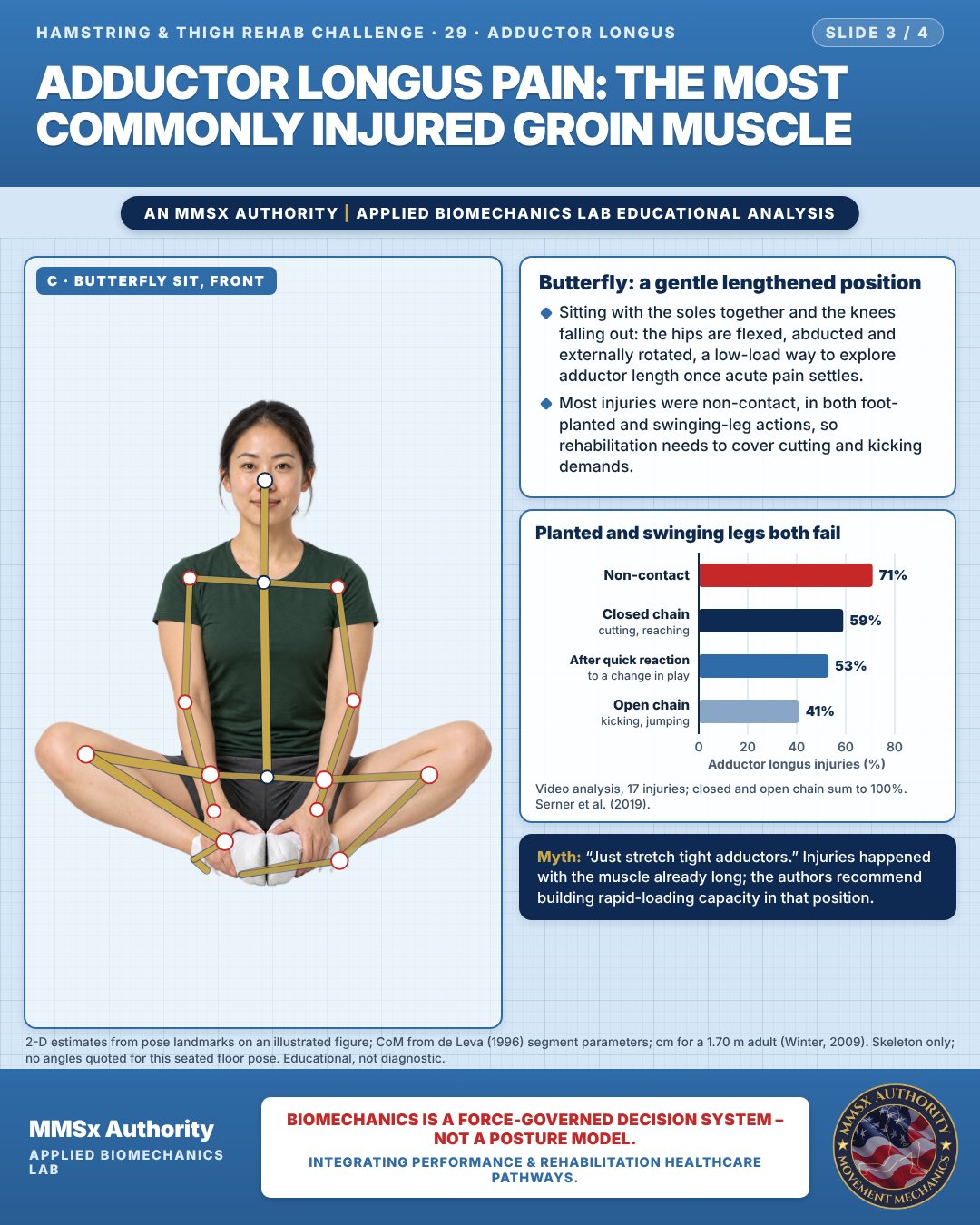
Butterfly: a gentle lengthened position
Sitting with the soles together and the knees falling out: the hips are flexed, abducted and externally rotated, a low-load way to explore adductor length once acute pain settles.
Most injuries were non-contact, in both foot-planted and swinging-leg actions, so rehabilitation needs to cover cutting and kicking demands.
Planted and swinging legs both fail
Decision pathway
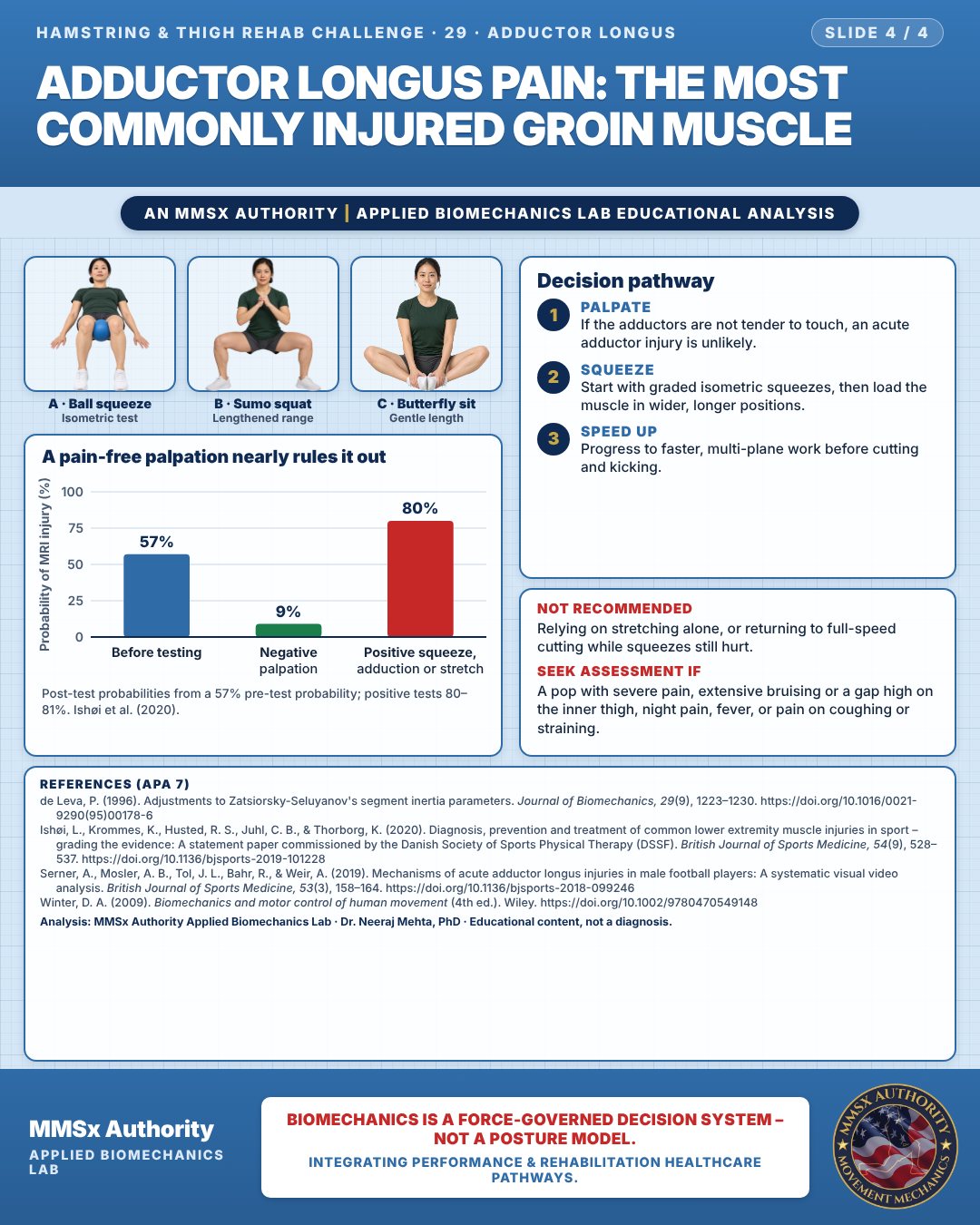
A pain-free palpation nearly rules it out
Palpate
If the adductors are not tender to touch, an acute adductor injury is unlikely.
Squeeze
Start with graded isometric squeezes, then load the muscle in wider, longer positions.
Speed up
Progress to faster, multi-plane work before cutting and kicking.
What the evidence supports
- No studies were identified for the treatment of acute adductor injuries (Ishøi et al., 2020).
- For long-standing adductor-related groin pain, an exercise-based approach with a large focus on adductor strengthening has been recommended (Ishøi et al., 2020).
- Mechanism-informed rehabilitation: increase the adductor longus's capacity for rapid loading in a lengthened position, and consider multi-plane (diagonal) exercises (Serner et al., 2019). Progress from isometric squeezes to loaded lengthened positions and then to cutting and kicking.
Myth and evidence
Myth“Groin strains happen because the adductors are tight, so just stretch them.”
EvidenceThe injuries occurred when the hip was already abducted and extended, and the muscle was then loaded fast (Serner et al., 2019). The authors recommend building the muscle's capacity to tolerate rapid loading in a lengthened position, not stretching alone.
Cautions
Not recommended
Relying on stretching alone, or returning to full-speed cutting while squeezes still hurt.
Seek assessment if
A pop with severe pain, extensive bruising or a gap high on the inner thigh, night pain, fever, or pain on coughing or straining.
Methods note
2-D estimates from pose landmarks on an illustrated figure; CoM from de Leva (1996) segment parameters; cm for a 1.70 m adult (Winter, 2009). Skeleton only; no angles quoted for this view. Pelvis line from the two hip landmarks in the front view. Skeleton only; no angles quoted for this seated floor pose. These are educational estimates, not a diagnosis.
References
- de Leva, P. (1996). Adjustments to Zatsiorsky-Seluyanov's segment inertia parameters. Journal of Biomechanics, 29(9), 1223–1230. https://doi.org/10.1016/0021-9290(95)00178-6
- Ishøi, L., Krommes, K., Husted, R. S., Juhl, C. B., & Thorborg, K. (2020). Diagnosis, prevention and treatment of common lower extremity muscle injuries in sport – grading the evidence: A statement paper commissioned by the Danish Society of Sports Physical Therapy (DSSF). British Journal of Sports Medicine, 54(9), 528–537. https://doi.org/10.1136/bjsports-2019-101228
- Serner, A., Mosler, A. B., Tol, J. L., Bahr, R., & Weir, A. (2019). Mechanisms of acute adductor longus injuries in male football players: A systematic visual video analysis. British Journal of Sports Medicine, 53(3), 158–164. https://doi.org/10.1136/bjsports-2018-099246
- Winter, D. A. (2009). Biomechanics and motor control of human movement (4th ed.). Wiley. https://doi.org/10.1002/9780470549148
Cite this article
Mehta, N. (2026, October 26). Adductor longus pain: the most commonly injured groin muscle. MMSx Authority Applied Biomechanics Lab. https://mmsxauthority.org/edu/analysis/hamstring-thigh/29-adductor-longus-pain-the-most-commonly-injured-groin-muscle/
Part of the collection
Mehta, N. (2026). Hamstring and Thigh Rehabilitation: 50 Evidence-Based Biomechanics Analyses [Collection]. MMSx Authority Applied Biomechanics Lab. Zenodo. https://doi.org/10.5281/zenodo.23735792
All Hamstring & Thigh Rehab Challenge articles · Rehabilitation Library