Hamstring & Thigh Rehab Challenge · 28
Groin strain: adductor injury in change-of-direction sports
A groin strain is an acute muscle injury in the groin region, most often of the adductor muscles (especially adductor longus), and less often of the…
Key points
- Examine. Confirm an adductor source: palpation, squeeze tests and resisted adduction.
- Load. Progress adductor strengthening from squeezes to lengthened, faster work.
- Return. Reintroduce cutting and kicking step by step; prevention includes adductor strength work.
What it is
A groin strain is an acute muscle injury in the groin region, most often of the adductor muscles (especially adductor longus), and less often of the hip flexors (iliopsoas, rectus femoris). It typically occurs during change of direction, kicking, reaching or jumping, with sudden pain on the inner thigh near the pubic bone.
How we analysed the movement
Three movements relevant to this topic were analysed from illustrated reference figures. Joint centres were located with two-dimensional pose estimation; hip and knee angles, pelvis level, the whole-body centre of mass and, where relevant, the hip lever (the horizontal distance from the hip joint to the upper-body centre of mass) and the resulting static hip moment were then calculated from standard segment parameters. The figures are educational estimates that show how position changes mechanical demand; they are not measurements of a patient. Every research value quoted below comes from the published source cited beside it.
Movement A: Side lunge (front view)
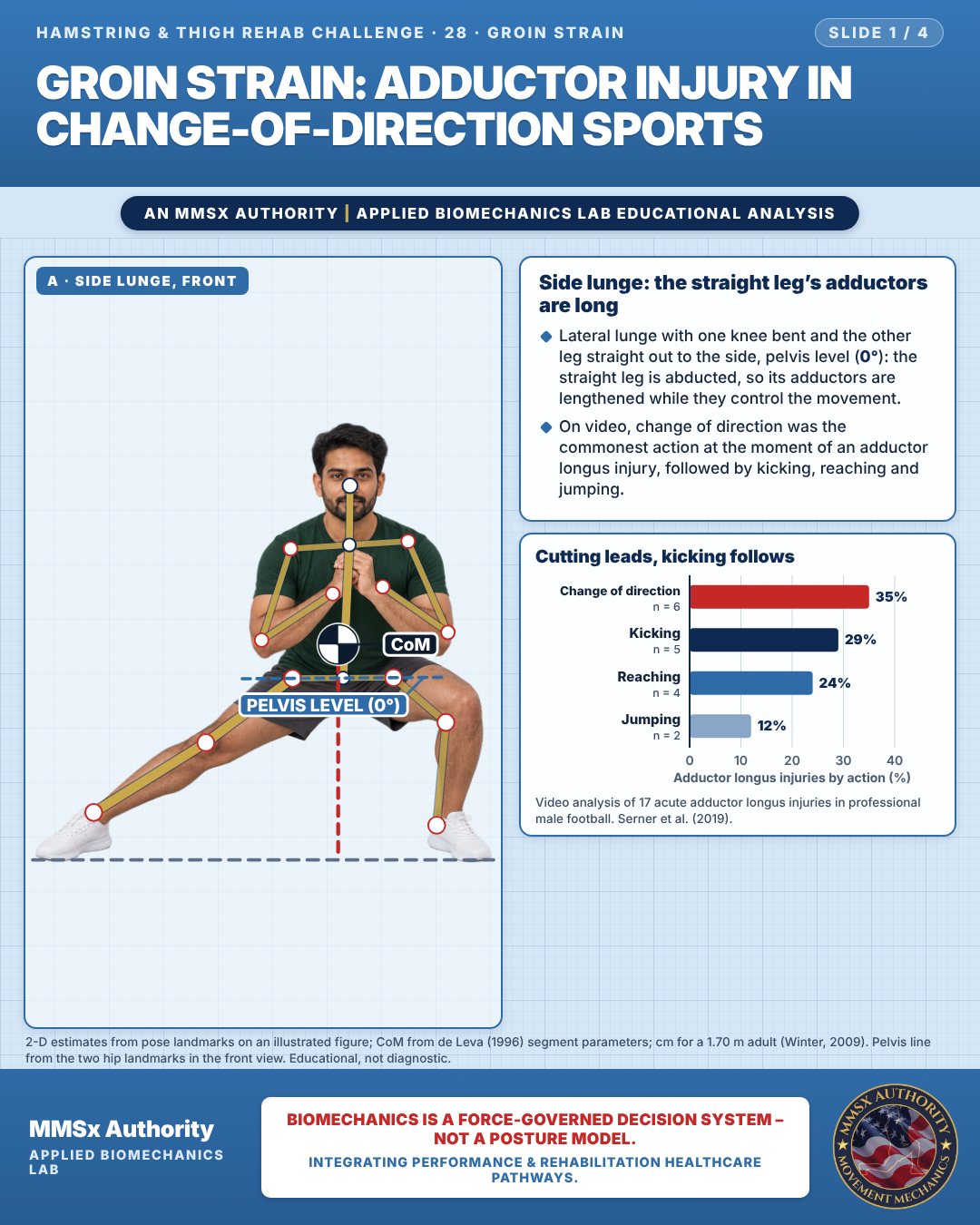
Side lunge: the straight leg’s adductors are long
Lateral lunge with one knee bent and the other leg straight out to the side, pelvis level (0°): the straight leg is abducted, so its adductors are lengthened while they control the movement.
On video, change of direction was the commonest action at the moment of an adductor longus injury, followed by kicking, reaching and jumping.
Cutting leads, kicking follows
Movement B: Cutting step (front view)
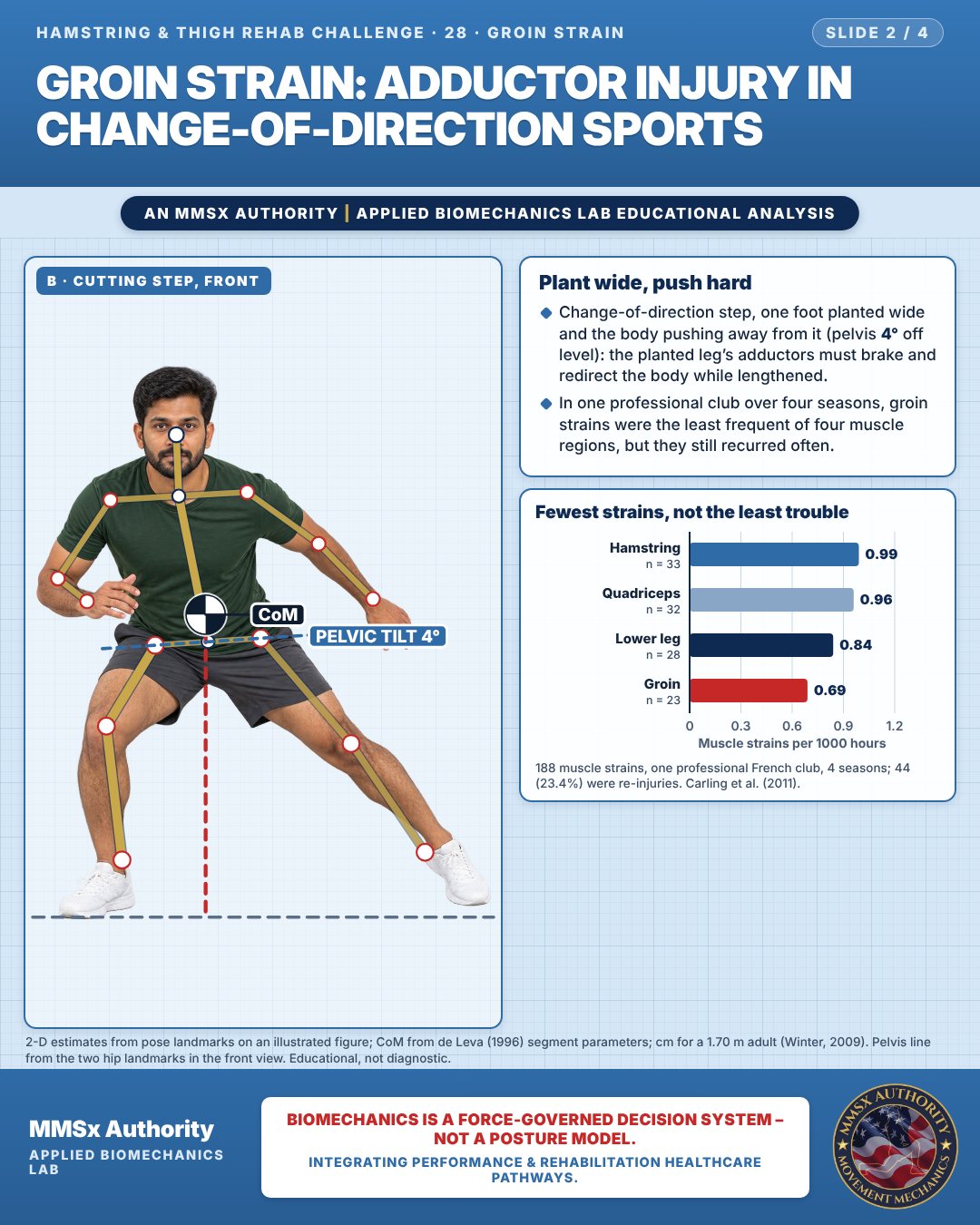
Plant wide, push hard
Change-of-direction step, one foot planted wide and the body pushing away from it (pelvis 4° off level): the planted leg’s adductors must brake and redirect the body while lengthened.
In one professional club over four seasons, groin strains were the least frequent of four muscle regions, but they still recurred often.
Fewest strains, not the least trouble
Movement C: Hand on groin (front view)
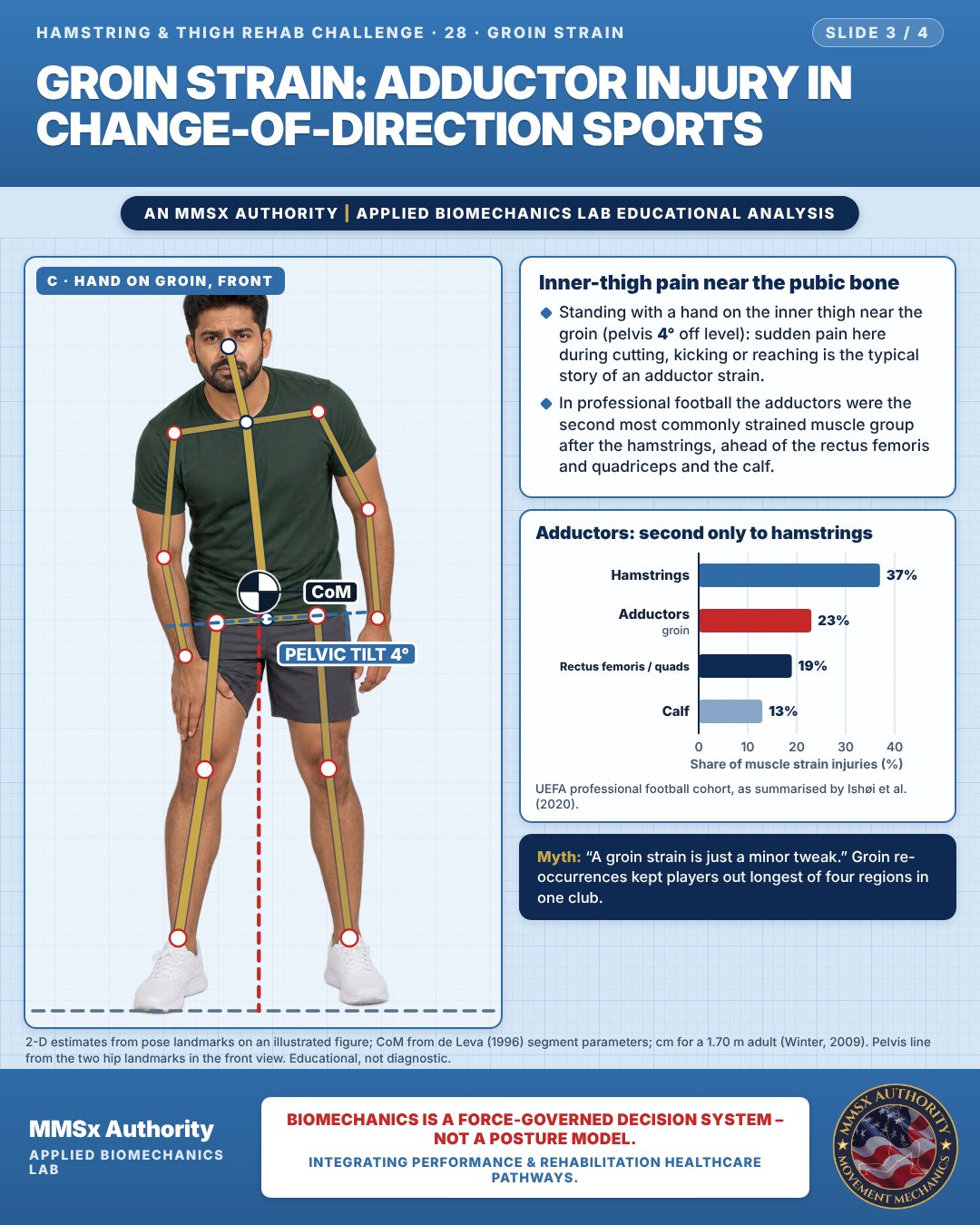
Inner-thigh pain near the pubic bone
Standing with a hand on the inner thigh near the groin (pelvis 4° off level): sudden pain here during cutting, kicking or reaching is the typical story of an adductor strain.
In professional football the adductors were the second most commonly strained muscle group after the hamstrings, ahead of the rectus femoris and quadriceps and the calf.
Adductors: second only to hamstrings
Decision pathway
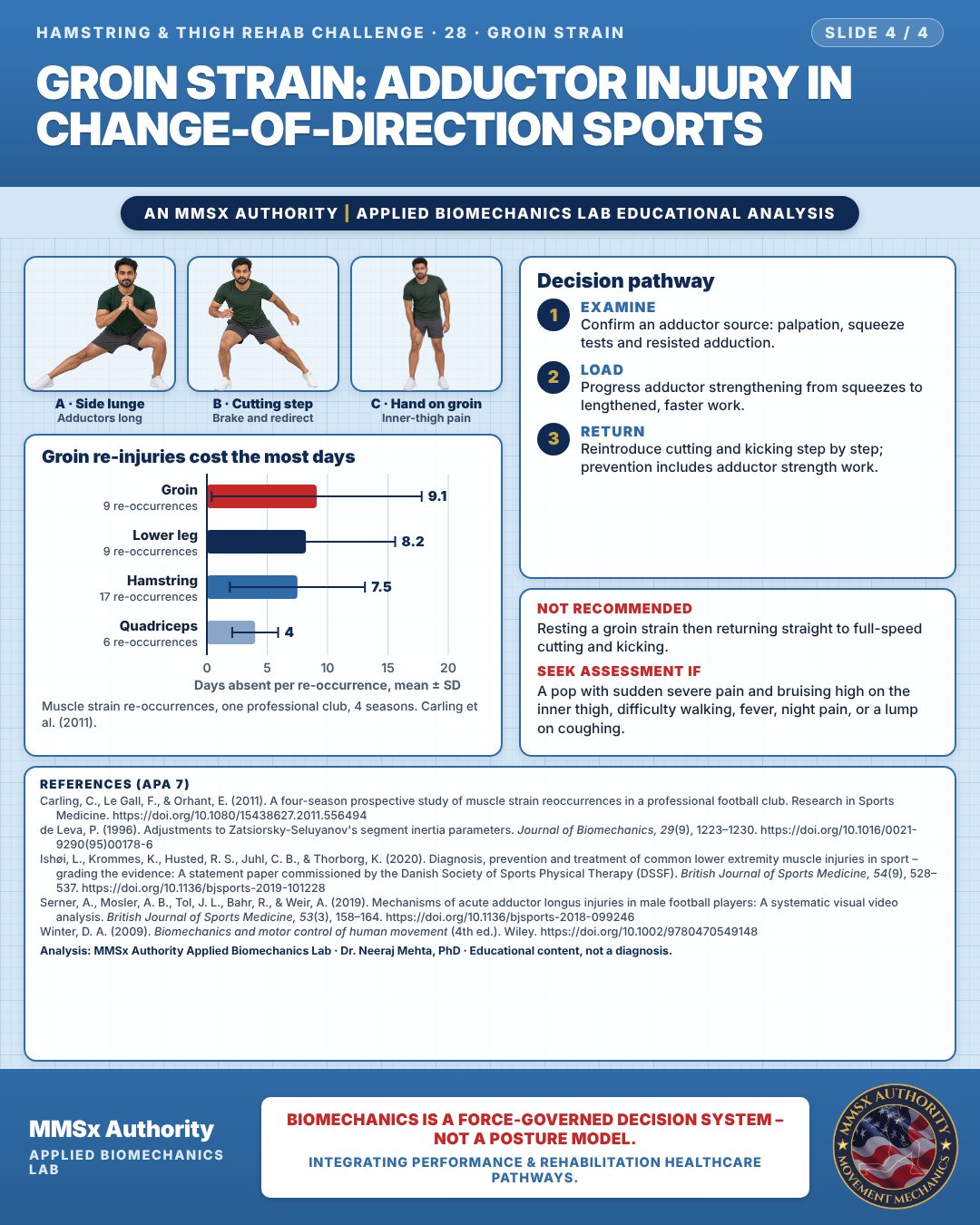
Groin re-injuries cost the most days
Examine
Confirm an adductor source: palpation, squeeze tests and resisted adduction.
Load
Progress adductor strengthening from squeezes to lengthened, faster work.
Return
Reintroduce cutting and kicking step by step; prevention includes adductor strength work.
What the evidence supports
- No studies were identified for the treatment of acute adductor injuries (Ishøi et al., 2020). Management is therefore based on clinical reasoning and criteria-based progressive loading.
- For long-standing adductor-related groin pain, an exercise-based approach with a large focus on strengthening the adductors has been recommended (Ishøi et al., 2020).
Myth and evidence
Myth“A groin strain is just a minor tweak.”
EvidenceIn one professional club over four seasons, 9 groin strain re-occurrences were recorded, and these had the longest mean absence of any region (9.1 days) (Carling et al., 2011). A structured return, not just rest, is needed.
Cautions
Not recommended
Resting a groin strain then returning straight to full-speed cutting and kicking.
Seek assessment if
A pop with sudden severe pain and bruising high on the inner thigh, difficulty walking, fever, night pain, or a lump on coughing.
Methods note
2-D estimates from pose landmarks on an illustrated figure; CoM from de Leva (1996) segment parameters; cm for a 1.70 m adult (Winter, 2009). Pelvis line from the two hip landmarks in the front view. These are educational estimates, not a diagnosis.
References
- Carling, C., Le Gall, F., & Orhant, E. (2011). A four-season prospective study of muscle strain reoccurrences in a professional football club. Research in Sports Medicine. https://doi.org/10.1080/15438627.2011.556494
- de Leva, P. (1996). Adjustments to Zatsiorsky-Seluyanov's segment inertia parameters. Journal of Biomechanics, 29(9), 1223–1230. https://doi.org/10.1016/0021-9290(95)00178-6
- Ishøi, L., Krommes, K., Husted, R. S., Juhl, C. B., & Thorborg, K. (2020). Diagnosis, prevention and treatment of common lower extremity muscle injuries in sport – grading the evidence: A statement paper commissioned by the Danish Society of Sports Physical Therapy (DSSF). British Journal of Sports Medicine, 54(9), 528–537. https://doi.org/10.1136/bjsports-2019-101228
- Serner, A., Mosler, A. B., Tol, J. L., Bahr, R., & Weir, A. (2019). Mechanisms of acute adductor longus injuries in male football players: A systematic visual video analysis. British Journal of Sports Medicine, 53(3), 158–164. https://doi.org/10.1136/bjsports-2018-099246
- Winter, D. A. (2009). Biomechanics and motor control of human movement (4th ed.). Wiley. https://doi.org/10.1002/9780470549148
Cite this article
Mehta, N. (2026, October 26). Groin strain: adductor injury in change-of-direction sports. MMSx Authority Applied Biomechanics Lab. https://mmsxauthority.org/edu/analysis/hamstring-thigh/28-groin-strain-adductor-injury-in-change-of-direction-sports/
Part of the collection
Mehta, N. (2026). Hamstring and Thigh Rehabilitation: 50 Evidence-Based Biomechanics Analyses [Collection]. MMSx Authority Applied Biomechanics Lab. Zenodo. https://doi.org/10.5281/zenodo.23735792
All Hamstring & Thigh Rehab Challenge articles · Rehabilitation Library