Hamstring & Thigh Rehab Challenge · 27
Front-of-thigh pain when squatting: load, depth and knee position
Front-of-thigh or front-of-knee pain during squatting is load-related pain from the knee-extensor mechanism: the quadriceps muscle, the quadriceps…
Key points
- Dose depth. Set a box just above the depth where pain starts, and lower it as symptoms allow.
- Share the load. Sit the hips back to move effort to the hip while the front of the thigh settles.
- Monitor. Judge progress by symptoms during and the day after, not by form rules alone.
What it is
Front-of-thigh or front-of-knee pain during squatting is load-related pain from the knee-extensor mechanism: the quadriceps muscle, the quadriceps and patellar tendons, and the patellofemoral joint. It usually reflects how much knee-extensor demand the squat creates, which depends on depth, load and how far the knees travel forward, rather than a single "wrong" technique.
How we analysed the movement
Three movements relevant to this topic were analysed from illustrated reference figures. Joint centres were located with two-dimensional pose estimation; hip and knee angles, pelvis level, the whole-body centre of mass and, where relevant, the hip lever (the horizontal distance from the hip joint to the upper-body centre of mass) and the resulting static hip moment were then calculated from standard segment parameters. The figures are educational estimates that show how position changes mechanical demand; they are not measurements of a patient. Every research value quoted below comes from the published source cited beside it.
Movement A: Knees-forward squat (side view)
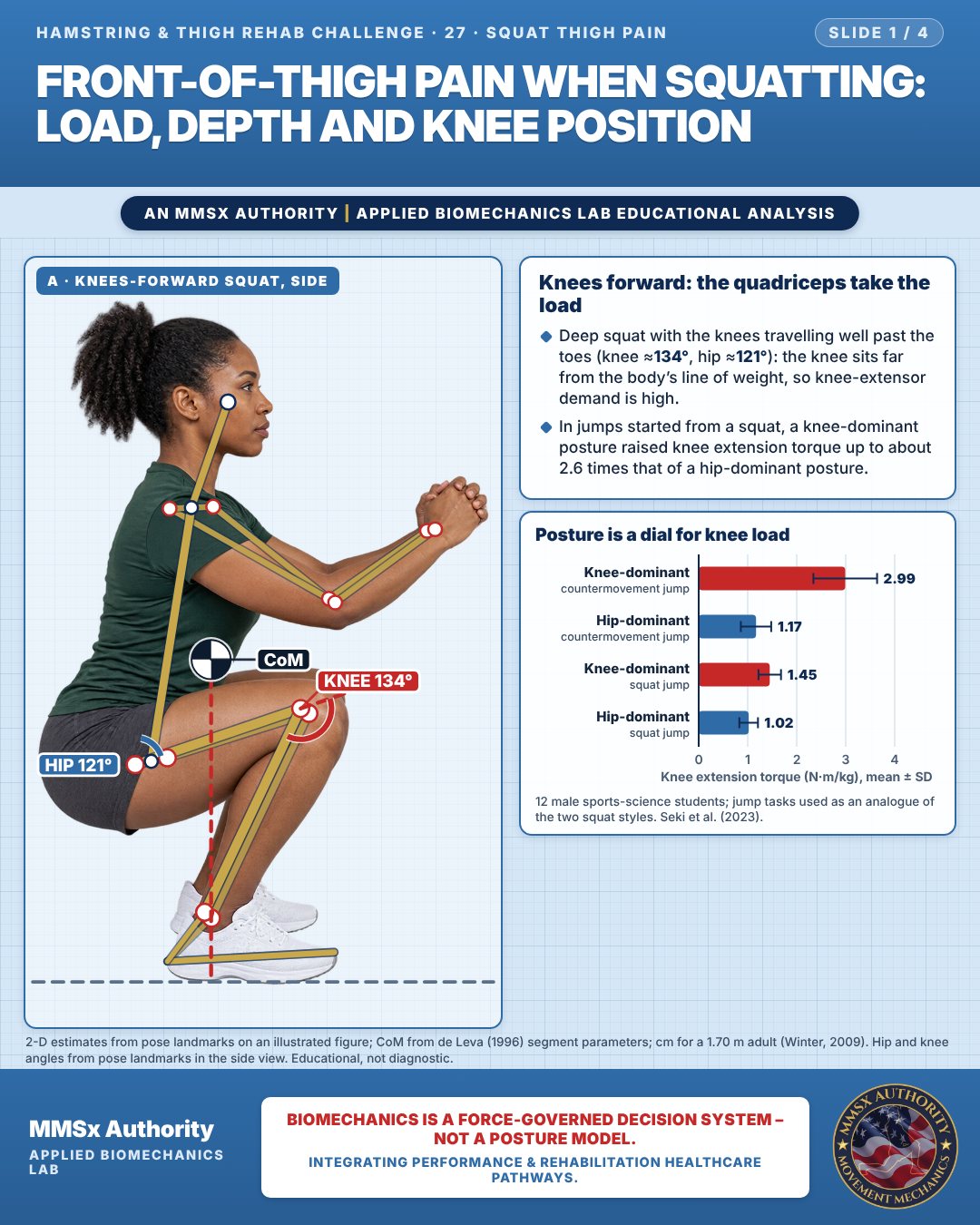
Knees forward: the quadriceps take the load
Deep squat with the knees travelling well past the toes (knee ≈134°, hip ≈121°): the knee sits far from the body’s line of weight, so knee-extensor demand is high.
In jumps started from a squat, a knee-dominant posture raised knee extension torque up to about 2.6 times that of a hip-dominant posture.
Posture is a dial for knee load
Movement B: Hips-back squat (side view)
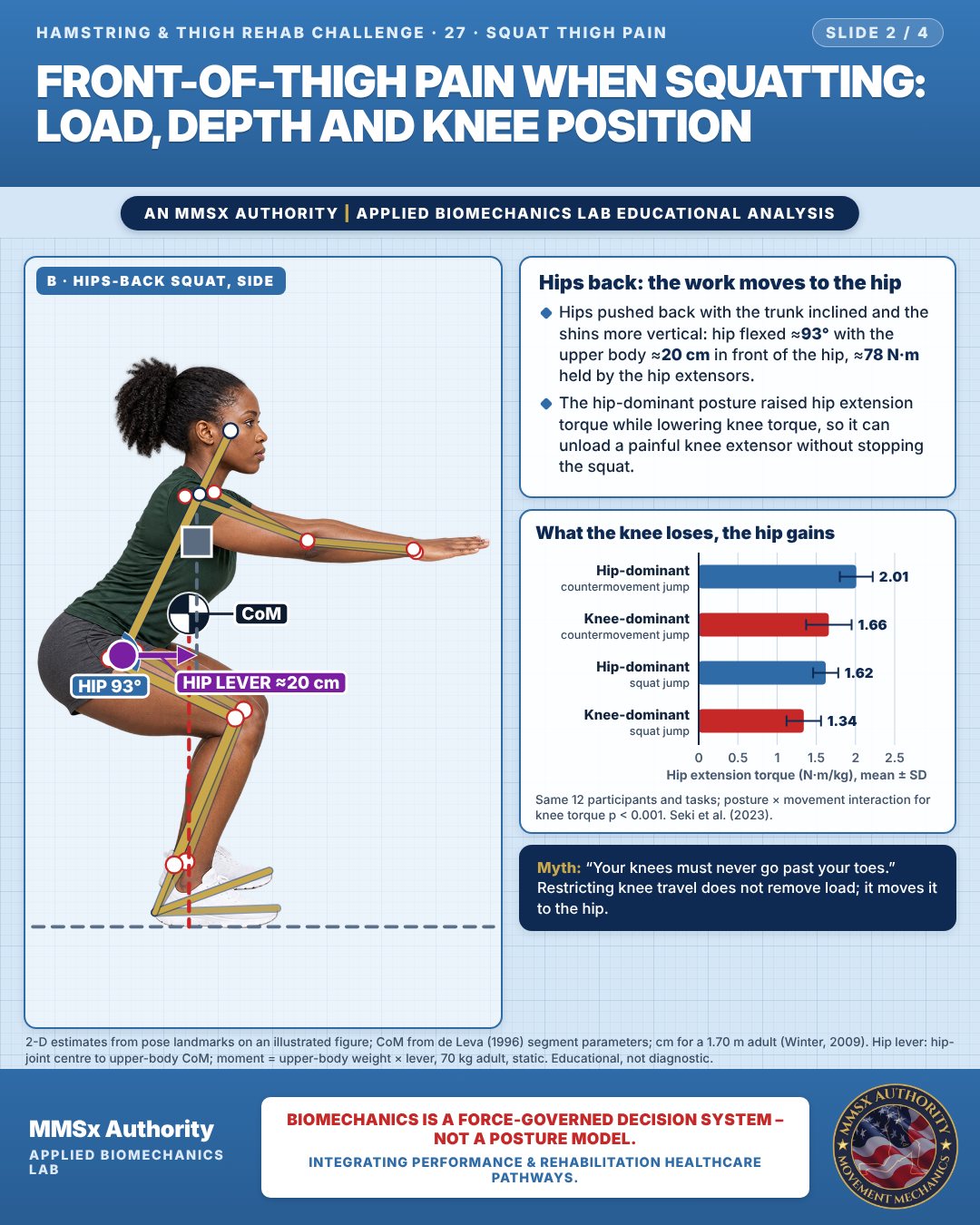
Hips back: the work moves to the hip
Hips pushed back with the trunk inclined and the shins more vertical: hip flexed ≈93° with the upper body ≈20 cm in front of the hip, ≈78 N·m held by the hip extensors.
The hip-dominant posture raised hip extension torque while lowering knee torque, so it can unload a painful knee extensor without stopping the squat.
What the knee loses, the hip gains
Movement C: Box squat (side view)
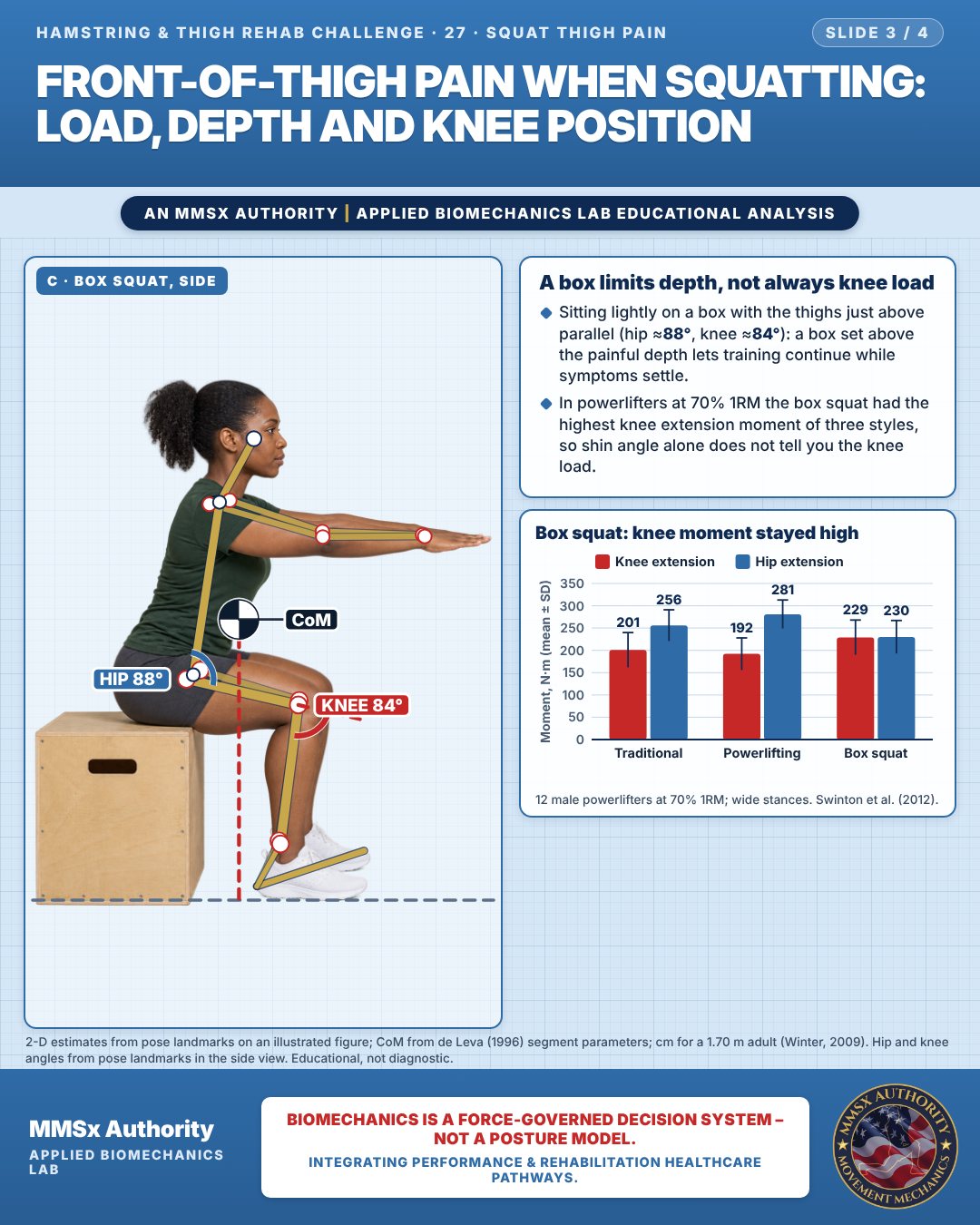
A box limits depth, not always knee load
Sitting lightly on a box with the thighs just above parallel (hip ≈88°, knee ≈84°): a box set above the painful depth lets training continue while symptoms settle.
In powerlifters at 70% 1RM the box squat had the highest knee extension moment of three styles, so shin angle alone does not tell you the knee load.
Box squat: knee moment stayed high
Decision pathway
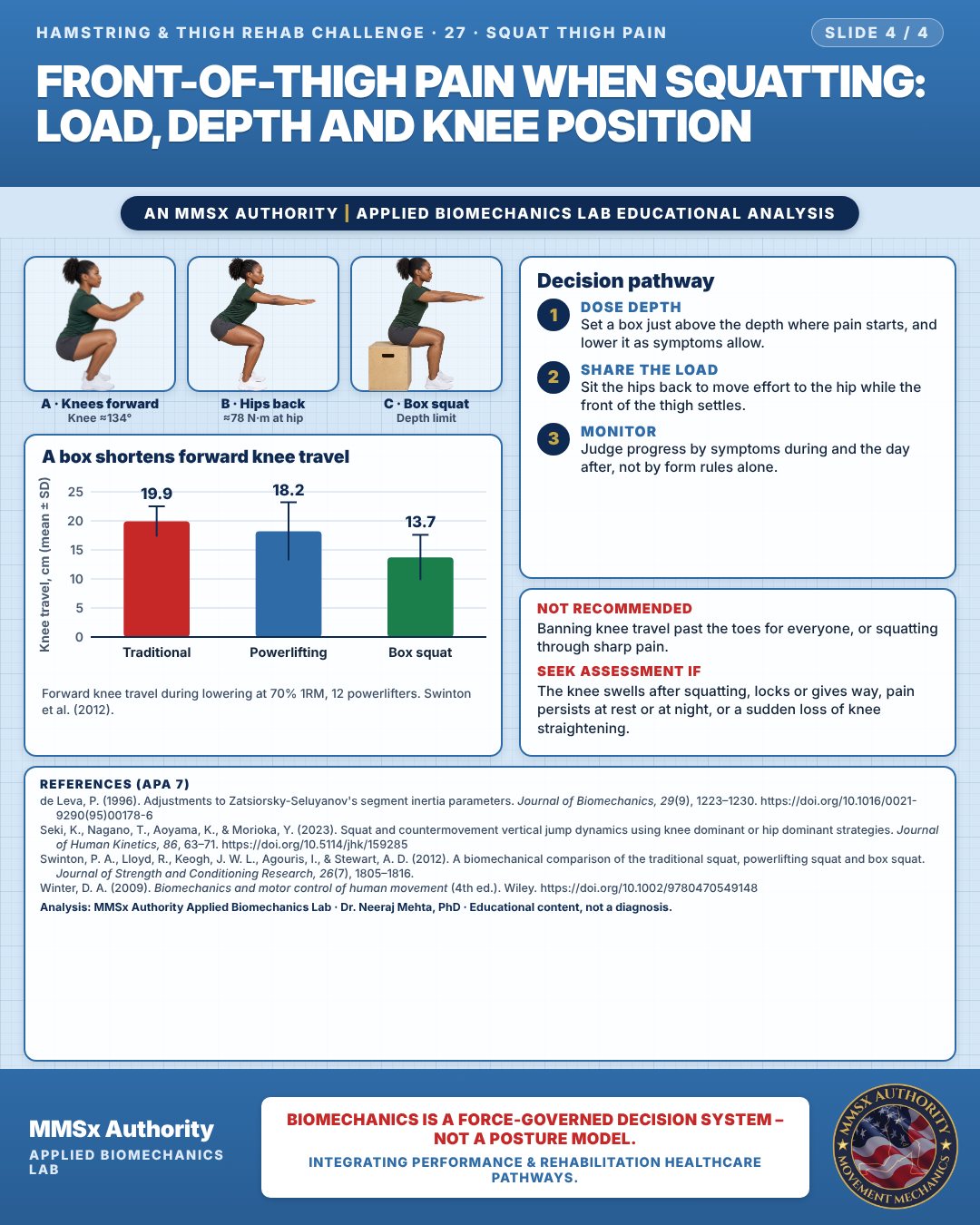
A box shortens forward knee travel
Dose depth
Set a box just above the depth where pain starts, and lower it as symptoms allow.
Share the load
Sit the hips back to move effort to the hip while the front of the thigh settles.
Monitor
Judge progress by symptoms during and the day after, not by form rules alone.
What the evidence supports
- Shifting to a hips-back pattern moves effort to the hip (Seki et al., 2023), but box squatting does not automatically lower knee moments (Swinton et al., 2012). Monitor symptoms, not only form.
Myth and evidence
Myth“Your knees must never go past your toes.”
EvidenceRestricting forward knee travel does not remove load; it moves it. A hips-back posture lowered knee torque but raised hip torque (Seki et al., 2023). Knee travel past the toes is a normal way to share load between the knee and hip, to be dosed rather than forbidden.
Cautions
Not recommended
Banning knee travel past the toes for everyone, or squatting through sharp pain.
Seek assessment if
The knee swells after squatting, locks or gives way, pain persists at rest or at night, or a sudden loss of knee straightening.
Methods note
2-D estimates from pose landmarks on an illustrated figure; CoM from de Leva (1996) segment parameters; cm for a 1.70 m adult (Winter, 2009). Hip and knee angles from pose landmarks in the side view. Hip lever: hip-joint centre to upper-body CoM; moment = upper-body weight × lever, 70 kg adult, static. These are educational estimates, not a diagnosis.
References
- de Leva, P. (1996). Adjustments to Zatsiorsky-Seluyanov's segment inertia parameters. Journal of Biomechanics, 29(9), 1223–1230. https://doi.org/10.1016/0021-9290(95)00178-6
- Seki, K., Nagano, T., Aoyama, K., & Morioka, Y. (2023). Squat and countermovement vertical jump dynamics using knee dominant or hip dominant strategies. Journal of Human Kinetics, 86, 63–71. https://doi.org/10.5114/jhk/159285
- Swinton, P. A., Lloyd, R., Keogh, J. W. L., Agouris, I., & Stewart, A. D. (2012). A biomechanical comparison of the traditional squat, powerlifting squat and box squat. Journal of Strength and Conditioning Research, 26(7), 1805–1816.
- Winter, D. A. (2009). Biomechanics and motor control of human movement (4th ed.). Wiley. https://doi.org/10.1002/9780470549148
Cite this article
Mehta, N. (2026, October 26). Front-of-thigh pain when squatting: load, depth and knee position. MMSx Authority Applied Biomechanics Lab. https://mmsxauthority.org/edu/analysis/hamstring-thigh/27-front-of-thigh-pain-when-squatting-load-depth-and-knee-position/
Part of the collection
Mehta, N. (2026). Hamstring and Thigh Rehabilitation: 50 Evidence-Based Biomechanics Analyses [Collection]. MMSx Authority Applied Biomechanics Lab. Zenodo. https://doi.org/10.5281/zenodo.23735792
All Hamstring & Thigh Rehab Challenge articles · Rehabilitation Library