Hamstring & Thigh Rehab Challenge · 26
Quadriceps tendinopathy: pain above the kneecap
Quadriceps tendinopathy is a load-related painful condition of the quadriceps tendon, usually felt as localised tenderness at the upper border of the kneecap.
Key points
- Calm. Reduce painful deep-flexion and decline loading; use isometric holds to settle pain.
- Load. Build heavy, slow quadriceps strength through a tolerable range.
- Progress. Add depth, then decline work and jumping, guided by next-day symptoms.
What it is
Quadriceps tendinopathy is a load-related painful condition of the quadriceps tendon, usually felt as localised tenderness at the upper border of the kneecap. It is less common than patellar tendinopathy and is most often seen in jumping and squatting sports (King et al., 2019a).
How we analysed the movement
Three movements relevant to this topic were analysed from illustrated reference figures. Joint centres were located with two-dimensional pose estimation; hip and knee angles, pelvis level, the whole-body centre of mass and, where relevant, the hip lever (the horizontal distance from the hip joint to the upper-body centre of mass) and the resulting static hip moment were then calculated from standard segment parameters. The figures are educational estimates that show how position changes mechanical demand; they are not measurements of a patient. Every research value quoted below comes from the published source cited beside it.
Movement A: Forward lunge (side view)
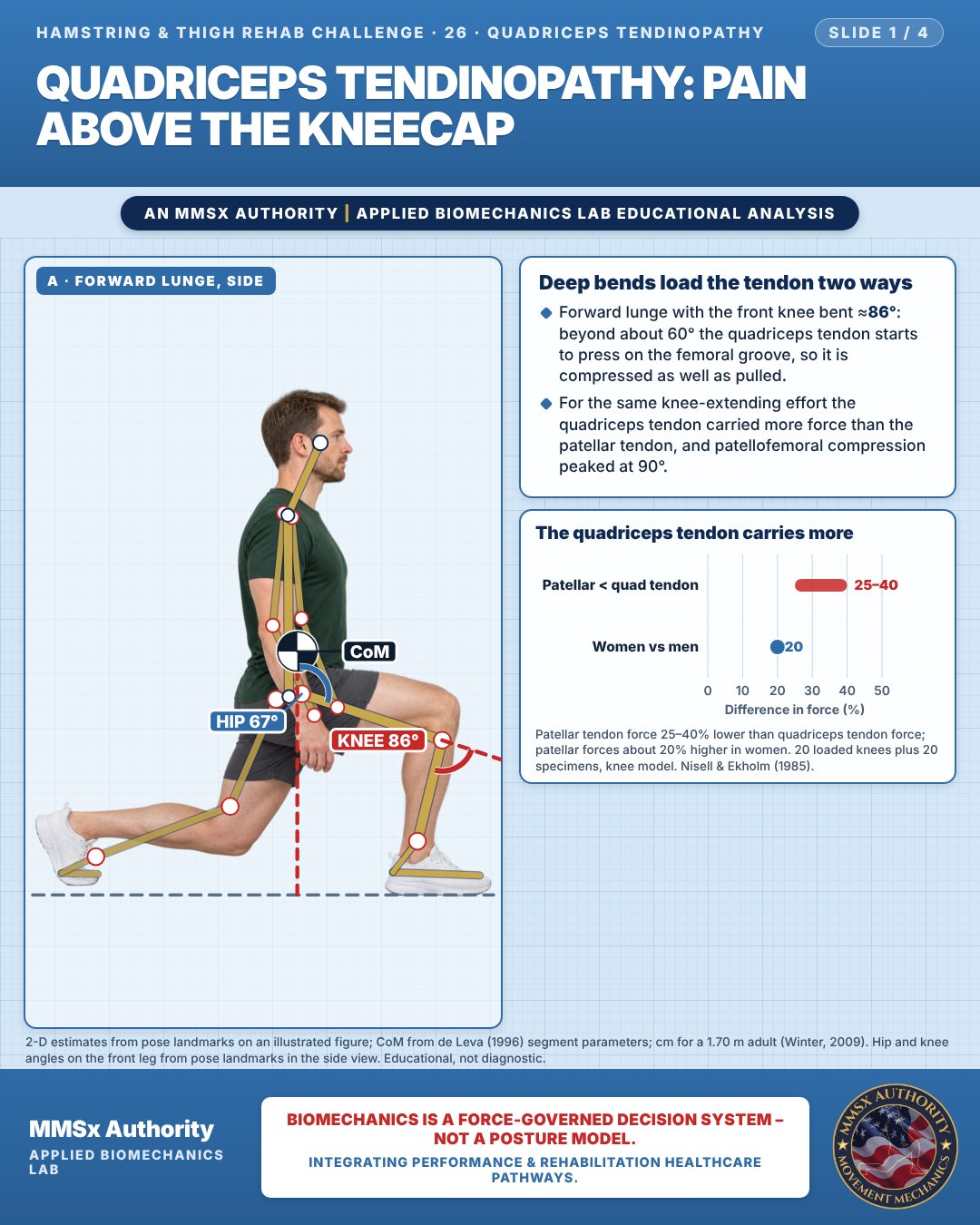
Deep bends load the tendon two ways
Forward lunge with the front knee bent ≈86°: beyond about 60° the quadriceps tendon starts to press on the femoral groove, so it is compressed as well as pulled.
For the same knee-extending effort the quadriceps tendon carried more force than the patellar tendon, and patellofemoral compression peaked at 90°.
The quadriceps tendon carries more
Movement B: Wall sit (side view)
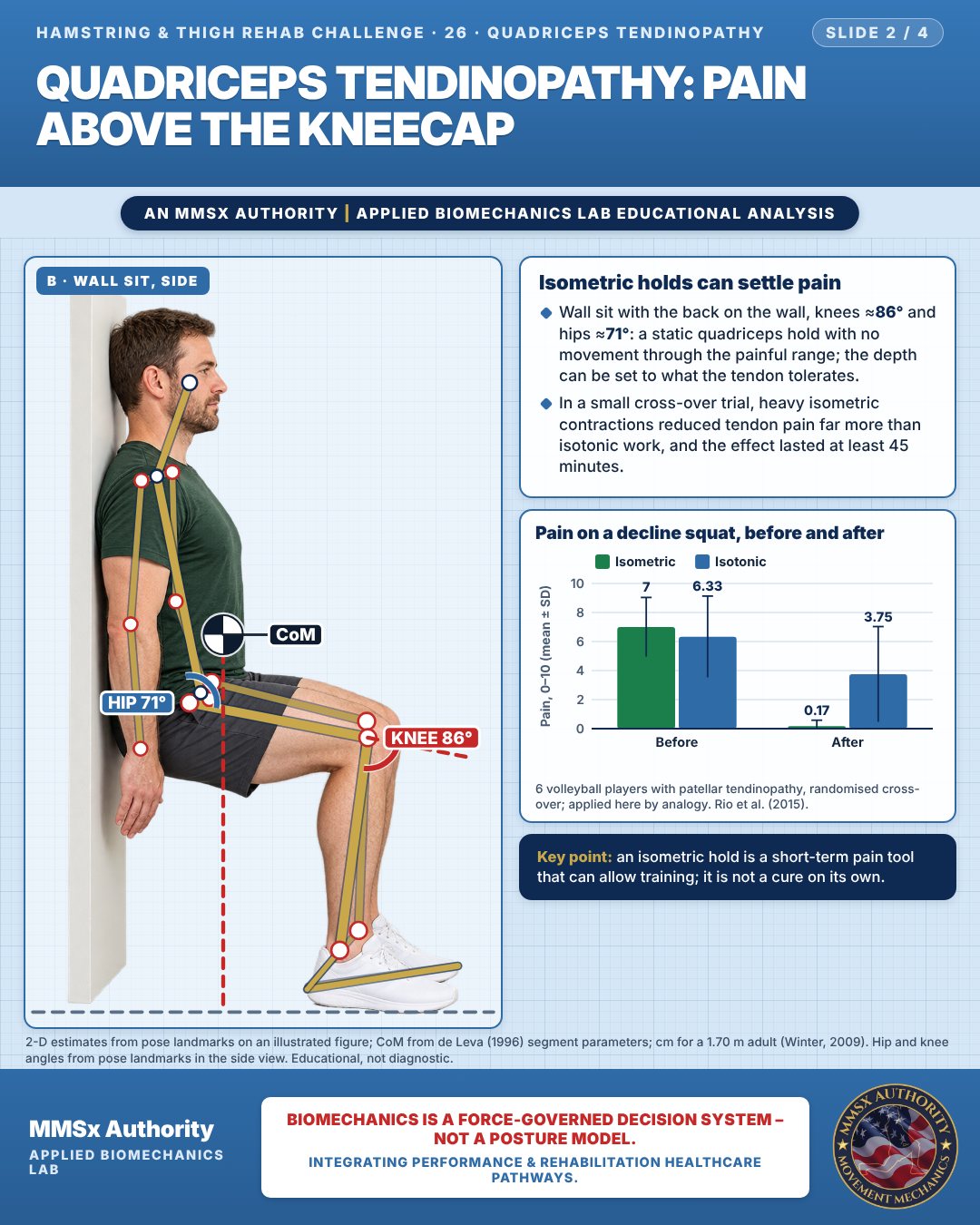
Isometric holds can settle pain
Wall sit with the back on the wall, knees ≈86° and hips ≈71°: a static quadriceps hold with no movement through the painful range; the depth can be set to what the tendon tolerates.
In a small cross-over trial, heavy isometric contractions reduced tendon pain far more than isotonic work, and the effect lasted at least 45 minutes.
Pain on a decline squat, before and after
Movement C: Decline squat (side view)
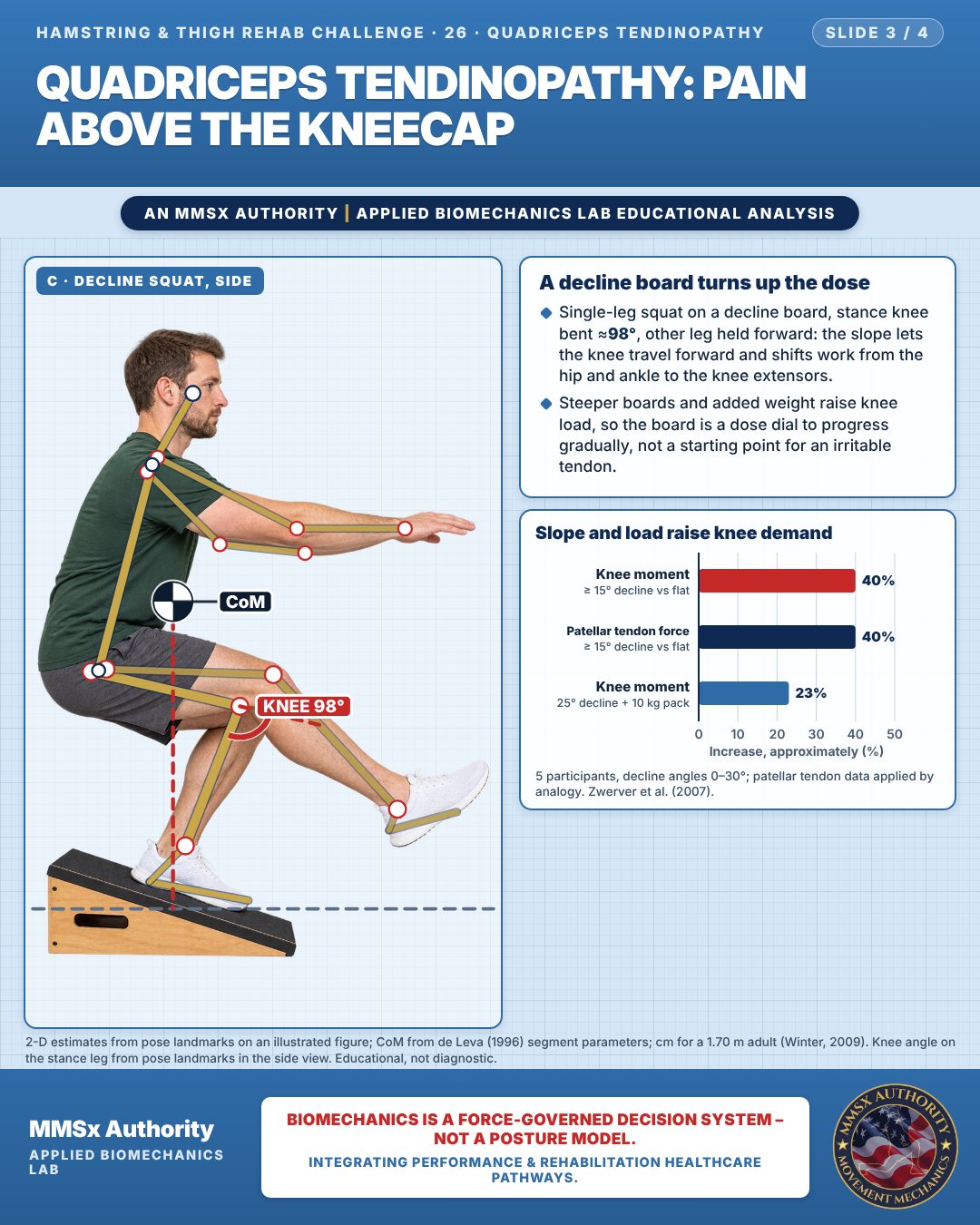
A decline board turns up the dose
Single-leg squat on a decline board, stance knee bent ≈98°, other leg held forward: the slope lets the knee travel forward and shifts work from the hip and ankle to the knee extensors.
Steeper boards and added weight raise knee load, so the board is a dose dial to progress gradually, not a starting point for an irritable tendon.
Slope and load raise knee demand
Decision pathway
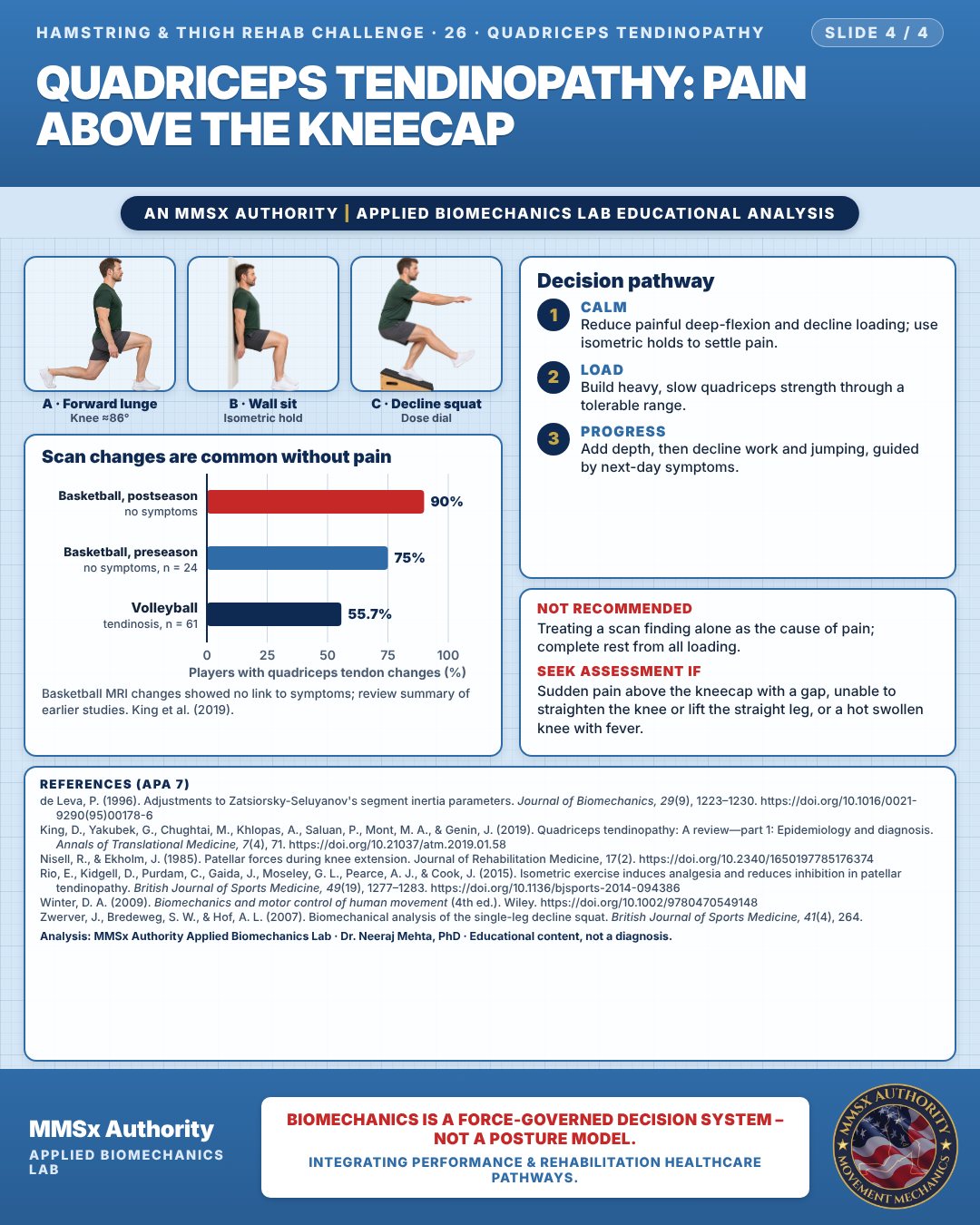
Scan changes are common without pain
Calm
Reduce painful deep-flexion and decline loading; use isometric holds to settle pain.
Load
Build heavy, slow quadriceps strength through a tolerable range.
Progress
Add depth, then decline work and jumping, guided by next-day symptoms.
What the evidence supports
- Quadriceps tendinopathy is initially managed non-operatively, including activity modification, physiotherapy and eccentric training (King et al., 2019b).
- Most treatment evidence comes from patellar tendinopathy studies; there is a shortage of quadriceps-specific trials (King et al., 2019b).
- Injections and surgery are reserved for persistent cases after failed conservative care, and the evidence for them is mainly from small patellar tendinopathy studies (King et al., 2019b).
Myth and evidence
Myth“The scan shows tendon damage, so that must be the cause of my pain.”
EvidenceIn asymptomatic basketball players, 75–90% had MRI changes consistent with quadriceps tendinopathy, with no link to symptoms (King et al., 2019a, summarising Pappas and colleagues). Pain and load tolerance, not the image alone, guide treatment.
Cautions
Not recommended
Treating a scan finding alone as the cause of pain; complete rest from all loading.
Seek assessment if
Sudden pain above the kneecap with a gap, unable to straighten the knee or lift the straight leg, or a hot swollen knee with fever.
Methods note
2-D estimates from pose landmarks on an illustrated figure; CoM from de Leva (1996) segment parameters; cm for a 1.70 m adult (Winter, 2009). Hip and knee angles on the front leg from pose landmarks in the side view. Hip and knee angles from pose landmarks in the side view. Knee angle on the stance leg from pose landmarks in the side view. These are educational estimates, not a diagnosis.
References
- de Leva, P. (1996). Adjustments to Zatsiorsky-Seluyanov's segment inertia parameters. Journal of Biomechanics, 29(9), 1223–1230. https://doi.org/10.1016/0021-9290(95)00178-6
- King, D., Yakubek, G., Chughtai, M., Khlopas, A., Saluan, P., Mont, M. A., & Genin, J. (2019). Quadriceps tendinopathy: A review—part 1: Epidemiology and diagnosis. Annals of Translational Medicine, 7(4), 71. https://doi.org/10.21037/atm.2019.01.58
- Nisell, R., & Ekholm, J. (1985). Patellar forces during knee extension. Journal of Rehabilitation Medicine, 17(2). https://doi.org/10.2340/1650197785176374
- Rio, E., Kidgell, D., Purdam, C., Gaida, J., Moseley, G. L., Pearce, A. J., & Cook, J. (2015). Isometric exercise induces analgesia and reduces inhibition in patellar tendinopathy. British Journal of Sports Medicine, 49(19), 1277–1283. https://doi.org/10.1136/bjsports-2014-094386
- Winter, D. A. (2009). Biomechanics and motor control of human movement (4th ed.). Wiley. https://doi.org/10.1002/9780470549148
- Zwerver, J., Bredeweg, S. W., & Hof, A. L. (2007). Biomechanical analysis of the single-leg decline squat. British Journal of Sports Medicine, 41(4), 264.
Cite this article
Mehta, N. (2026, October 26). Quadriceps tendinopathy: pain above the kneecap. MMSx Authority Applied Biomechanics Lab. https://mmsxauthority.org/edu/analysis/hamstring-thigh/26-quadriceps-tendinopathy-pain-above-the-kneecap/
Part of the collection
Mehta, N. (2026). Hamstring and Thigh Rehabilitation: 50 Evidence-Based Biomechanics Analyses [Collection]. MMSx Authority Applied Biomechanics Lab. Zenodo. https://doi.org/10.5281/zenodo.23735792
All Hamstring & Thigh Rehab Challenge articles · Rehabilitation Library