Hamstring & Thigh Rehab Challenge · 25
Quadriceps weakness after knee injury: why it lingers
Persistent quadriceps weakness after knee injury or surgery (for example ACL injury or reconstruction) is a lasting deficit in knee-extensor strength.
Key points
- Activate. Start with quadriceps setting and straight-leg raises while swelling settles.
- Isolate. Add machine knee extension so the weak side cannot hide; test both legs.
- Clear. Return on objective criteria, quadriceps symmetry above 90%, and keep training after.
What it is
Persistent quadriceps weakness after knee injury or surgery (for example ACL injury or reconstruction) is a lasting deficit in knee-extensor strength. It is driven partly by muscle atrophy and partly by arthrogenic muscle inhibition: a reflex reduction in the nervous system's ability to fully activate the quadriceps. It is often measured as quadriceps activation (central activation ratio) and as limb symmetry (involved / uninvolved strength × 100).
How we analysed the movement
Three movements relevant to this topic were analysed from illustrated reference figures. Joint centres were located with two-dimensional pose estimation; hip and knee angles, pelvis level, the whole-body centre of mass and, where relevant, the hip lever (the horizontal distance from the hip joint to the upper-body centre of mass) and the resulting static hip moment were then calculated from standard segment parameters. The figures are educational estimates that show how position changes mechanical demand; they are not measurements of a patient. Every research value quoted below comes from the published source cited beside it.
Movement A: Straight-leg raise (side view)
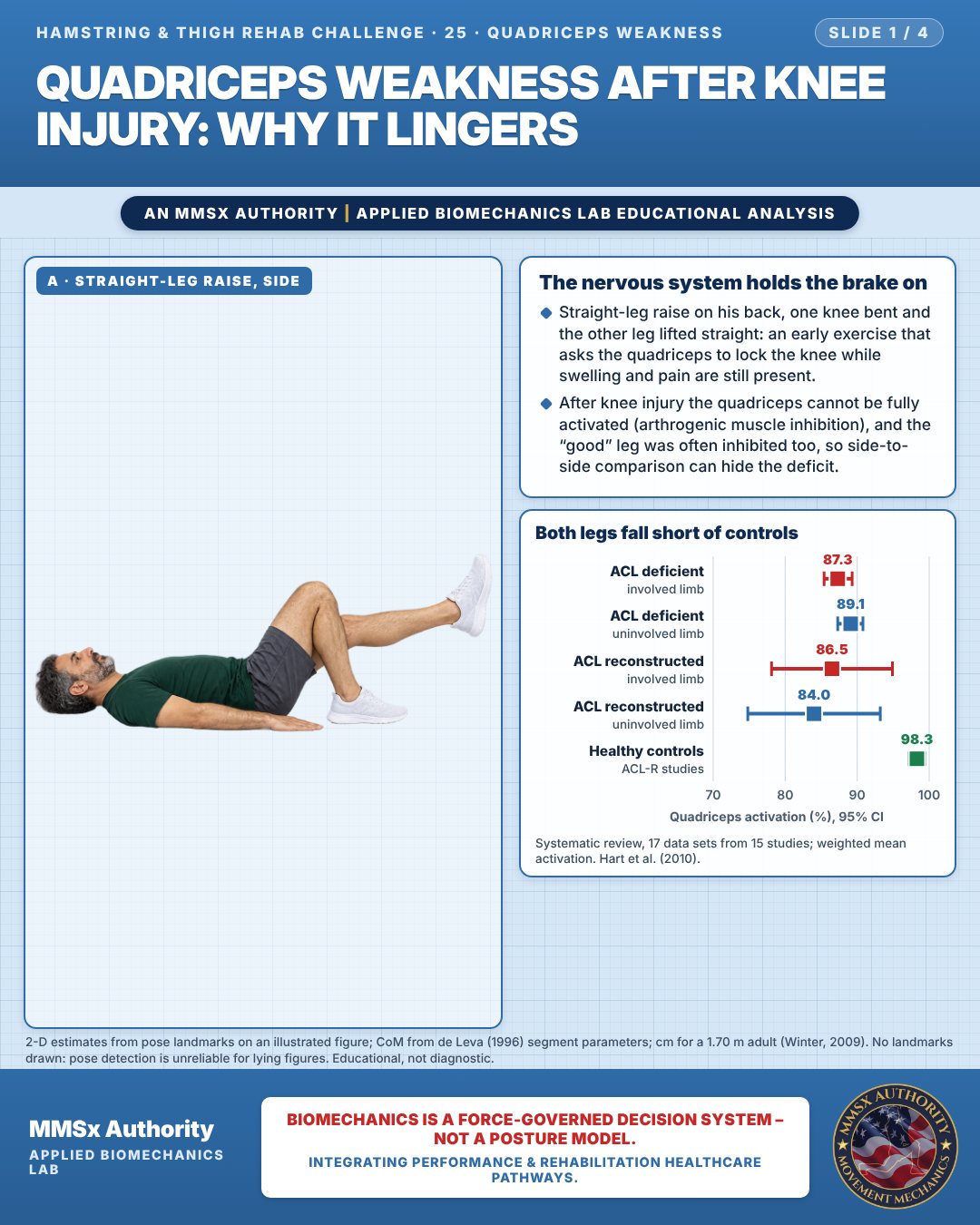
The nervous system holds the brake on
Straight-leg raise on his back, one knee bent and the other leg lifted straight: an early exercise that asks the quadriceps to lock the knee while swelling and pain are still present.
After knee injury the quadriceps cannot be fully activated (arthrogenic muscle inhibition), and the “good” leg was often inhibited too, so side-to-side comparison can hide the deficit.
Both legs fall short of controls
Movement B: Knee extension (side view)
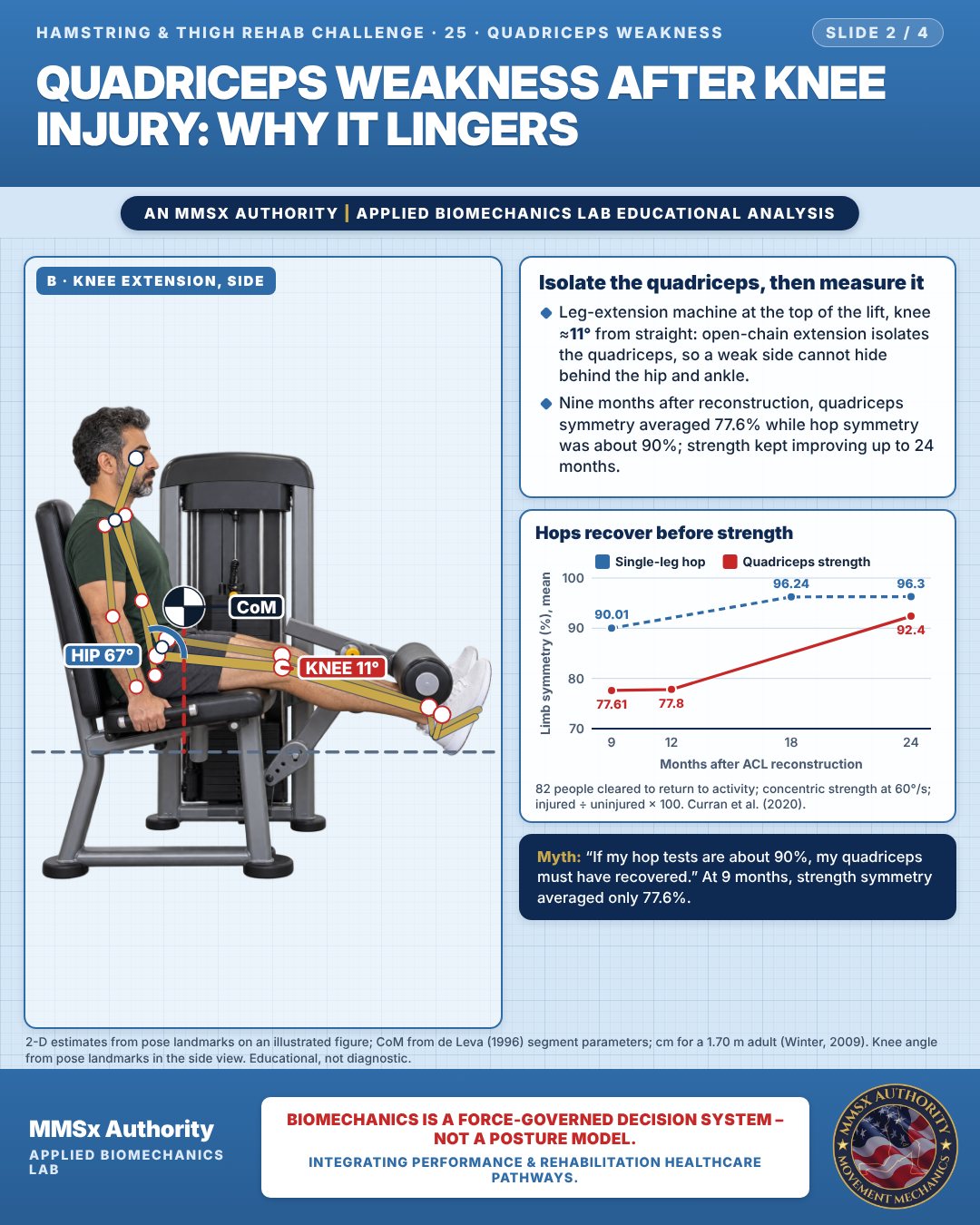
Isolate the quadriceps, then measure it
Leg-extension machine at the top of the lift, knee ≈11° from straight: open-chain extension isolates the quadriceps, so a weak side cannot hide behind the hip and ankle.
Nine months after reconstruction, quadriceps symmetry averaged 77.6% while hop symmetry was about 90%; strength kept improving up to 24 months.
Hops recover before strength
Movement C: Step-up (side view)
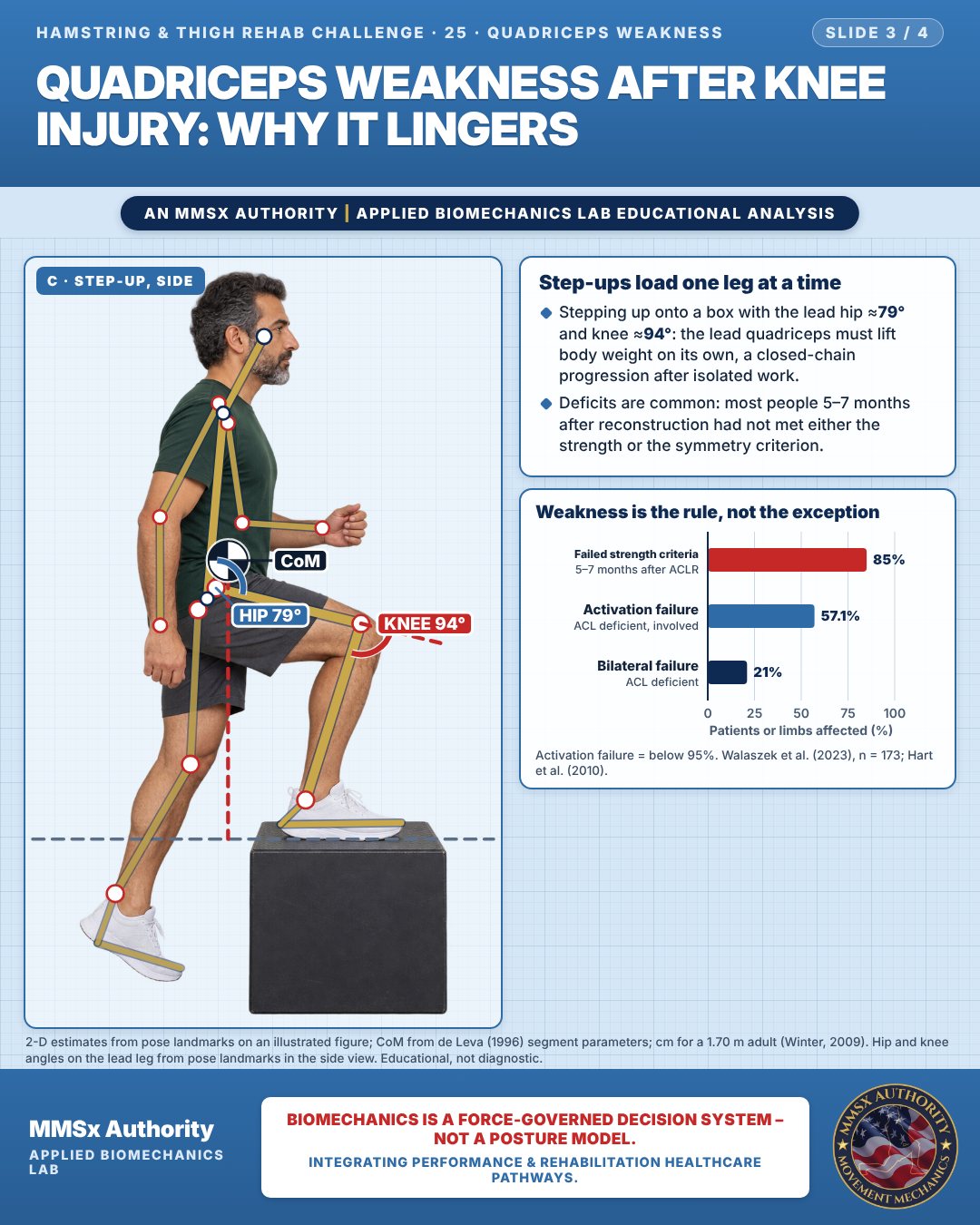
Step-ups load one leg at a time
Stepping up onto a box with the lead hip ≈79° and knee ≈94°: the lead quadriceps must lift body weight on its own, a closed-chain progression after isolated work.
Deficits are common: most people 5–7 months after reconstruction had not met either the strength or the symmetry criterion.
Weakness is the rule, not the exception
Decision pathway
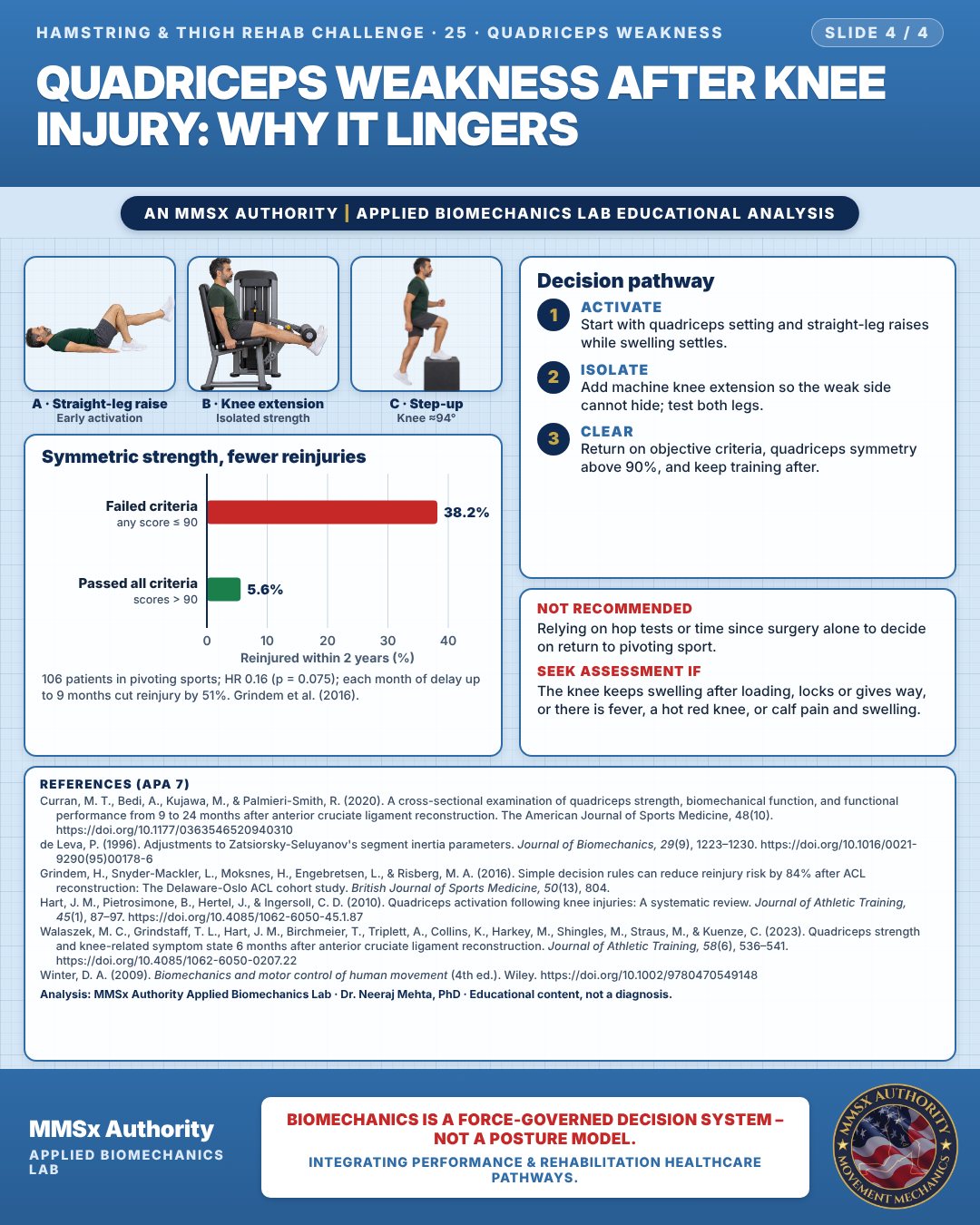
Symmetric strength, fewer reinjuries
Activate
Start with quadriceps setting and straight-leg raises while swelling settles.
Isolate
Add machine knee extension so the weak side cannot hide; test both legs.
Clear
Return on objective criteria, quadriceps symmetry above 90%, and keep training after.
What the evidence supports
- Quadriceps strengthening should target the involved limb and recognise that the uninvolved limb may also be inhibited. Symmetry indices can therefore overestimate recovery (Hart et al., 2010).
- Return-to-sport decisions should use objective criteria, including quadriceps strength symmetry above 90%, and return to pivoting sport should not occur before 9 months after ACL reconstruction (Grindem et al., 2016).
- Recovery continues after return to activity: strength and hop symmetry were still improving between 9 and 24 months (Curran et al., 2020). Strengthening should continue beyond clearance.
Myth and evidence
Myth“If my hop tests are about 90%, my quadriceps must have recovered.”
EvidenceAt 9 months after ACL reconstruction, hop distance symmetry averaged about 90% while quadriceps strength symmetry averaged only 77.6% (Curran et al., 2020). At 5–7 months after reconstruction, 85% of individuals had not met either the quadriceps strength criterion or the symmetry criterion (Walaszek et al., 2023).
Cautions
Not recommended
Relying on hop tests or time since surgery alone to decide on return to pivoting sport.
Seek assessment if
The knee keeps swelling after loading, locks or gives way, or there is fever, a hot red knee, or calf pain and swelling.
Methods note
2-D estimates from pose landmarks on an illustrated figure; CoM from de Leva (1996) segment parameters; cm for a 1.70 m adult (Winter, 2009). No landmarks drawn: pose detection is unreliable for lying figures. Knee angle from pose landmarks in the side view. Hip and knee angles on the lead leg from pose landmarks in the side view. These are educational estimates, not a diagnosis.
References
- Curran, M. T., Bedi, A., Kujawa, M., & Palmieri-Smith, R. (2020). A cross-sectional examination of quadriceps strength, biomechanical function, and functional performance from 9 to 24 months after anterior cruciate ligament reconstruction. The American Journal of Sports Medicine, 48(10). https://doi.org/10.1177/0363546520940310
- de Leva, P. (1996). Adjustments to Zatsiorsky-Seluyanov's segment inertia parameters. Journal of Biomechanics, 29(9), 1223–1230. https://doi.org/10.1016/0021-9290(95)00178-6
- Grindem, H., Snyder-Mackler, L., Moksnes, H., Engebretsen, L., & Risberg, M. A. (2016). Simple decision rules can reduce reinjury risk by 84% after ACL reconstruction: The Delaware-Oslo ACL cohort study. British Journal of Sports Medicine, 50(13), 804.
- Hart, J. M., Pietrosimone, B., Hertel, J., & Ingersoll, C. D. (2010). Quadriceps activation following knee injuries: A systematic review. Journal of Athletic Training, 45(1), 87–97. https://doi.org/10.4085/1062-6050-45.1.87
- Walaszek, M. C., Grindstaff, T. L., Hart, J. M., Birchmeier, T., Triplett, A., Collins, K., Harkey, M., Shingles, M., Straus, M., & Kuenze, C. (2023). Quadriceps strength and knee-related symptom state 6 months after anterior cruciate ligament reconstruction. Journal of Athletic Training, 58(6), 536–541. https://doi.org/10.4085/1062-6050-0207.22
- Winter, D. A. (2009). Biomechanics and motor control of human movement (4th ed.). Wiley. https://doi.org/10.1002/9780470549148
Cite this article
Mehta, N. (2026, October 26). Quadriceps weakness after knee injury: why it lingers. MMSx Authority Applied Biomechanics Lab. https://mmsxauthority.org/edu/analysis/hamstring-thigh/25-quadriceps-weakness-after-knee-injury-why-it-lingers/
Part of the collection
Mehta, N. (2026). Hamstring and Thigh Rehabilitation: 50 Evidence-Based Biomechanics Analyses [Collection]. MMSx Authority Applied Biomechanics Lab. Zenodo. https://doi.org/10.5281/zenodo.23735792
All Hamstring & Thigh Rehab Challenge articles · Rehabilitation Library