Hamstring & Thigh Rehab Challenge · 23
Thigh bruise (dead leg): recovery and when it can calcify
A thigh contusion ("dead leg", "corked thigh") is a direct-impact injury, usually to the quadriceps, from a knee, helmet, ball or stick.
Key points
- Protect. Limit bleeding early and rest the knee in a bent position.
- Restore. Regain pain-free knee bend with heel slides; track the range day by day.
- Reload. Strengthen and return to running and contact as knee bend and strength return.
What it is
A thigh contusion ("dead leg", "corked thigh") is a direct-impact injury, usually to the quadriceps, from a knee, helmet, ball or stick. Bleeding within the muscle causes swelling, pain, stiffness and limited knee bending. It is a clinical diagnosis based on a typical history and examination. It differs from a strain, which is an indirect (non-contact) injury.
How we analysed the movement
Three movements relevant to this topic were analysed from illustrated reference figures. Joint centres were located with two-dimensional pose estimation; hip and knee angles, pelvis level, the whole-body centre of mass and, where relevant, the hip lever (the horizontal distance from the hip joint to the upper-body centre of mass) and the resulting static hip moment were then calculated from standard segment parameters. The figures are educational estimates that show how position changes mechanical demand; they are not measurements of a patient. Every research value quoted below comes from the published source cited beside it.
Movement A: Knee bent rest (side view)
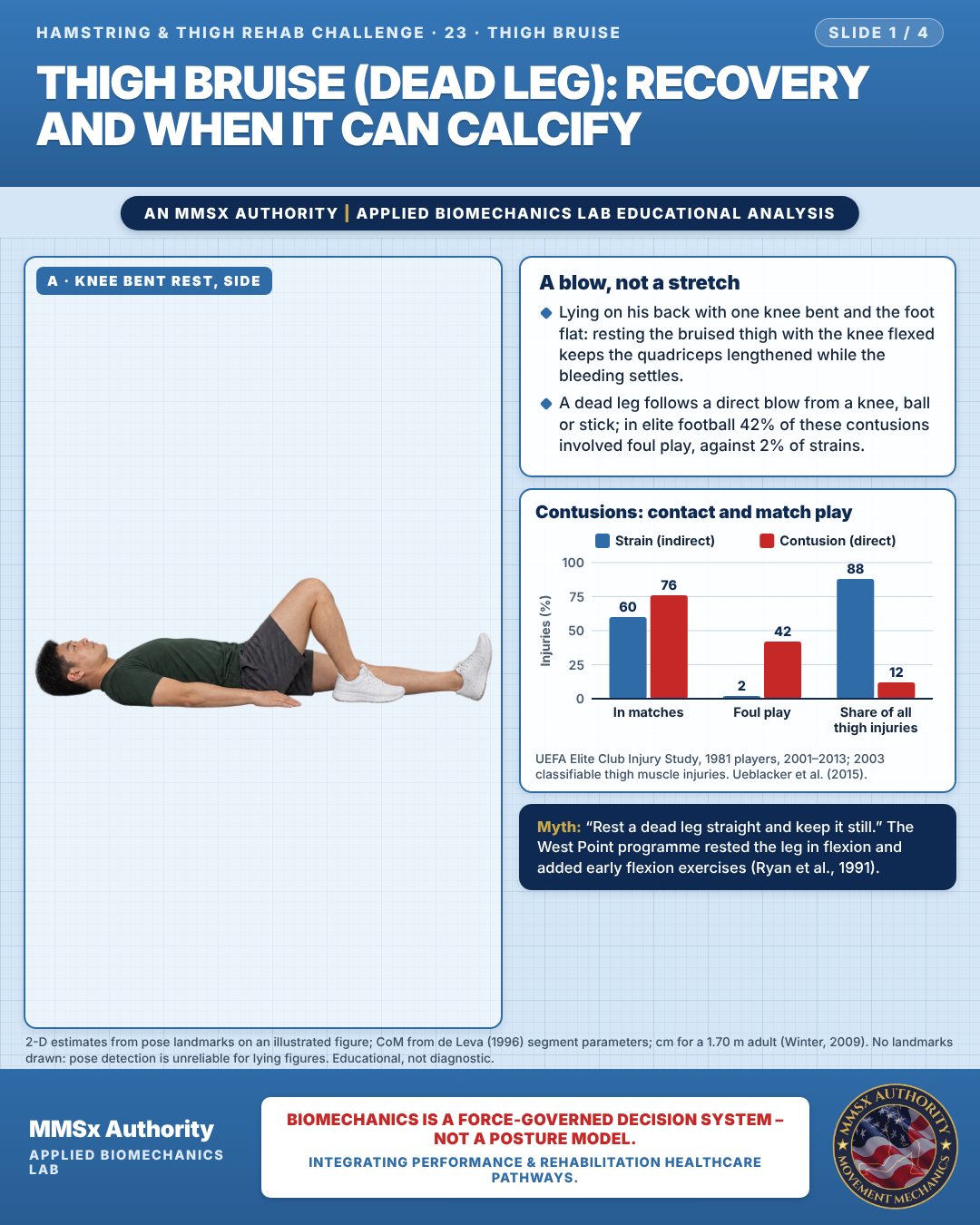
A blow, not a stretch
Lying on his back with one knee bent and the foot flat: resting the bruised thigh with the knee flexed keeps the quadriceps lengthened while the bleeding settles.
A dead leg follows a direct blow from a knee, ball or stick; in elite football 42% of these contusions involved foul play, against 2% of strains.
Contusions: contact and match play
Movement B: Heel slide (side view)
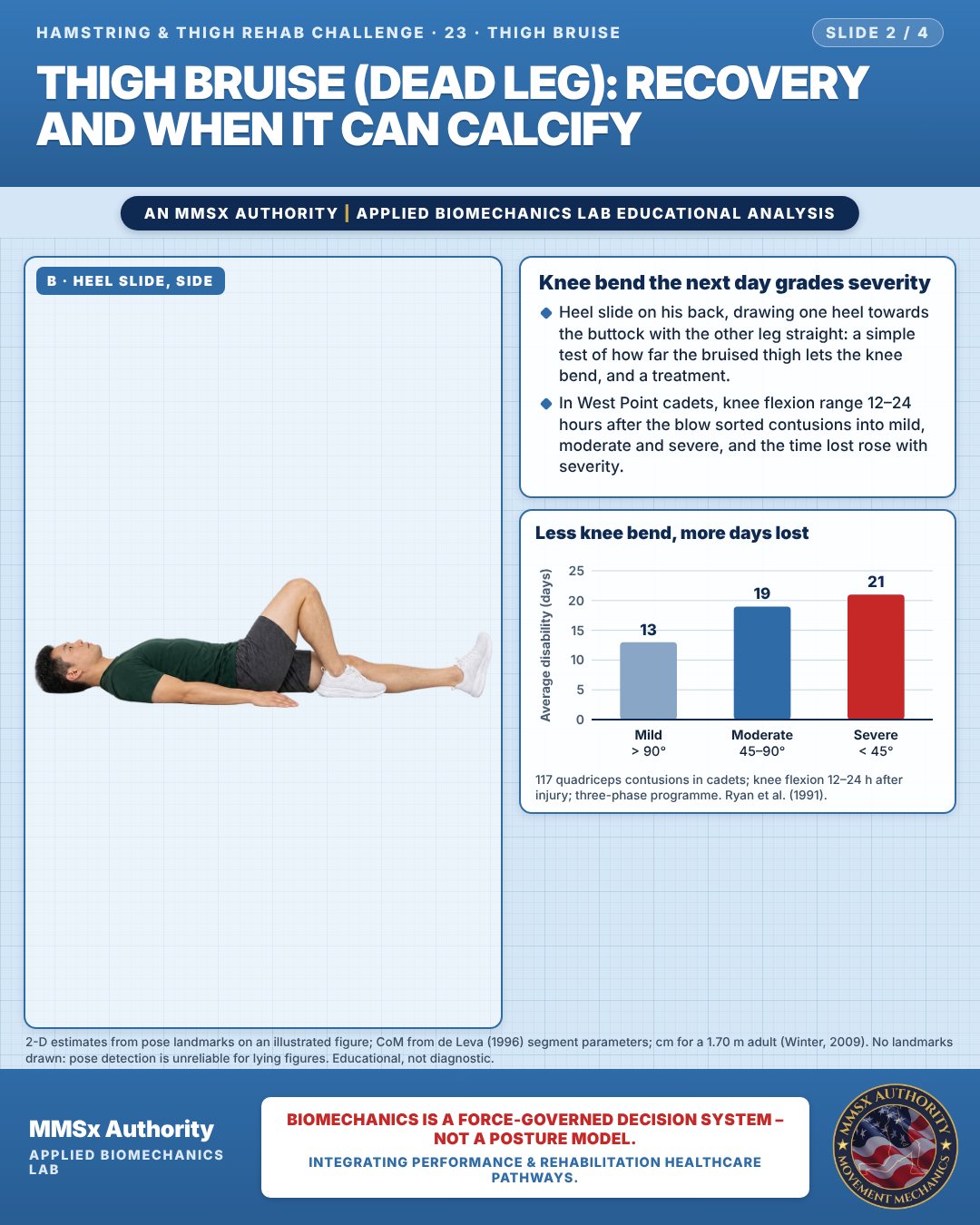
Knee bend the next day grades severity
Heel slide on his back, drawing one heel towards the buttock with the other leg straight: a simple test of how far the bruised thigh lets the knee bend, and a treatment.
In West Point cadets, knee flexion range 12–24 hours after the blow sorted contusions into mild, moderate and severe, and the time lost rose with severity.
Less knee bend, more days lost
Movement C: Sit-to-stand (side view)
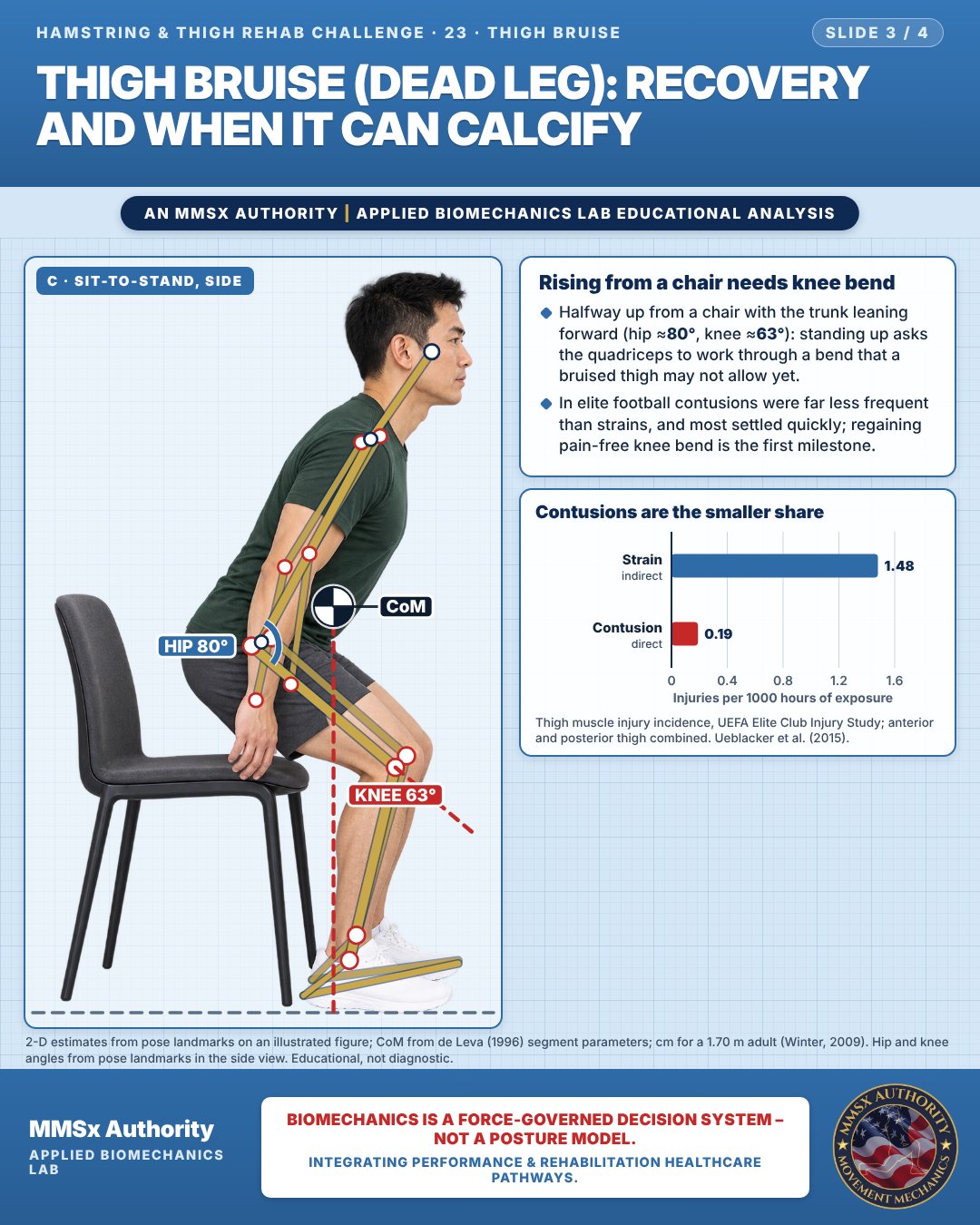
Rising from a chair needs knee bend
Halfway up from a chair with the trunk leaning forward (hip ≈80°, knee ≈63°): standing up asks the quadriceps to work through a bend that a bruised thigh may not allow yet.
In elite football contusions were far less frequent than strains, and most settled quickly; regaining pain-free knee bend is the first milestone.
Contusions are the smaller share
Decision pathway
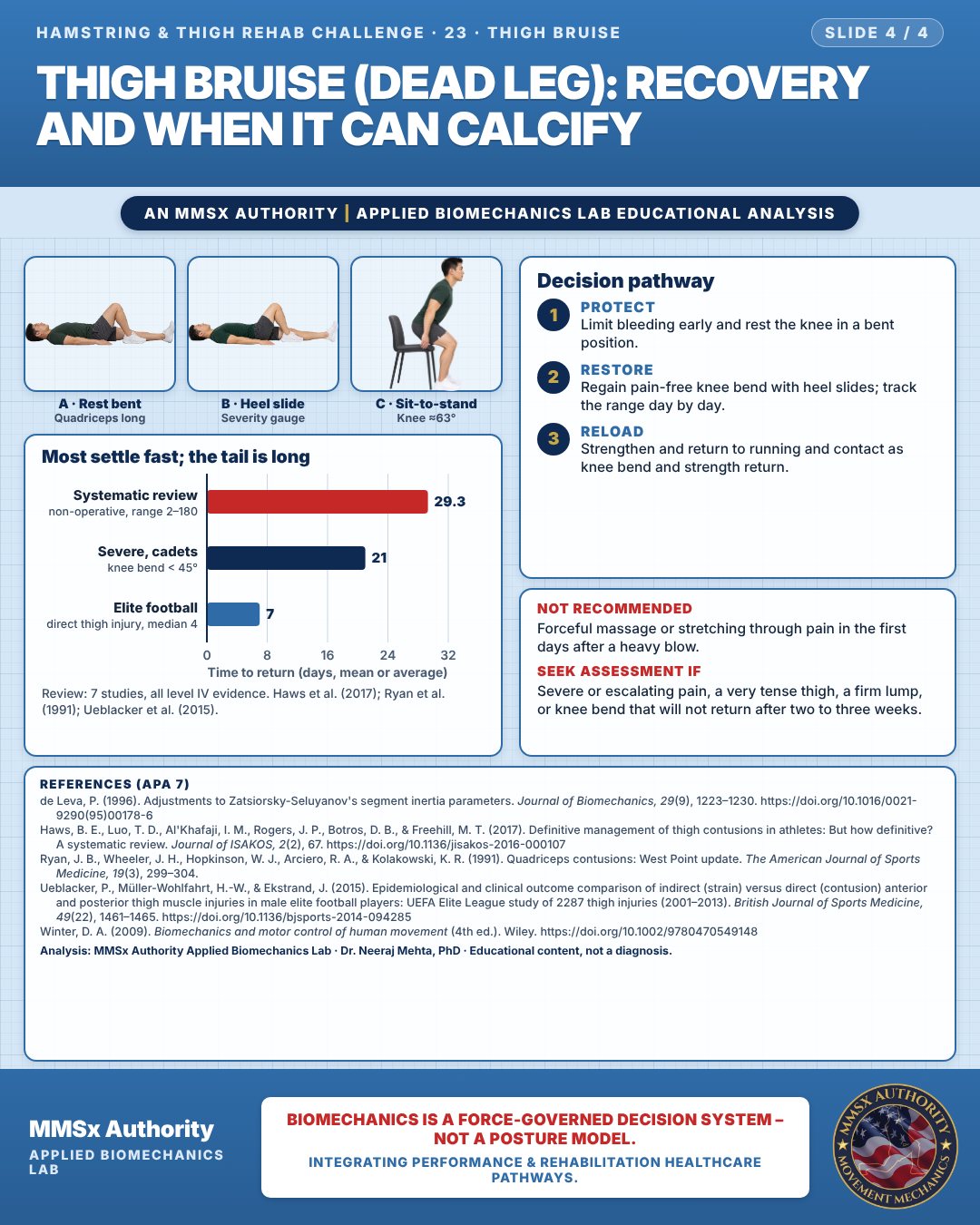
Most settle fast; the tail is long
Protect
Limit bleeding early and rest the knee in a bent position.
Restore
Regain pain-free knee bend with heel slides; track the range day by day.
Reload
Strengthen and return to running and contact as knee bend and strength return.
What the evidence supports
- The overall evidence base is weak: all included studies in the systematic review were level IV (Haws et al., 2017).
Cautions
Not recommended
Forceful massage or stretching through pain in the first days after a heavy blow.
Seek assessment if
Severe or escalating pain, a very tense thigh, a firm lump, or knee bend that will not return after two to three weeks.
Methods note
2-D estimates from pose landmarks on an illustrated figure; CoM from de Leva (1996) segment parameters; cm for a 1.70 m adult (Winter, 2009). No landmarks drawn: pose detection is unreliable for lying figures. Hip and knee angles from pose landmarks in the side view. These are educational estimates, not a diagnosis.
References
- de Leva, P. (1996). Adjustments to Zatsiorsky-Seluyanov's segment inertia parameters. Journal of Biomechanics, 29(9), 1223–1230. https://doi.org/10.1016/0021-9290(95)00178-6
- Haws, B. E., Luo, T. D., Al'Khafaji, I. M., Rogers, J. P., Botros, D. B., & Freehill, M. T. (2017). Definitive management of thigh contusions in athletes: But how definitive? A systematic review. Journal of ISAKOS, 2(2), 67. https://doi.org/10.1136/jisakos-2016-000107
- Ryan, J. B., Wheeler, J. H., Hopkinson, W. J., Arciero, R. A., & Kolakowski, K. R. (1991). Quadriceps contusions: West Point update. The American Journal of Sports Medicine, 19(3), 299–304.
- Ueblacker, P., Müller-Wohlfahrt, H.-W., & Ekstrand, J. (2015). Epidemiological and clinical outcome comparison of indirect (strain) versus direct (contusion) anterior and posterior thigh muscle injuries in male elite football players: UEFA Elite League study of 2287 thigh injuries (2001–2013). British Journal of Sports Medicine, 49(22), 1461–1465. https://doi.org/10.1136/bjsports-2014-094285
- Winter, D. A. (2009). Biomechanics and motor control of human movement (4th ed.). Wiley. https://doi.org/10.1002/9780470549148
Cite this article
Mehta, N. (2026, October 26). Thigh bruise (dead leg): recovery and when it can calcify. MMSx Authority Applied Biomechanics Lab. https://mmsxauthority.org/edu/analysis/hamstring-thigh/23-thigh-bruise-dead-leg-recovery-and-when-it-can-calcify/
Part of the collection
Mehta, N. (2026). Hamstring and Thigh Rehabilitation: 50 Evidence-Based Biomechanics Analyses [Collection]. MMSx Authority Applied Biomechanics Lab. Zenodo. https://doi.org/10.5281/zenodo.23735792
All Hamstring & Thigh Rehab Challenge articles · Rehabilitation Library