Hamstring & Thigh Rehab Challenge · 21
Quadriceps strain: the kicking and sprinting injury
A quadriceps strain is an indirect (non-contact) injury to the muscle, musculotendinous junction or tendon of one of the four quadriceps muscles,…
Key points
- Confirm. Separate a strain from a blow; palpate the rectus femoris and test resisted knee extension.
- Load. Progress criteria-based loading, from isometric holds to the Spanish squat and lengthened work.
- Return. Rebuild sprinting and then kicking gradually; re-injury clustered within six months.
What it is
A quadriceps strain is an indirect (non-contact) injury to the muscle, musculotendinous junction or tendon of one of the four quadriceps muscles, most often the rectus femoris. It typically occurs during kicking, sprinting or sudden acceleration, and gives sudden pain at the front of the thigh. It differs from a contusion ("dead leg"), which is caused by a direct blow.
How we analysed the movement
Three movements relevant to this topic were analysed from illustrated reference figures. Joint centres were located with two-dimensional pose estimation; hip and knee angles, pelvis level, the whole-body centre of mass and, where relevant, the hip lever (the horizontal distance from the hip joint to the upper-body centre of mass) and the resulting static hip moment were then calculated from standard segment parameters. The figures are educational estimates that show how position changes mechanical demand; they are not measurements of a patient. Every research value quoted below comes from the published source cited beside it.
Movement A: Kick backswing (side view)
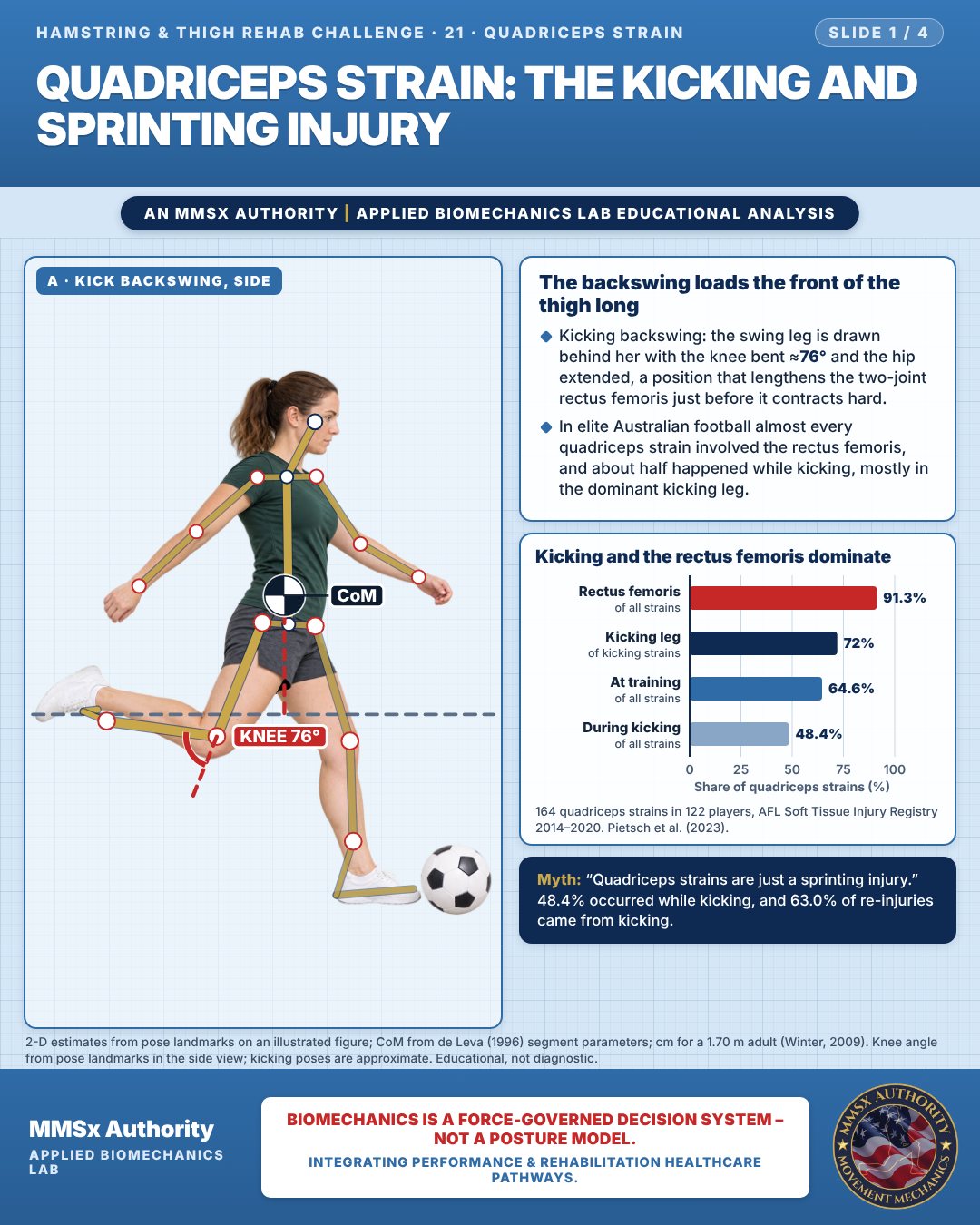
The backswing loads the front of the thigh long
Kicking backswing: the swing leg is drawn behind her with the knee bent ≈76° and the hip extended, a position that lengthens the two-joint rectus femoris just before it contracts hard.
In elite Australian football almost every quadriceps strain involved the rectus femoris, and about half happened while kicking, mostly in the dominant kicking leg.
Kicking and the rectus femoris dominate
Movement B: Hand on thigh (side view)
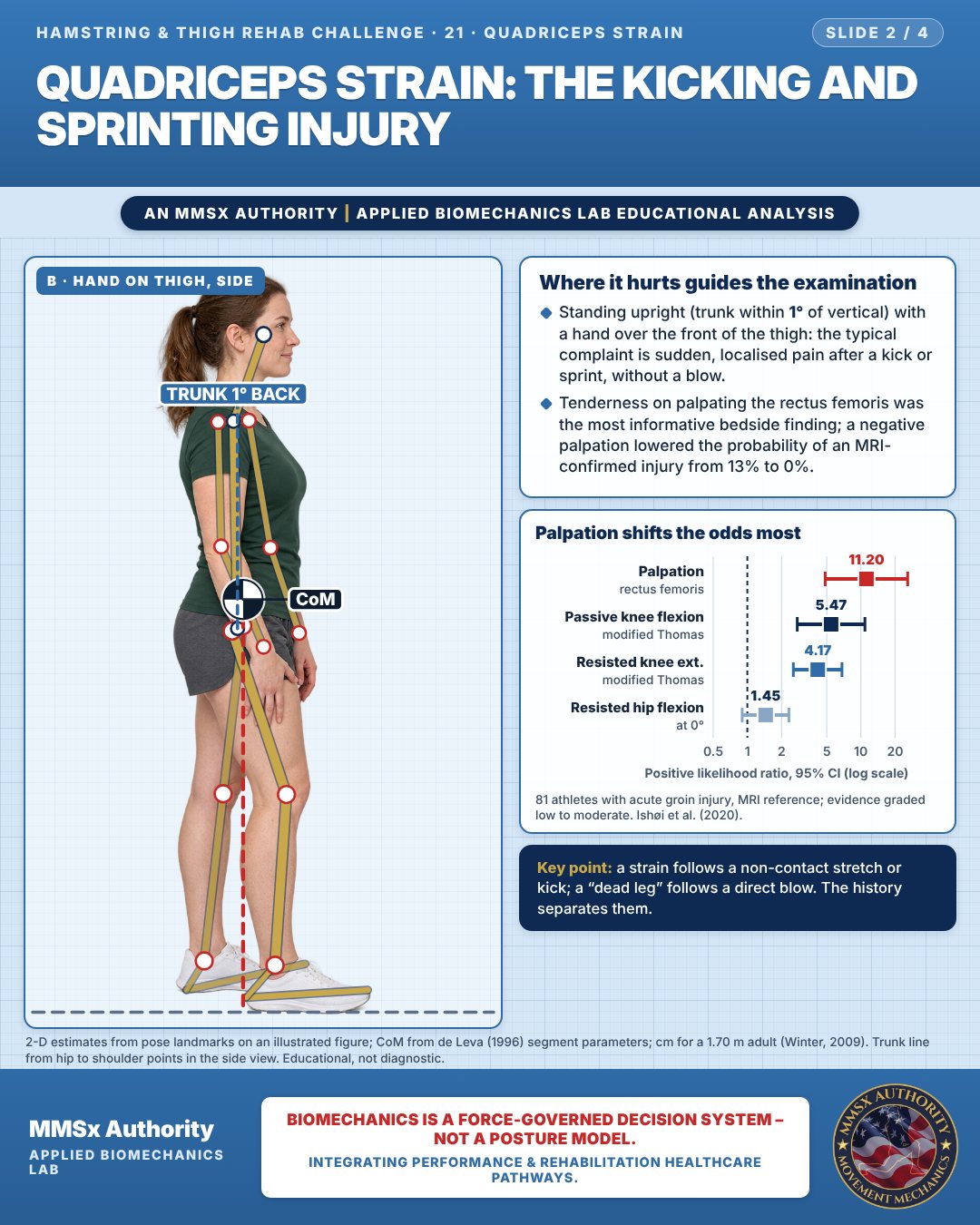
Where it hurts guides the examination
Standing upright (trunk within 1° of vertical) with a hand over the front of the thigh: the typical complaint is sudden, localised pain after a kick or sprint, without a blow.
Tenderness on palpating the rectus femoris was the most informative bedside finding; a negative palpation lowered the probability of an MRI-confirmed injury from 13% to 0%.
Palpation shifts the odds most
Movement C: Spanish squat (side view)
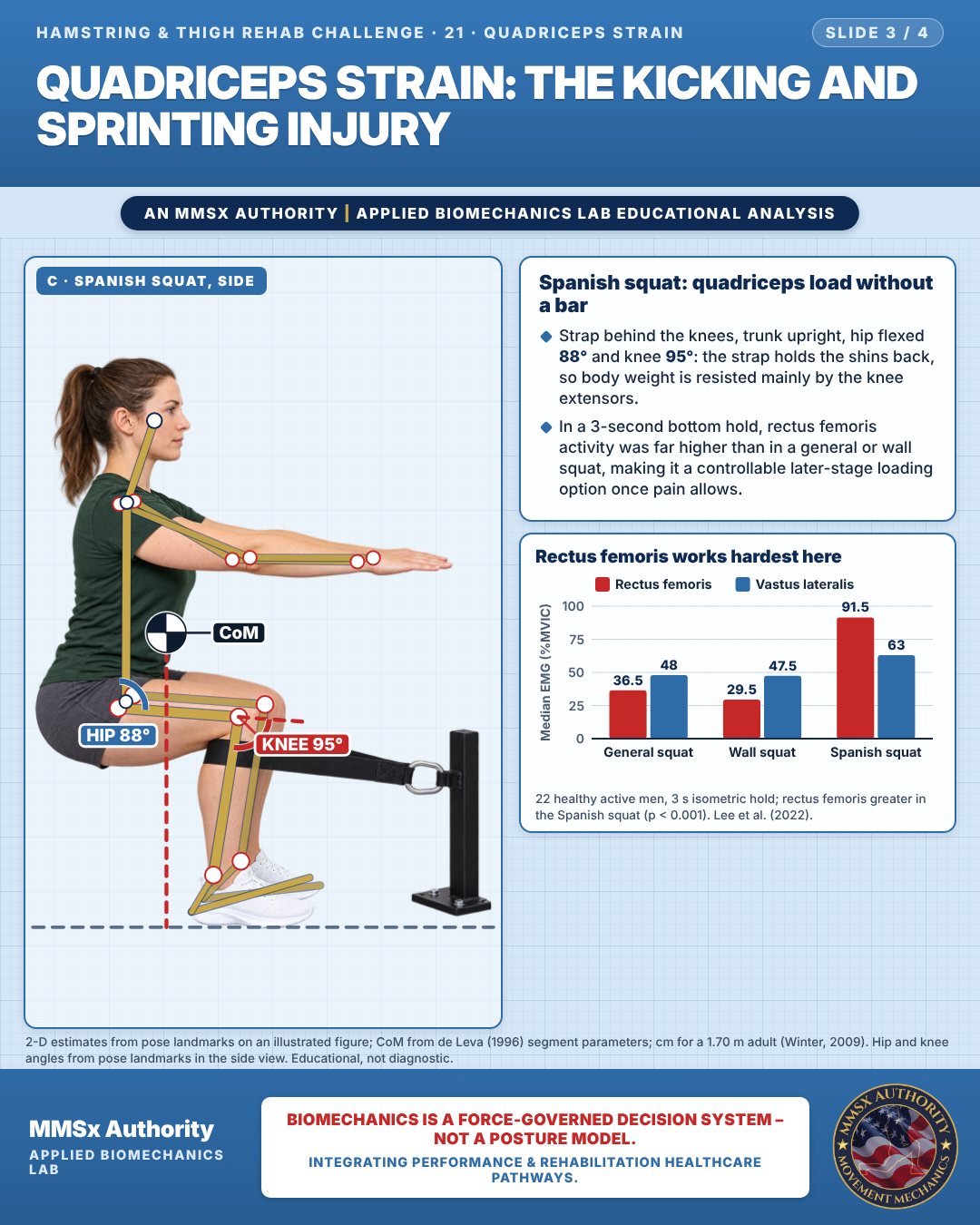
Spanish squat: quadriceps load without a bar
Strap behind the knees, trunk upright, hip flexed 88° and knee 95°: the strap holds the shins back, so body weight is resisted mainly by the knee extensors.
In a 3-second bottom hold, rectus femoris activity was far higher than in a general or wall squat, making it a controllable later-stage loading option once pain allows.
Rectus femoris works hardest here
Decision pathway
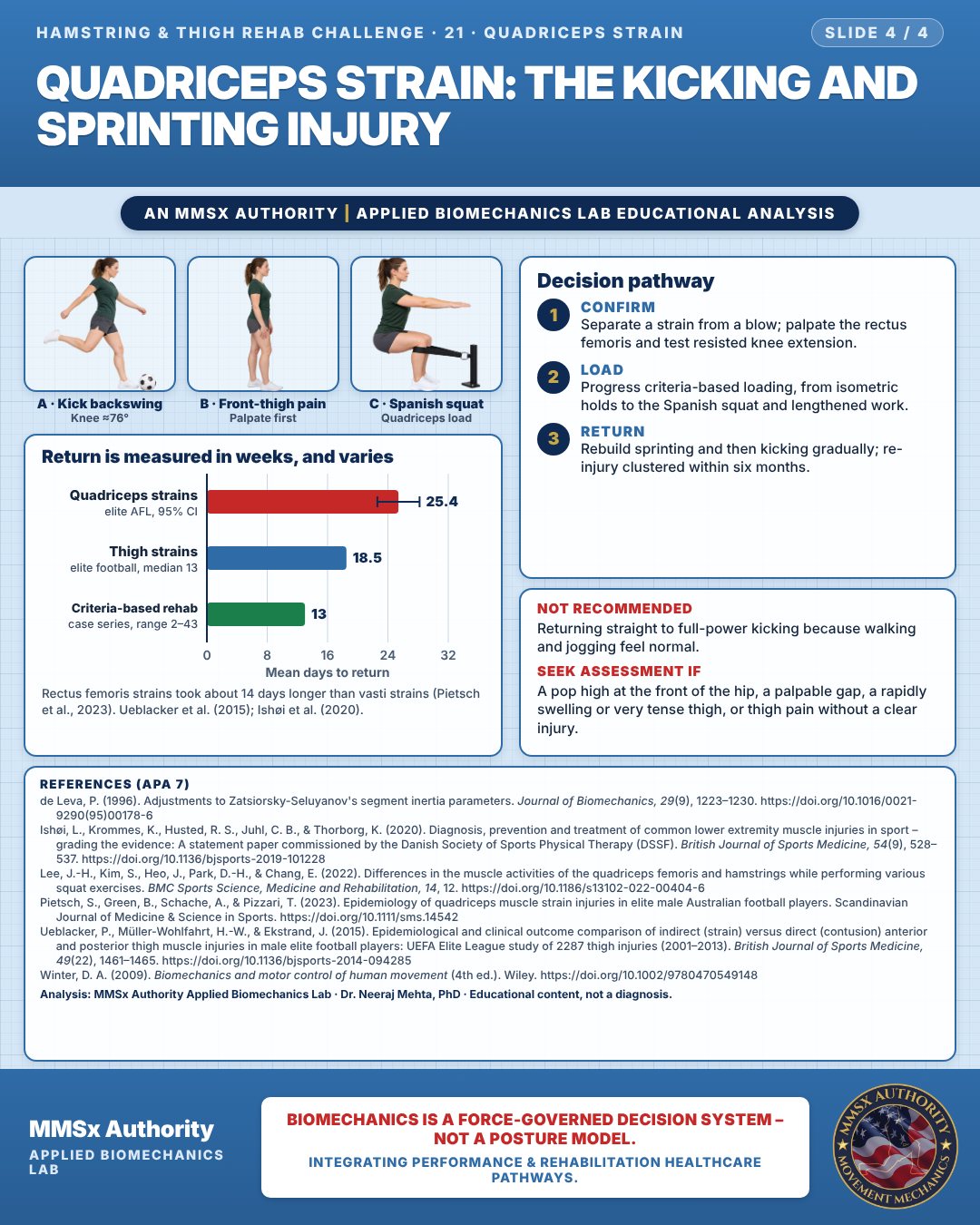
Return is measured in weeks, and varies
Confirm
Separate a strain from a blow; palpate the rectus femoris and test resisted knee extension.
Load
Progress criteria-based loading, from isometric holds to the Spanish squat and lengthened work.
Return
Rebuild sprinting and then kicking gradually; re-injury clustered within six months.
What the evidence supports
- No systematic reviews or randomised trials of treatment for quadriceps strain were identified. The only evidence was one case series of a criteria-based two-phase programme, graded very low quality (Ishøi et al., 2020).
- Prevention: the FIFA 11+ programme was associated with a 27% lower risk of quadriceps/anterior thigh injury, but the effect was small and not statistically significant (RR 0.73, 95% CI 0.48 to 1.12; low-quality evidence) (Ishøi et al., 2020).
Myth and evidence
Myth“Quadriceps strains are just a sprinting injury.”
EvidenceIn elite Australian football, about half (48.4%) occurred during kicking, mostly in the dominant kicking leg (72%), and almost all re-injuries came from kicking (63.0%) (Pietsch et al., 2023). Rehabilitation needs a graded return to kicking, not only to running.
Cautions
Not recommended
Returning straight to full-power kicking because walking and jogging feel normal.
Seek assessment if
A pop high at the front of the hip, a palpable gap, a rapidly swelling or very tense thigh, or thigh pain without a clear injury.
Methods note
2-D estimates from pose landmarks on an illustrated figure; CoM from de Leva (1996) segment parameters; cm for a 1.70 m adult (Winter, 2009). Knee angle from pose landmarks in the side view; kicking poses are approximate. Trunk line from hip to shoulder points in the side view. Hip and knee angles from pose landmarks in the side view. These are educational estimates, not a diagnosis.
References
- de Leva, P. (1996). Adjustments to Zatsiorsky-Seluyanov's segment inertia parameters. Journal of Biomechanics, 29(9), 1223–1230. https://doi.org/10.1016/0021-9290(95)00178-6
- Ishøi, L., Krommes, K., Husted, R. S., Juhl, C. B., & Thorborg, K. (2020). Diagnosis, prevention and treatment of common lower extremity muscle injuries in sport – grading the evidence: A statement paper commissioned by the Danish Society of Sports Physical Therapy (DSSF). British Journal of Sports Medicine, 54(9), 528–537. https://doi.org/10.1136/bjsports-2019-101228
- Lee, J.-H., Kim, S., Heo, J., Park, D.-H., & Chang, E. (2022). Differences in the muscle activities of the quadriceps femoris and hamstrings while performing various squat exercises. BMC Sports Science, Medicine and Rehabilitation, 14, 12. https://doi.org/10.1186/s13102-022-00404-6
- Pietsch, S., Green, B., Schache, A., & Pizzari, T. (2023). Epidemiology of quadriceps muscle strain injuries in elite male Australian football players. Scandinavian Journal of Medicine & Science in Sports. https://doi.org/10.1111/sms.14542
- Ueblacker, P., Müller-Wohlfahrt, H.-W., & Ekstrand, J. (2015). Epidemiological and clinical outcome comparison of indirect (strain) versus direct (contusion) anterior and posterior thigh muscle injuries in male elite football players: UEFA Elite League study of 2287 thigh injuries (2001–2013). British Journal of Sports Medicine, 49(22), 1461–1465. https://doi.org/10.1136/bjsports-2014-094285
- Winter, D. A. (2009). Biomechanics and motor control of human movement (4th ed.). Wiley. https://doi.org/10.1002/9780470549148
Cite this article
Mehta, N. (2026, October 26). Quadriceps strain: the kicking and sprinting injury. MMSx Authority Applied Biomechanics Lab. https://mmsxauthority.org/edu/analysis/hamstring-thigh/21-quadriceps-strain-the-kicking-and-sprinting-injury/
Part of the collection
Mehta, N. (2026). Hamstring and Thigh Rehabilitation: 50 Evidence-Based Biomechanics Analyses [Collection]. MMSx Authority Applied Biomechanics Lab. Zenodo. https://doi.org/10.5281/zenodo.23735792
All Hamstring & Thigh Rehab Challenge articles · Rehabilitation Library