Hamstring & Thigh Rehab Challenge · 20
Hamstring muscle bruise versus strain: telling them apart
A hamstring contusion (bruise) is muscle damage and bleeding caused by a direct blow, for example a knee or object striking the back of the thigh.
Key points
- History. Ask how it happened: a direct blow suggests a bruise; sudden pain while sprinting or stretching suggests a strain.
- Examine. Palpate the length of the tender area and measure the knee extension deficit; both relate to recovery time.
- Image. Keep MRI for a suspected grade III tear or an atypical picture; a normal scan does not exclude injury.
What it is
A hamstring contusion (bruise) is muscle damage and bleeding caused by a direct blow, for example a knee or object striking the back of the thigh. A hamstring strain is an indirect injury caused by excessive stretch or forceful contraction, usually during sprinting or stretching movements. The JOSPT guideline advises considering contusion when direct trauma to the posterior thigh is the mechanism (Martin et al., 2022).
How we analysed the movement
Three movements relevant to this topic were analysed from illustrated reference figures. Joint centres were located with two-dimensional pose estimation; hip and knee angles, pelvis level, the whole-body centre of mass and, where relevant, the hip lever (the horizontal distance from the hip joint to the upper-body centre of mass) and the resulting static hip moment were then calculated from standard segment parameters. The figures are educational estimates that show how position changes mechanical demand; they are not measurements of a patient. Every research value quoted below comes from the published source cited beside it.
Movement A: Pad on thigh (side view)
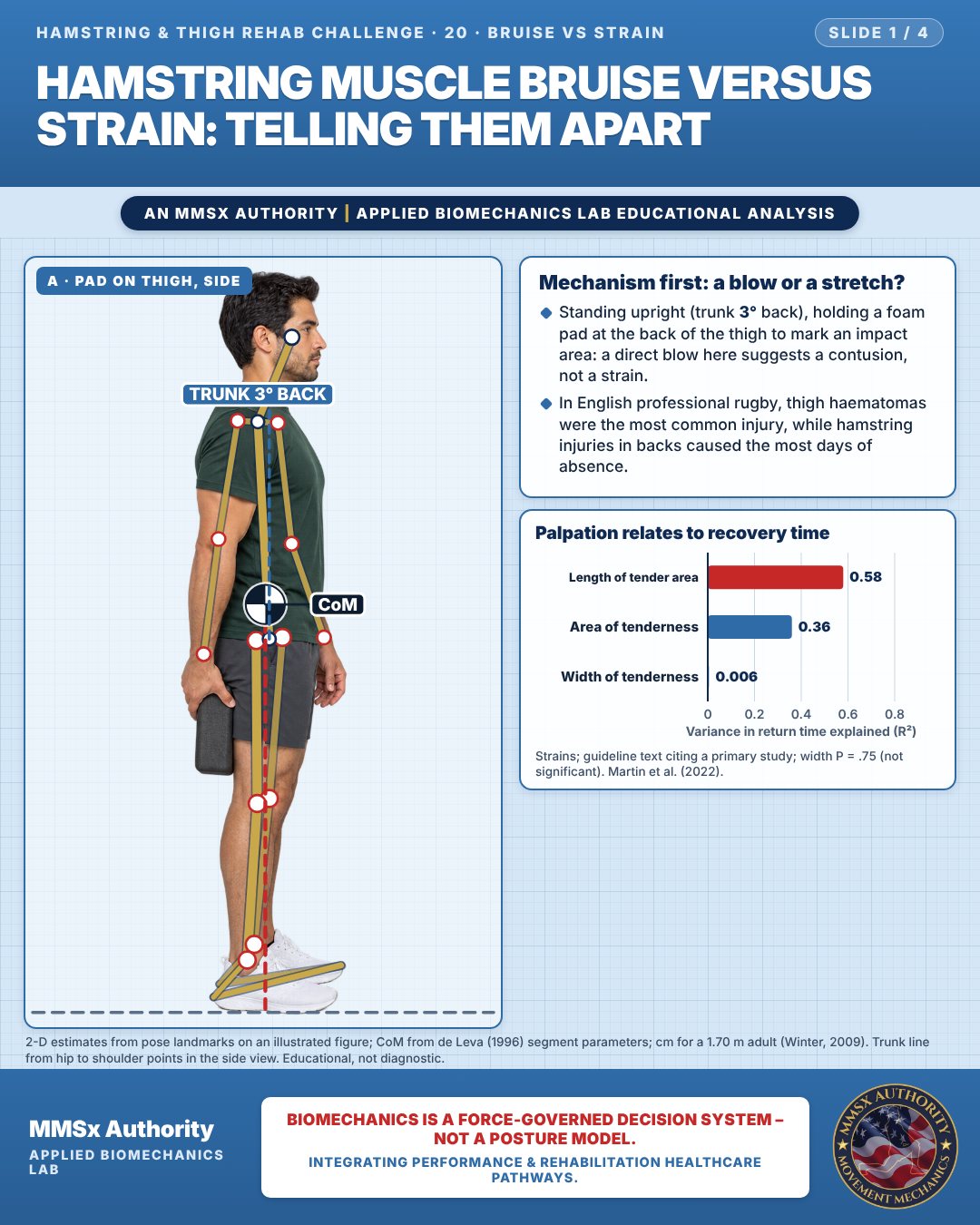
Mechanism first: a blow or a stretch?
Standing upright (trunk 3° back), holding a foam pad at the back of the thigh to mark an impact area: a direct blow here suggests a contusion, not a strain.
In English professional rugby, thigh haematomas were the most common injury, while hamstring injuries in backs caused the most days of absence.
Palpation relates to recovery time
Movement B: Slow walk (side view)
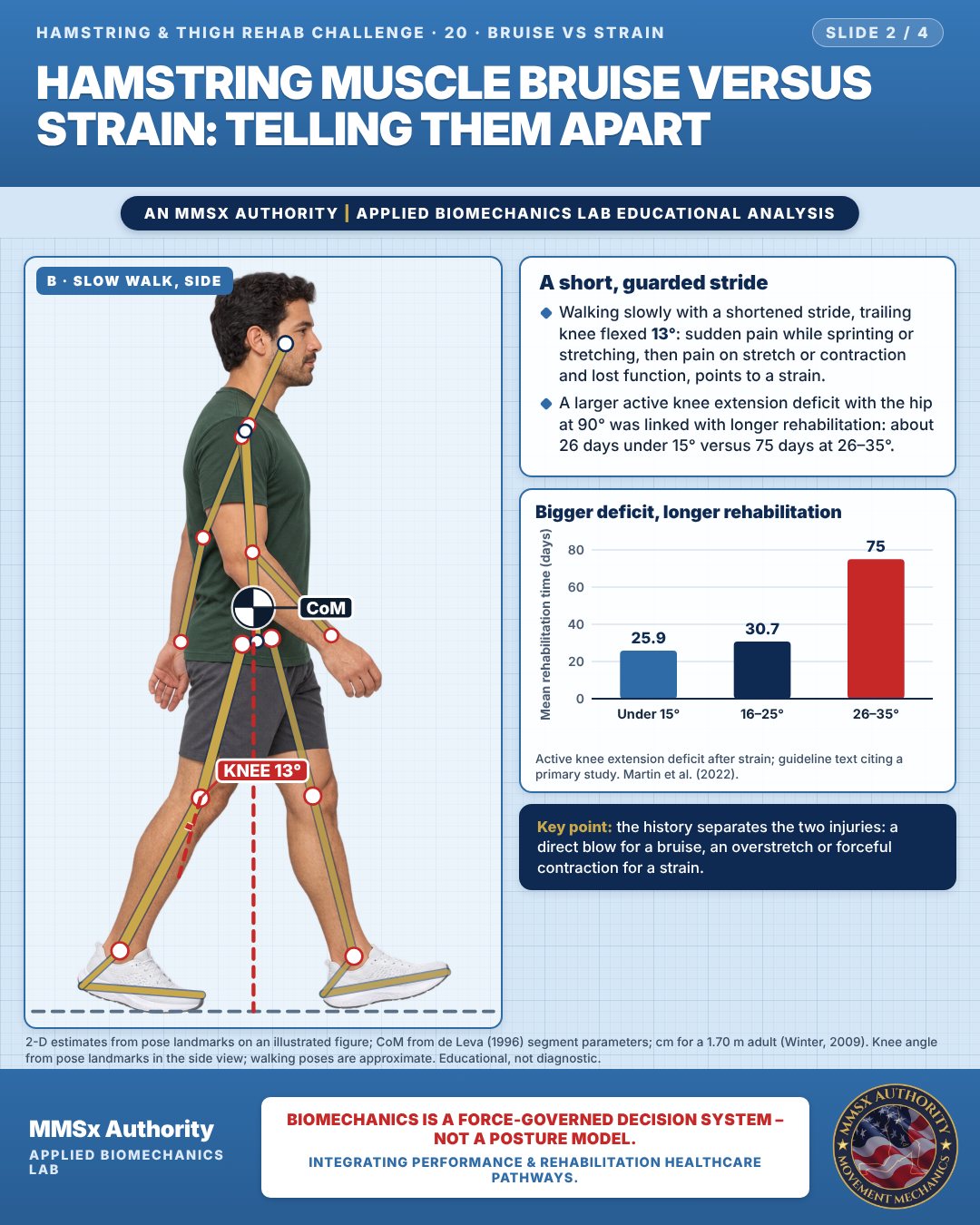
A short, guarded stride
Walking slowly with a shortened stride, trailing knee flexed 13°: sudden pain while sprinting or stretching, then pain on stretch or contraction and lost function, points to a strain.
A larger active knee extension deficit with the hip at 90° was linked with longer rehabilitation: about 26 days under 15° versus 75 days at 26–35°.
Bigger deficit, longer rehabilitation
Movement C: Ice pack, seated (side view)
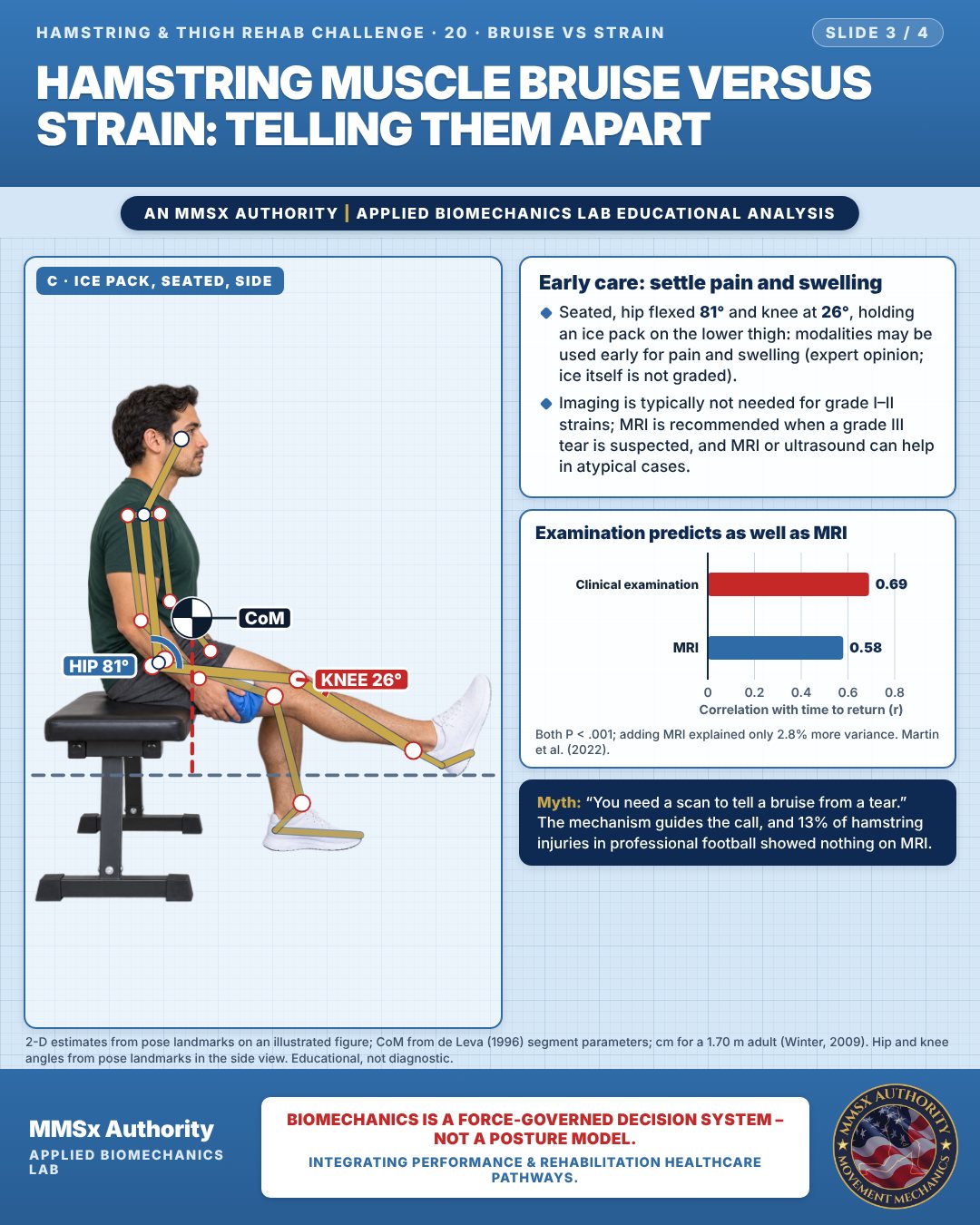
Early care: settle pain and swelling
Seated, hip flexed 81° and knee at 26°, holding an ice pack on the lower thigh: modalities may be used early for pain and swelling (expert opinion; ice itself is not graded).
Imaging is typically not needed for grade I–II strains; MRI is recommended when a grade III tear is suspected, and MRI or ultrasound can help in atypical cases.
Examination predicts as well as MRI
Decision pathway
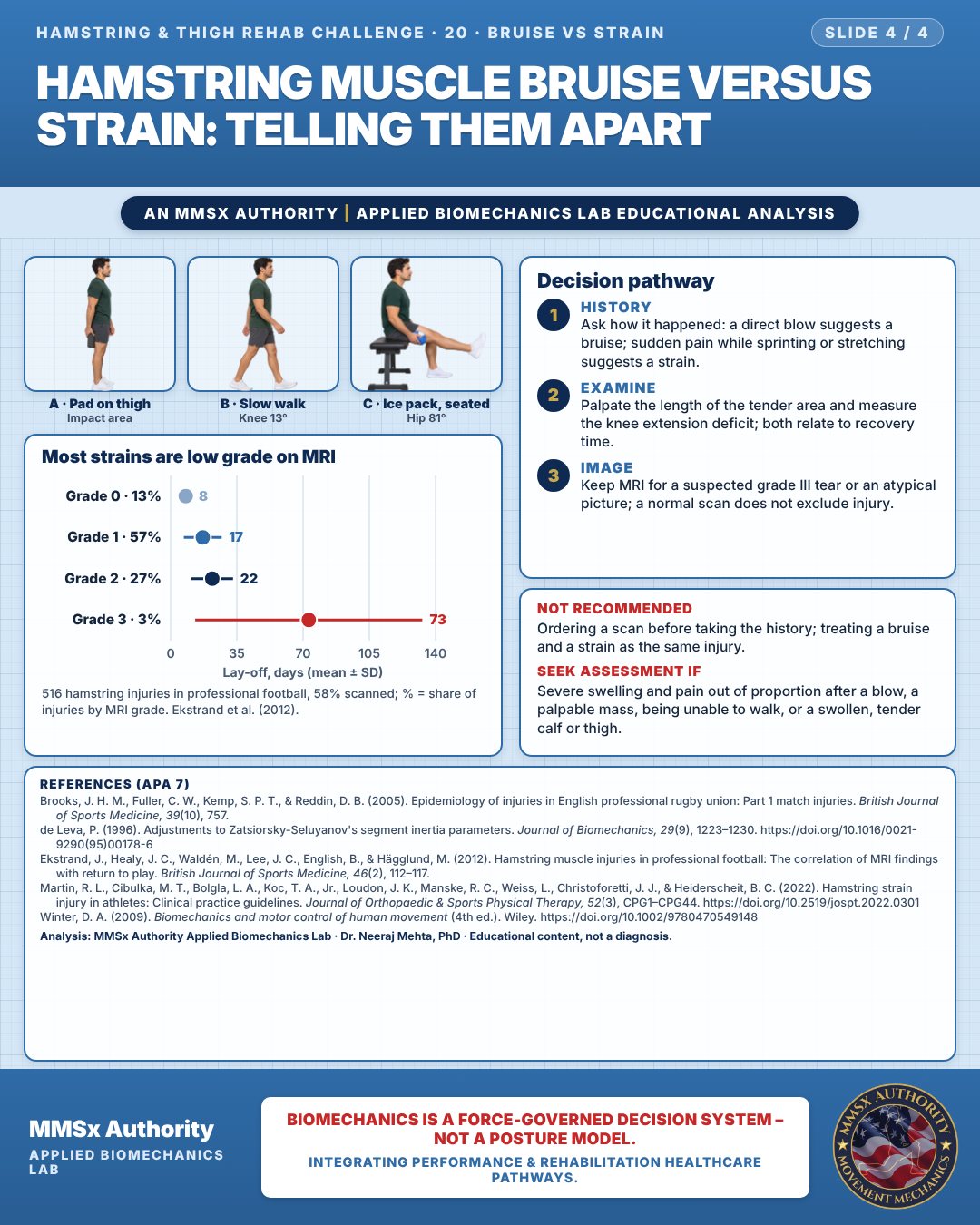
Most strains are low grade on MRI
History
Ask how it happened: a direct blow suggests a bruise; sudden pain while sprinting or stretching suggests a strain.
Examine
Palpate the length of the tender area and measure the knee extension deficit; both relate to recovery time.
Image
Keep MRI for a suspected grade III tear or an atypical picture; a normal scan does not exclude injury.
What the evidence supports
- Take the mechanism first. A direct blow suggests contusion; sudden pain during sprinting or stretching, with pain on stretching and/or activating the hamstring, tenderness and loss of function, suggests strain (Grade B) (Martin et al., 2022).
- Imaging is typically not needed for grade I or II strains. MRI is recommended for suspected grade III, and MRI or ultrasound can help with atypical presentations (Martin et al., 2022).
Myth and evidence
Myth“You need a scan to tell a bruise from a tear.”
EvidenceThe mechanism (direct blow vs stretch or sprint) guides the differential. Clinical examination predicted return time (r = 0.69) at least as well as MRI (r = 0.58), and MRI added only 2.8% explained variance (Martin et al., 2022). In addition, 13% of hamstring injuries in professional football showed nothing on MRI (Ekstrand et al., 2012).
Cautions
Not recommended
Ordering a scan before taking the history; treating a bruise and a strain as the same injury.
Seek assessment if
Severe swelling and pain out of proportion after a blow, a palpable mass, being unable to walk, or a swollen, tender calf or thigh.
Methods note
2-D estimates from pose landmarks on an illustrated figure; CoM from de Leva (1996) segment parameters; cm for a 1.70 m adult (Winter, 2009). Trunk line from hip to shoulder points in the side view. Knee angle from pose landmarks in the side view; walking poses are approximate. Hip and knee angles from pose landmarks in the side view. These are educational estimates, not a diagnosis.
References
- Brooks, J. H. M., Fuller, C. W., Kemp, S. P. T., & Reddin, D. B. (2005). Epidemiology of injuries in English professional rugby union: Part 1 match injuries. British Journal of Sports Medicine, 39(10), 757.
- de Leva, P. (1996). Adjustments to Zatsiorsky-Seluyanov's segment inertia parameters. Journal of Biomechanics, 29(9), 1223–1230. https://doi.org/10.1016/0021-9290(95)00178-6
- Ekstrand, J., Healy, J. C., Waldén, M., Lee, J. C., English, B., & Hägglund, M. (2012). Hamstring muscle injuries in professional football: The correlation of MRI findings with return to play. British Journal of Sports Medicine, 46(2), 112–117.
- Martin, R. L., Cibulka, M. T., Bolgla, L. A., Koc, T. A., Jr., Loudon, J. K., Manske, R. C., Weiss, L., Christoforetti, J. J., & Heiderscheit, B. C. (2022). Hamstring strain injury in athletes: Clinical practice guidelines. Journal of Orthopaedic & Sports Physical Therapy, 52(3), CPG1–CPG44. https://doi.org/10.2519/jospt.2022.0301
- Winter, D. A. (2009). Biomechanics and motor control of human movement (4th ed.). Wiley. https://doi.org/10.1002/9780470549148
Cite this article
Mehta, N. (2026, October 26). Hamstring muscle bruise versus strain: telling them apart. MMSx Authority Applied Biomechanics Lab. https://mmsxauthority.org/edu/analysis/hamstring-thigh/20-hamstring-muscle-bruise-versus-strain-telling-them-apart/
Part of the collection
Mehta, N. (2026). Hamstring and Thigh Rehabilitation: 50 Evidence-Based Biomechanics Analyses [Collection]. MMSx Authority Applied Biomechanics Lab. Zenodo. https://doi.org/10.5281/zenodo.23735792
All Hamstring & Thigh Rehab Challenge articles · Rehabilitation Library