Hamstring & Thigh Rehab Challenge · 19
Hamstring cramps: fatigue, hydration and what the evidence supports
An exercise-associated muscle cramp (EAMC) is a sudden, painful, involuntary contraction of skeletal muscle during or soon after exercise.
Key points
- Relieve. Stop and gently stretch the cramping muscle; a strong-tasting stimulus may shorten a cramp through a reflex.
- Prevent. Pace sensibly and build fatigue resistance: previous cramps and going faster than usual were the strongest predictors.
- Hydrate. Drink for comfort and safety, not as a cramp cure; extra fluid or salt alone is not supported.
What it is
An exercise-associated muscle cramp (EAMC) is a sudden, painful, involuntary contraction of skeletal muscle during or soon after exercise. Posterior thigh cramping can also accompany a grade I hamstring strain: the JOSPT guideline lists "tightness and possible cramping in the posterior thigh" among grade I features (Martin et al., 2022).
How we analysed the movement
Three movements relevant to this topic were analysed from illustrated reference figures. Joint centres were located with two-dimensional pose estimation; hip and knee angles, pelvis level, the whole-body centre of mass and, where relevant, the hip lever (the horizontal distance from the hip joint to the upper-body centre of mass) and the resulting static hip moment were then calculated from standard segment parameters. The figures are educational estimates that show how position changes mechanical demand; they are not measurements of a patient. Every research value quoted below comes from the published source cited beside it.
Movement A: Thigh cramp (side view)
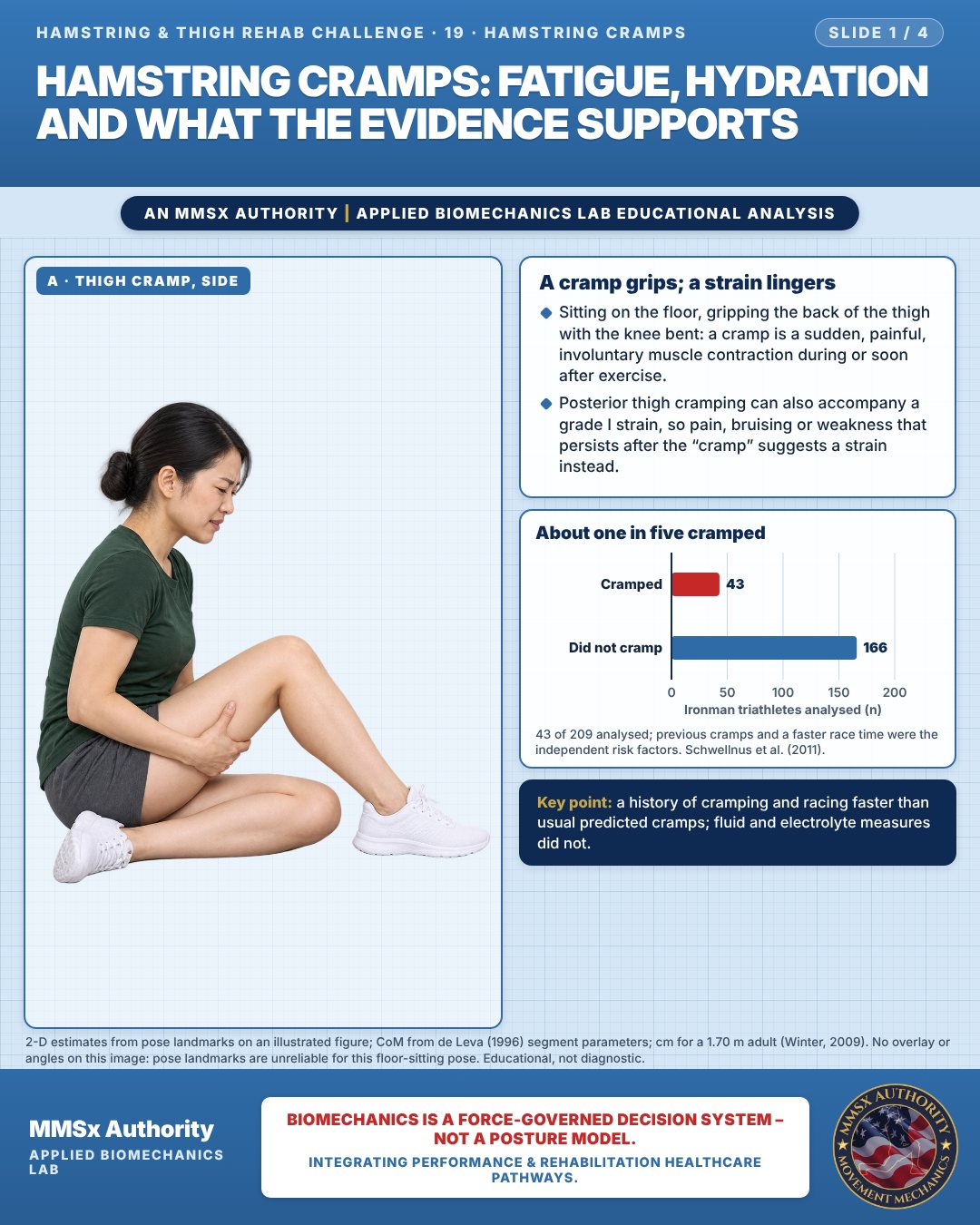
A cramp grips; a strain lingers
Sitting on the floor, gripping the back of the thigh with the knee bent: a cramp is a sudden, painful, involuntary muscle contraction during or soon after exercise.
Posterior thigh cramping can also accompany a grade I strain, so pain, bruising or weakness that persists after the “cramp” suggests a strain instead.
About one in five cramped
Movement B: Drinking water (side view)
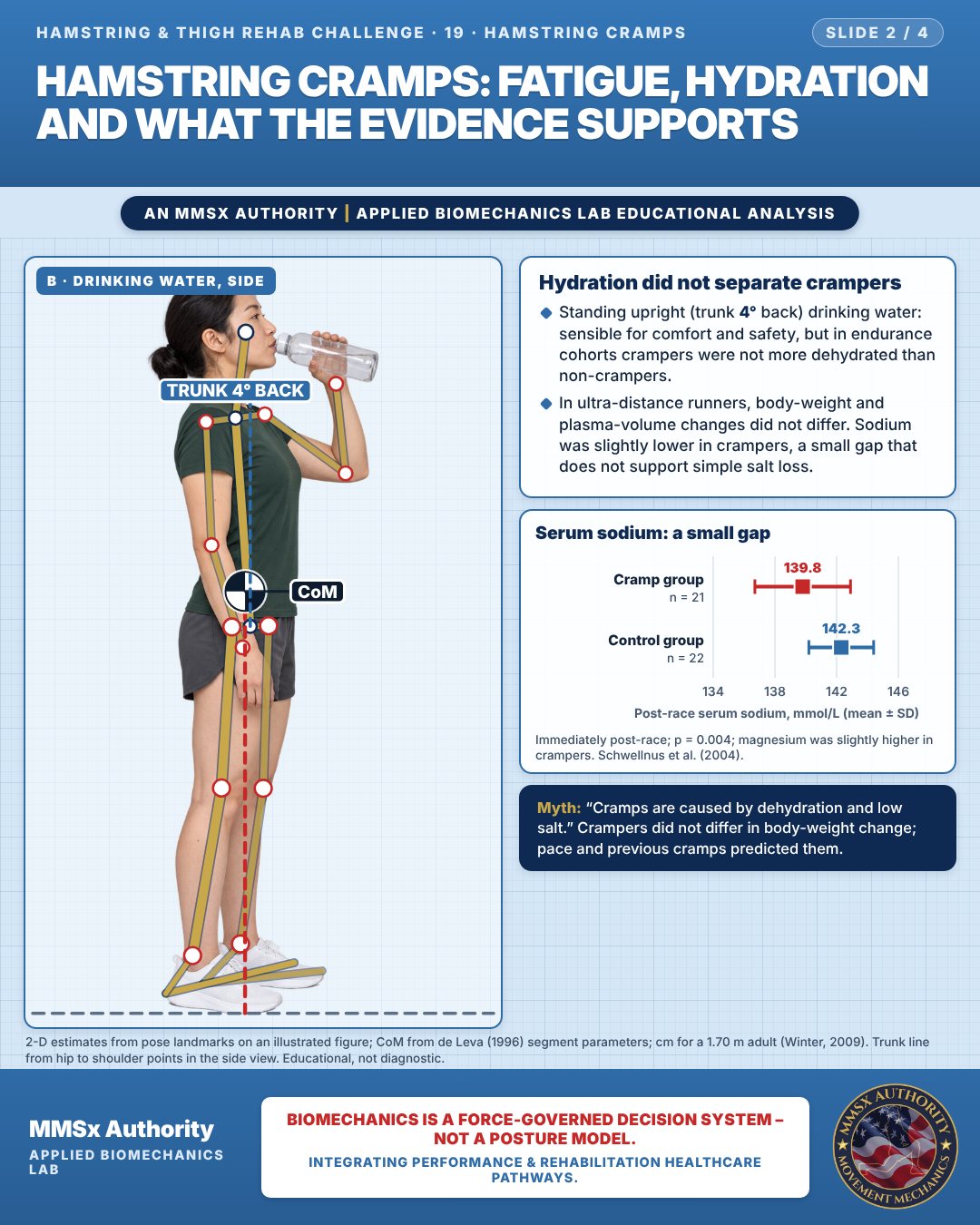
Hydration did not separate crampers
Standing upright (trunk 4° back) drinking water: sensible for comfort and safety, but in endurance cohorts crampers were not more dehydrated than non-crampers.
In ultra-distance runners, body-weight and plasma-volume changes did not differ. Sodium was slightly lower in crampers, a small gap that does not support simple salt loss.
Serum sodium: a small gap
Movement C: Long-sit stretch (side view)
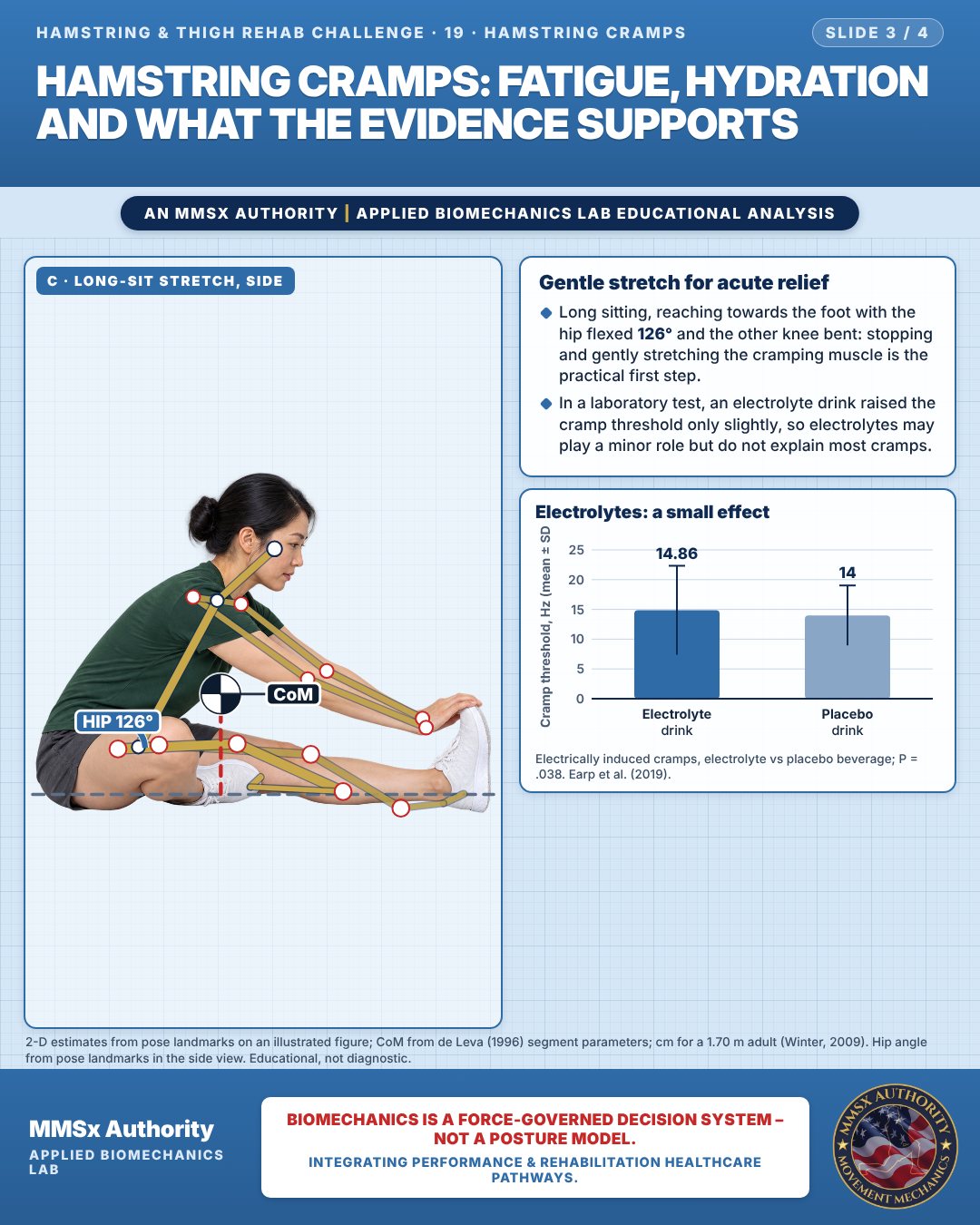
Gentle stretch for acute relief
Long sitting, reaching towards the foot with the hip flexed 126° and the other knee bent: stopping and gently stretching the cramping muscle is the practical first step.
In a laboratory test, an electrolyte drink raised the cramp threshold only slightly, so electrolytes may play a minor role but do not explain most cramps.
Electrolytes: a small effect
Decision pathway
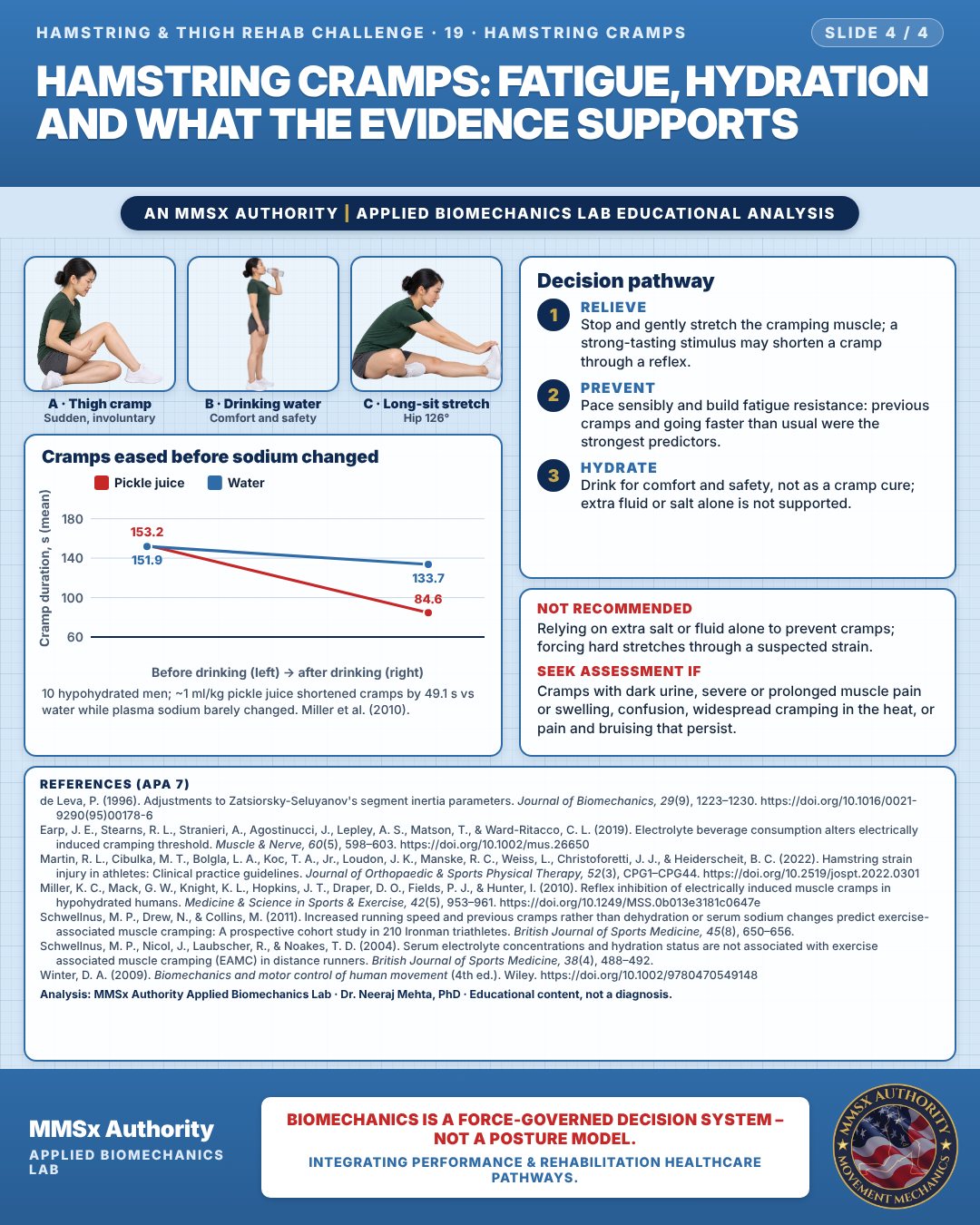
Cramps eased before sodium changed
Relieve
Stop and gently stretch the cramping muscle; a strong-tasting stimulus may shorten a cramp through a reflex.
Prevent
Pace sensibly and build fatigue resistance: previous cramps and going faster than usual were the strongest predictors.
Hydrate
Drink for comfort and safety, not as a cramp cure; extra fluid or salt alone is not supported.
What the evidence supports
- Acute relief: stop and gently stretch the cramping muscle. A reflex-triggering stimulus may shorten cramps (Miller et al., 2010). Guideline-graded evidence on cramp treatment was not found in this session.
- Prevention: the strongest predictors were previous cramping and going faster than usual (Schwellnus et al., 2011). This supports pacing and fatigue-resistance training (neuromuscular conditioning) over extra fluid or salt alone. Hydrate for comfort and safety, not as a cramp cure (Schwellnus et al., 2004, 2011).
Myth and evidence
Myth“Cramps are caused by dehydration and low salt.”
EvidenceIn two prospective endurance cohorts, crampers did not differ from non-crampers in body weight change (Schwellnus et al., 2004, 2011). A faster pace and a history of cramps predicted them (Schwellnus et al., 2011), and cramps were shortened before blood sodium changed (Miller et al., 2010).
Cautions
Not recommended
Relying on extra salt or fluid alone to prevent cramps; forcing hard stretches through a suspected strain.
Seek assessment if
Cramps with dark urine, severe or prolonged muscle pain or swelling, confusion, widespread cramping in the heat, or pain and bruising that persist.
Methods note
2-D estimates from pose landmarks on an illustrated figure; CoM from de Leva (1996) segment parameters; cm for a 1.70 m adult (Winter, 2009). No overlay or angles on this image: pose landmarks are unreliable for this floor-sitting pose. Trunk line from hip to shoulder points in the side view. Hip angle from pose landmarks in the side view. These are educational estimates, not a diagnosis.
References
- de Leva, P. (1996). Adjustments to Zatsiorsky-Seluyanov's segment inertia parameters. Journal of Biomechanics, 29(9), 1223–1230. https://doi.org/10.1016/0021-9290(95)00178-6
- Earp, J. E., Stearns, R. L., Stranieri, A., Agostinucci, J., Lepley, A. S., Matson, T., & Ward-Ritacco, C. L. (2019). Electrolyte beverage consumption alters electrically induced cramping threshold. Muscle & Nerve, 60(5), 598–603. https://doi.org/10.1002/mus.26650
- Martin, R. L., Cibulka, M. T., Bolgla, L. A., Koc, T. A., Jr., Loudon, J. K., Manske, R. C., Weiss, L., Christoforetti, J. J., & Heiderscheit, B. C. (2022). Hamstring strain injury in athletes: Clinical practice guidelines. Journal of Orthopaedic & Sports Physical Therapy, 52(3), CPG1–CPG44. https://doi.org/10.2519/jospt.2022.0301
- Miller, K. C., Mack, G. W., Knight, K. L., Hopkins, J. T., Draper, D. O., Fields, P. J., & Hunter, I. (2010). Reflex inhibition of electrically induced muscle cramps in hypohydrated humans. Medicine & Science in Sports & Exercise, 42(5), 953–961. https://doi.org/10.1249/MSS.0b013e3181c0647e
- Schwellnus, M. P., Drew, N., & Collins, M. (2011). Increased running speed and previous cramps rather than dehydration or serum sodium changes predict exercise-associated muscle cramping: A prospective cohort study in 210 Ironman triathletes. British Journal of Sports Medicine, 45(8), 650–656.
- Schwellnus, M. P., Nicol, J., Laubscher, R., & Noakes, T. D. (2004). Serum electrolyte concentrations and hydration status are not associated with exercise associated muscle cramping (EAMC) in distance runners. British Journal of Sports Medicine, 38(4), 488–492.
- Winter, D. A. (2009). Biomechanics and motor control of human movement (4th ed.). Wiley. https://doi.org/10.1002/9780470549148
Cite this article
Mehta, N. (2026, October 26). Hamstring cramps: fatigue, hydration and what the evidence supports. MMSx Authority Applied Biomechanics Lab. https://mmsxauthority.org/edu/analysis/hamstring-thigh/19-hamstring-cramps-fatigue-hydration-and-what-the-evidence-supports/
Part of the collection
Mehta, N. (2026). Hamstring and Thigh Rehabilitation: 50 Evidence-Based Biomechanics Analyses [Collection]. MMSx Authority Applied Biomechanics Lab. Zenodo. https://doi.org/10.5281/zenodo.23735792
All Hamstring & Thigh Rehab Challenge articles · Rehabilitation Library