Hamstring & Thigh Rehab Challenge · 18
Slump and straight-leg raise tests: what they tell you about the nerve
The straight-leg raise (SLR) and slump tests are passive positioning tests. Movement analysis, verified research data and a decision pathway.
Key points
- Screen. Use the SLR and slump test within a lumbar and neurological screen, read with their accuracy in mind.
- Differentiate. Reproduce the leg symptoms, then move a distant joint (head or ankle) to see whether they change.
- Measure. Track hamstring length as the knee extension deficit with the hip at 90°, using an inclinometer.
What it is
The straight-leg raise (SLR) and slump tests are passive positioning tests. In the SLR, the hip is flexed with the knee extended (supine). In the slump test, the spine is flexed in sitting while the knee is extended and the ankle dorsiflexed. A positive test reproduces the patient's leg symptoms, and these are changed by a structurally distant movement, such as lifting the head in the slump test (Movement C). The SLR is also used to measure hamstring length (Martin et al., 2022).
How we analysed the movement
Three movements relevant to this topic were analysed from illustrated reference figures. Joint centres were located with two-dimensional pose estimation; hip and knee angles, pelvis level, the whole-body centre of mass and, where relevant, the hip lever (the horizontal distance from the hip joint to the upper-body centre of mass) and the resulting static hip moment were then calculated from standard segment parameters. The figures are educational estimates that show how position changes mechanical demand; they are not measurements of a patient. Every research value quoted below comes from the published source cited beside it.
Movement A: Straight-leg raise (side view)
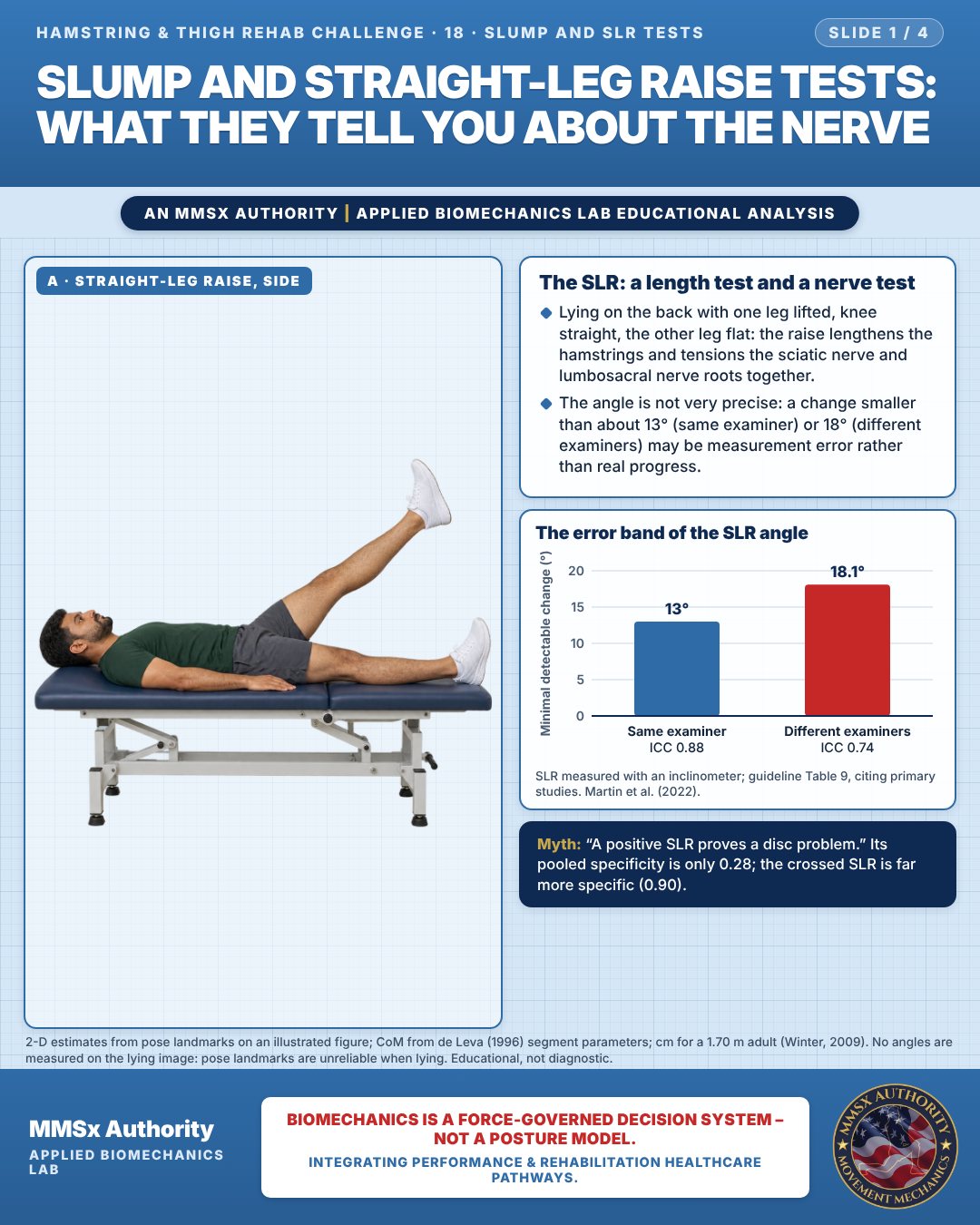
The SLR: a length test and a nerve test
Lying on the back with one leg lifted, knee straight, the other leg flat: the raise lengthens the hamstrings and tensions the sciatic nerve and lumbosacral nerve roots together.
The angle is not very precise: a change smaller than about 13° (same examiner) or 18° (different examiners) may be measurement error rather than real progress.
The error band of the SLR angle
Movement B: Slump test (side view)
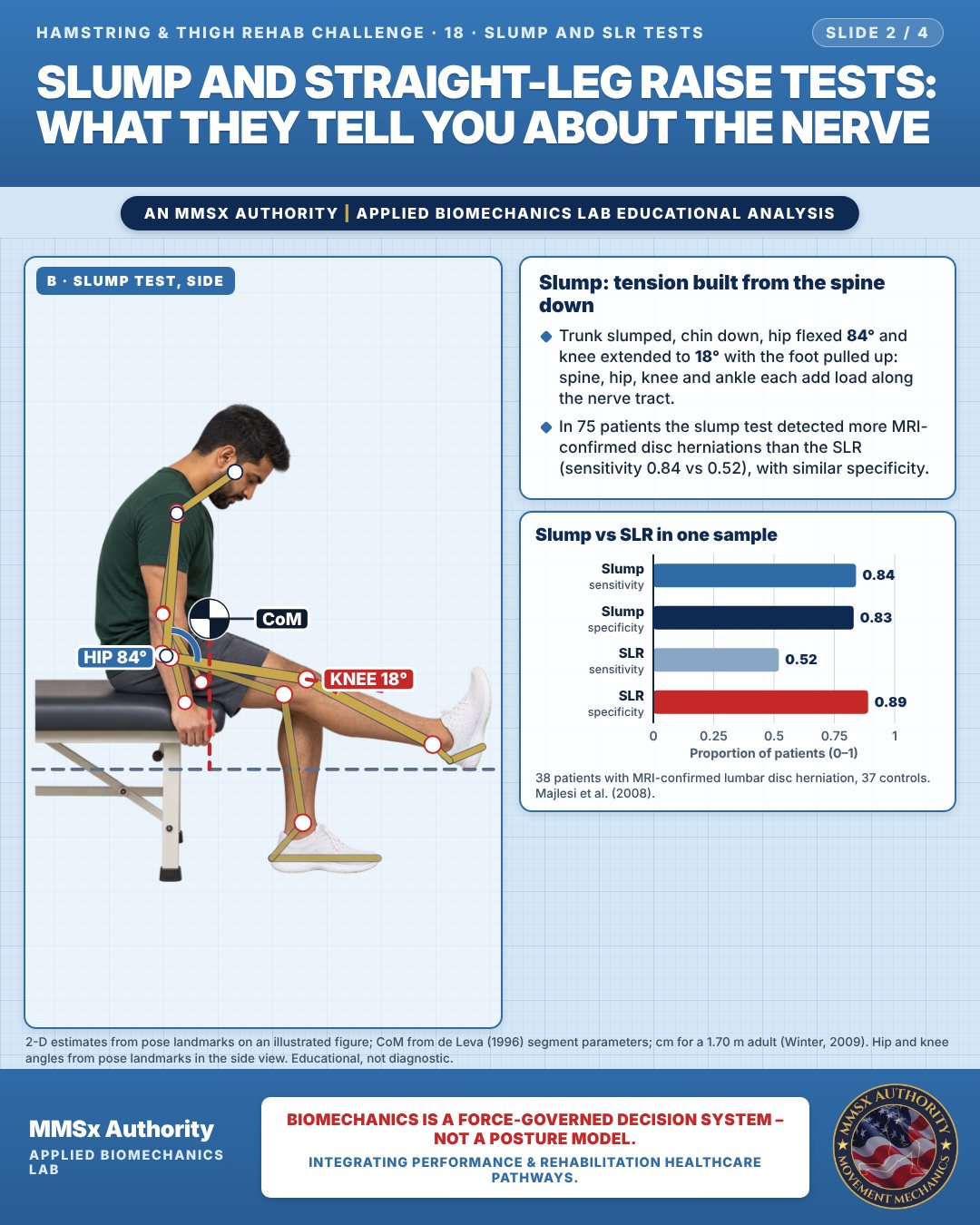
Slump: tension built from the spine down
Trunk slumped, chin down, hip flexed 84° and knee extended to 18° with the foot pulled up: spine, hip, knee and ankle each add load along the nerve tract.
In 75 patients the slump test detected more MRI-confirmed disc herniations than the SLR (sensitivity 0.84 vs 0.52), with similar specificity.
Slump vs SLR in one sample
Movement C: Slump, head up (side view)
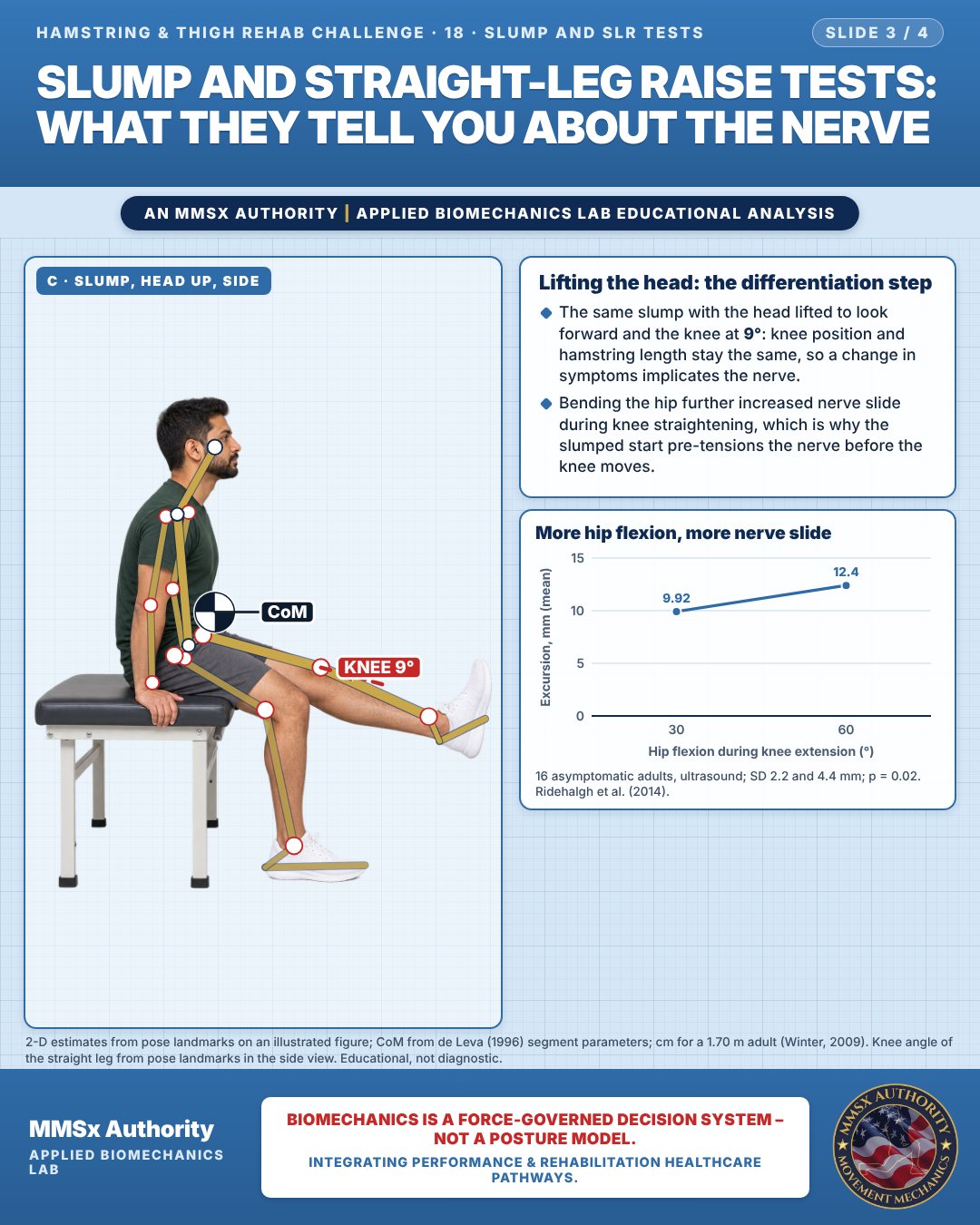
Lifting the head: the differentiation step
The same slump with the head lifted to look forward and the knee at 9°: knee position and hamstring length stay the same, so a change in symptoms implicates the nerve.
Bending the hip further increased nerve slide during knee straightening, which is why the slumped start pre-tensions the nerve before the knee moves.
More hip flexion, more nerve slide
Decision pathway
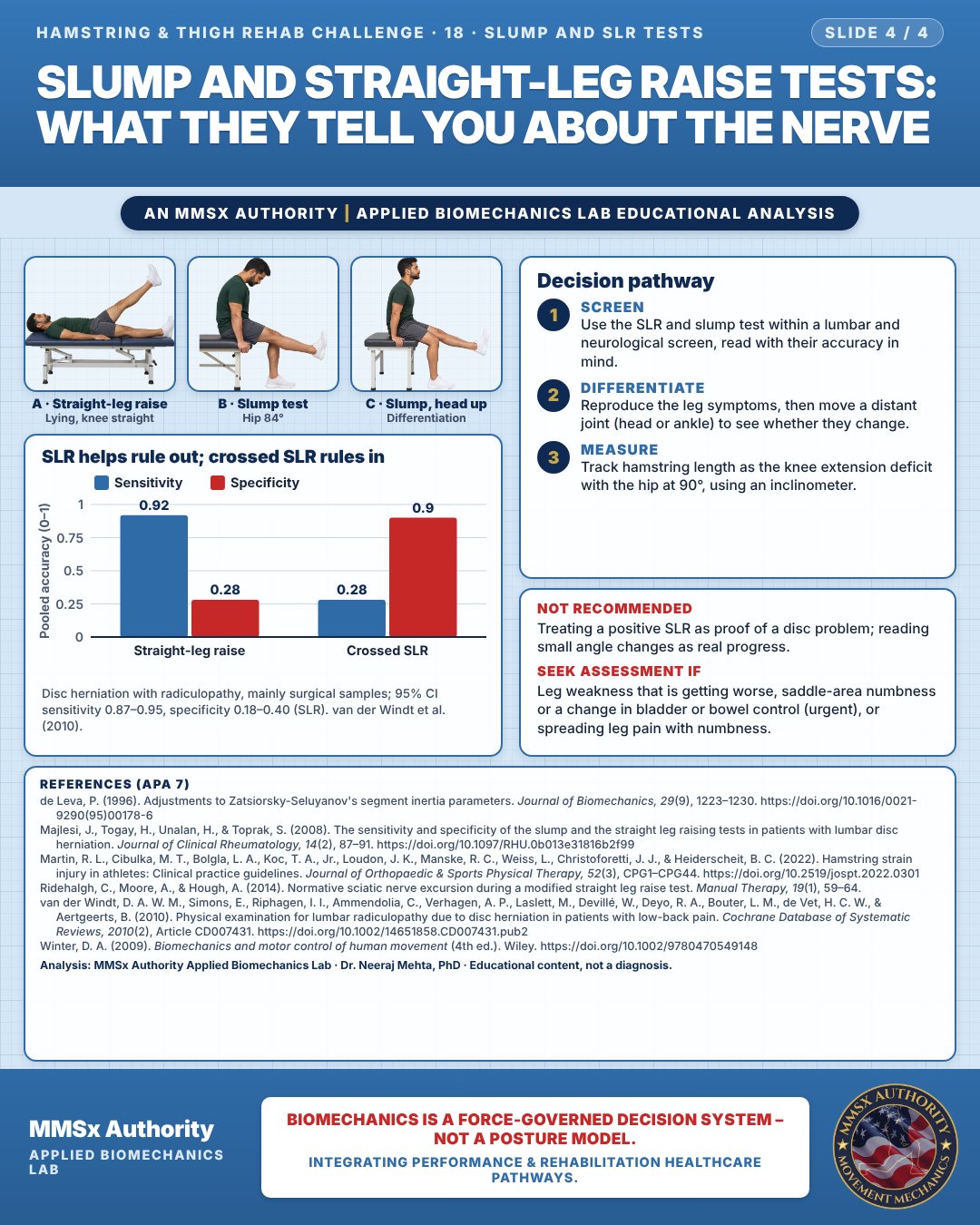
SLR helps rule out; crossed SLR rules in
Screen
Use the SLR and slump test within a lumbar and neurological screen, read with their accuracy in mind.
Differentiate
Reproduce the leg symptoms, then move a distant joint (head or ankle) to see whether they change.
Measure
Track hamstring length as the knee extension deficit with the hip at 90°, using an inclinometer.
What the evidence supports
- Use the SLR and slump test as part of a neurological and lumbar screen, and interpret them with their accuracy in mind (van der Windt et al., 2010; Majlesi et al., 2008).
- Measure hamstring length as the knee extension deficit with the hip at 90°, using an inclinometer (Grade A) (Martin et al., 2022).
- Neural mobilisation is Grade F (expert opinion) (Martin et al., 2022).
Myth and evidence
Myth“A positive SLR proves a disc problem.”
EvidenceThe SLR's pooled specificity is only 0.28: most positive tests occur in people without disc herniation causing radiculopathy, whereas the crossed SLR is far more specific (0.90) (van der Windt et al., 2010). Structural differentiation, such as head up versus head down in the slump test, is what links symptoms to the nerve.
Cautions
Not recommended
Treating a positive SLR as proof of a disc problem; reading small angle changes as real progress.
Seek assessment if
Leg weakness that is getting worse, saddle-area numbness or a change in bladder or bowel control (urgent), or spreading leg pain with numbness.
Methods note
2-D estimates from pose landmarks on an illustrated figure; CoM from de Leva (1996) segment parameters; cm for a 1.70 m adult (Winter, 2009). No angles are measured on the lying image: pose landmarks are unreliable when lying. Hip and knee angles from pose landmarks in the side view. Knee angle of the straight leg from pose landmarks in the side view. These are educational estimates, not a diagnosis.
References
- de Leva, P. (1996). Adjustments to Zatsiorsky-Seluyanov's segment inertia parameters. Journal of Biomechanics, 29(9), 1223–1230. https://doi.org/10.1016/0021-9290(95)00178-6
- Majlesi, J., Togay, H., Unalan, H., & Toprak, S. (2008). The sensitivity and specificity of the slump and the straight leg raising tests in patients with lumbar disc herniation. Journal of Clinical Rheumatology, 14(2), 87–91. https://doi.org/10.1097/RHU.0b013e31816b2f99
- Martin, R. L., Cibulka, M. T., Bolgla, L. A., Koc, T. A., Jr., Loudon, J. K., Manske, R. C., Weiss, L., Christoforetti, J. J., & Heiderscheit, B. C. (2022). Hamstring strain injury in athletes: Clinical practice guidelines. Journal of Orthopaedic & Sports Physical Therapy, 52(3), CPG1–CPG44. https://doi.org/10.2519/jospt.2022.0301
- Ridehalgh, C., Moore, A., & Hough, A. (2014). Normative sciatic nerve excursion during a modified straight leg raise test. Manual Therapy, 19(1), 59–64.
- van der Windt, D. A. W. M., Simons, E., Riphagen, I. I., Ammendolia, C., Verhagen, A. P., Laslett, M., Devillé, W., Deyo, R. A., Bouter, L. M., de Vet, H. C. W., & Aertgeerts, B. (2010). Physical examination for lumbar radiculopathy due to disc herniation in patients with low-back pain. Cochrane Database of Systematic Reviews, 2010(2), Article CD007431. https://doi.org/10.1002/14651858.CD007431.pub2
- Winter, D. A. (2009). Biomechanics and motor control of human movement (4th ed.). Wiley. https://doi.org/10.1002/9780470549148
Cite this article
Mehta, N. (2026, October 26). Slump and straight-leg raise tests: what they tell you about the nerve. MMSx Authority Applied Biomechanics Lab. https://mmsxauthority.org/edu/analysis/hamstring-thigh/18-slump-and-straight-leg-raise-tests-what-they-tell-you-about-the-nerve/
Part of the collection
Mehta, N. (2026). Hamstring and Thigh Rehabilitation: 50 Evidence-Based Biomechanics Analyses [Collection]. MMSx Authority Applied Biomechanics Lab. Zenodo. https://doi.org/10.5281/zenodo.23735792
All Hamstring & Thigh Rehab Challenge articles · Rehabilitation Library