Hamstring & Thigh Rehab Challenge · 17
Sciatic nerve sensitivity: when “tight hamstrings” is a nerve sign
Sciatic nerve sensitivity (neural mechanosensitivity) is an increased sensitivity of the sciatic nerve and its branches to stretch or compression.
Key points
- Differentiate. Change neck or ankle position: if the thigh symptoms change, treat the nerve as a contributor.
- Glide. Start with sliders (look up as the knee straightens) when the nerve is irritable.
- Progress. Add tensioners as tolerated and expect modest range gains rather than dramatic ones.
What it is
Sciatic nerve sensitivity (neural mechanosensitivity) is an increased sensitivity of the sciatic nerve and its branches to stretch or compression. It can feel like posterior thigh "tightness". It is typically changed by moving body parts away from the hamstring, such as the neck or ankle: these movements alter nerve load without changing hamstring length (structural differentiation). Neck flexion alone moved the sciatic nerve in the thigh by only about 0.1 mm, while knee-and-neck combinations moved it 2.6–3.2 mm (Ellis et al., 2012).
How we analysed the movement
Three movements relevant to this topic were analysed from illustrated reference figures. Joint centres were located with two-dimensional pose estimation; hip and knee angles, pelvis level, the whole-body centre of mass and, where relevant, the hip lever (the horizontal distance from the hip joint to the upper-body centre of mass) and the resulting static hip moment were then calculated from standard segment parameters. The figures are educational estimates that show how position changes mechanical demand; they are not measurements of a patient. Every research value quoted below comes from the published source cited beside it.
Movement A: Slump sitting (side view)
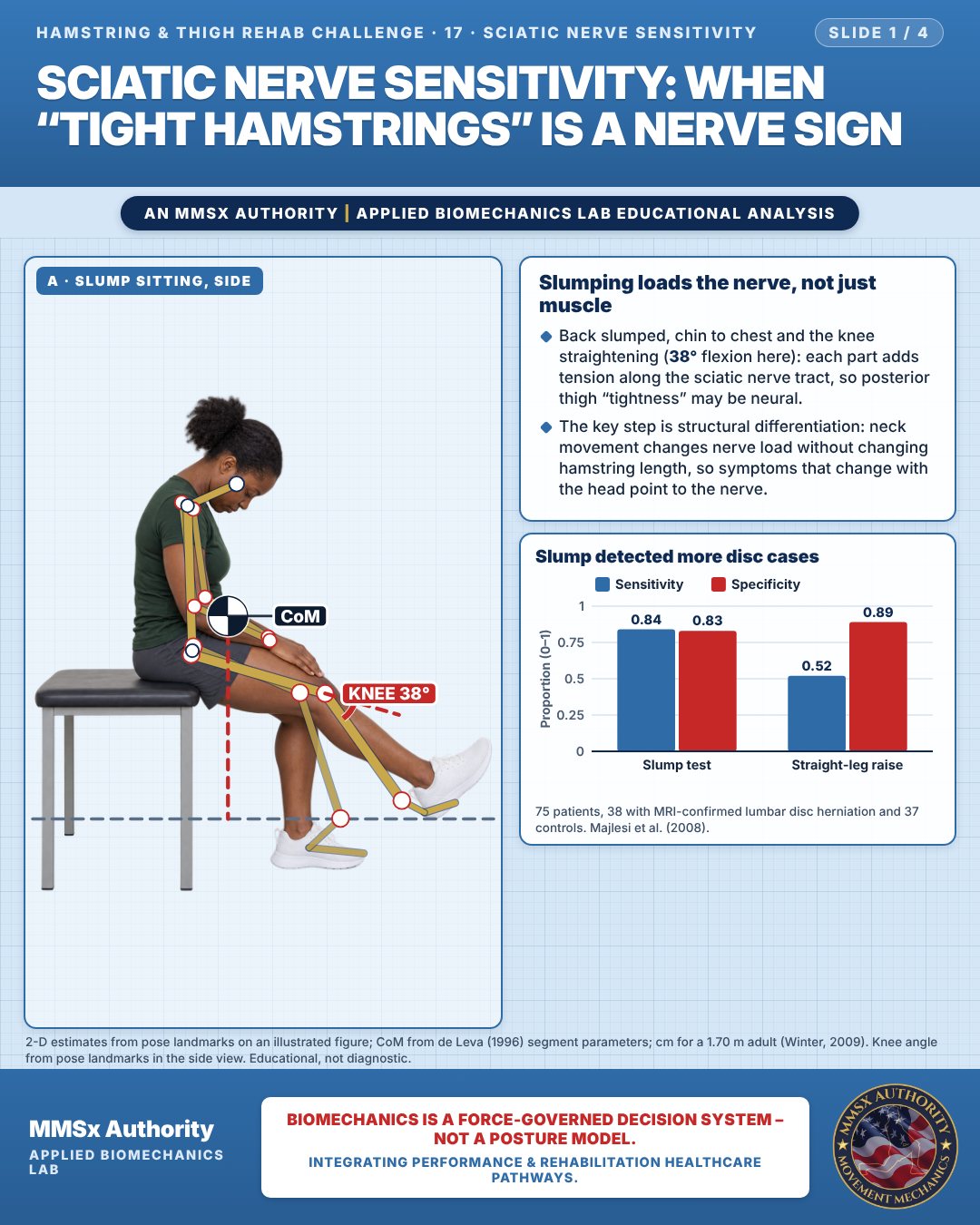
Slumping loads the nerve, not just muscle
Back slumped, chin to chest and the knee straightening (38° flexion here): each part adds tension along the sciatic nerve tract, so posterior thigh “tightness” may be neural.
The key step is structural differentiation: neck movement changes nerve load without changing hamstring length, so symptoms that change with the head point to the nerve.
Slump detected more disc cases
Movement B: Nerve glide (side view)
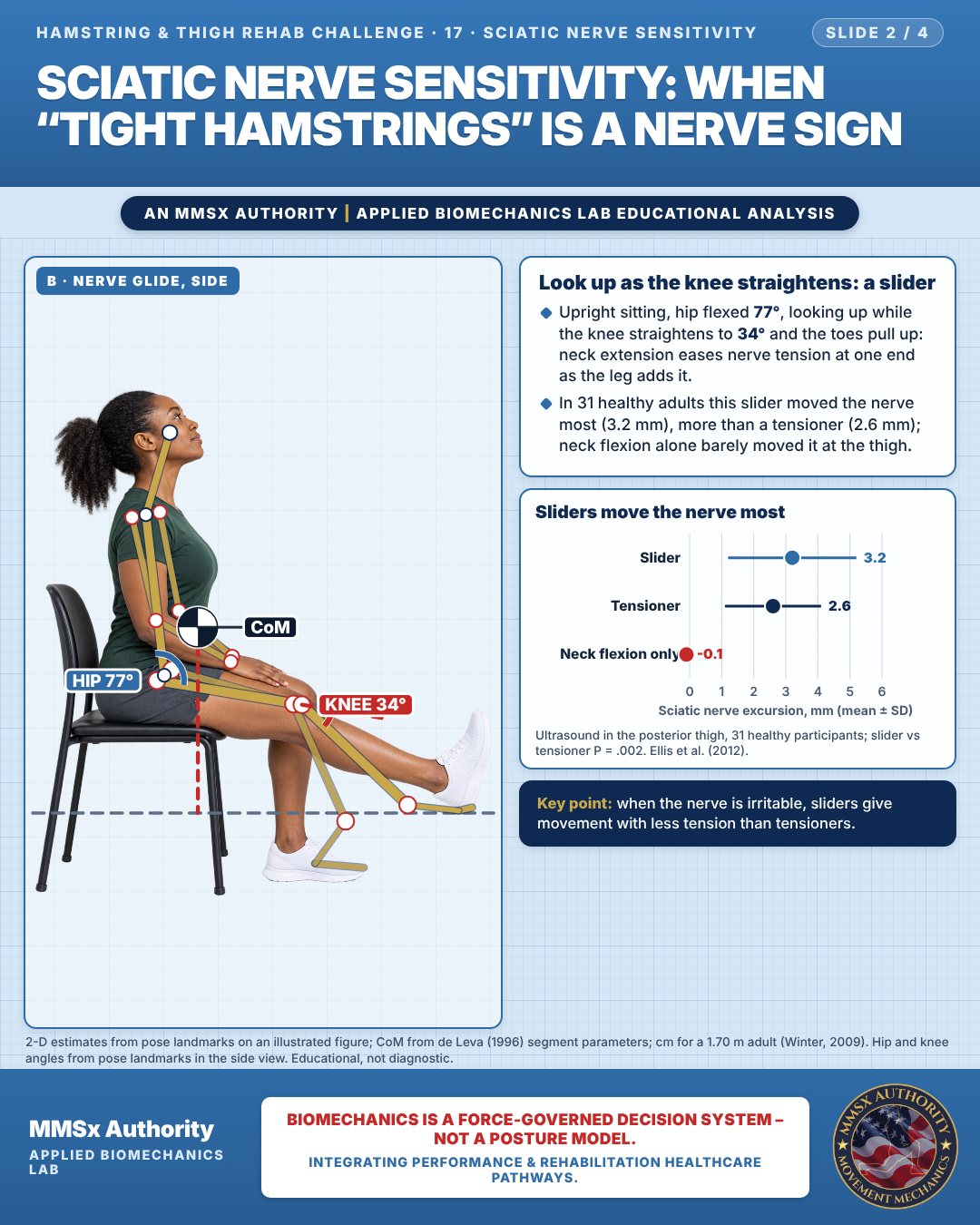
Look up as the knee straightens: a slider
Upright sitting, hip flexed 77°, looking up while the knee straightens to 34° and the toes pull up: neck extension eases nerve tension at one end as the leg adds it.
In 31 healthy adults this slider moved the nerve most (3.2 mm), more than a tensioner (2.6 mm); neck flexion alone barely moved it at the thigh.
Sliders move the nerve most
Movement C: Hand on buttock (side view)
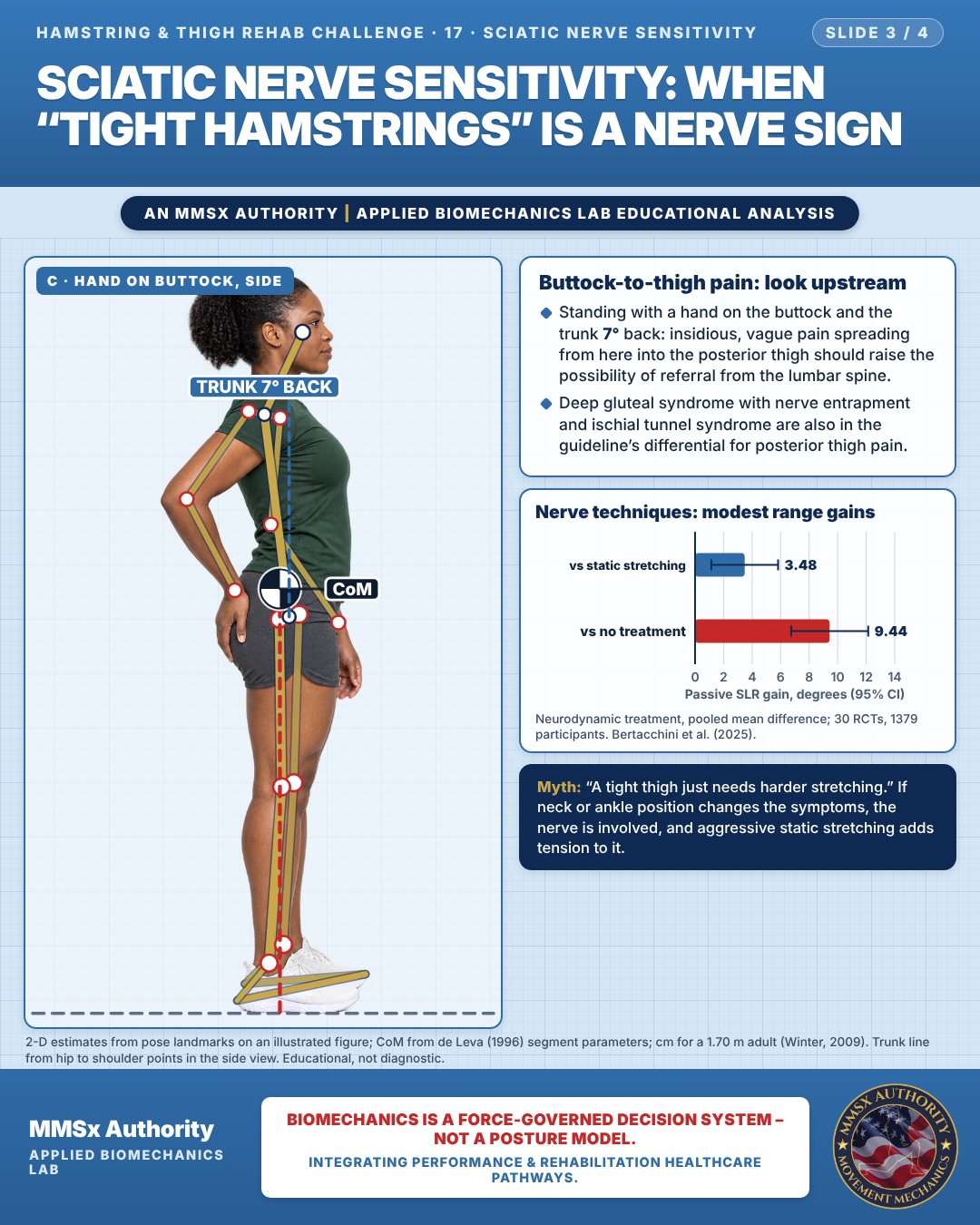
Buttock-to-thigh pain: look upstream
Standing with a hand on the buttock and the trunk 7° back: insidious, vague pain spreading from here into the posterior thigh should raise the possibility of referral from the lumbar spine.
Deep gluteal syndrome with nerve entrapment and ischial tunnel syndrome are also in the guideline’s differential for posterior thigh pain.
Nerve techniques: modest range gains
Decision pathway
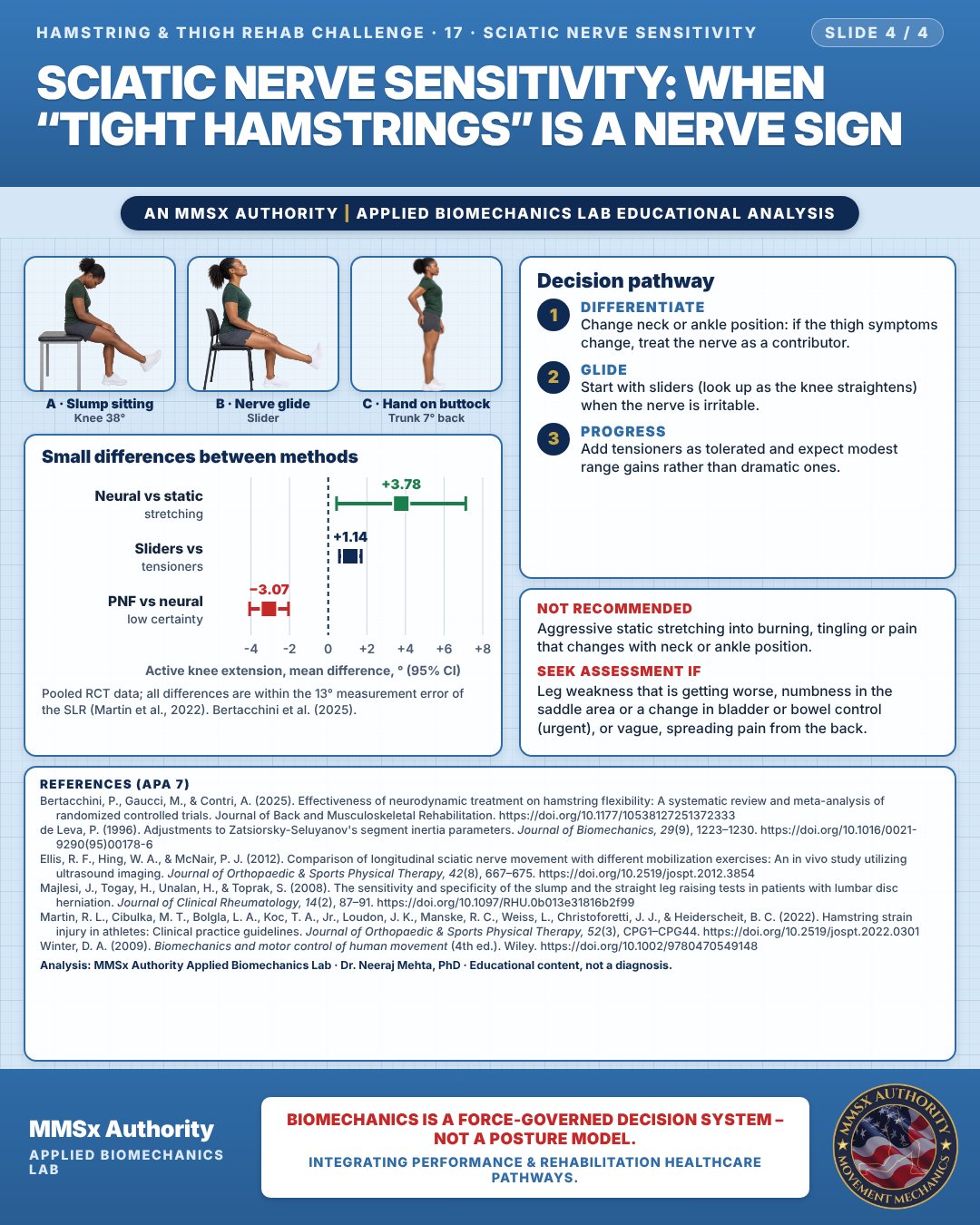
Small differences between methods
Differentiate
Change neck or ankle position: if the thigh symptoms change, treat the nerve as a contributor.
Glide
Start with sliders (look up as the knee straightens) when the nerve is irritable.
Progress
Add tensioners as tolerated and expect modest range gains rather than dramatic ones.
What the evidence supports
- Neural tissue mobilisation may be performed after hamstring injury (Grade F, expert opinion) (Martin et al., 2022). Pooled trial data show small ROM gains over stretching (Bertacchini et al., 2025).
Cautions
Not recommended
Aggressive static stretching into burning, tingling or pain that changes with neck or ankle position.
Seek assessment if
Leg weakness that is getting worse, numbness in the saddle area or a change in bladder or bowel control (urgent), or vague, spreading pain from the back.
Methods note
2-D estimates from pose landmarks on an illustrated figure; CoM from de Leva (1996) segment parameters; cm for a 1.70 m adult (Winter, 2009). Knee angle from pose landmarks in the side view. Hip and knee angles from pose landmarks in the side view. Trunk line from hip to shoulder points in the side view. These are educational estimates, not a diagnosis.
References
- Bertacchini, P., Gaucci, M., & Contri, A. (2025). Effectiveness of neurodynamic treatment on hamstring flexibility: A systematic review and meta-analysis of randomized controlled trials. Journal of Back and Musculoskeletal Rehabilitation. https://doi.org/10.1177/10538127251372333
- de Leva, P. (1996). Adjustments to Zatsiorsky-Seluyanov's segment inertia parameters. Journal of Biomechanics, 29(9), 1223–1230. https://doi.org/10.1016/0021-9290(95)00178-6
- Ellis, R. F., Hing, W. A., & McNair, P. J. (2012). Comparison of longitudinal sciatic nerve movement with different mobilization exercises: An in vivo study utilizing ultrasound imaging. Journal of Orthopaedic & Sports Physical Therapy, 42(8), 667–675. https://doi.org/10.2519/jospt.2012.3854
- Majlesi, J., Togay, H., Unalan, H., & Toprak, S. (2008). The sensitivity and specificity of the slump and the straight leg raising tests in patients with lumbar disc herniation. Journal of Clinical Rheumatology, 14(2), 87–91. https://doi.org/10.1097/RHU.0b013e31816b2f99
- Martin, R. L., Cibulka, M. T., Bolgla, L. A., Koc, T. A., Jr., Loudon, J. K., Manske, R. C., Weiss, L., Christoforetti, J. J., & Heiderscheit, B. C. (2022). Hamstring strain injury in athletes: Clinical practice guidelines. Journal of Orthopaedic & Sports Physical Therapy, 52(3), CPG1–CPG44. https://doi.org/10.2519/jospt.2022.0301
- Winter, D. A. (2009). Biomechanics and motor control of human movement (4th ed.). Wiley. https://doi.org/10.1002/9780470549148
Cite this article
Mehta, N. (2026, October 26). Sciatic nerve sensitivity: when “tight hamstrings” is a nerve sign. MMSx Authority Applied Biomechanics Lab. https://mmsxauthority.org/edu/analysis/hamstring-thigh/17-sciatic-nerve-sensitivity-when-tight-hamstrings-is-a-nerve-sign/
Part of the collection
Mehta, N. (2026). Hamstring and Thigh Rehabilitation: 50 Evidence-Based Biomechanics Analyses [Collection]. MMSx Authority Applied Biomechanics Lab. Zenodo. https://doi.org/10.5281/zenodo.23735792
All Hamstring & Thigh Rehab Challenge articles · Rehabilitation Library