Hamstring & Thigh Rehab Challenge · 16
Hamstring pain behind the knee: tendon, nerve or knee joint?
Pain at the back of the knee can come from the distal hamstring tendons (biceps femoris laterally.
Key points
- Locate. Find where tenderness is greatest: at the tendon insertion, in a swelling, or nowhere specific.
- Differentiate. Check whether hip or neck position changes the pain; if it does, consider the nerve or the lumbar spine.
- Match. Load a sore tendon progressively, have the knee joint behind a cyst assessed, and use gentle nerve glides for nerve signs.
What it is
Pain at the back of the knee can come from the distal hamstring tendons (biceps femoris laterally; semitendinosus and semimembranosus medially), from the knee joint (for example a popliteal or Baker's cyst, usually linked to an intra-articular problem), or it can be referred from the lumbar spine or from nerve tissue. When posterior thigh symptoms are mainly distal, the JOSPT guideline says the differential "may need to include hip and knee pathologies, as well as isolated tendon lesions, apophysitis, and avulsion fractures". Maximal tenderness at the origin or insertion should prompt consideration of tendon pathology (Martin et al., 2022).
How we analysed the movement
Three movements relevant to this topic were analysed from illustrated reference figures. Joint centres were located with two-dimensional pose estimation; hip and knee angles, pelvis level, the whole-body centre of mass and, where relevant, the hip lever (the horizontal distance from the hip joint to the upper-body centre of mass) and the resulting static hip moment were then calculated from standard segment parameters. The figures are educational estimates that show how position changes mechanical demand; they are not measurements of a patient. Every research value quoted below comes from the published source cited beside it.
Movement A: Hand behind knee (side view)
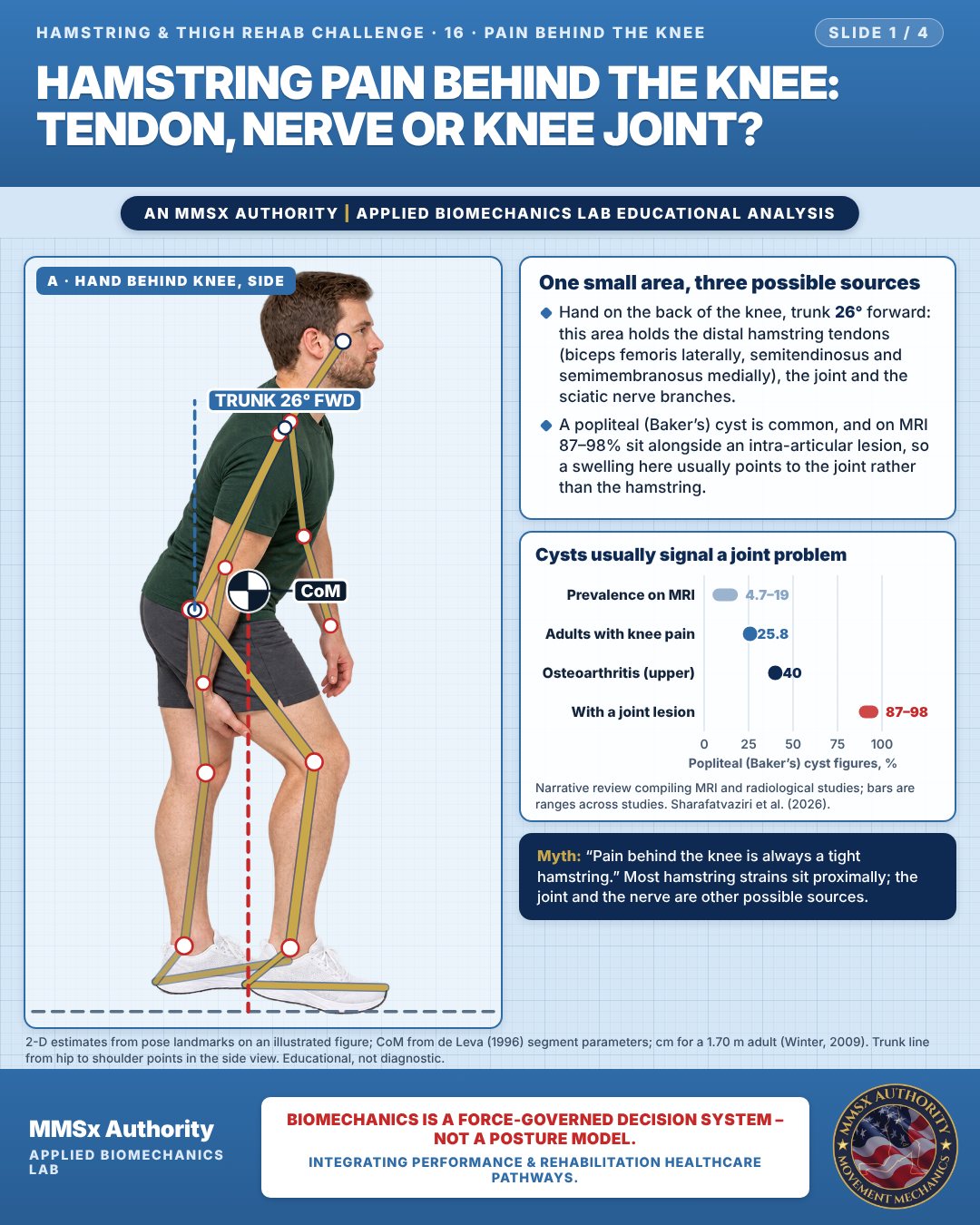
One small area, three possible sources
Hand on the back of the knee, trunk 26° forward: this area holds the distal hamstring tendons (biceps femoris laterally, semitendinosus and semimembranosus medially), the joint and the sciatic nerve branches.
A popliteal (Baker’s) cyst is common, and on MRI 87–98% sit alongside an intra-articular lesion, so a swelling here usually points to the joint rather than the hamstring.
Cysts usually signal a joint problem
Movement B: Deep squat (side view)
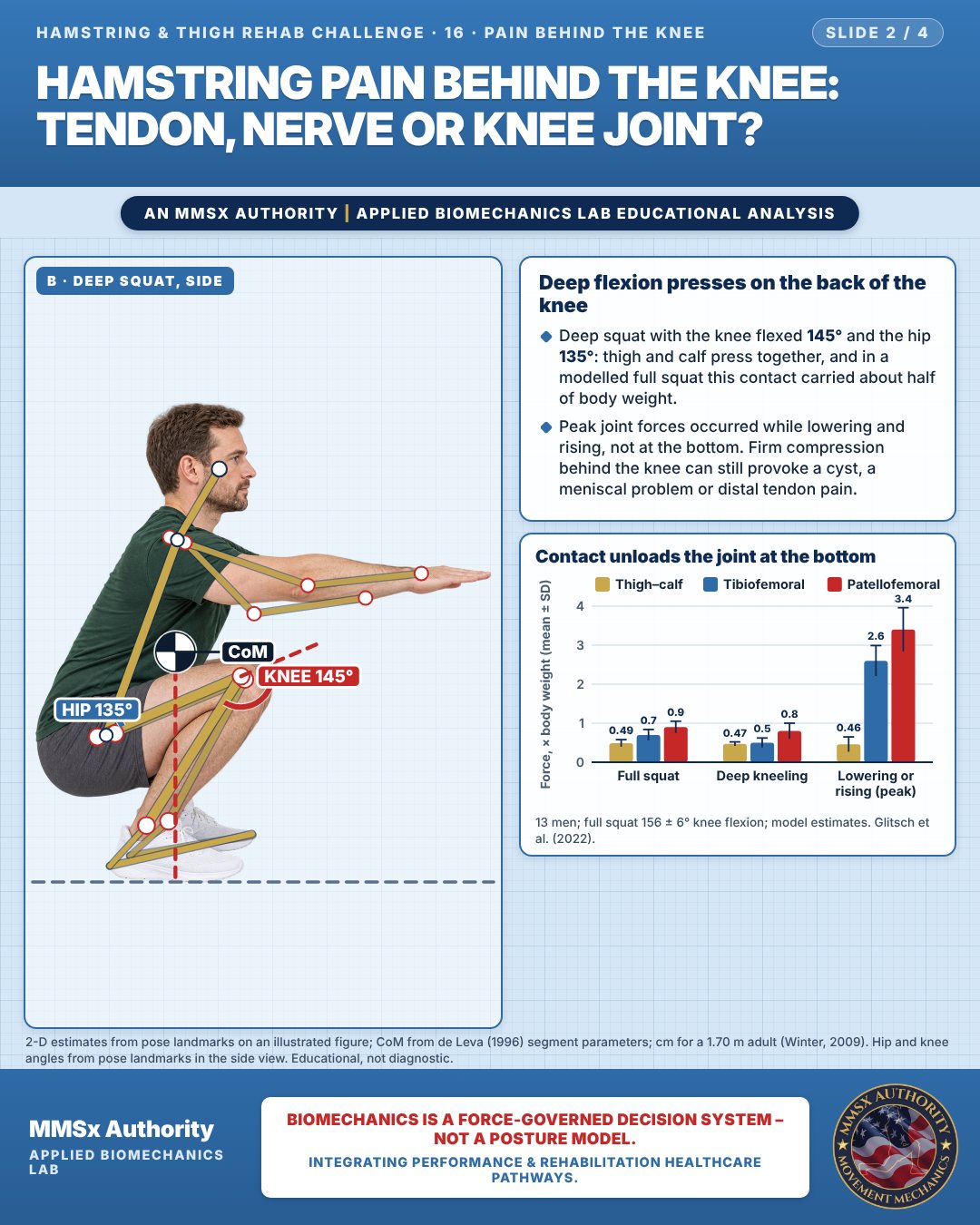
Deep flexion presses on the back of the knee
Deep squat with the knee flexed 145° and the hip 135°: thigh and calf press together, and in a modelled full squat this contact carried about half of body weight.
Peak joint forces occurred while lowering and rising, not at the bottom. Firm compression behind the knee can still provoke a cyst, a meniscal problem or distal tendon pain.
Contact unloads the joint at the bottom
Movement C: Knee extension (side view)
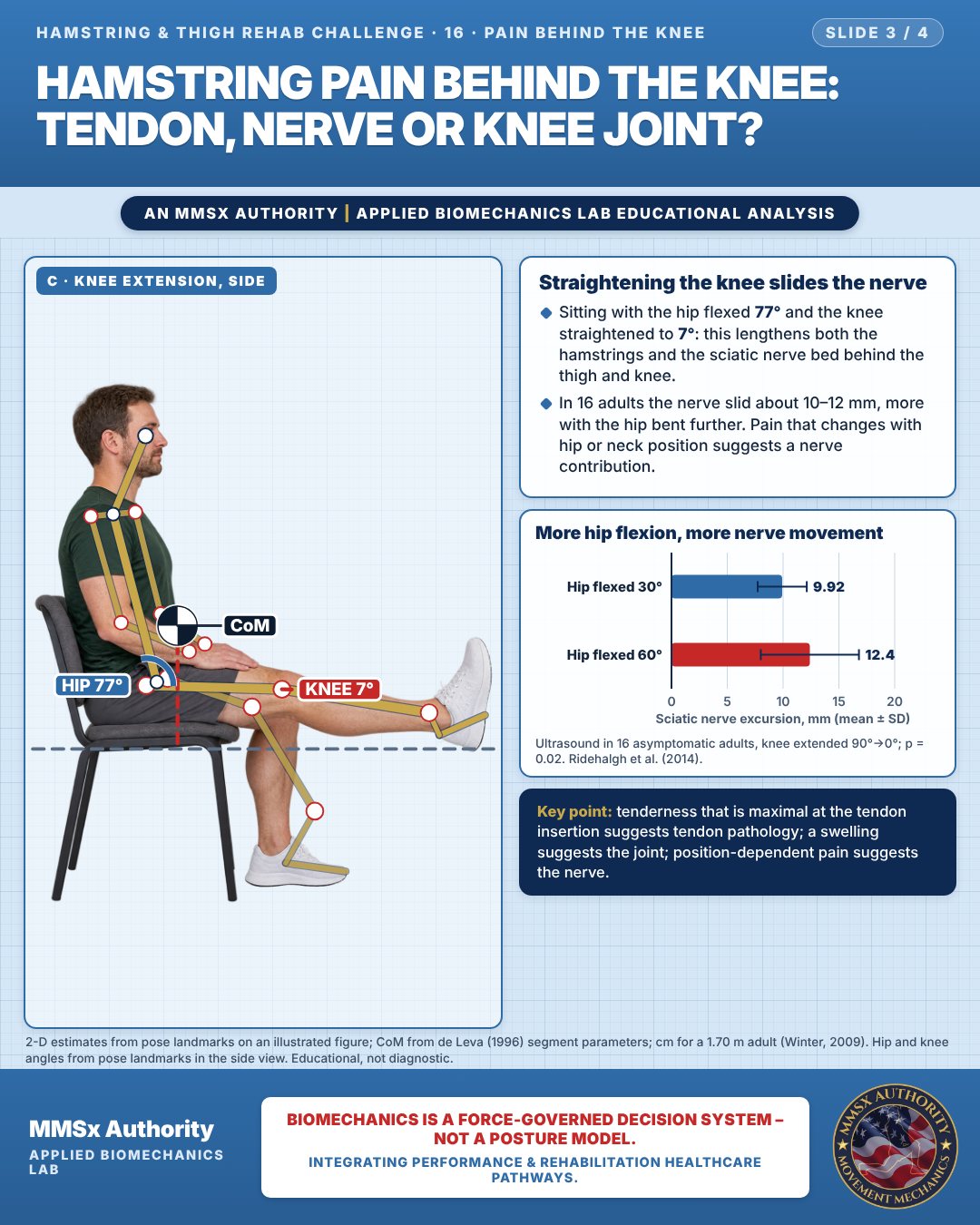
Straightening the knee slides the nerve
Sitting with the hip flexed 77° and the knee straightened to 7°: this lengthens both the hamstrings and the sciatic nerve bed behind the thigh and knee.
In 16 adults the nerve slid about 10–12 mm, more with the hip bent further. Pain that changes with hip or neck position suggests a nerve contribution.
More hip flexion, more nerve movement
Decision pathway
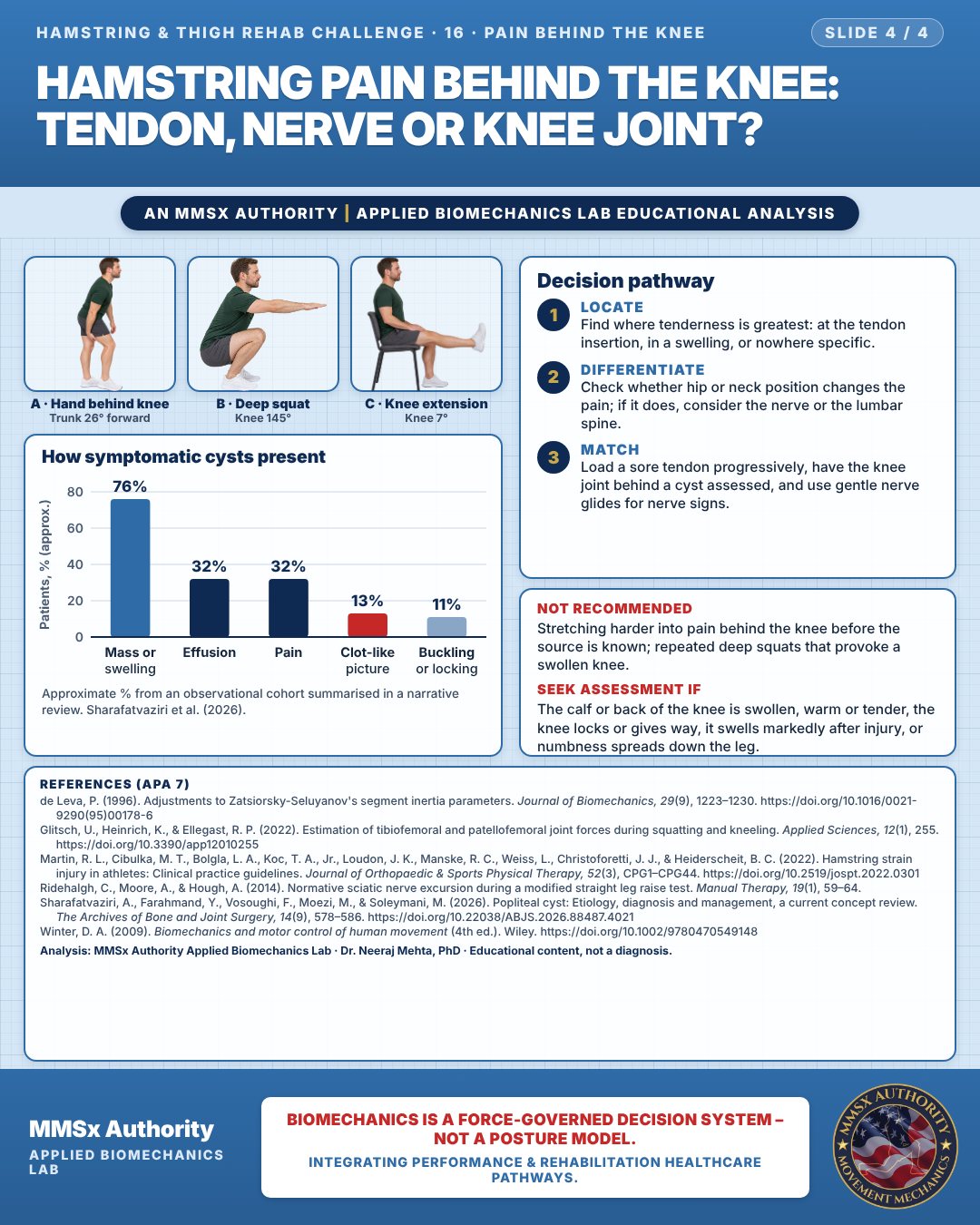
How symptomatic cysts present
Locate
Find where tenderness is greatest: at the tendon insertion, in a swelling, or nowhere specific.
Differentiate
Check whether hip or neck position changes the pain; if it does, consider the nerve or the lumbar spine.
Match
Load a sore tendon progressively, have the knee joint behind a cyst assessed, and use gentle nerve glides for nerve signs.
What the evidence supports
- Match management to the source. Distal tendon pain is managed with tendon-loading principles. A Baker's cyst calls for assessment of the underlying knee joint problem, because most cysts are associated with intra-articular pathology (Sharafatvaziri et al., 2026). Nerve-related symptoms: neural mobilisation may be used (Grade F, expert opinion) (Martin et al., 2022).
Myth and evidence
Myth“Pain behind the knee is always a tight hamstring.”
EvidencePain in this area can come from the joint (most Baker's cysts sit alongside an intra-articular lesion: 87–98%) (Sharafatvaziri et al., 2026). It can also come from the nerve, which moves 10–12 mm when the knee straightens in sitting (Ridehalgh et al., 2014). Distal hamstring strains are also uncommon compared with proximal ones (Martin et al., 2022).
Cautions
Not recommended
Stretching harder into pain behind the knee before the source is known; repeated deep squats that provoke a swollen knee.
Seek assessment if
The calf or back of the knee is swollen, warm or tender, the knee locks or gives way, it swells markedly after injury, or numbness spreads down the leg.
Methods note
2-D estimates from pose landmarks on an illustrated figure; CoM from de Leva (1996) segment parameters; cm for a 1.70 m adult (Winter, 2009). Trunk line from hip to shoulder points in the side view. Hip and knee angles from pose landmarks in the side view. These are educational estimates, not a diagnosis.
References
- de Leva, P. (1996). Adjustments to Zatsiorsky-Seluyanov's segment inertia parameters. Journal of Biomechanics, 29(9), 1223–1230. https://doi.org/10.1016/0021-9290(95)00178-6
- Glitsch, U., Heinrich, K., & Ellegast, R. P. (2022). Estimation of tibiofemoral and patellofemoral joint forces during squatting and kneeling. Applied Sciences, 12(1), 255. https://doi.org/10.3390/app12010255
- Martin, R. L., Cibulka, M. T., Bolgla, L. A., Koc, T. A., Jr., Loudon, J. K., Manske, R. C., Weiss, L., Christoforetti, J. J., & Heiderscheit, B. C. (2022). Hamstring strain injury in athletes: Clinical practice guidelines. Journal of Orthopaedic & Sports Physical Therapy, 52(3), CPG1–CPG44. https://doi.org/10.2519/jospt.2022.0301
- Ridehalgh, C., Moore, A., & Hough, A. (2014). Normative sciatic nerve excursion during a modified straight leg raise test. Manual Therapy, 19(1), 59–64.
- Sharafatvaziri, A., Farahmand, Y., Vosoughi, F., Moezi, M., & Soleymani, M. (2026). Popliteal cyst: Etiology, diagnosis and management, a current concept review. The Archives of Bone and Joint Surgery, 14(9), 578–586. https://doi.org/10.22038/ABJS.2026.88487.4021
- Winter, D. A. (2009). Biomechanics and motor control of human movement (4th ed.). Wiley. https://doi.org/10.1002/9780470549148
Cite this article
Mehta, N. (2026, October 26). Hamstring pain behind the knee: tendon, nerve or knee joint? MMSx Authority Applied Biomechanics Lab. https://mmsxauthority.org/edu/analysis/hamstring-thigh/16-hamstring-pain-behind-the-knee-tendon-nerve-or-knee-joint/
Part of the collection
Mehta, N. (2026). Hamstring and Thigh Rehabilitation: 50 Evidence-Based Biomechanics Analyses [Collection]. MMSx Authority Applied Biomechanics Lab. Zenodo. https://doi.org/10.5281/zenodo.23735792
All Hamstring & Thigh Rehab Challenge articles · Rehabilitation Library