Hamstring & Thigh Rehab Challenge · 15
Romanian deadlift for hamstrings: loading the hip hinge safely
The Romanian deadlift (RDL) is a hip-hinge exercise: from standing, the hips move backward with the knees softly bent and the spine held neutral,…
Key points
- Hinge well. Push the hips back with soft knees and a flat back; lower only as far as that holds.
- Progress. Add load, range and single-leg work gradually, within a programme that includes the Nordic.
- Balance. Pair the RDL with knee-flexion work that biases biceps femoris.
What it is
The Romanian deadlift (RDL) is a hip-hinge exercise: from standing, the hips move backward with the knees softly bent and the spine held neutral, lowering the load along the thighs towards mid-shin, then returning by extending the hips. It loads the hamstrings and gluteals as hip extensors through a long muscle length, with the medial hamstrings (semitendinosus) highly active.
How we analysed the movement
Three movements relevant to this topic were analysed from illustrated reference figures. Joint centres were located with two-dimensional pose estimation; hip and knee angles, pelvis level, the whole-body centre of mass and, where relevant, the hip lever (the horizontal distance from the hip joint to the upper-body centre of mass) and the resulting static hip moment were then calculated from standard segment parameters. The figures are educational estimates that show how position changes mechanical demand; they are not measurements of a patient. Every research value quoted below comes from the published source cited beside it.
Movement A: Rdl top (side view)
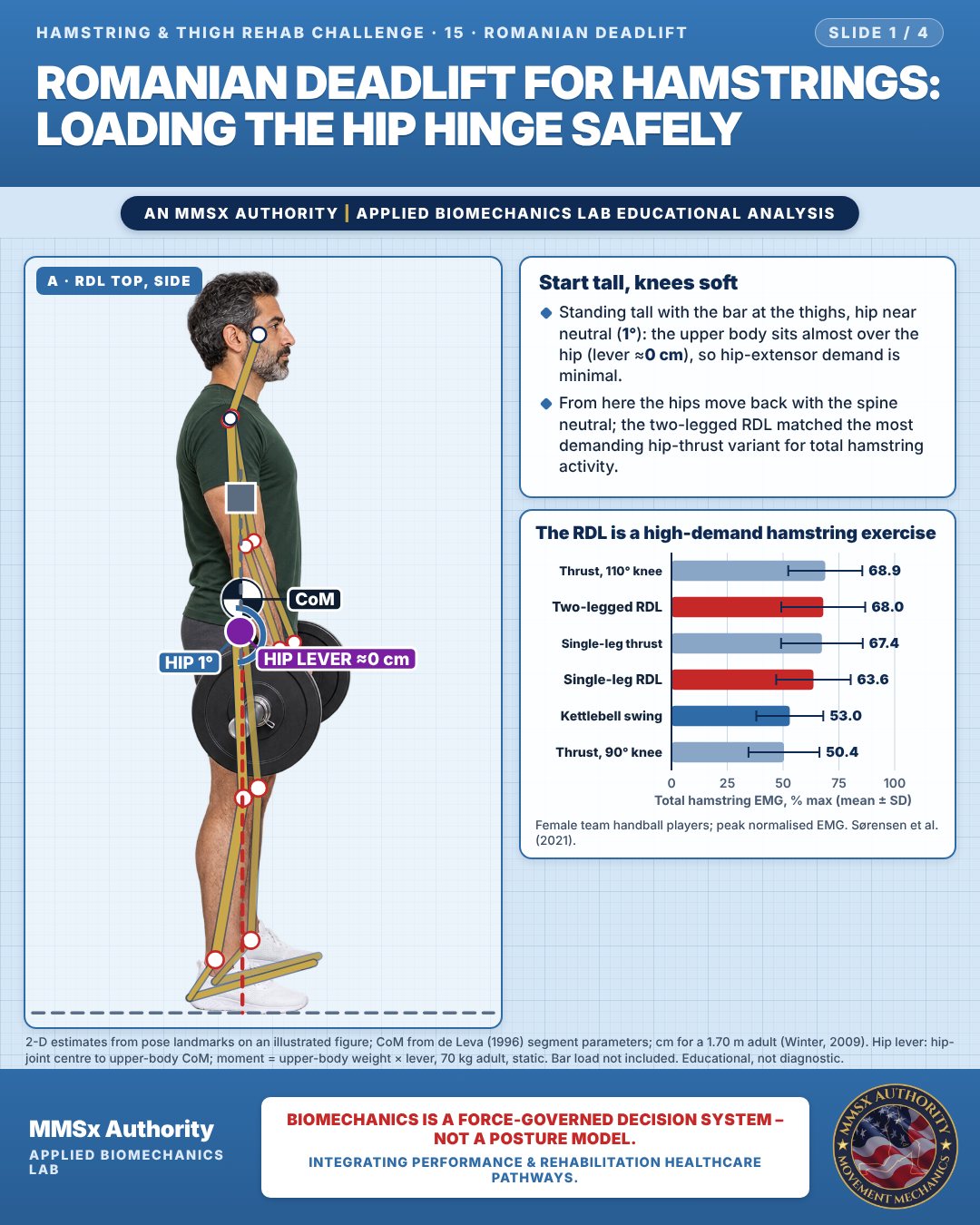
Start tall, knees soft
Standing tall with the bar at the thighs, hip near neutral (1°): the upper body sits almost over the hip (lever ≈0 cm), so hip-extensor demand is minimal.
From here the hips move back with the spine neutral; the two-legged RDL matched the most demanding hip-thrust variant for total hamstring activity.
The RDL is a high-demand hamstring exercise
Movement B: Rdl halfway (side view)
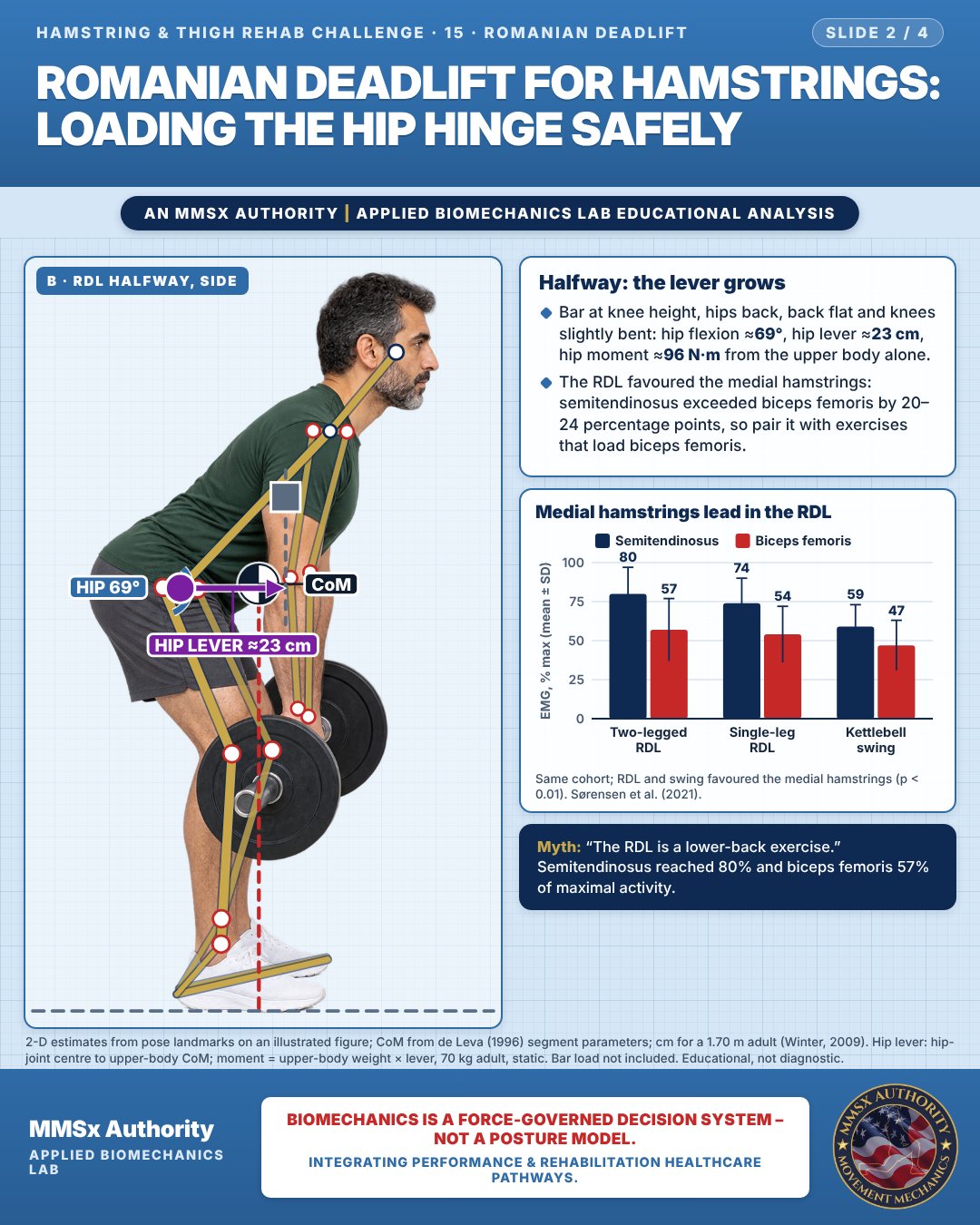
Halfway: the lever grows
Bar at knee height, hips back, back flat and knees slightly bent: hip flexion ≈69°, hip lever ≈23 cm, hip moment ≈96 N·m from the upper body alone.
The RDL favoured the medial hamstrings: semitendinosus exceeded biceps femoris by 20–24 percentage points, so pair it with exercises that load biceps femoris.
Medial hamstrings lead in the RDL
Movement C: Rdl bottom (side view)
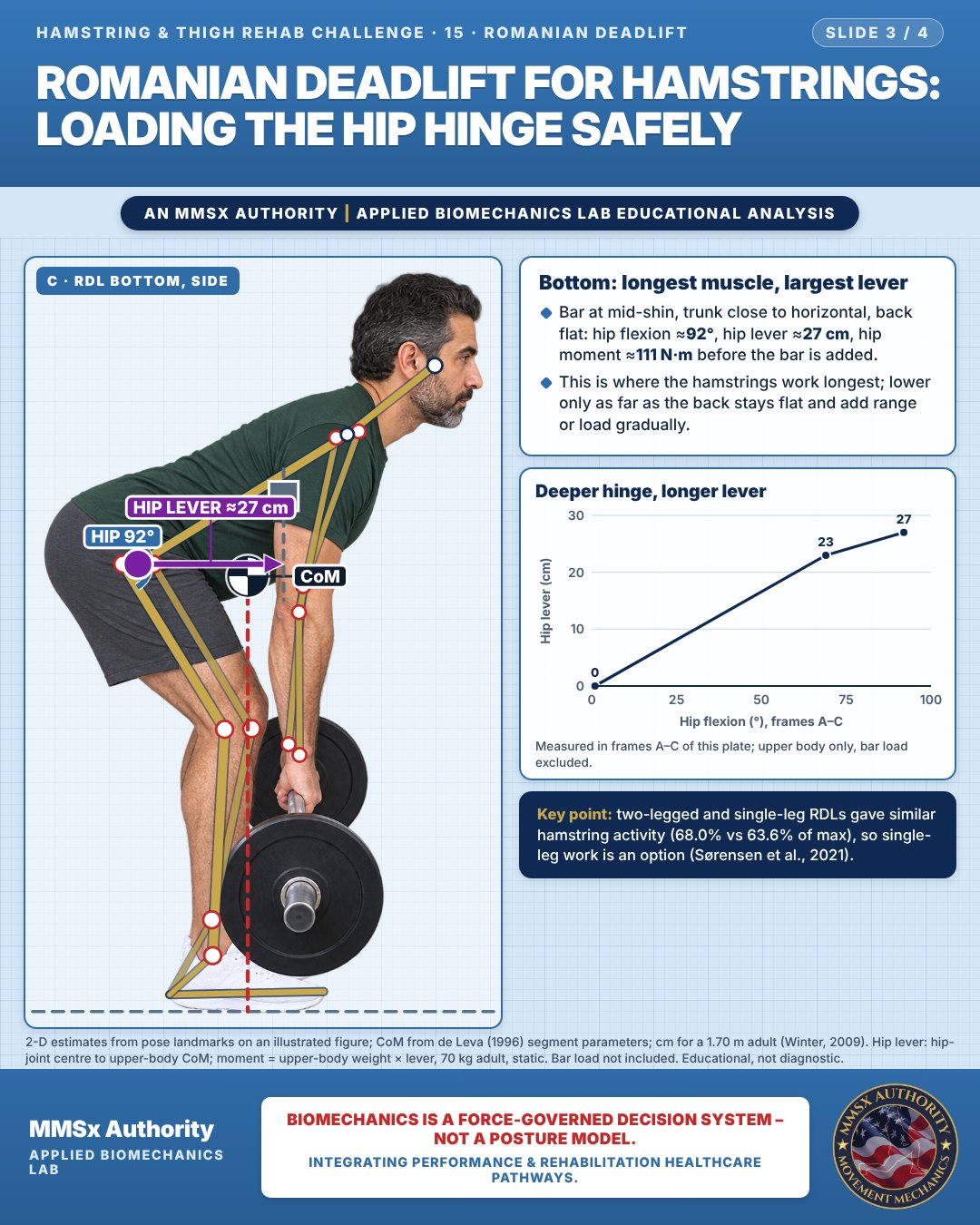
Bottom: longest muscle, largest lever
Bar at mid-shin, trunk close to horizontal, back flat: hip flexion ≈92°, hip lever ≈27 cm, hip moment ≈111 N·m before the bar is added.
This is where the hamstrings work longest; lower only as far as the back stays flat and add range or load gradually.
Deeper hinge, longer lever
Decision pathway
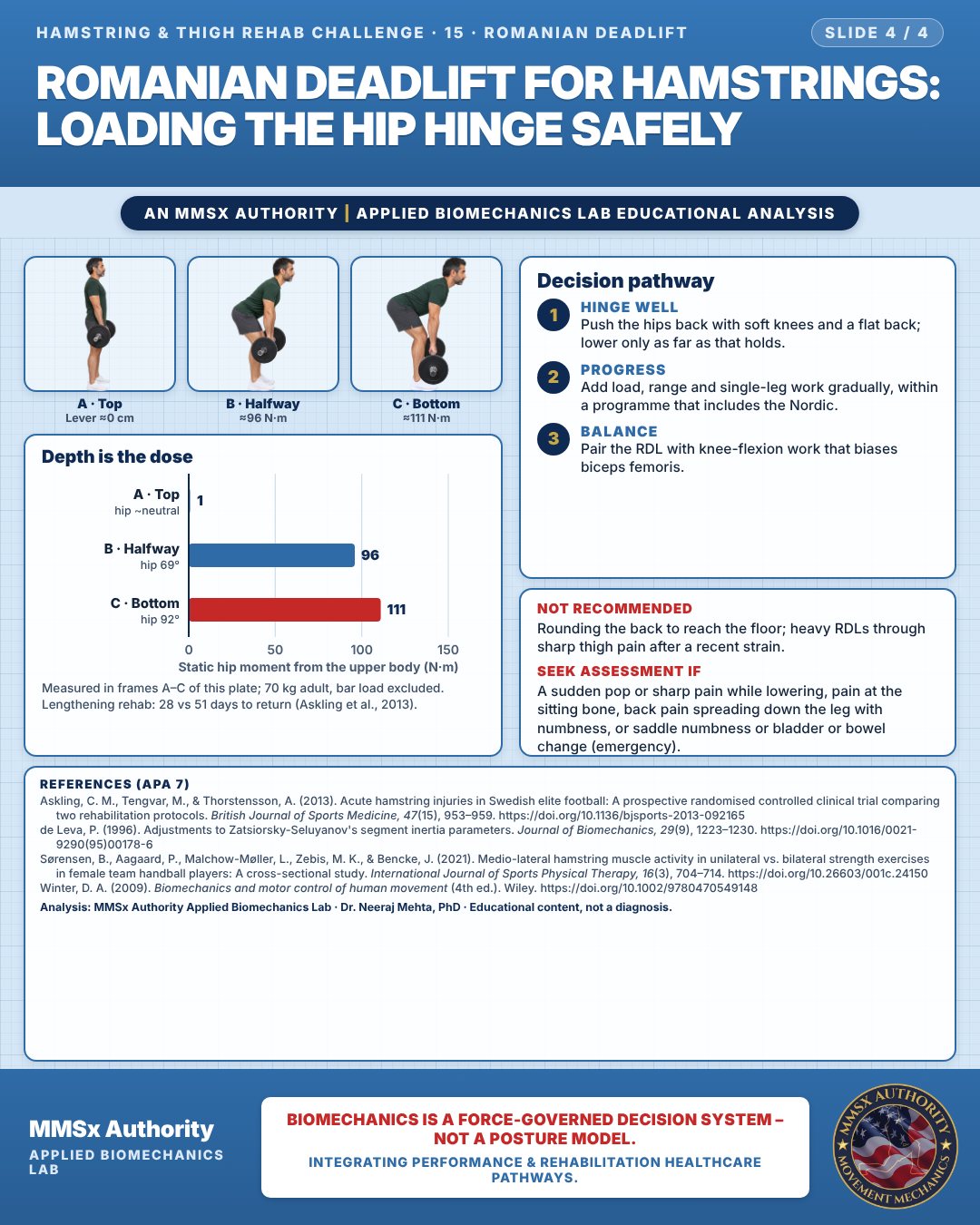
Depth is the dose
Hinge well
Push the hips back with soft knees and a flat back; lower only as far as that holds.
Progress
Add load, range and single-leg work gradually, within a programme that includes the Nordic.
Balance
Pair the RDL with knee-flexion work that biases biceps femoris.
What the evidence supports
- Two-legged and single-leg RDLs produce similar hamstring activity (68.0% vs 63.6% of max) (Sørensen et al., 2021), so single-leg versions can be used when loading capacity or equipment is limited.
Cautions
Not recommended
Rounding the back to reach the floor; heavy RDLs through sharp thigh pain after a recent strain.
Seek assessment if
A sudden pop or sharp pain while lowering, pain at the sitting bone, back pain spreading down the leg with numbness, or saddle numbness or bladder or bowel change (emergency).
Methods note
2-D estimates from pose landmarks on an illustrated figure; CoM from de Leva (1996) segment parameters; cm for a 1.70 m adult (Winter, 2009). Hip lever: hip-joint centre to upper-body CoM; moment = upper-body weight × lever, 70 kg adult, static. Bar load not included. These are educational estimates, not a diagnosis.
References
- Askling, C. M., Tengvar, M., & Thorstensson, A. (2013). Acute hamstring injuries in Swedish elite football: A prospective randomised controlled clinical trial comparing two rehabilitation protocols. British Journal of Sports Medicine, 47(15), 953–959. https://doi.org/10.1136/bjsports-2013-092165
- de Leva, P. (1996). Adjustments to Zatsiorsky-Seluyanov's segment inertia parameters. Journal of Biomechanics, 29(9), 1223–1230. https://doi.org/10.1016/0021-9290(95)00178-6
- Sørensen, B., Aagaard, P., Malchow-Møller, L., Zebis, M. K., & Bencke, J. (2021). Medio-lateral hamstring muscle activity in unilateral vs. bilateral strength exercises in female team handball players: A cross-sectional study. International Journal of Sports Physical Therapy, 16(3), 704–714. https://doi.org/10.26603/001c.24150
- Winter, D. A. (2009). Biomechanics and motor control of human movement (4th ed.). Wiley. https://doi.org/10.1002/9780470549148
Cite this article
Mehta, N. (2026, October 26). Romanian deadlift for hamstrings: loading the hip hinge safely. MMSx Authority Applied Biomechanics Lab. https://mmsxauthority.org/edu/analysis/hamstring-thigh/15-romanian-deadlift-for-hamstrings-loading-the-hip-hinge-safely/
Part of the collection
Mehta, N. (2026). Hamstring and Thigh Rehabilitation: 50 Evidence-Based Biomechanics Analyses [Collection]. MMSx Authority Applied Biomechanics Lab. Zenodo. https://doi.org/10.5281/zenodo.23735792
All Hamstring & Thigh Rehab Challenge articles · Rehabilitation Library