Hamstring & Thigh Rehab Challenge · 14
Hip extension versus knee flexion exercises: training both hamstring roles
The long hamstrings (biceps femoris long head, semitendinosus, semimembranosus) cross both the hip and the knee, so they work as hip extensors…
Key points
- Hinge. Use deadlift-type hip extension to load the hamstrings at the hip.
- Curl. Add knee-flexion work, including the Nordic and seated curls with the hip flexed.
- Combine. Train both roles in prevention and, after injury, add eccentric work as tolerated.
What it is
The long hamstrings (biceps femoris long head, semitendinosus, semimembranosus) cross both the hip and the knee, so they work as hip extensors (hip-hinge exercises such as deadlifts, swings and back extensions) and as knee flexors (leg curls, Nordic curls). Different exercises load the individual hamstring muscles differently: hip-extension exercise selectively activates the long hamstrings, and the Nordic exercise preferentially recruits semitendinosus (Bourne et al., 2017b).
How we analysed the movement
Three movements relevant to this topic were analysed from illustrated reference figures. Joint centres were located with two-dimensional pose estimation; hip and knee angles, pelvis level, the whole-body centre of mass and, where relevant, the hip lever (the horizontal distance from the hip joint to the upper-body centre of mass) and the resulting static hip moment were then calculated from standard segment parameters. The figures are educational estimates that show how position changes mechanical demand; they are not measurements of a patient. Every research value quoted below comes from the published source cited beside it.
Movement A: Kettlebell hinge (side view)
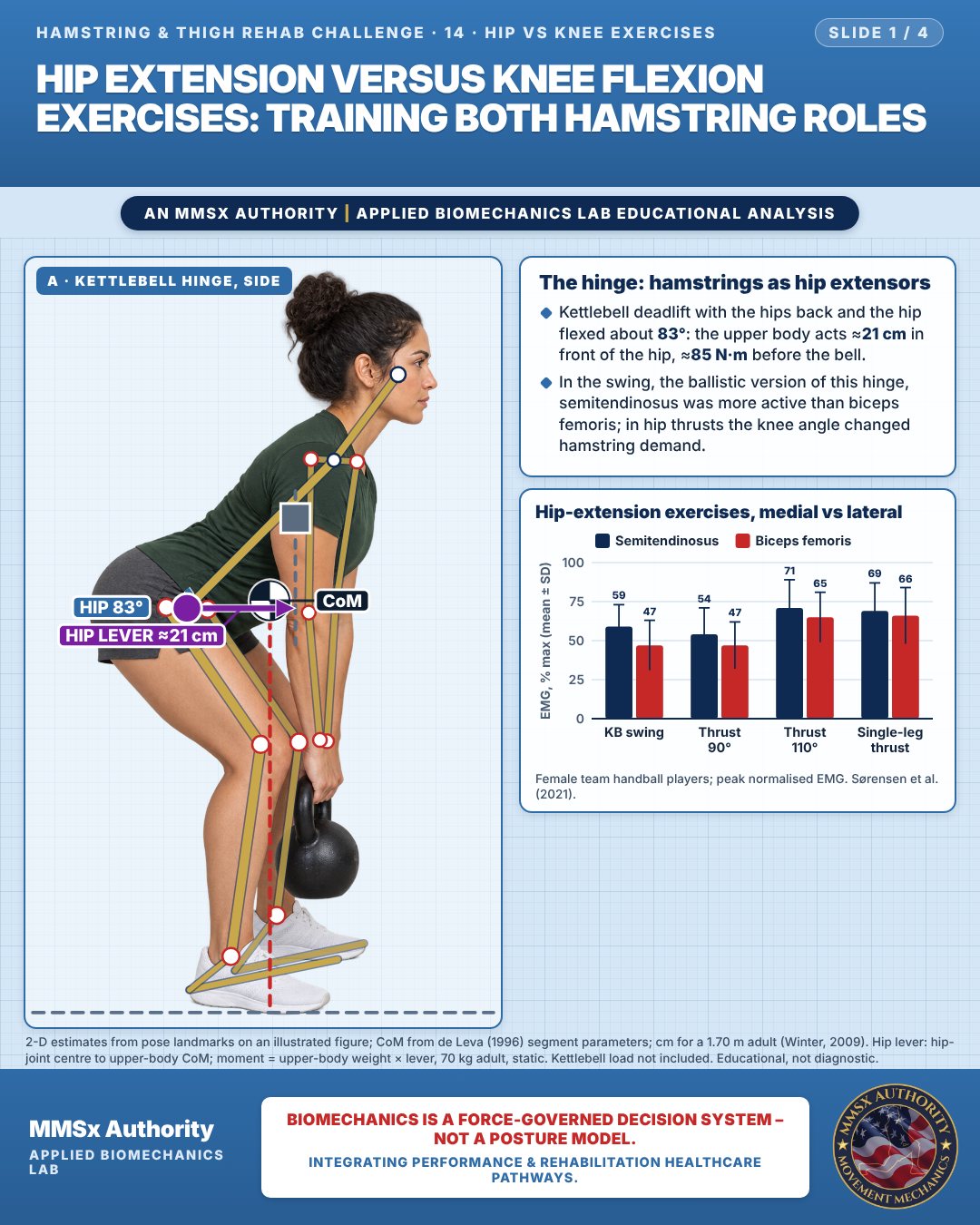
The hinge: hamstrings as hip extensors
Kettlebell deadlift with the hips back and the hip flexed about 83°: the upper body acts ≈21 cm in front of the hip, ≈85 N·m before the bell.
In the swing, the ballistic version of this hinge, semitendinosus was more active than biceps femoris; in hip thrusts the knee angle changed hamstring demand.
Hip-extension exercises, medial vs lateral
Movement B: Prone leg curl (side view)
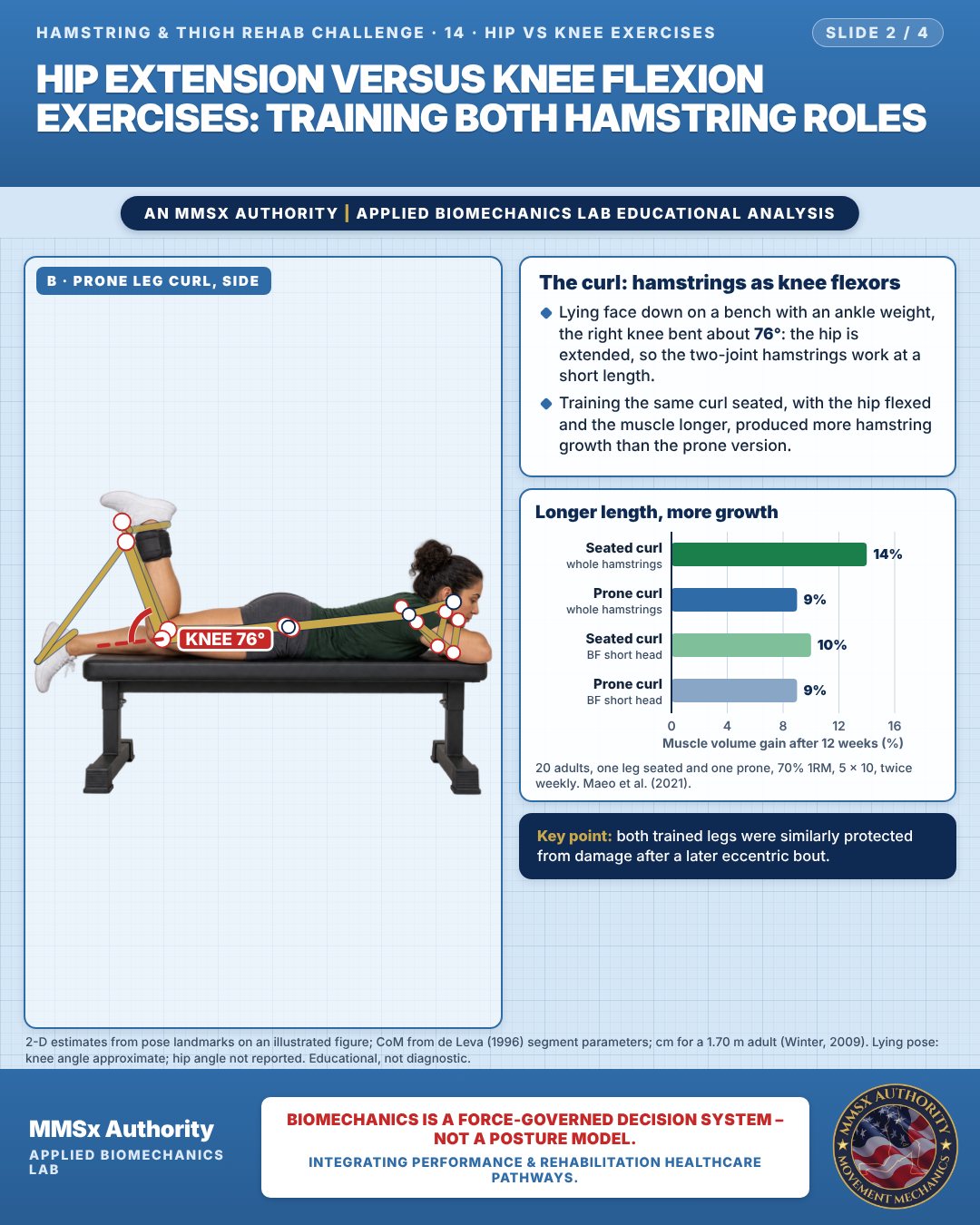
The curl: hamstrings as knee flexors
Lying face down on a bench with an ankle weight, the right knee bent about 76°: the hip is extended, so the two-joint hamstrings work at a short length.
Training the same curl seated, with the hip flexed and the muscle longer, produced more hamstring growth than the prone version.
Longer length, more growth
Movement C: Standing band curl (side view)
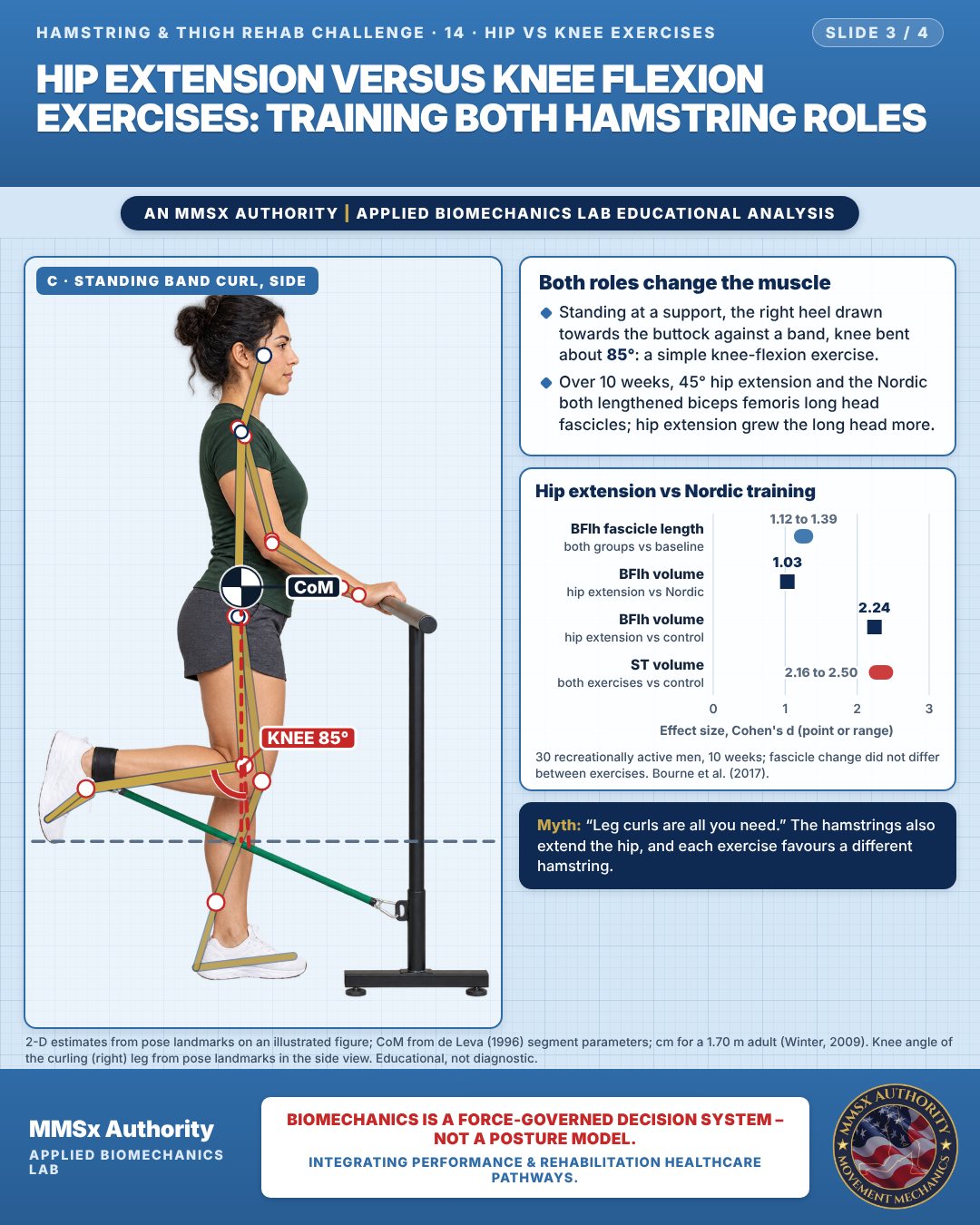
Both roles change the muscle
Standing at a support, the right heel drawn towards the buttock against a band, knee bent about 85°: a simple knee-flexion exercise.
Over 10 weeks, 45° hip extension and the Nordic both lengthened biceps femoris long head fascicles; hip extension grew the long head more.
Hip extension vs Nordic training
Decision pathway
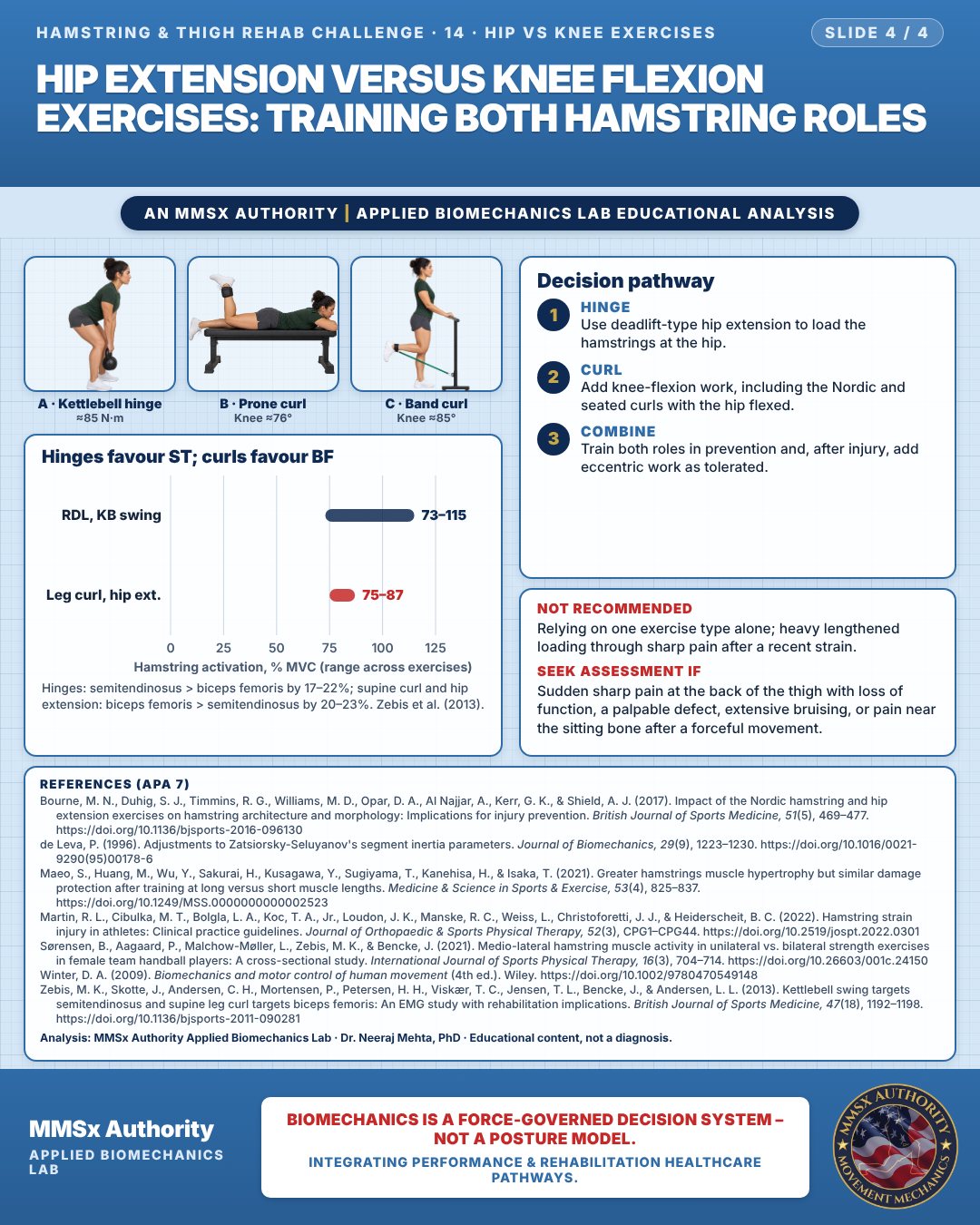
Hinges favour ST; curls favour BF
Hinge
Use deadlift-type hip extension to load the hamstrings at the hip.
Curl
Add knee-flexion work, including the Nordic and seated curls with the hip flexed.
Combine
Train both roles in prevention and, after injury, add eccentric work as tolerated.
What the evidence supports
- Include both hip-extension (hinge) and knee-flexion (curl, Nordic) exercises: they bias different hamstring muscles (Bourne et al., 2017b; Zebis et al., 2013) and both lengthen BFlh fascicles (Bourne et al., 2017a).
- Include the Nordic hamstring exercise in multi-component prevention (Grade A); add eccentric training as tolerated after injury (Grade B) (Martin et al., 2022).
- Consider training knee flexion with the hip flexed (seated curl) for greater hypertrophy (Maeo et al., 2021).
Myth and evidence
Myth“Leg curls are all you need for strong hamstrings.”
EvidenceThe hamstrings are hip extensors as well as knee flexors, and exercises differ in which hamstring they load: hip-extension exercise grew the long head more than the Nordic (d = 1.03) (Bourne et al., 2017a), and hinge exercises bias semitendinosus while leg curls bias biceps femoris (Zebis et al., 2013).
Cautions
Not recommended
Relying on one exercise type alone; heavy lengthened loading through sharp pain after a recent strain.
Seek assessment if
Sudden sharp pain at the back of the thigh with loss of function, a palpable defect, extensive bruising, or pain near the sitting bone after a forceful movement.
Methods note
2-D estimates from pose landmarks on an illustrated figure; CoM from de Leva (1996) segment parameters; cm for a 1.70 m adult (Winter, 2009). Hip lever: hip-joint centre to upper-body CoM; moment = upper-body weight × lever, 70 kg adult, static. Kettlebell load not included. Lying pose: knee angle approximate; hip angle not reported. Knee angle of the curling (right) leg from pose landmarks in the side view. These are educational estimates, not a diagnosis.
References
- Bourne, M. N., Duhig, S. J., Timmins, R. G., Williams, M. D., Opar, D. A., Al Najjar, A., Kerr, G. K., & Shield, A. J. (2017). Impact of the Nordic hamstring and hip extension exercises on hamstring architecture and morphology: Implications for injury prevention. British Journal of Sports Medicine, 51(5), 469–477. https://doi.org/10.1136/bjsports-2016-096130
- de Leva, P. (1996). Adjustments to Zatsiorsky-Seluyanov's segment inertia parameters. Journal of Biomechanics, 29(9), 1223–1230. https://doi.org/10.1016/0021-9290(95)00178-6
- Maeo, S., Huang, M., Wu, Y., Sakurai, H., Kusagawa, Y., Sugiyama, T., Kanehisa, H., & Isaka, T. (2021). Greater hamstrings muscle hypertrophy but similar damage protection after training at long versus short muscle lengths. Medicine & Science in Sports & Exercise, 53(4), 825–837. https://doi.org/10.1249/MSS.0000000000002523
- Martin, R. L., Cibulka, M. T., Bolgla, L. A., Koc, T. A., Jr., Loudon, J. K., Manske, R. C., Weiss, L., Christoforetti, J. J., & Heiderscheit, B. C. (2022). Hamstring strain injury in athletes: Clinical practice guidelines. Journal of Orthopaedic & Sports Physical Therapy, 52(3), CPG1–CPG44. https://doi.org/10.2519/jospt.2022.0301
- Sørensen, B., Aagaard, P., Malchow-Møller, L., Zebis, M. K., & Bencke, J. (2021). Medio-lateral hamstring muscle activity in unilateral vs. bilateral strength exercises in female team handball players: A cross-sectional study. International Journal of Sports Physical Therapy, 16(3), 704–714. https://doi.org/10.26603/001c.24150
- Winter, D. A. (2009). Biomechanics and motor control of human movement (4th ed.). Wiley. https://doi.org/10.1002/9780470549148
- Zebis, M. K., Skotte, J., Andersen, C. H., Mortensen, P., Petersen, H. H., Viskær, T. C., Jensen, T. L., Bencke, J., & Andersen, L. L. (2013). Kettlebell swing targets semitendinosus and supine leg curl targets biceps femoris: An EMG study with rehabilitation implications. British Journal of Sports Medicine, 47(18), 1192–1198. https://doi.org/10.1136/bjsports-2011-090281
Cite this article
Mehta, N. (2026, October 26). Hip extension versus knee flexion exercises: training both hamstring roles. MMSx Authority Applied Biomechanics Lab. https://mmsxauthority.org/edu/analysis/hamstring-thigh/14-hip-extension-versus-knee-flexion-exercises-training-both-hamstring/
Part of the collection
Mehta, N. (2026). Hamstring and Thigh Rehabilitation: 50 Evidence-Based Biomechanics Analyses [Collection]. MMSx Authority Applied Biomechanics Lab. Zenodo. https://doi.org/10.5281/zenodo.23735792
All Hamstring & Thigh Rehab Challenge articles · Rehabilitation Library