Hamstring & Thigh Rehab Challenge · 13
Hamstring injury in footballers: high-speed running and fatigue
Hamstring strain injury in football is an acute, usually non-contact tear of hamstring muscle fibres (most often the long head of biceps femoris)…
Key points
- Prevent. Include the Nordic exercise in a multi-component programme with high-speed running.
- Plan load. Keep regular sprint exposure and avoid large, rapid spikes above the usual weekly average.
- Prepare. Train for late-match fatigue; after injury, progress and return by criteria.
What it is
Hamstring strain injury in football is an acute, usually non-contact tear of hamstring muscle fibres (most often the long head of biceps femoris) occurring during high-speed running or during movements that place the hamstring in a lengthened position, such as kicking, braking or reaching (Gronwald et al., 2022; Martin et al., 2022).
How we analysed the movement
Three movements relevant to this topic were analysed from illustrated reference figures. Joint centres were located with two-dimensional pose estimation; hip and knee angles, pelvis level, the whole-body centre of mass and, where relevant, the hip lever (the horizontal distance from the hip joint to the upper-body centre of mass) and the resulting static hip moment were then calculated from standard segment parameters. The figures are educational estimates that show how position changes mechanical demand; they are not measurements of a patient. Every research value quoted below comes from the published source cited beside it.
Movement A: Kick backswing (side view)
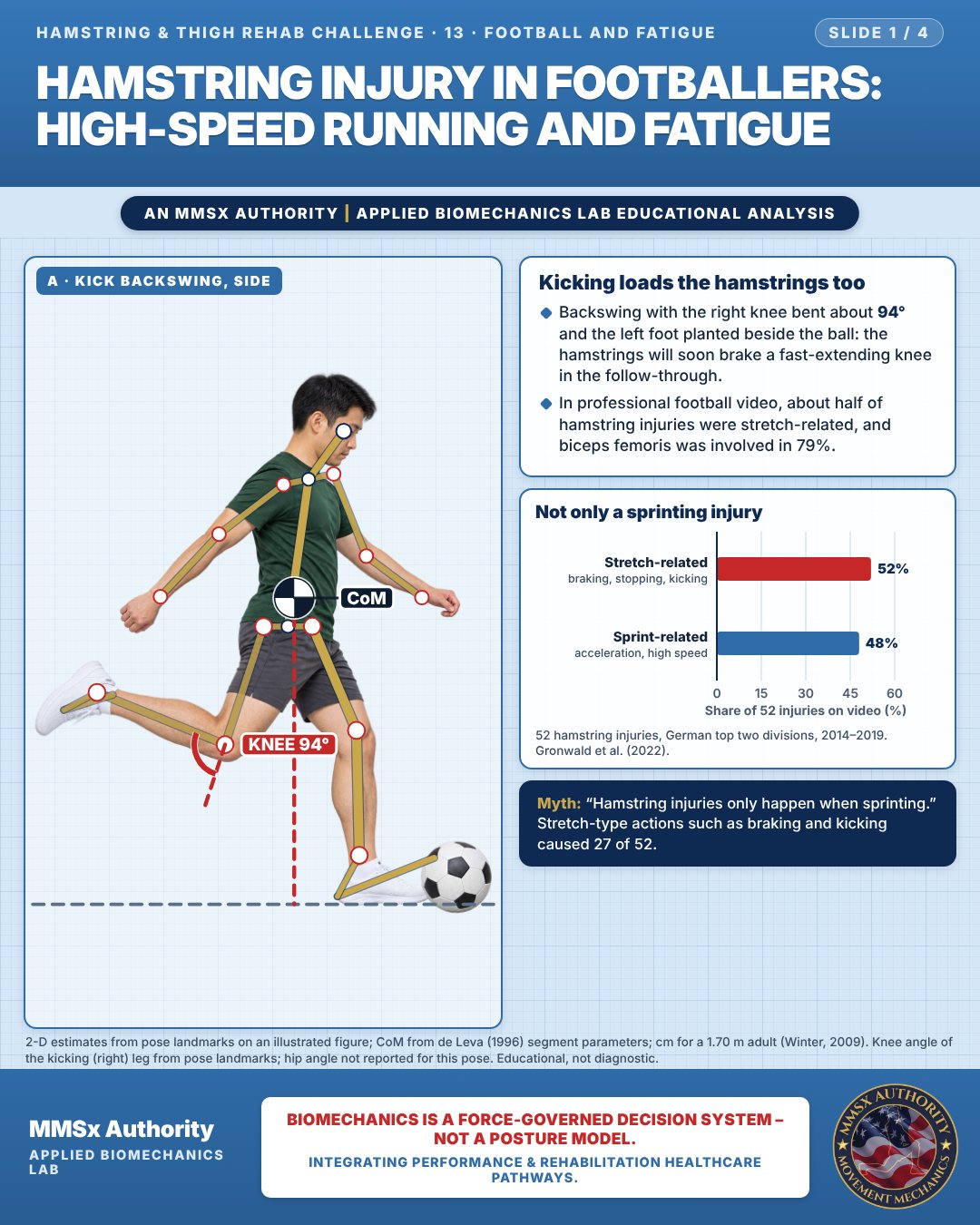
Kicking loads the hamstrings too
Backswing with the right knee bent about 94° and the left foot planted beside the ball: the hamstrings will soon brake a fast-extending knee in the follow-through.
In professional football video, about half of hamstring injuries were stretch-related, and biceps femoris was involved in 79%.
Not only a sprinting injury
Movement B: Kick follow-through (side view)
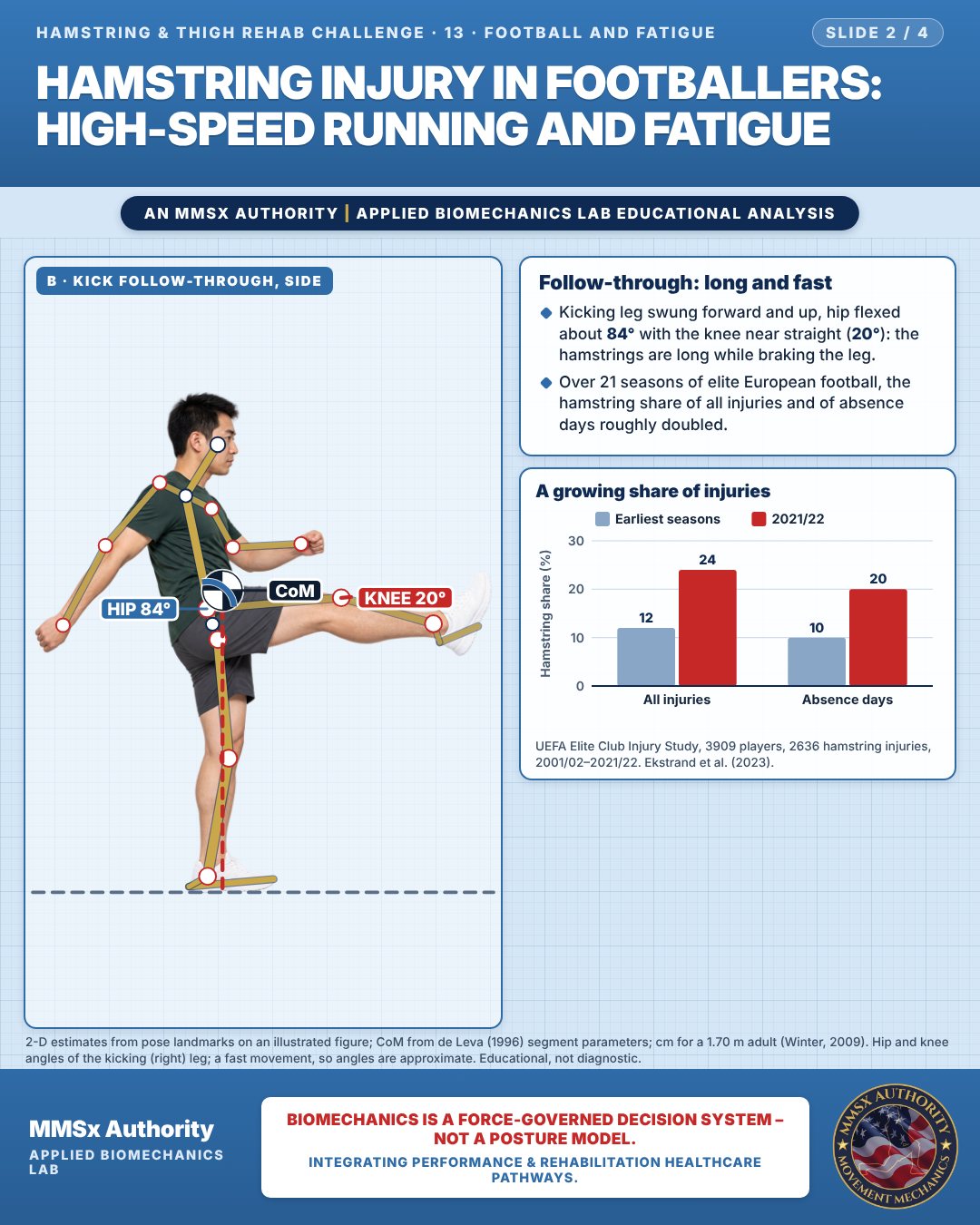
Follow-through: long and fast
Kicking leg swung forward and up, hip flexed about 84° with the knee near straight (20°): the hamstrings are long while braking the leg.
Over 21 seasons of elite European football, the hamstring share of all injuries and of absence days roughly doubled.
A growing share of injuries
Movement C: Hands on knees (side view)
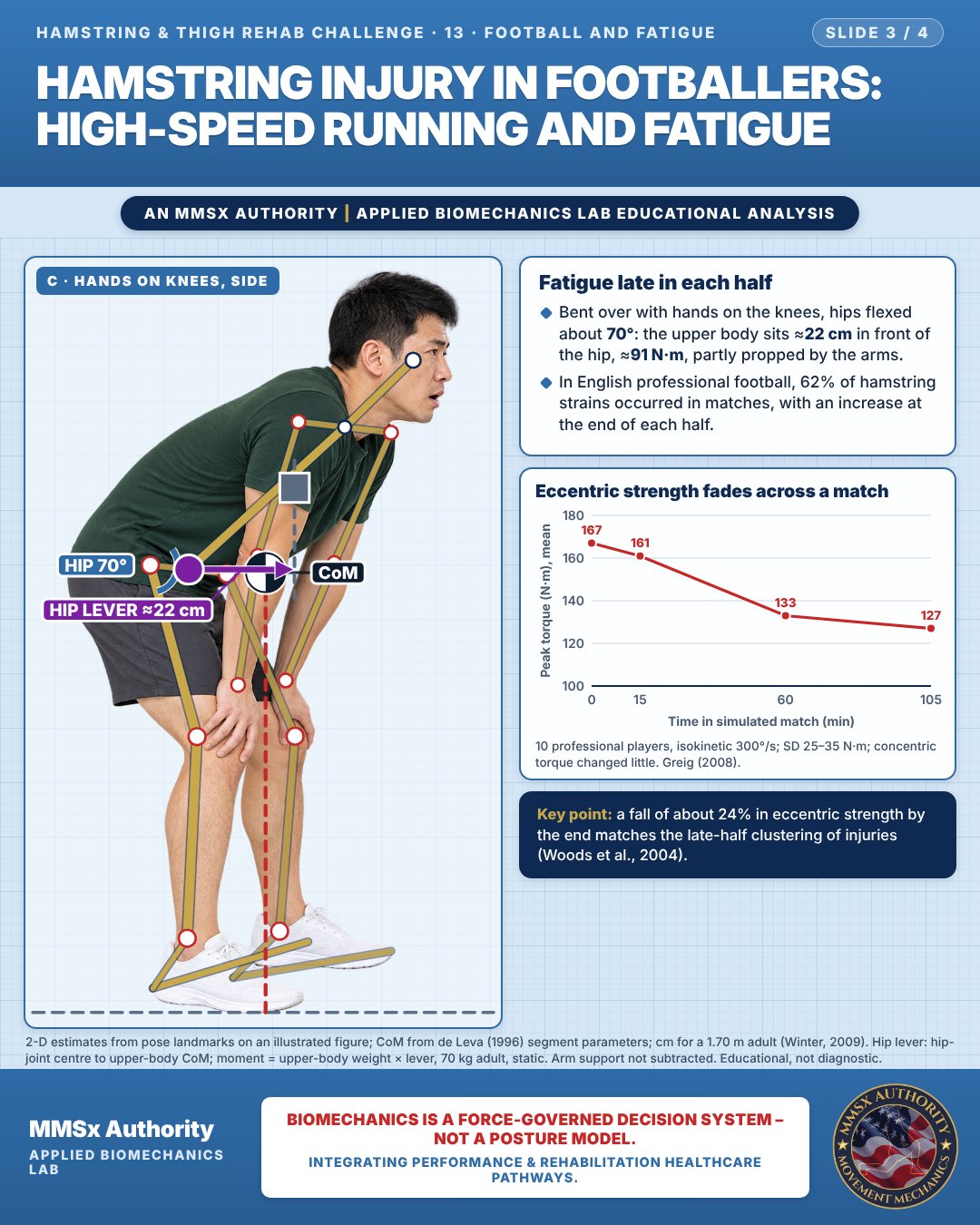
Fatigue late in each half
Bent over with hands on the knees, hips flexed about 70°: the upper body sits ≈22 cm in front of the hip, ≈91 N·m, partly propped by the arms.
In English professional football, 62% of hamstring strains occurred in matches, with an increase at the end of each half.
Eccentric strength fades across a match
Decision pathway
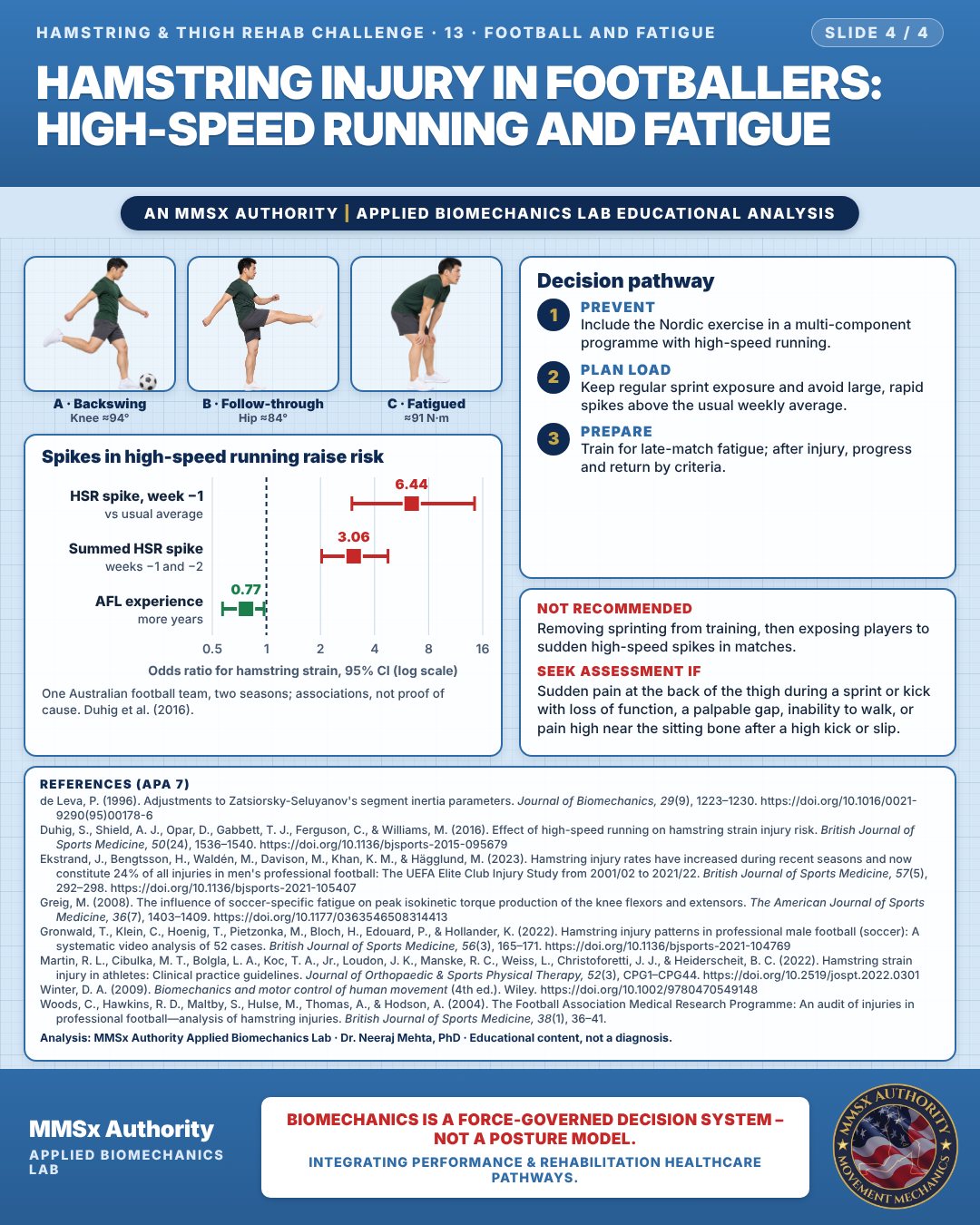
Spikes in high-speed running raise risk
Prevent
Include the Nordic exercise in a multi-component programme with high-speed running.
Plan load
Keep regular sprint exposure and avoid large, rapid spikes above the usual weekly average.
Prepare
Train for late-match fatigue; after injury, progress and return by criteria.
What the evidence supports
- Include the Nordic hamstring exercise in a multi-component prevention programme with warm-up, stability, strengthening and functional work including high-speed running (Grade A) (Martin et al., 2022).
- Plan high-speed running exposure: avoid large, rapid spikes in HSR above the player's usual average; reducing HSR in the week before a match may offset risk (Duhig et al., 2016).
- Prepare for fatigue: eccentric strength declines late in matches (Greig, 2008), when injuries cluster (Woods et al., 2004).
Myth and evidence
Myth“Hamstring injuries only happen when sprinting.”
EvidenceAbout half of injuries in a professional video analysis were stretch-related (braking, stopping, kicking), not sprint-related (Gronwald et al., 2022). Also, "less sprinting in training keeps players safe" is not supported: what was associated with risk was a sudden spike above usual HSR exposure (Duhig et al., 2016), so players need regular, progressive high-speed exposure.
Cautions
Not recommended
Removing sprinting from training, then exposing players to sudden high-speed spikes in matches.
Seek assessment if
Sudden pain at the back of the thigh during a sprint or kick with loss of function, a palpable gap, inability to walk, or pain high near the sitting bone after a high kick or slip.
Methods note
2-D estimates from pose landmarks on an illustrated figure; CoM from de Leva (1996) segment parameters; cm for a 1.70 m adult (Winter, 2009). Knee angle of the kicking (right) leg from pose landmarks; hip angle not reported for this pose. Hip and knee angles of the kicking (right) leg; a fast movement, so angles are approximate. Hip lever: hip-joint centre to upper-body CoM; moment = upper-body weight × lever, 70 kg adult, static. Arm support not subtracted. These are educational estimates, not a diagnosis.
References
- de Leva, P. (1996). Adjustments to Zatsiorsky-Seluyanov's segment inertia parameters. Journal of Biomechanics, 29(9), 1223–1230. https://doi.org/10.1016/0021-9290(95)00178-6
- Duhig, S., Shield, A. J., Opar, D., Gabbett, T. J., Ferguson, C., & Williams, M. (2016). Effect of high-speed running on hamstring strain injury risk. British Journal of Sports Medicine, 50(24), 1536–1540. https://doi.org/10.1136/bjsports-2015-095679
- Ekstrand, J., Bengtsson, H., Waldén, M., Davison, M., Khan, K. M., & Hägglund, M. (2023). Hamstring injury rates have increased during recent seasons and now constitute 24% of all injuries in men's professional football: The UEFA Elite Club Injury Study from 2001/02 to 2021/22. British Journal of Sports Medicine, 57(5), 292–298. https://doi.org/10.1136/bjsports-2021-105407
- Greig, M. (2008). The influence of soccer-specific fatigue on peak isokinetic torque production of the knee flexors and extensors. The American Journal of Sports Medicine, 36(7), 1403–1409. https://doi.org/10.1177/0363546508314413
- Gronwald, T., Klein, C., Hoenig, T., Pietzonka, M., Bloch, H., Edouard, P., & Hollander, K. (2022). Hamstring injury patterns in professional male football (soccer): A systematic video analysis of 52 cases. British Journal of Sports Medicine, 56(3), 165–171. https://doi.org/10.1136/bjsports-2021-104769
- Martin, R. L., Cibulka, M. T., Bolgla, L. A., Koc, T. A., Jr., Loudon, J. K., Manske, R. C., Weiss, L., Christoforetti, J. J., & Heiderscheit, B. C. (2022). Hamstring strain injury in athletes: Clinical practice guidelines. Journal of Orthopaedic & Sports Physical Therapy, 52(3), CPG1–CPG44. https://doi.org/10.2519/jospt.2022.0301
- Winter, D. A. (2009). Biomechanics and motor control of human movement (4th ed.). Wiley. https://doi.org/10.1002/9780470549148
- Woods, C., Hawkins, R. D., Maltby, S., Hulse, M., Thomas, A., & Hodson, A. (2004). The Football Association Medical Research Programme: An audit of injuries in professional football—analysis of hamstring injuries. British Journal of Sports Medicine, 38(1), 36–41.
Cite this article
Mehta, N. (2026, October 26). Hamstring injury in footballers: high-speed running and fatigue. MMSx Authority Applied Biomechanics Lab. https://mmsxauthority.org/edu/analysis/hamstring-thigh/13-hamstring-injury-in-footballers-high-speed-running-and-fatigue/
Part of the collection
Mehta, N. (2026). Hamstring and Thigh Rehabilitation: 50 Evidence-Based Biomechanics Analyses [Collection]. MMSx Authority Applied Biomechanics Lab. Zenodo. https://doi.org/10.5281/zenodo.23735792
All Hamstring & Thigh Rehab Challenge articles · Rehabilitation Library