Hamstring & Thigh Rehab Challenge · 12
Return to running after a hamstring strain: criteria, not calendar days
Criteria-based return to running means progressing running speed and volume, and finally clearing a player for full training and matches, when…
Key points
- Measure. Record pain, knee-flexor strength (dynamometer) and active knee extension, not days since injury.
- Progress. Add eccentric work, agility and trunk control; raise running speed as each stage stays pain-free.
- Clear. Return when field tests, matched flexibility and psychological readiness are met; MRI is not a criterion.
What it is
Criteria-based return to running means progressing running speed and volume, and finally clearing a player for full training and matches, when defined clinical and performance criteria are met (pain, strength, flexibility, functional and field tests, psychological readiness), rather than after a fixed number of days. Return to play has been defined by international consensus as "the moment a player has received criteria-based medical clearance and is mentally ready" for full availability for match selection and/or full training (van der Horst et al., 2017).
How we analysed the movement
Three movements relevant to this topic were analysed from illustrated reference figures. Joint centres were located with two-dimensional pose estimation; hip and knee angles, pelvis level, the whole-body centre of mass and, where relevant, the hip lever (the horizontal distance from the hip joint to the upper-body centre of mass) and the resulting static hip moment were then calculated from standard segment parameters. The figures are educational estimates that show how position changes mechanical demand; they are not measurements of a patient. Every research value quoted below comes from the published source cited beside it.
Movement A: Single-leg bridge (side view)
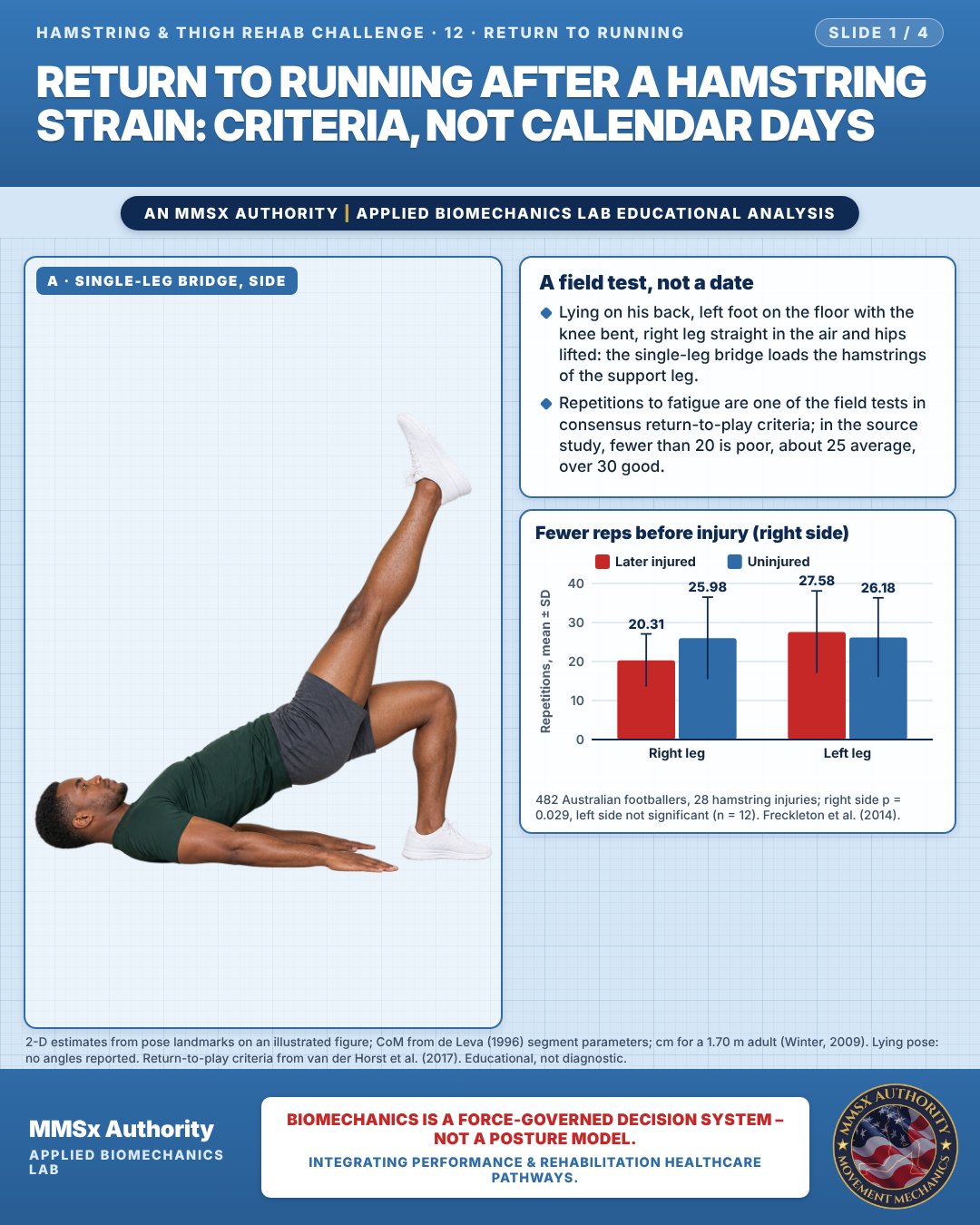
A field test, not a date
Lying on his back, left foot on the floor with the knee bent, right leg straight in the air and hips lifted: the single-leg bridge loads the hamstrings of the support leg.
Repetitions to fatigue are one of the field tests in consensus return-to-play criteria; in the source study, fewer than 20 is poor, about 25 average, over 30 good.
Fewer reps before injury (right side)
Movement B: A-skip drill (side view)
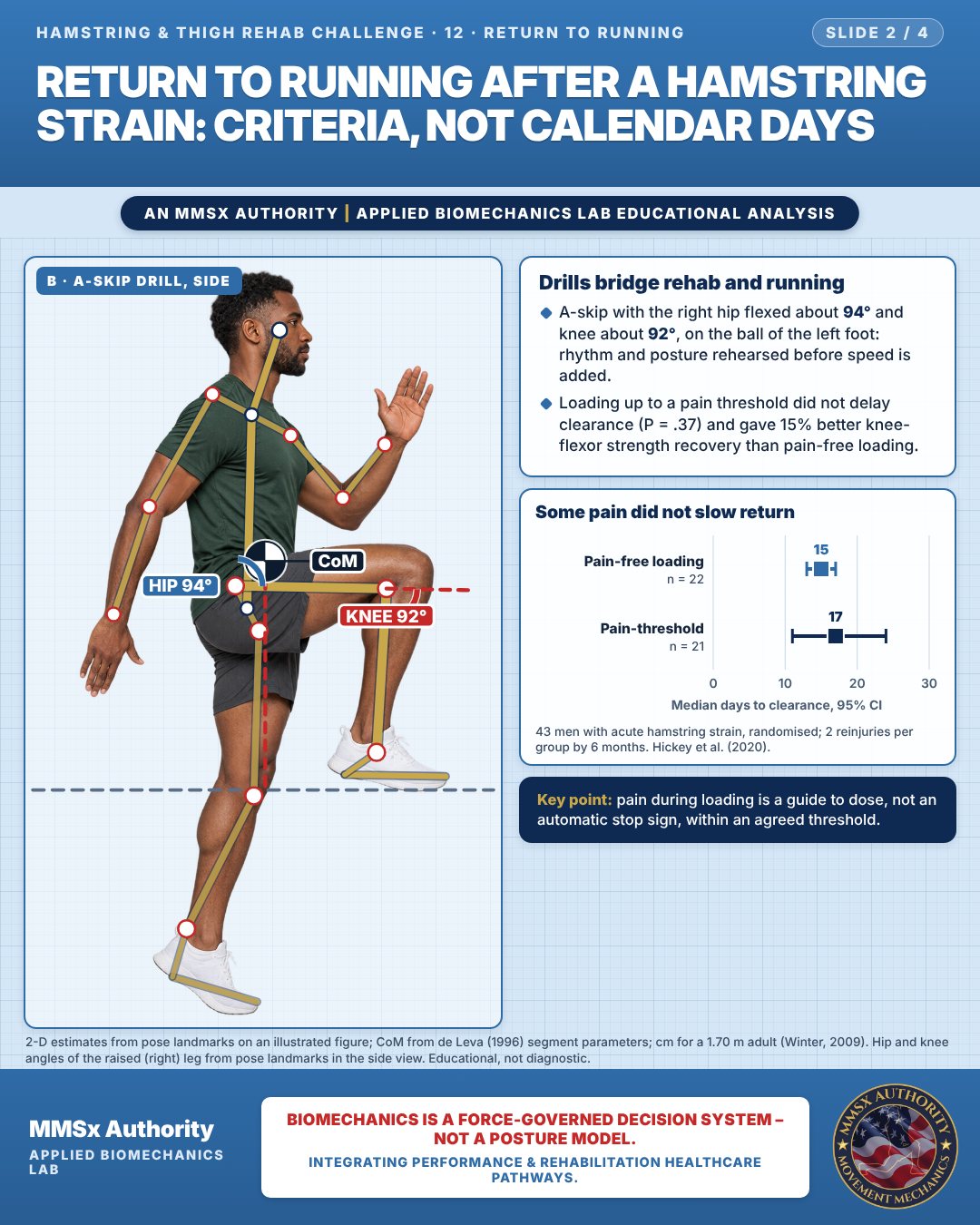
Drills bridge rehab and running
A-skip with the right hip flexed about 94° and knee about 92°, on the ball of the left foot: rhythm and posture rehearsed before speed is added.
Loading up to a pain threshold did not delay clearance (P = .37) and gave 15% better knee-flexor strength recovery than pain-free loading.
Some pain did not slow return
Movement C: Stride run (side view)
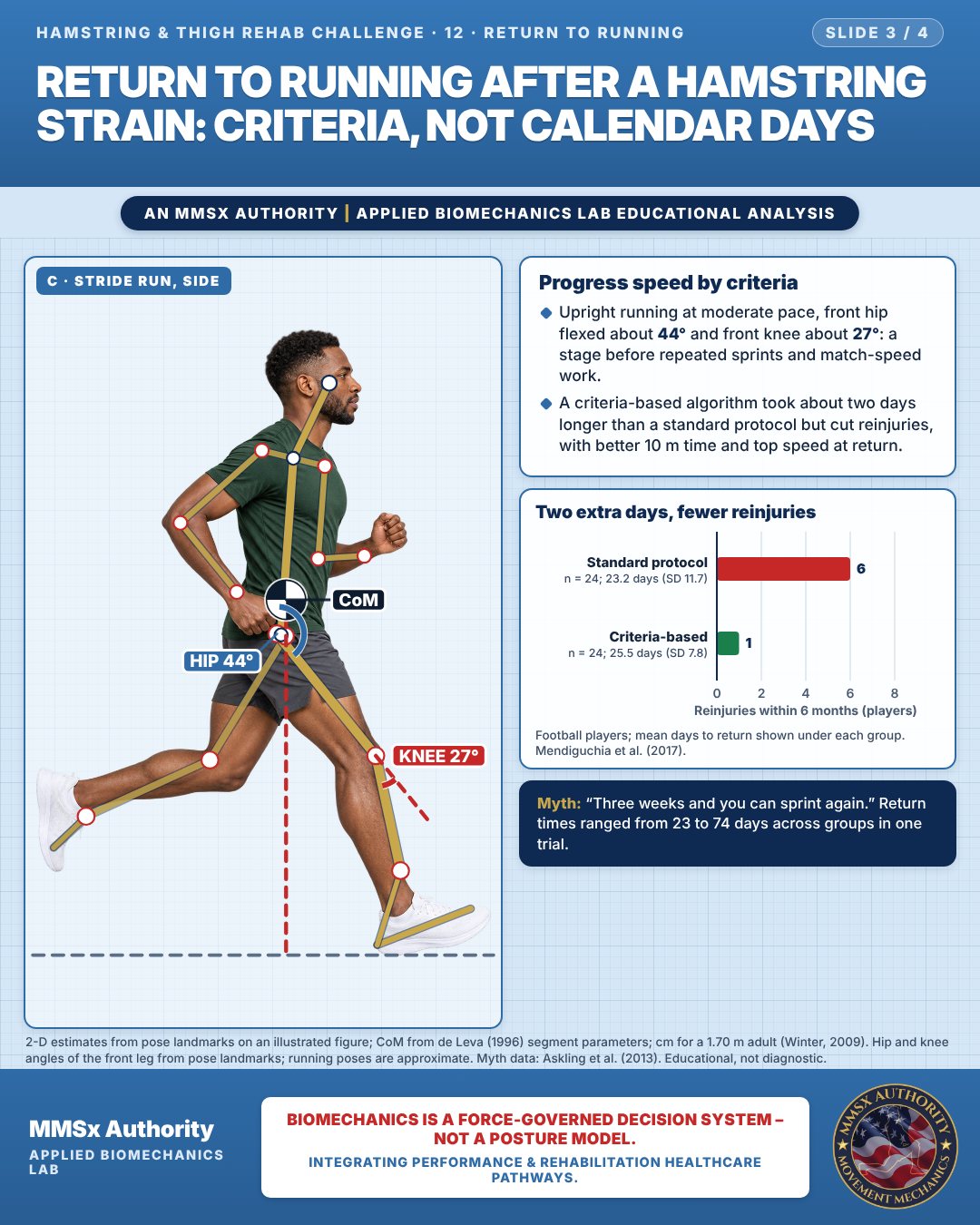
Progress speed by criteria
Upright running at moderate pace, front hip flexed about 44° and front knee about 27°: a stage before repeated sprints and match-speed work.
A criteria-based algorithm took about two days longer than a standard protocol but cut reinjuries, with better 10 m time and top speed at return.
Two extra days, fewer reinjuries
Decision pathway
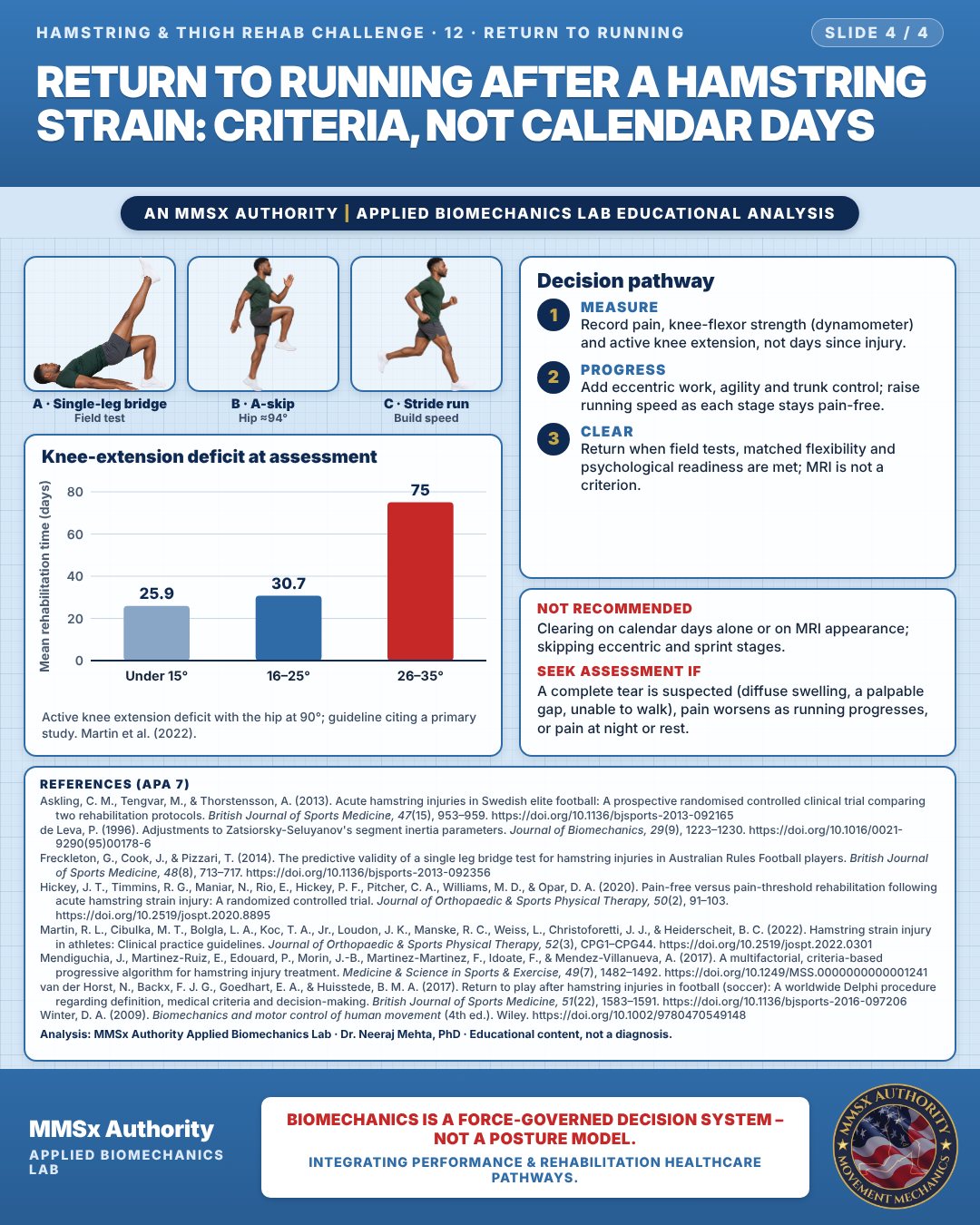
Knee-extension deficit at assessment
Measure
Record pain, knee-flexor strength (dynamometer) and active knee extension, not days since injury.
Progress
Add eccentric work, agility and trunk control; raise running speed as each stage stays pain-free.
Clear
Return when field tests, matched flexibility and psychological readiness are met; MRI is not a criterion.
What the evidence supports
- Consensus RTP criteria (four-round Delphi, 58 experts from 28 FIFA Medical Centres of Excellence): medical clearance; no pain on hamstring palpation; no pain during strength and flexibility testing; no pain during or after functional testing; similar hamstring flexibility (active and passive straight-leg raise); field-test performance (repeated sprint ability, deceleration, single-leg bridge, position-specific GPS-targeted rehabilitation); and psychological readiness. MRI findings were excluded as a criterion (van der Horst et al., 2017).
- Not supported: clearing on calendar days alone, or on MRI appearance (van der Horst et al., 2017).
Myth and evidence
Myth“A hamstring strain is healed after three weeks, so I can sprint again.”
EvidenceReturn times vary widely with injury type and rehabilitation (23 to 74 days across groups in one trial) (Askling et al., 2013), and a criteria-based algorithm reduced reinjuries compared with a standard protocol (1 vs 6) for about two extra days (Mendiguchia et al., 2017). Expert consensus defines readiness by criteria, not by time (van der Horst et al., 2017).
Cautions
Not recommended
Clearing on calendar days alone or on MRI appearance; skipping eccentric and sprint stages.
Seek assessment if
A complete tear is suspected (diffuse swelling, a palpable gap, unable to walk), pain worsens as running progresses, or pain at night or rest.
Methods note
2-D estimates from pose landmarks on an illustrated figure; CoM from de Leva (1996) segment parameters; cm for a 1.70 m adult (Winter, 2009). Lying pose: no angles reported. Return-to-play criteria from van der Horst et al. (2017). Hip and knee angles of the raised (right) leg from pose landmarks in the side view. Hip and knee angles of the front leg from pose landmarks; running poses are approximate. Myth data: Askling et al. (2013). These are educational estimates, not a diagnosis.
References
- Askling, C. M., Tengvar, M., & Thorstensson, A. (2013). Acute hamstring injuries in Swedish elite football: A prospective randomised controlled clinical trial comparing two rehabilitation protocols. British Journal of Sports Medicine, 47(15), 953–959. https://doi.org/10.1136/bjsports-2013-092165
- de Leva, P. (1996). Adjustments to Zatsiorsky-Seluyanov's segment inertia parameters. Journal of Biomechanics, 29(9), 1223–1230. https://doi.org/10.1016/0021-9290(95)00178-6
- Freckleton, G., Cook, J., & Pizzari, T. (2014). The predictive validity of a single leg bridge test for hamstring injuries in Australian Rules Football players. British Journal of Sports Medicine, 48(8), 713–717. https://doi.org/10.1136/bjsports-2013-092356
- Hickey, J. T., Timmins, R. G., Maniar, N., Rio, E., Hickey, P. F., Pitcher, C. A., Williams, M. D., & Opar, D. A. (2020). Pain-free versus pain-threshold rehabilitation following acute hamstring strain injury: A randomized controlled trial. Journal of Orthopaedic & Sports Physical Therapy, 50(2), 91–103. https://doi.org/10.2519/jospt.2020.8895
- Martin, R. L., Cibulka, M. T., Bolgla, L. A., Koc, T. A., Jr., Loudon, J. K., Manske, R. C., Weiss, L., Christoforetti, J. J., & Heiderscheit, B. C. (2022). Hamstring strain injury in athletes: Clinical practice guidelines. Journal of Orthopaedic & Sports Physical Therapy, 52(3), CPG1–CPG44. https://doi.org/10.2519/jospt.2022.0301
- Mendiguchia, J., Martinez-Ruiz, E., Edouard, P., Morin, J.-B., Martinez-Martinez, F., Idoate, F., & Mendez-Villanueva, A. (2017). A multifactorial, criteria-based progressive algorithm for hamstring injury treatment. Medicine & Science in Sports & Exercise, 49(7), 1482–1492. https://doi.org/10.1249/MSS.0000000000001241
- van der Horst, N., Backx, F. J. G., Goedhart, E. A., & Huisstede, B. M. A. (2017). Return to play after hamstring injuries in football (soccer): A worldwide Delphi procedure regarding definition, medical criteria and decision-making. British Journal of Sports Medicine, 51(22), 1583–1591. https://doi.org/10.1136/bjsports-2016-097206
- Winter, D. A. (2009). Biomechanics and motor control of human movement (4th ed.). Wiley. https://doi.org/10.1002/9780470549148
Cite this article
Mehta, N. (2026, October 26). Return to running after a hamstring strain: criteria, not calendar days. MMSx Authority Applied Biomechanics Lab. https://mmsxauthority.org/edu/analysis/hamstring-thigh/12-return-to-running-after-a-hamstring-strain-criteria-not-calendar-days/
Part of the collection
Mehta, N. (2026). Hamstring and Thigh Rehabilitation: 50 Evidence-Based Biomechanics Analyses [Collection]. MMSx Authority Applied Biomechanics Lab. Zenodo. https://doi.org/10.5281/zenodo.23735792
All Hamstring & Thigh Rehab Challenge articles · Rehabilitation Library