Hamstring & Thigh Rehab Challenge · 11
Hamstring stretching: does it prevent injury or just change tolerance?
Hamstring stretching means holding (static) or moving (dynamic, e.g. Movement analysis, verified research data and a decision pathway.
Key points
- Prevent. Build strength, including the Nordic exercise, within a multi-component programme.
- Stretch for range. Use about 4 min per session or 10 min per week when range itself is the goal.
- Warm up. Prefer dynamic swings and short holds before sprinting; keep long holds for separate sessions.
What it is
Hamstring stretching means holding (static) or moving (dynamic, e.g. leg swings) the hip and knee into a position that lengthens the hamstring muscle–tendon unit. Short-term programmes reliably increase range of motion, but over 3–8 weeks this appears to come mostly from greater stretch tolerance (a sensory change) rather than a change in muscle or tendon stiffness (Freitas et al., 2018).
How we analysed the movement
Three movements relevant to this topic were analysed from illustrated reference figures. Joint centres were located with two-dimensional pose estimation; hip and knee angles, pelvis level, the whole-body centre of mass and, where relevant, the hip lever (the horizontal distance from the hip joint to the upper-body centre of mass) and the resulting static hip moment were then calculated from standard segment parameters. The figures are educational estimates that show how position changes mechanical demand; they are not measurements of a patient. Every research value quoted below comes from the published source cited beside it.
Movement A: Heel-on-step stretch (side view)
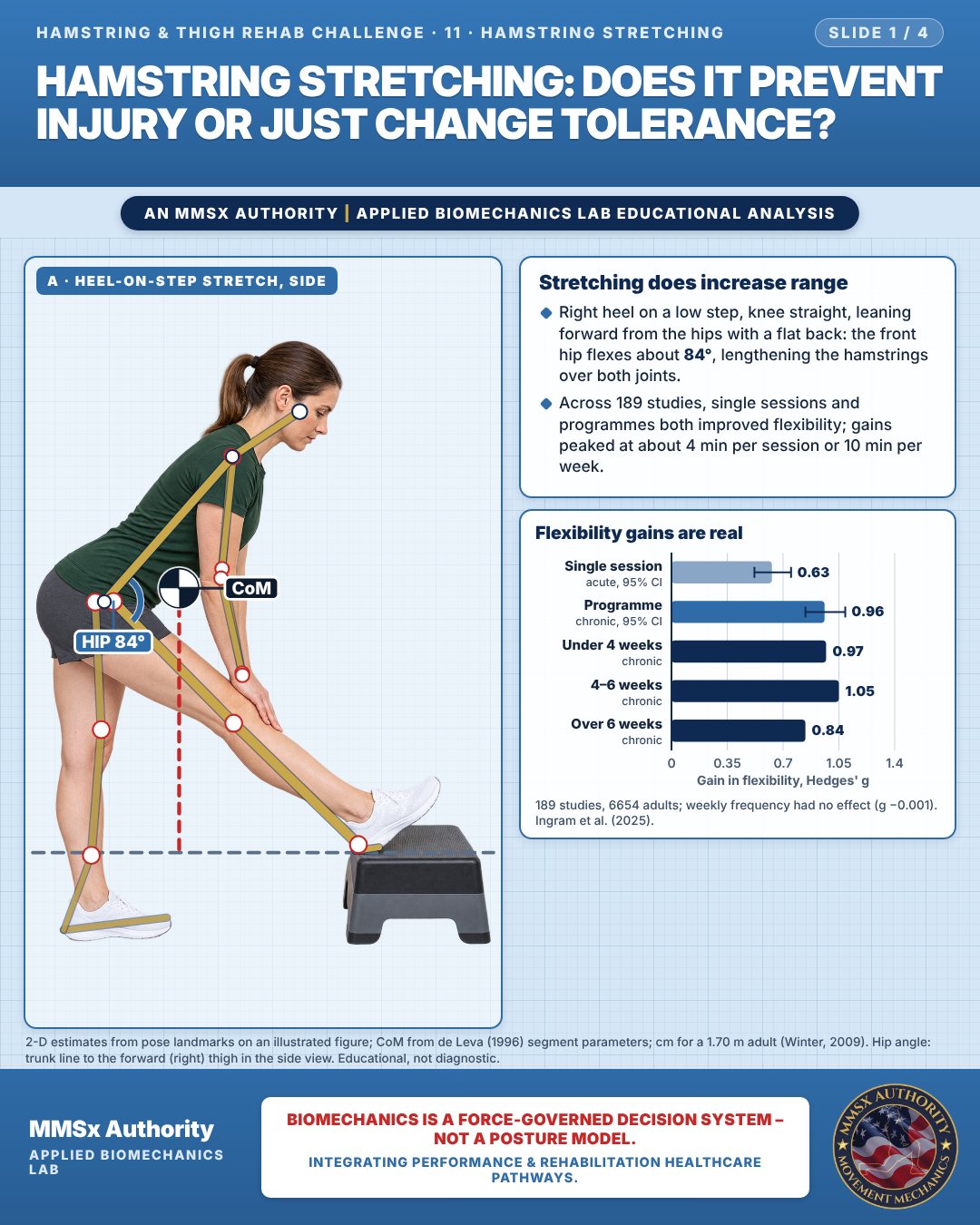
Stretching does increase range
Right heel on a low step, knee straight, leaning forward from the hips with a flat back: the front hip flexes about 84°, lengthening the hamstrings over both joints.
Across 189 studies, single sessions and programmes both improved flexibility; gains peaked at about 4 min per session or 10 min per week.
Flexibility gains are real
Movement B: Strap stretch (side view)
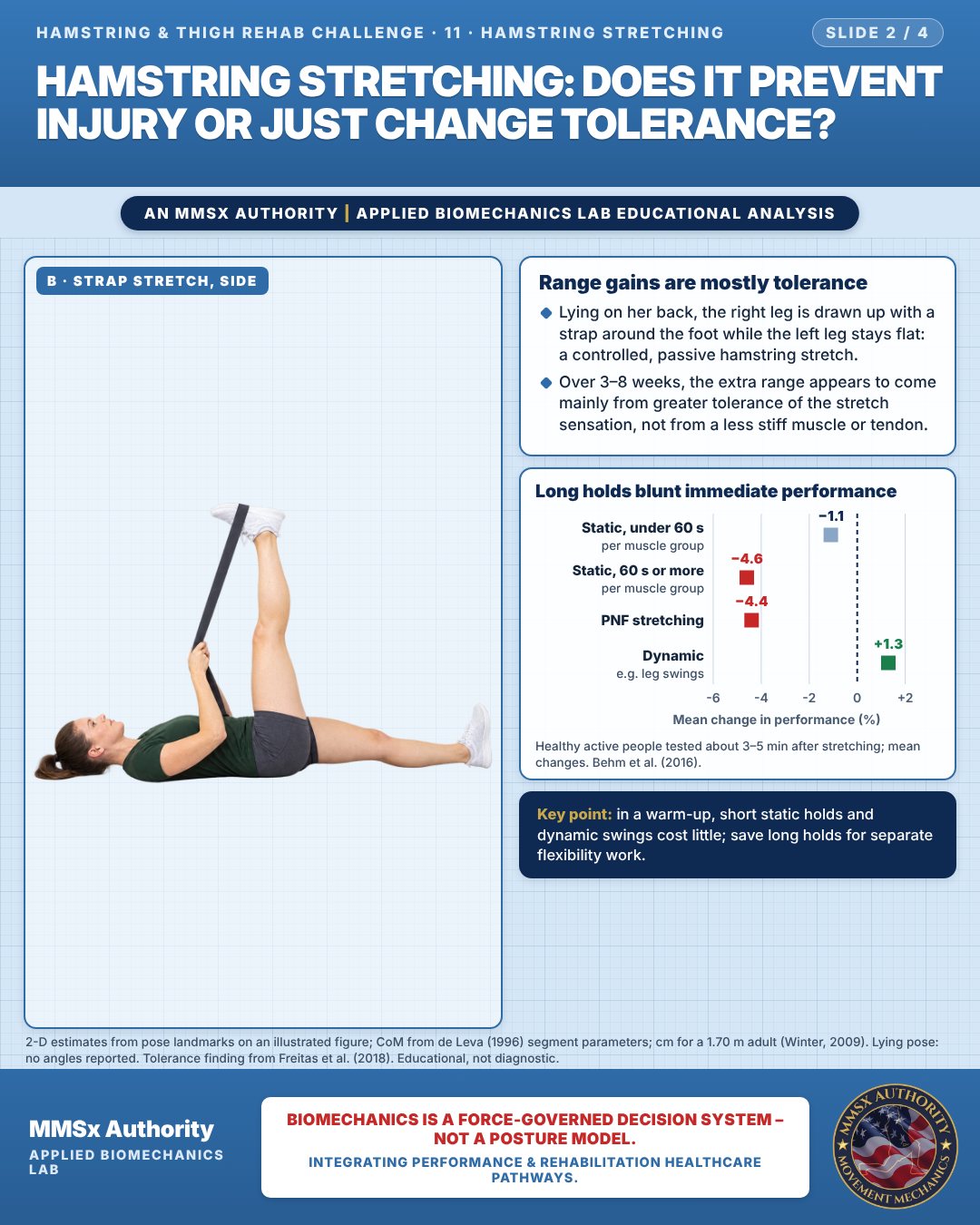
Range gains are mostly tolerance
Lying on her back, the right leg is drawn up with a strap around the foot while the left leg stays flat: a controlled, passive hamstring stretch.
Over 3–8 weeks, the extra range appears to come mainly from greater tolerance of the stretch sensation, not from a less stiff muscle or tendon.
Long holds blunt immediate performance
Movement C: Leg swing (side view)
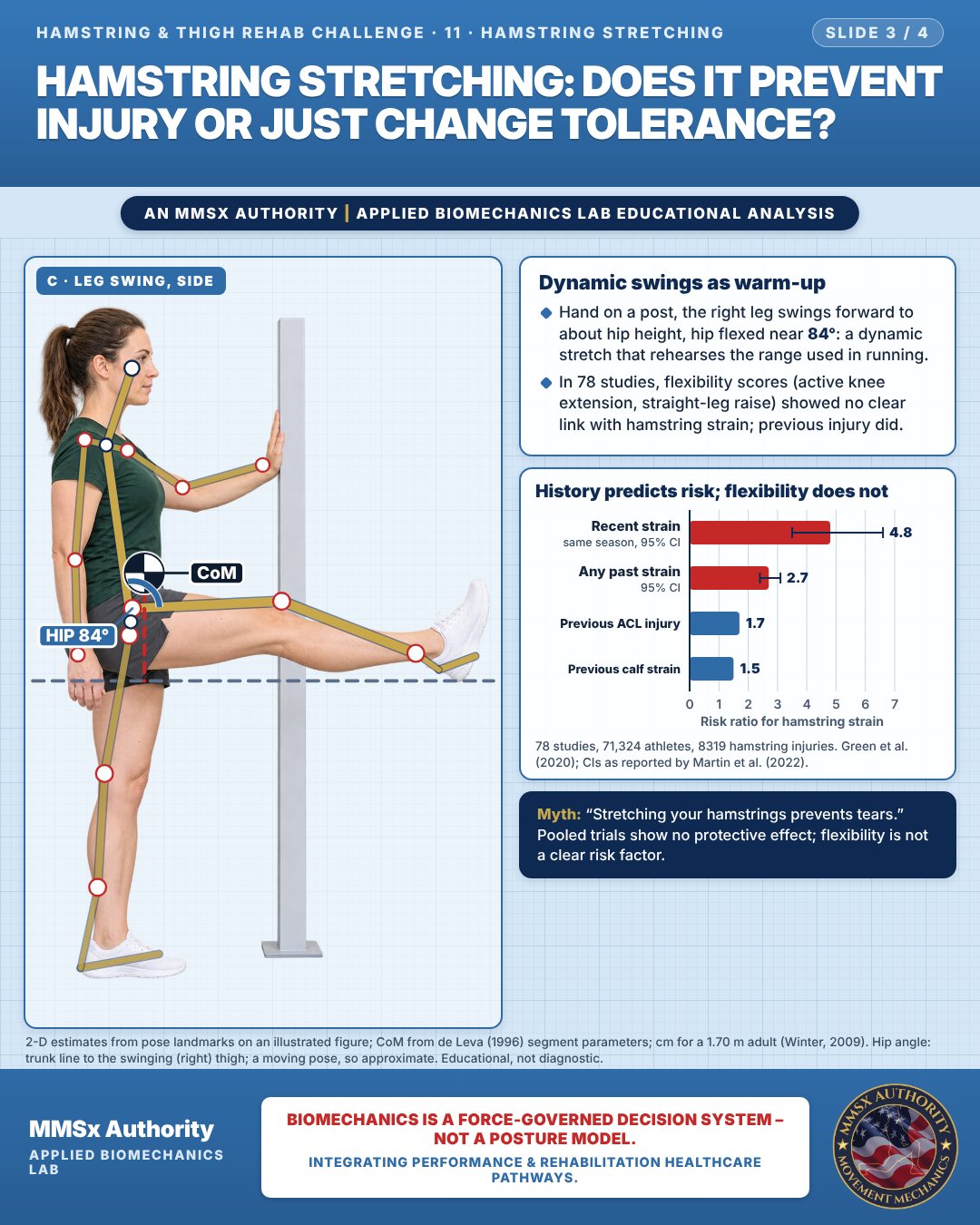
Dynamic swings as warm-up
Hand on a post, the right leg swings forward to about hip height, hip flexed near 84°: a dynamic stretch that rehearses the range used in running.
In 78 studies, flexibility scores (active knee extension, straight-leg raise) showed no clear link with hamstring strain; previous injury did.
History predicts risk; flexibility does not
Decision pathway
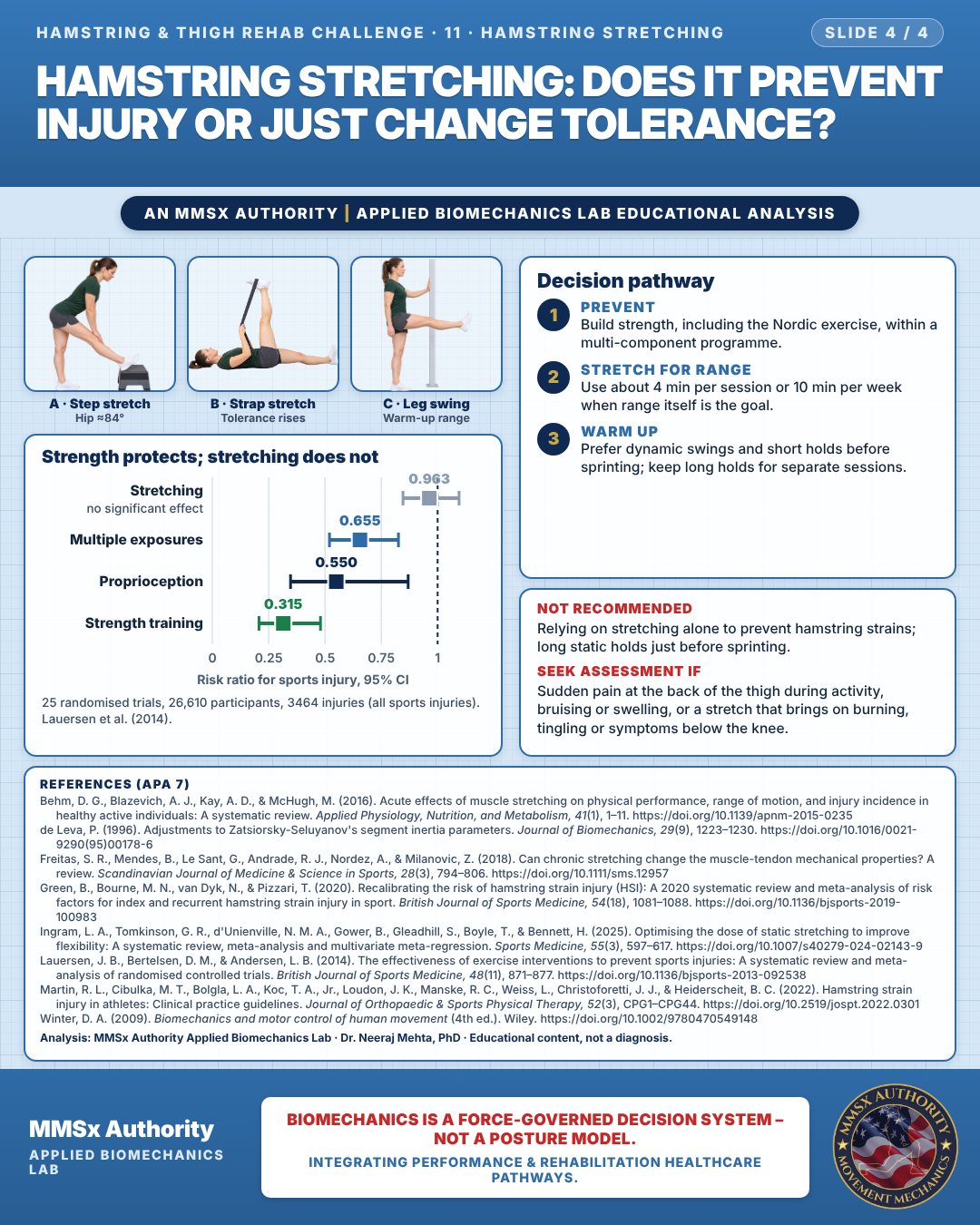
Strength protects; stretching does not
Prevent
Build strength, including the Nordic exercise, within a multi-component programme.
Stretch for range
Use about 4 min per session or 10 min per week when range itself is the goal.
Warm up
Prefer dynamic swings and short holds before sprinting; keep long holds for separate sessions.
What the evidence supports
- Recommended: the Nordic hamstring exercise within a multi-component prevention programme that also includes warm-up, stretching, stability training, strengthening and functional/high-speed running work (Grade A) (Martin et al., 2022).
- Stretching is included as one component of prevention and rehabilitation programmes, but the guideline gives no standalone graded recommendation for stretching (Martin et al., 2022).
- Use stretching for range-of-motion goals: about 4 min per muscle per session or ~10 min per week appears sufficient (Ingram et al., 2025).
- Not supported: relying on stretching alone to prevent injury (Lauersen et al., 2014).
Myth and evidence
Myth“Stretching your hamstrings prevents hamstring tears.”
EvidencePooled trial data show no protective effect of stretching (RR 0.963, CI crosses 1) (Lauersen et al., 2014), and flexibility is not a clear risk factor (Green et al., 2020). Short programmes mainly increase tolerance to stretch rather than changing muscle or tendon stiffness (Freitas et al., 2018). Stretching is useful for range of motion; strength training is what reduces injury.
Cautions
Not recommended
Relying on stretching alone to prevent hamstring strains; long static holds just before sprinting.
Seek assessment if
Sudden pain at the back of the thigh during activity, bruising or swelling, or a stretch that brings on burning, tingling or symptoms below the knee.
Methods note
2-D estimates from pose landmarks on an illustrated figure; CoM from de Leva (1996) segment parameters; cm for a 1.70 m adult (Winter, 2009). Hip angle: trunk line to the forward (right) thigh in the side view. Lying pose: no angles reported. Tolerance finding from Freitas et al. (2018). Hip angle: trunk line to the swinging (right) thigh; a moving pose, so approximate. These are educational estimates, not a diagnosis.
References
- Behm, D. G., Blazevich, A. J., Kay, A. D., & McHugh, M. (2016). Acute effects of muscle stretching on physical performance, range of motion, and injury incidence in healthy active individuals: A systematic review. Applied Physiology, Nutrition, and Metabolism, 41(1), 1–11. https://doi.org/10.1139/apnm-2015-0235
- de Leva, P. (1996). Adjustments to Zatsiorsky-Seluyanov's segment inertia parameters. Journal of Biomechanics, 29(9), 1223–1230. https://doi.org/10.1016/0021-9290(95)00178-6
- Freitas, S. R., Mendes, B., Le Sant, G., Andrade, R. J., Nordez, A., & Milanovic, Z. (2018). Can chronic stretching change the muscle-tendon mechanical properties? A review. Scandinavian Journal of Medicine & Science in Sports, 28(3), 794–806. https://doi.org/10.1111/sms.12957
- Green, B., Bourne, M. N., van Dyk, N., & Pizzari, T. (2020). Recalibrating the risk of hamstring strain injury (HSI): A 2020 systematic review and meta-analysis of risk factors for index and recurrent hamstring strain injury in sport. British Journal of Sports Medicine, 54(18), 1081–1088. https://doi.org/10.1136/bjsports-2019-100983
- Ingram, L. A., Tomkinson, G. R., d'Unienville, N. M. A., Gower, B., Gleadhill, S., Boyle, T., & Bennett, H. (2025). Optimising the dose of static stretching to improve flexibility: A systematic review, meta-analysis and multivariate meta-regression. Sports Medicine, 55(3), 597–617. https://doi.org/10.1007/s40279-024-02143-9
- Lauersen, J. B., Bertelsen, D. M., & Andersen, L. B. (2014). The effectiveness of exercise interventions to prevent sports injuries: A systematic review and meta-analysis of randomised controlled trials. British Journal of Sports Medicine, 48(11), 871–877. https://doi.org/10.1136/bjsports-2013-092538
- Martin, R. L., Cibulka, M. T., Bolgla, L. A., Koc, T. A., Jr., Loudon, J. K., Manske, R. C., Weiss, L., Christoforetti, J. J., & Heiderscheit, B. C. (2022). Hamstring strain injury in athletes: Clinical practice guidelines. Journal of Orthopaedic & Sports Physical Therapy, 52(3), CPG1–CPG44. https://doi.org/10.2519/jospt.2022.0301
- Winter, D. A. (2009). Biomechanics and motor control of human movement (4th ed.). Wiley. https://doi.org/10.1002/9780470549148
Cite this article
Mehta, N. (2026, October 26). Hamstring stretching: does it prevent injury or just change tolerance? MMSx Authority Applied Biomechanics Lab. https://mmsxauthority.org/edu/analysis/hamstring-thigh/11-hamstring-stretching-does-it-prevent-injury-or-just-change-tolerance/
Part of the collection
Mehta, N. (2026). Hamstring and Thigh Rehabilitation: 50 Evidence-Based Biomechanics Analyses [Collection]. MMSx Authority Applied Biomechanics Lab. Zenodo. https://doi.org/10.5281/zenodo.23735792
All Hamstring & Thigh Rehab Challenge articles · Rehabilitation Library