Hamstring & Thigh Rehab Challenge · 10
Tight hamstrings: stiffness, protective tension or nerve sensitivity?
"Tight hamstrings" is a lay description of limited straight-leg hip flexion or knee extension (for example a toe-touch, straight-leg raise or sit-and-reach).
Key points
- Assess. Compare toe-touch, straight-leg raise and sit-and-reach, adding nerve-sensitising moves.
- Classify. Decide whether stiffness, guarding, stretch tolerance or nerve sensitivity fits best.
- Strengthen. For injury prevention, prioritise strength; flexibility screening predicts poorly.
What it is
"Tight hamstrings" is a lay description of limited straight-leg hip flexion or knee extension (for example a toe-touch, straight-leg raise or sit-and-reach). Reduced range can reflect tissue stiffness, the individual's tolerance of the stretch sensation, involuntary muscle activity, or neural mechanosensitivity of the sciatic nerve tract. Range alone does not identify which.
How we analysed the movement
Three movements relevant to this topic were analysed from illustrated reference figures. Joint centres were located with two-dimensional pose estimation; hip and knee angles, pelvis level, the whole-body centre of mass and, where relevant, the hip lever (the horizontal distance from the hip joint to the upper-body centre of mass) and the resulting static hip moment were then calculated from standard segment parameters. The figures are educational estimates that show how position changes mechanical demand; they are not measurements of a patient. Every research value quoted below comes from the published source cited beside it.
Movement A: Toe-touch attempt (side view)
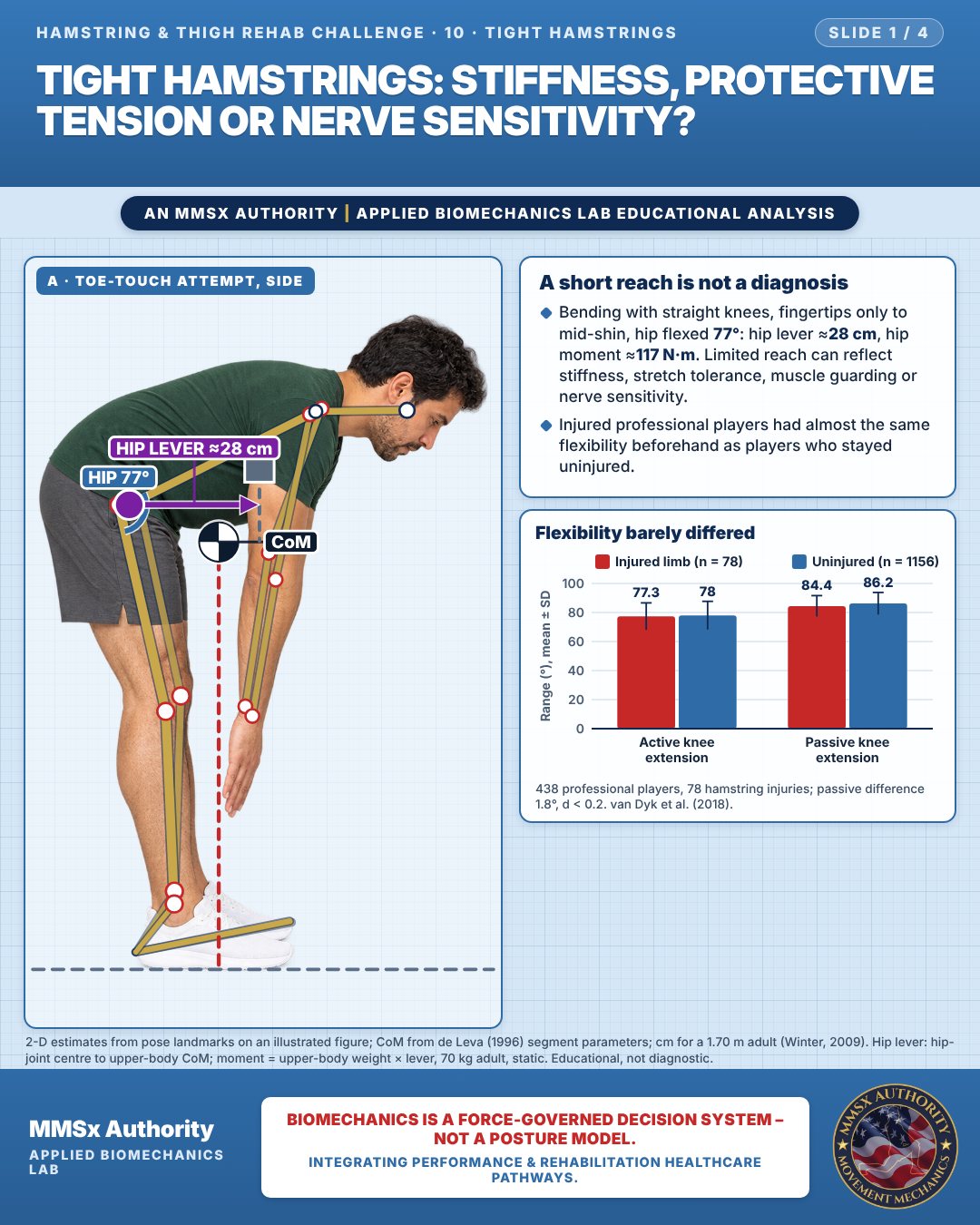
A short reach is not a diagnosis
Bending with straight knees, fingertips only to mid-shin, hip flexed 77°: hip lever ≈28 cm, hip moment ≈117 N·m. Limited reach can reflect stiffness, stretch tolerance, muscle guarding or nerve sensitivity.
Injured professional players had almost the same flexibility beforehand as players who stayed uninjured.
Flexibility barely differed
Movement B: Straight-leg raise (side view)
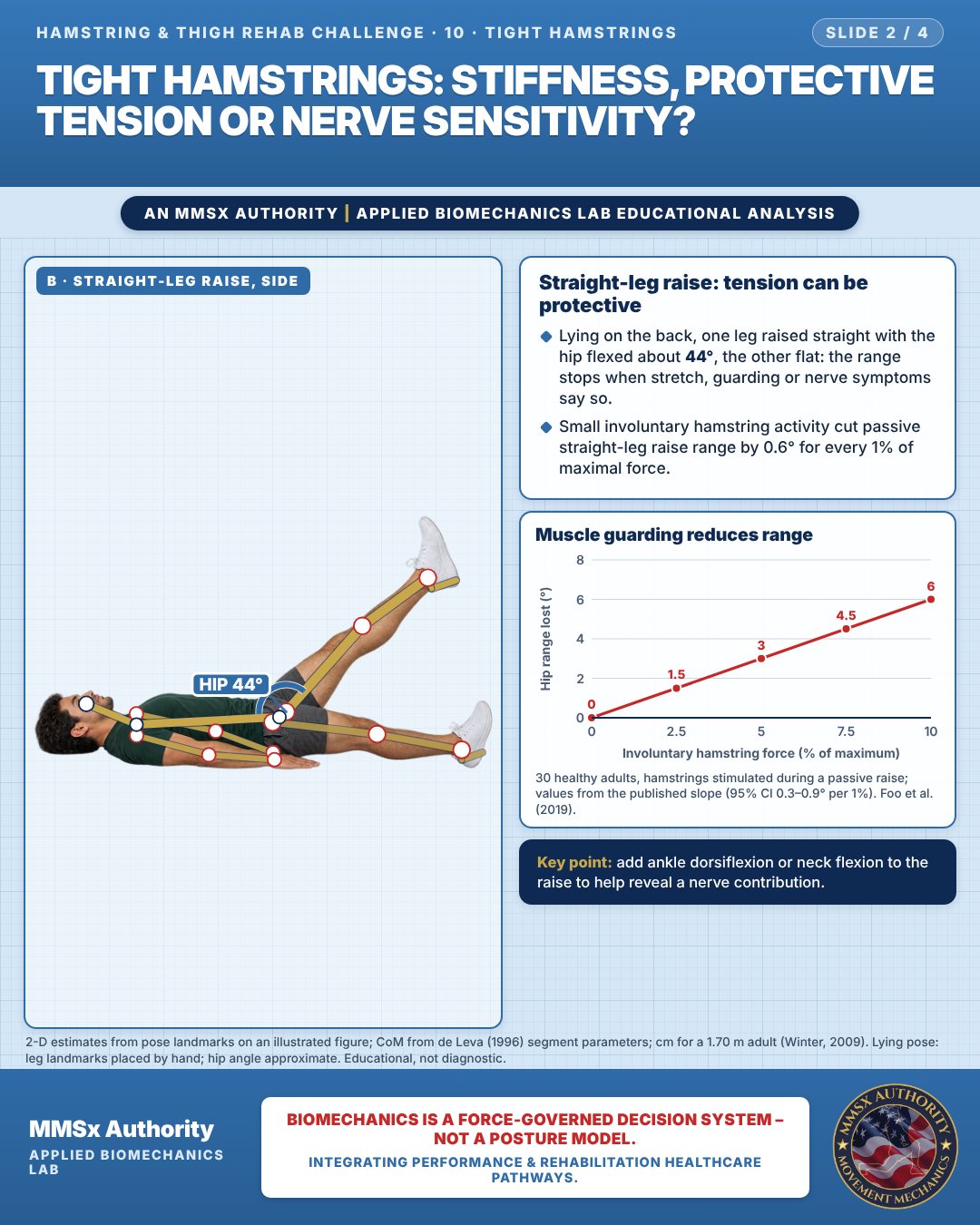
Straight-leg raise: tension can be protective
Lying on the back, one leg raised straight with the hip flexed about 44°, the other flat: the range stops when stretch, guarding or nerve symptoms say so.
Small involuntary hamstring activity cut passive straight-leg raise range by 0.6° for every 1% of maximal force.
Muscle guarding reduces range
Movement C: Sit-and-reach (side view)
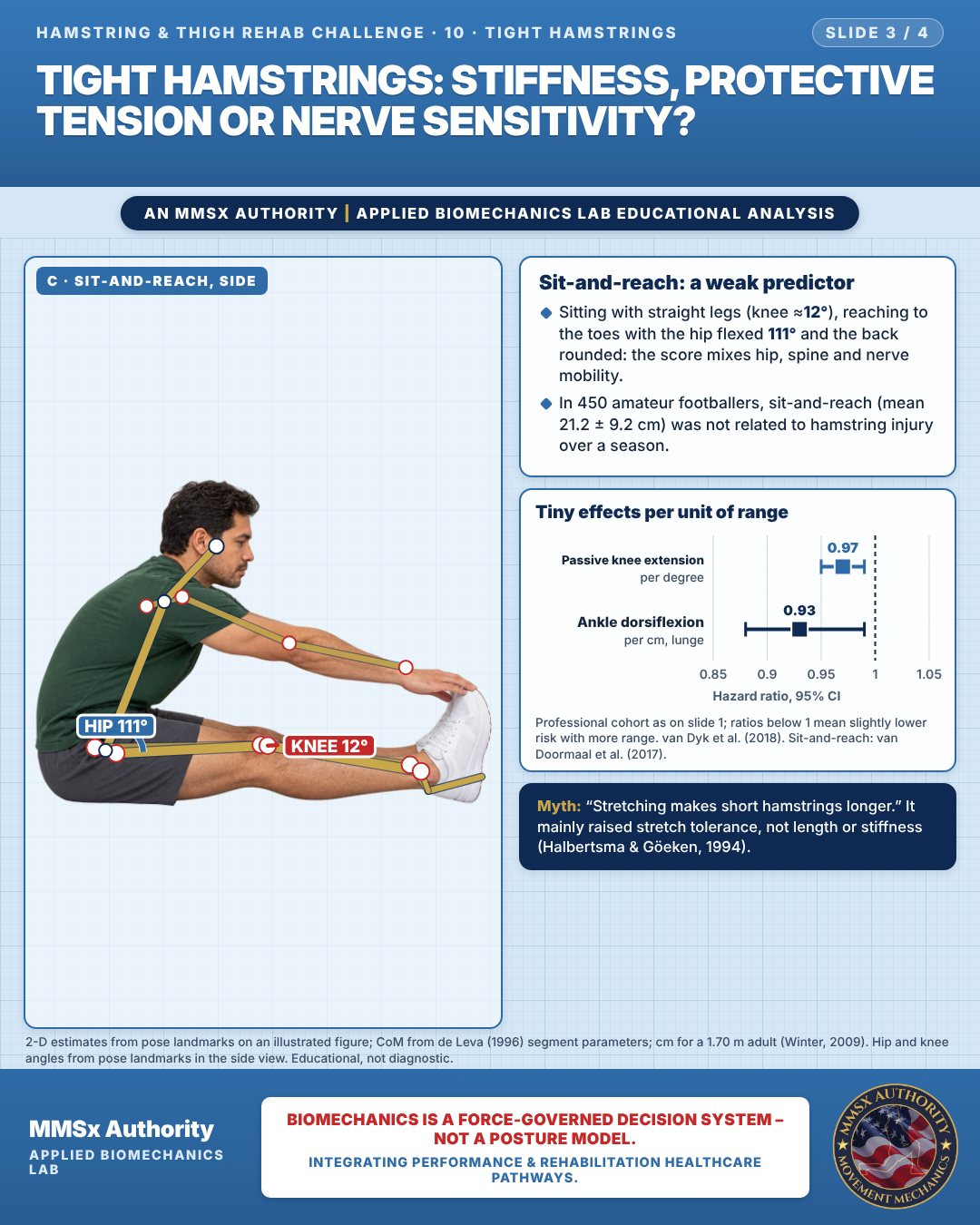
Sit-and-reach: a weak predictor
Sitting with straight legs (knee ≈12°), reaching to the toes with the hip flexed 111° and the back rounded: the score mixes hip, spine and nerve mobility.
In 450 amateur footballers, sit-and-reach (mean 21.2 ± 9.2 cm) was not related to hamstring injury over a season.
Tiny effects per unit of range
Decision pathway
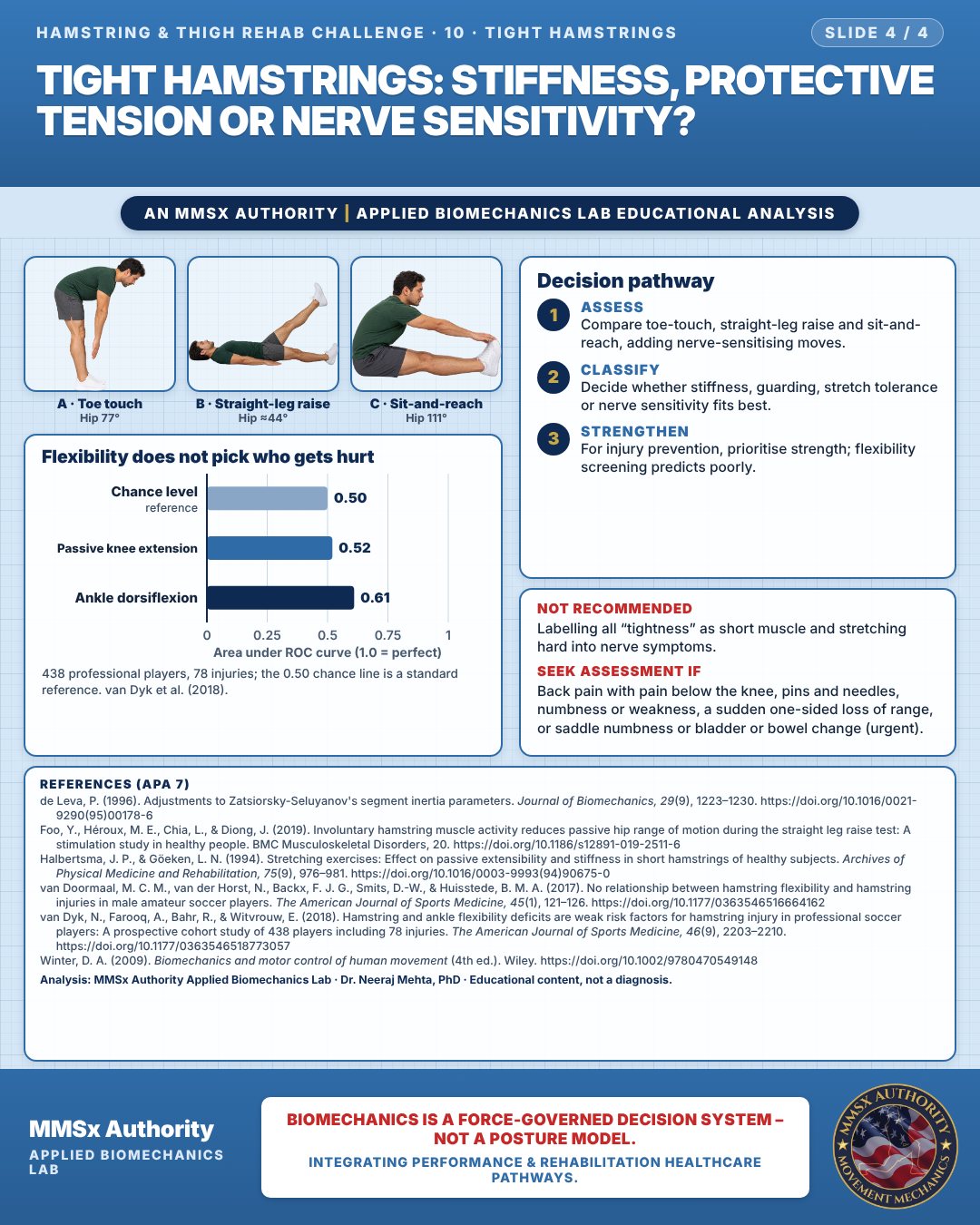
Flexibility does not pick who gets hurt
Assess
Compare toe-touch, straight-leg raise and sit-and-reach, adding nerve-sensitising moves.
Classify
Decide whether stiffness, guarding, stretch tolerance or nerve sensitivity fits best.
Strengthen
For injury prevention, prioritise strength; flexibility screening predicts poorly.
Myth and evidence
Myth“Tight hamstrings cause hamstring injuries, so stretch them.”
EvidenceFlexibility was not related to injury in amateur players (van Doormaal et al., 2017) and was a weak, non-discriminating factor in professionals (1.8° difference, AUC 0.52; van Dyk et al., 2018). Gains from stretching are largely increased stretch tolerance rather than longer or less stiff muscle (Halbertsma & Göeken, 1994).
Cautions
Not recommended
Labelling all “tightness” as short muscle and stretching hard into nerve symptoms.
Seek assessment if
Back pain with pain below the knee, pins and needles, numbness or weakness, a sudden one-sided loss of range, or saddle numbness or bladder or bowel change (urgent).
Methods note
2-D estimates from pose landmarks on an illustrated figure; CoM from de Leva (1996) segment parameters; cm for a 1.70 m adult (Winter, 2009). Hip lever: hip-joint centre to upper-body CoM; moment = upper-body weight × lever, 70 kg adult, static. Lying pose: leg landmarks placed by hand; hip angle approximate. Hip and knee angles from pose landmarks in the side view. These are educational estimates, not a diagnosis.
References
- de Leva, P. (1996). Adjustments to Zatsiorsky-Seluyanov's segment inertia parameters. Journal of Biomechanics, 29(9), 1223–1230. https://doi.org/10.1016/0021-9290(95)00178-6
- Foo, Y., Héroux, M. E., Chia, L., & Diong, J. (2019). Involuntary hamstring muscle activity reduces passive hip range of motion during the straight leg raise test: A stimulation study in healthy people. BMC Musculoskeletal Disorders, 20. https://doi.org/10.1186/s12891-019-2511-6
- Halbertsma, J. P., & Göeken, L. N. (1994). Stretching exercises: Effect on passive extensibility and stiffness in short hamstrings of healthy subjects. Archives of Physical Medicine and Rehabilitation, 75(9), 976–981. https://doi.org/10.1016/0003-9993(94)90675-0
- van Doormaal, M. C. M., van der Horst, N., Backx, F. J. G., Smits, D.-W., & Huisstede, B. M. A. (2017). No relationship between hamstring flexibility and hamstring injuries in male amateur soccer players. The American Journal of Sports Medicine, 45(1), 121–126. https://doi.org/10.1177/0363546516664162
- van Dyk, N., Farooq, A., Bahr, R., & Witvrouw, E. (2018). Hamstring and ankle flexibility deficits are weak risk factors for hamstring injury in professional soccer players: A prospective cohort study of 438 players including 78 injuries. The American Journal of Sports Medicine, 46(9), 2203–2210. https://doi.org/10.1177/0363546518773057
- Winter, D. A. (2009). Biomechanics and motor control of human movement (4th ed.). Wiley. https://doi.org/10.1002/9780470549148
Cite this article
Mehta, N. (2026, October 26). Tight hamstrings: stiffness, protective tension or nerve sensitivity? MMSx Authority Applied Biomechanics Lab. https://mmsxauthority.org/edu/analysis/hamstring-thigh/10-tight-hamstrings-stiffness-protective-tension-or-nerve-sensitivity/
Part of the collection
Mehta, N. (2026). Hamstring and Thigh Rehabilitation: 50 Evidence-Based Biomechanics Analyses [Collection]. MMSx Authority Applied Biomechanics Lab. Zenodo. https://doi.org/10.5281/zenodo.23735792
All Hamstring & Thigh Rehab Challenge articles · Rehabilitation Library