Hamstring & Thigh Rehab Challenge · 09
Eccentric hamstring strength: why lengthening control matters
Eccentric hamstring strength is the force the hamstrings can produce while being lengthened under load, commonly measured as knee-flexor force during…
Key points
- Build. Progress eccentric work: Nordics, slider curls and Romanian deadlifts.
- Rehab. Lengthened-position loading after a strain shortened return to play (Askling et al., 2013).
- Interpret. Do not use one strength number or a >10% side difference as a pass or fail test.
What it is
Eccentric hamstring strength is the force the hamstrings can produce while being lengthened under load, commonly measured as knee-flexor force during the Nordic exercise or as eccentric torque on an isokinetic dynamometer. It reflects the braking demand placed on the hamstrings in late swing.
How we analysed the movement
Three movements relevant to this topic were analysed from illustrated reference figures. Joint centres were located with two-dimensional pose estimation; hip and knee angles, pelvis level, the whole-body centre of mass and, where relevant, the hip lever (the horizontal distance from the hip joint to the upper-body centre of mass) and the resulting static hip moment were then calculated from standard segment parameters. The figures are educational estimates that show how position changes mechanical demand; they are not measurements of a patient. Every research value quoted below comes from the published source cited beside it.
Movement A: Slider leg curl (side view)
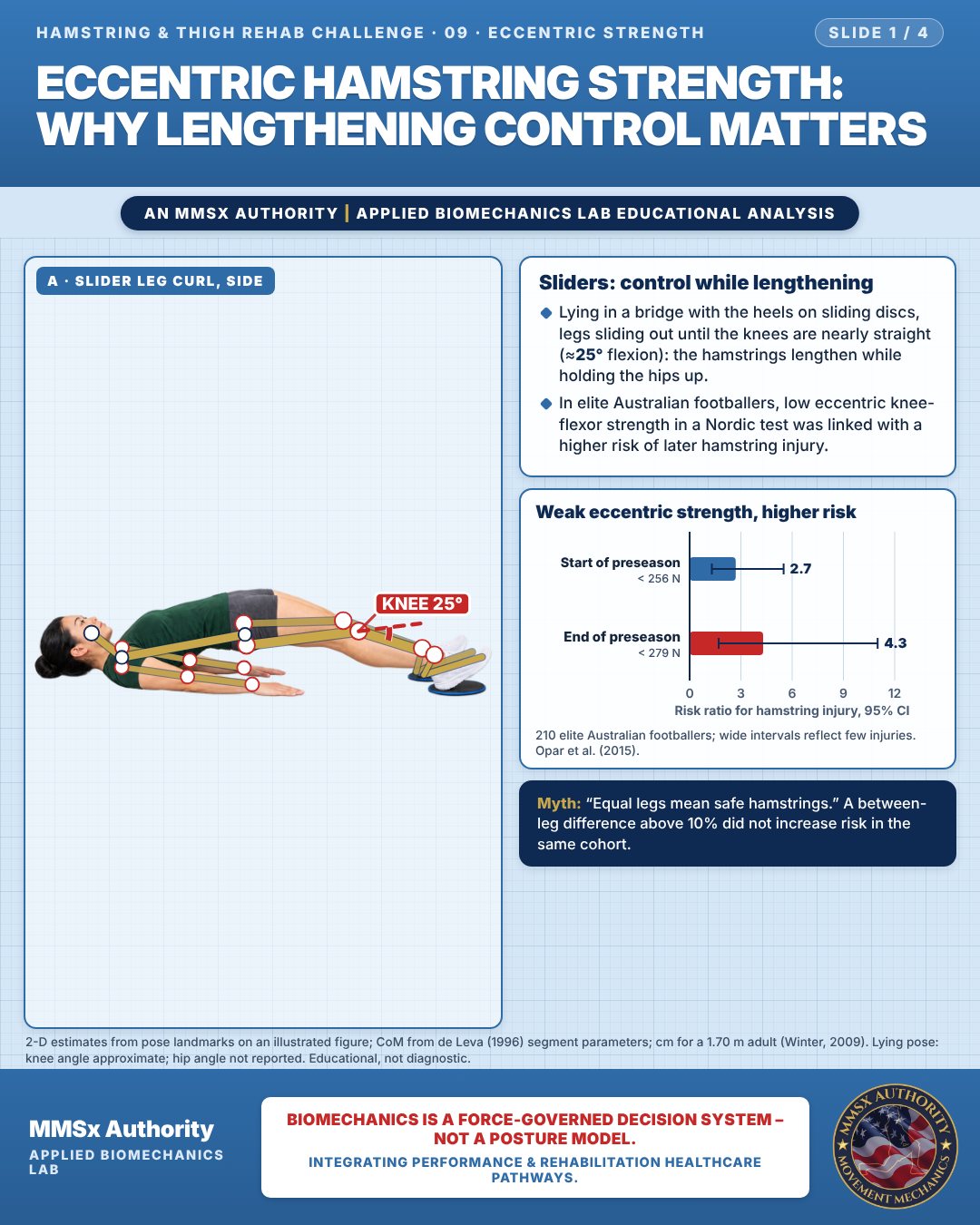
Sliders: control while lengthening
Lying in a bridge with the heels on sliding discs, legs sliding out until the knees are nearly straight (≈25° flexion): the hamstrings lengthen while holding the hips up.
In elite Australian footballers, low eccentric knee-flexor strength in a Nordic test was linked with a higher risk of later hamstring injury.
Weak eccentric strength, higher risk
Movement B: Dumbbell rdl (side view)
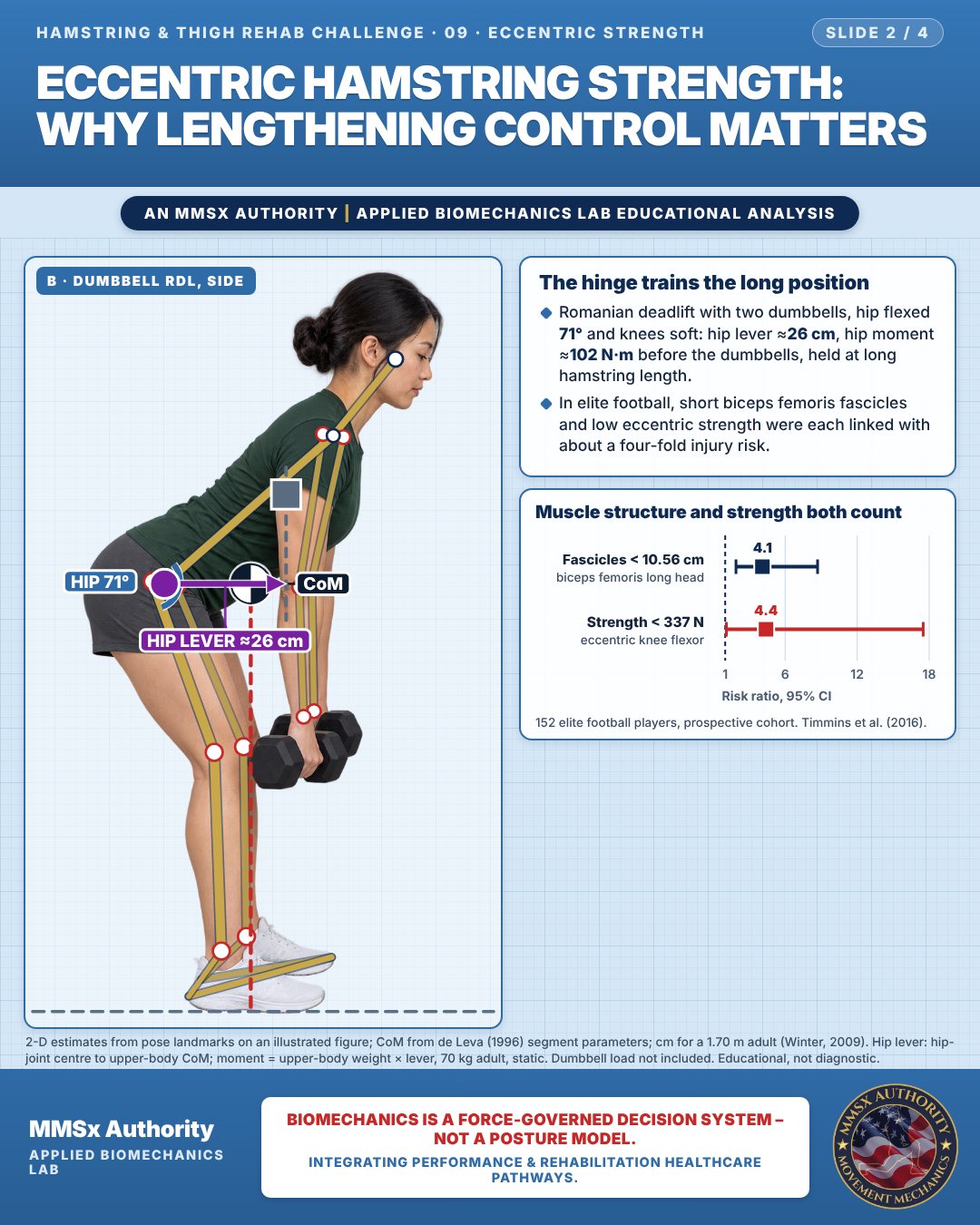
The hinge trains the long position
Romanian deadlift with two dumbbells, hip flexed 71° and knees soft: hip lever ≈26 cm, hip moment ≈102 N·m before the dumbbells, held at long hamstring length.
In elite football, short biceps femoris fascicles and low eccentric strength were each linked with about a four-fold injury risk.
Muscle structure and strength both count
Movement C: Walking lunge (side view)
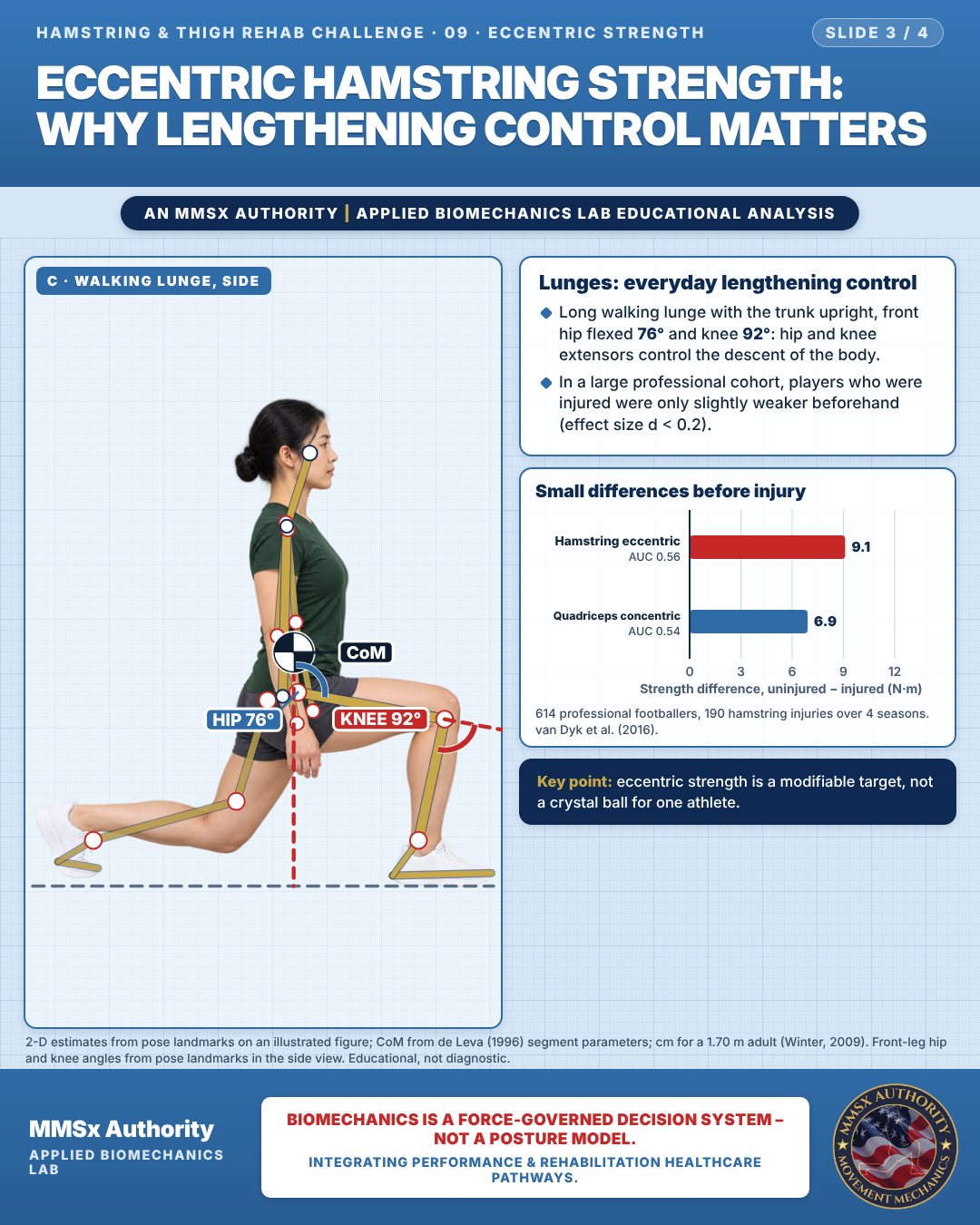
Lunges: everyday lengthening control
Long walking lunge with the trunk upright, front hip flexed 76° and knee 92°: hip and knee extensors control the descent of the body.
In a large professional cohort, players who were injured were only slightly weaker beforehand (effect size d < 0.2).
Small differences before injury
Decision pathway
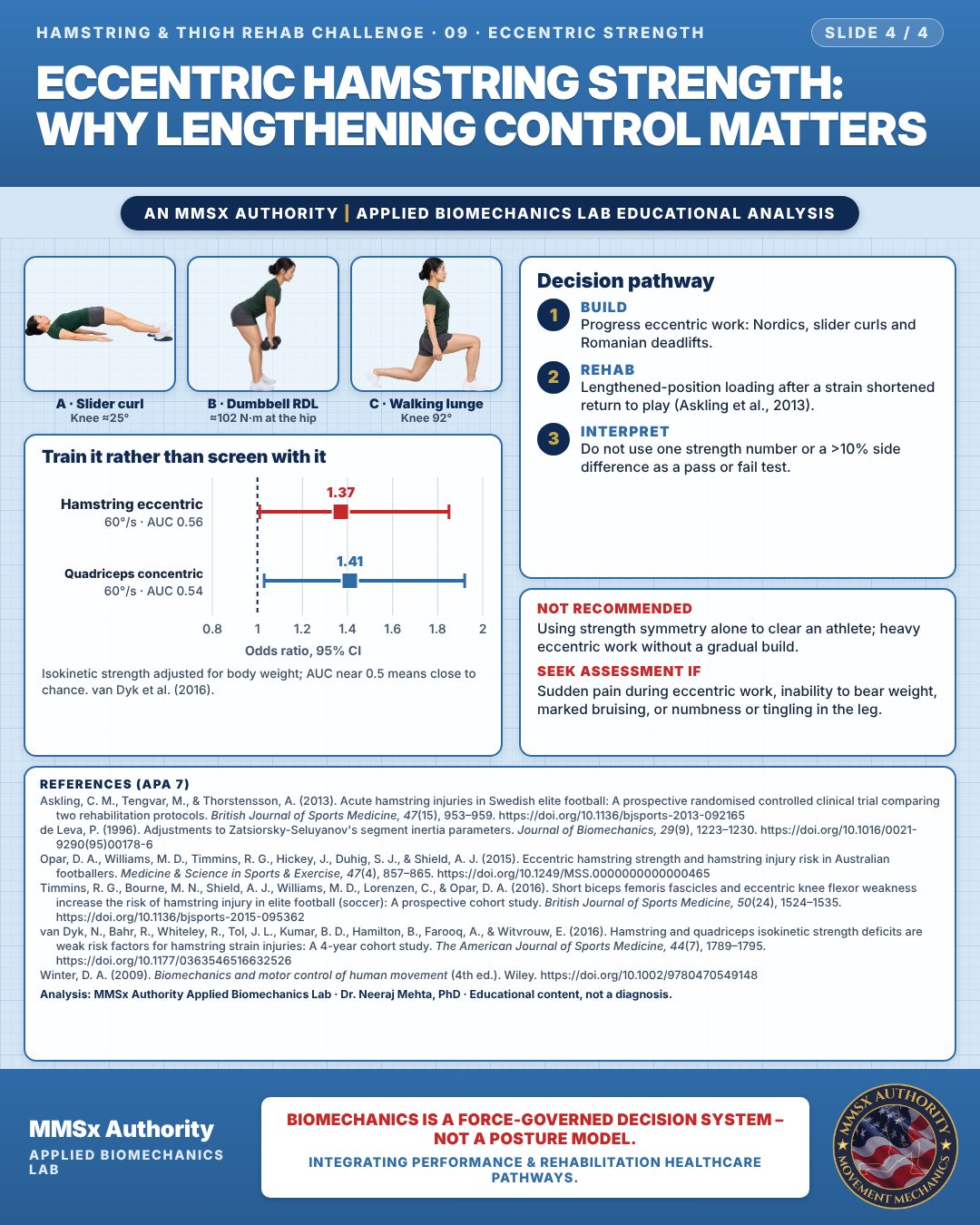
Train it rather than screen with it
Build
Progress eccentric work: Nordics, slider curls and Romanian deadlifts.
Rehab
Lengthened-position loading after a strain shortened return to play (Askling et al., 2013).
Interpret
Do not use one strength number or a >10% side difference as a pass or fail test.
What the evidence supports
- Lengthened-state eccentric work during rehabilitation (L-protocol) shortened return to play (Askling et al., 2013).
- Do not rely on a between-limb difference >10% as a stand-alone risk marker (Opar et al., 2015).
Myth and evidence
Myth“If both legs are equally strong, the hamstrings are safe.”
EvidenceAbsolute eccentric strength mattered in Australian football, but a >10% between-limb imbalance did not increase risk (Opar et al., 2015). Even absolute strength discriminated poorly in a large cohort (AUC 0.56; van Dyk et al., 2016). Eccentric strength is a modifiable target, not a crystal ball.
Cautions
Not recommended
Using strength symmetry alone to clear an athlete; heavy eccentric work without a gradual build.
Seek assessment if
Sudden pain during eccentric work, inability to bear weight, marked bruising, or numbness or tingling in the leg.
Methods note
2-D estimates from pose landmarks on an illustrated figure; CoM from de Leva (1996) segment parameters; cm for a 1.70 m adult (Winter, 2009). Lying pose: knee angle approximate; hip angle not reported. Hip lever: hip-joint centre to upper-body CoM; moment = upper-body weight × lever, 70 kg adult, static. Dumbbell load not included. Front-leg hip and knee angles from pose landmarks in the side view. These are educational estimates, not a diagnosis.
References
- Askling, C. M., Tengvar, M., & Thorstensson, A. (2013). Acute hamstring injuries in Swedish elite football: A prospective randomised controlled clinical trial comparing two rehabilitation protocols. British Journal of Sports Medicine, 47(15), 953–959. https://doi.org/10.1136/bjsports-2013-092165
- de Leva, P. (1996). Adjustments to Zatsiorsky-Seluyanov's segment inertia parameters. Journal of Biomechanics, 29(9), 1223–1230. https://doi.org/10.1016/0021-9290(95)00178-6
- Opar, D. A., Williams, M. D., Timmins, R. G., Hickey, J., Duhig, S. J., & Shield, A. J. (2015). Eccentric hamstring strength and hamstring injury risk in Australian footballers. Medicine & Science in Sports & Exercise, 47(4), 857–865. https://doi.org/10.1249/MSS.0000000000000465
- Timmins, R. G., Bourne, M. N., Shield, A. J., Williams, M. D., Lorenzen, C., & Opar, D. A. (2016). Short biceps femoris fascicles and eccentric knee flexor weakness increase the risk of hamstring injury in elite football (soccer): A prospective cohort study. British Journal of Sports Medicine, 50(24), 1524–1535. https://doi.org/10.1136/bjsports-2015-095362
- van Dyk, N., Bahr, R., Whiteley, R., Tol, J. L., Kumar, B. D., Hamilton, B., Farooq, A., & Witvrouw, E. (2016). Hamstring and quadriceps isokinetic strength deficits are weak risk factors for hamstring strain injuries: A 4-year cohort study. The American Journal of Sports Medicine, 44(7), 1789–1795. https://doi.org/10.1177/0363546516632526
- Winter, D. A. (2009). Biomechanics and motor control of human movement (4th ed.). Wiley. https://doi.org/10.1002/9780470549148
Cite this article
Mehta, N. (2026, October 26). Eccentric hamstring strength: why lengthening control matters. MMSx Authority Applied Biomechanics Lab. https://mmsxauthority.org/edu/analysis/hamstring-thigh/09-eccentric-hamstring-strength-why-lengthening-control-matters/
Part of the collection
Mehta, N. (2026). Hamstring and Thigh Rehabilitation: 50 Evidence-Based Biomechanics Analyses [Collection]. MMSx Authority Applied Biomechanics Lab. Zenodo. https://doi.org/10.5281/zenodo.23735792
All Hamstring & Thigh Rehab Challenge articles · Rehabilitation Library