Hamstring & Thigh Rehab Challenge · 08
Nordic hamstring curl: what the injury-prevention evidence shows
The Nordic hamstring exercise (NHE) is a partner-assisted, bodyweight, eccentric knee-flexor exercise.
Key points
- Include. Add the Nordic, or a programme containing it, to team-sport prevention.
- Progress. Build volume gradually, e.g. from 2 × 6 to 3 × 8–12 over 4 weeks, to limit soreness.
- Comply. Benefits came with high compliance; pair it with hip-extension exercises.
What it is
The Nordic hamstring exercise (NHE) is a partner-assisted, bodyweight, eccentric knee-flexor exercise. The athlete kneels with ankles held and lowers the trunk forward as slowly as possible, keeping the hips extended, then catches the fall with the hands. It loads the hamstrings eccentrically through knee extension.
How we analysed the movement
Three movements relevant to this topic were analysed from illustrated reference figures. Joint centres were located with two-dimensional pose estimation; hip and knee angles, pelvis level, the whole-body centre of mass and, where relevant, the hip lever (the horizontal distance from the hip joint to the upper-body centre of mass) and the resulting static hip moment were then calculated from standard segment parameters. The figures are educational estimates that show how position changes mechanical demand; they are not measurements of a patient. Every research value quoted below comes from the published source cited beside it.
Movement A: Nordic start (side view)
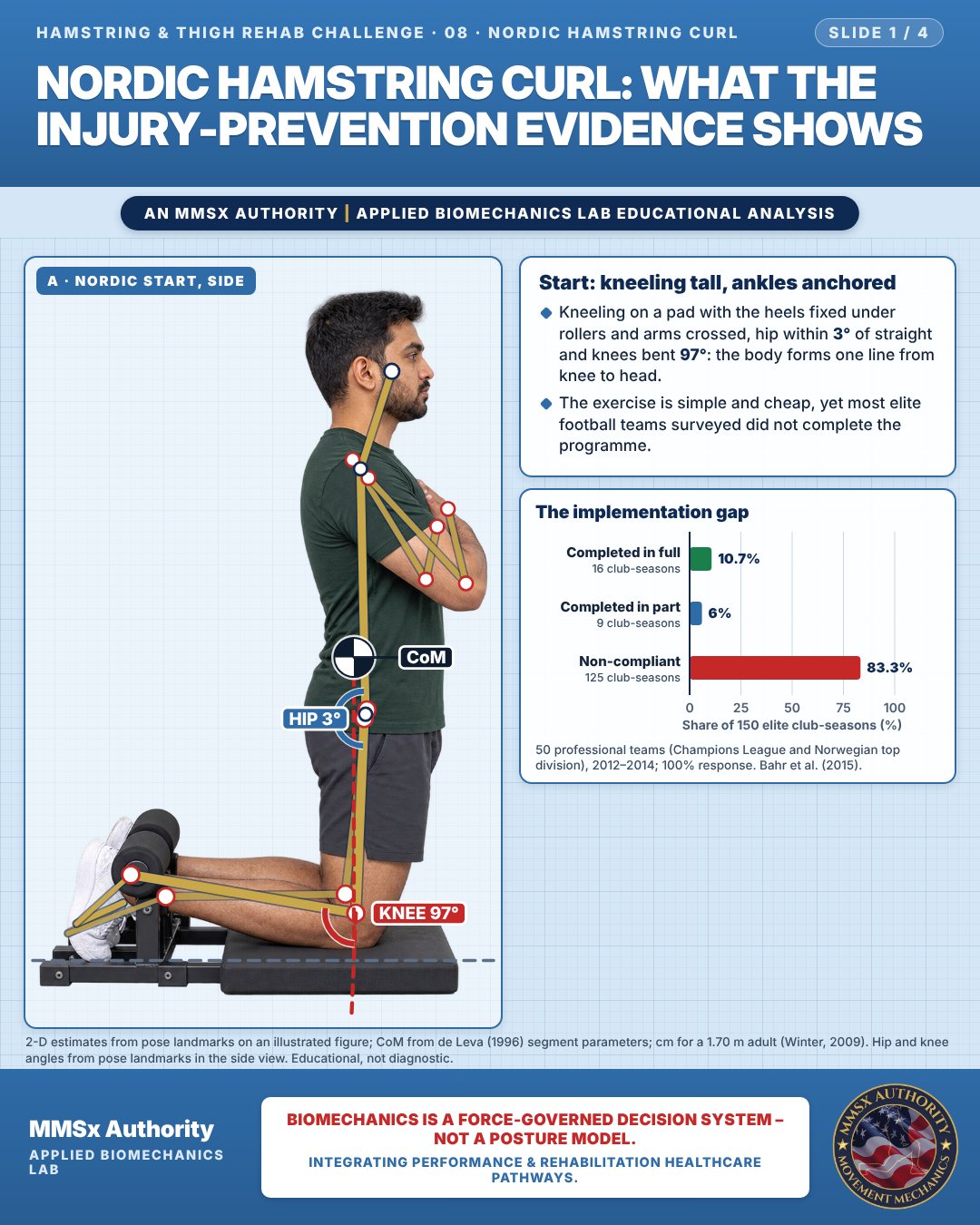
Start: kneeling tall, ankles anchored
Kneeling on a pad with the heels fixed under rollers and arms crossed, hip within 3° of straight and knees bent 97°: the body forms one line from knee to head.
The exercise is simple and cheap, yet most elite football teams surveyed did not complete the programme.
The implementation gap
Movement B: Nordic lowering (side view)
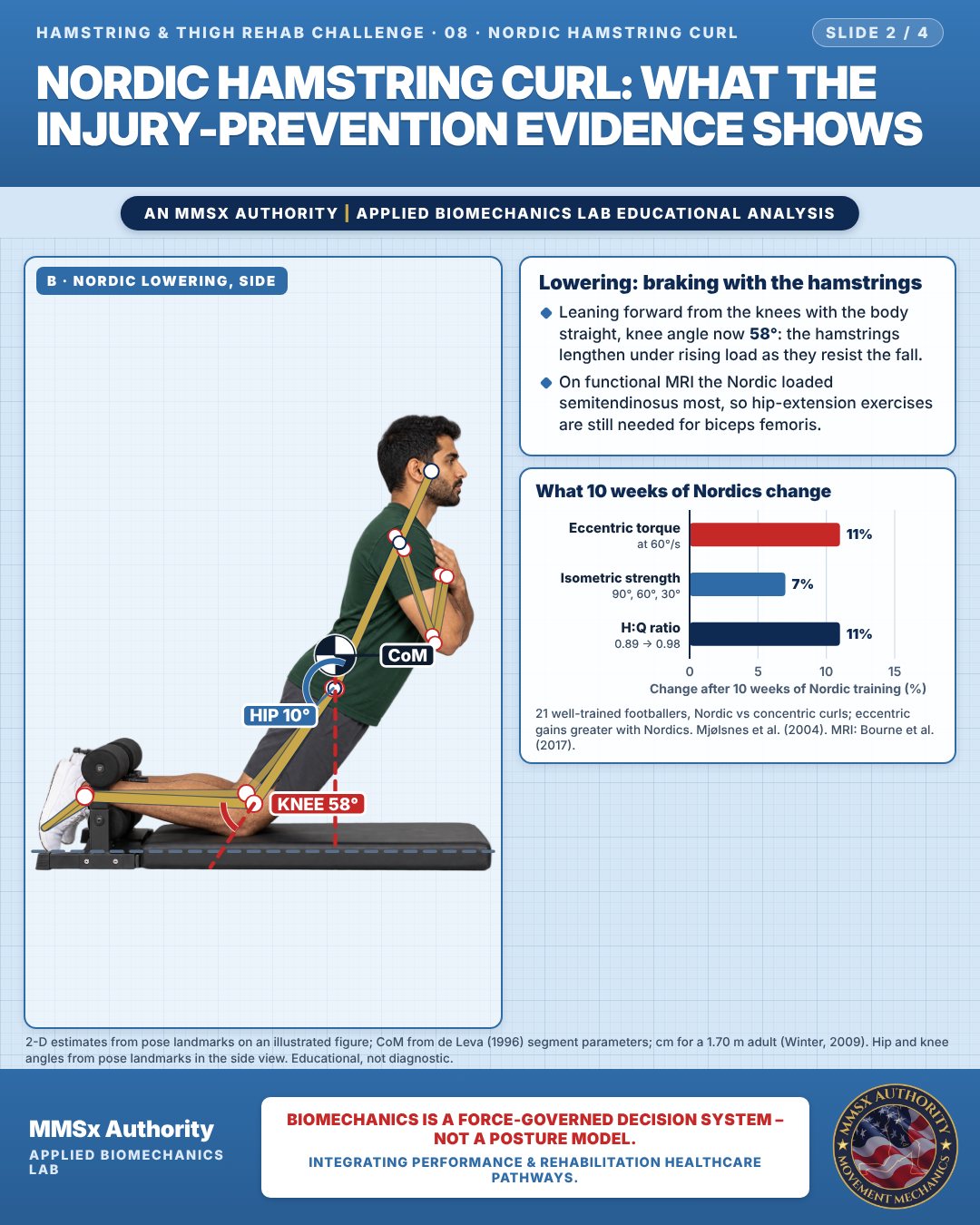
Lowering: braking with the hamstrings
Leaning forward from the knees with the body straight, knee angle now 58°: the hamstrings lengthen under rising load as they resist the fall.
On functional MRI the Nordic loaded semitendinosus most, so hip-extension exercises are still needed for biceps femoris.
What 10 weeks of Nordics change
Movement C: Nordic catch (side view)
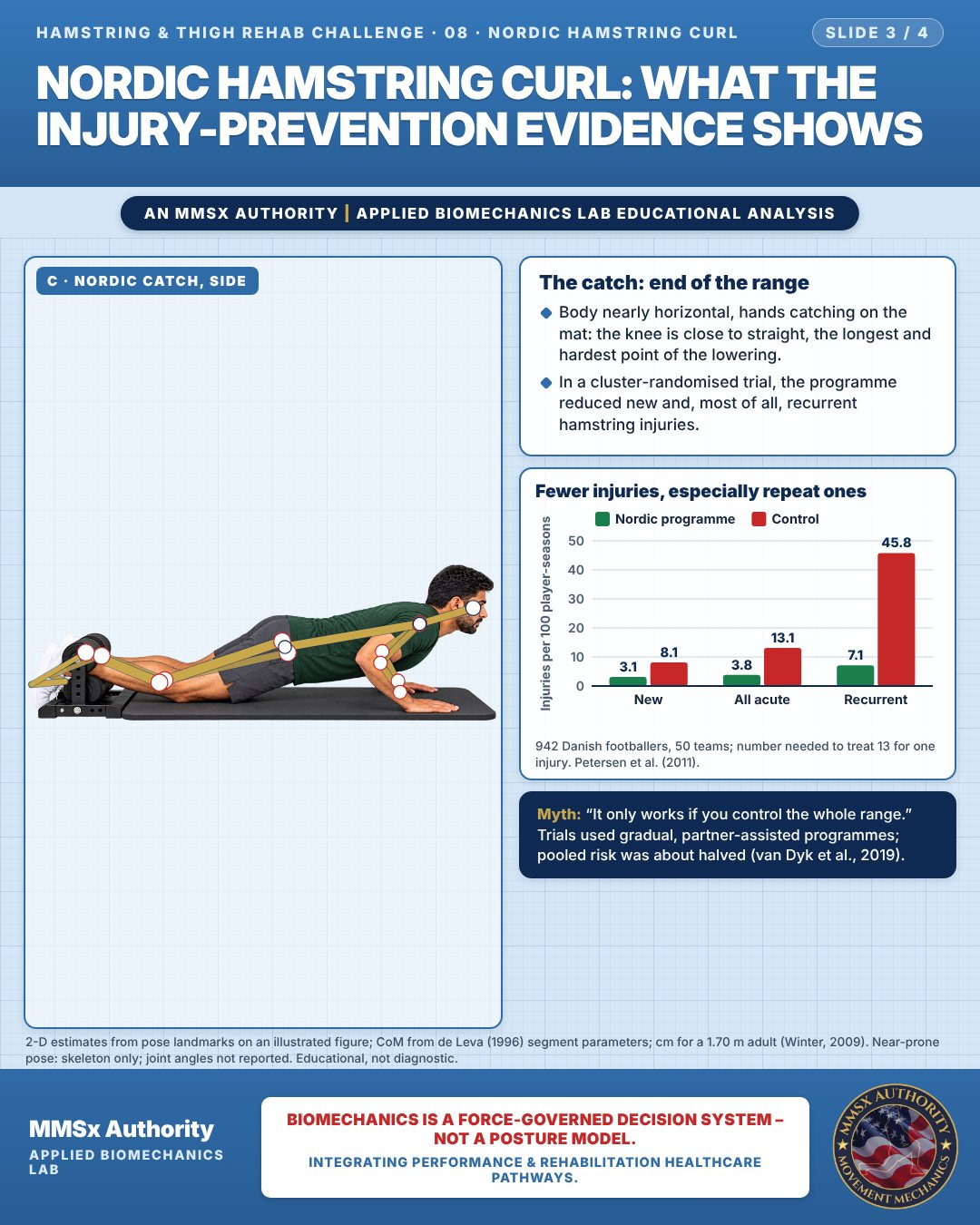
The catch: end of the range
Body nearly horizontal, hands catching on the mat: the knee is close to straight, the longest and hardest point of the lowering.
In a cluster-randomised trial, the programme reduced new and, most of all, recurrent hamstring injuries.
Fewer injuries, especially repeat ones
Decision pathway
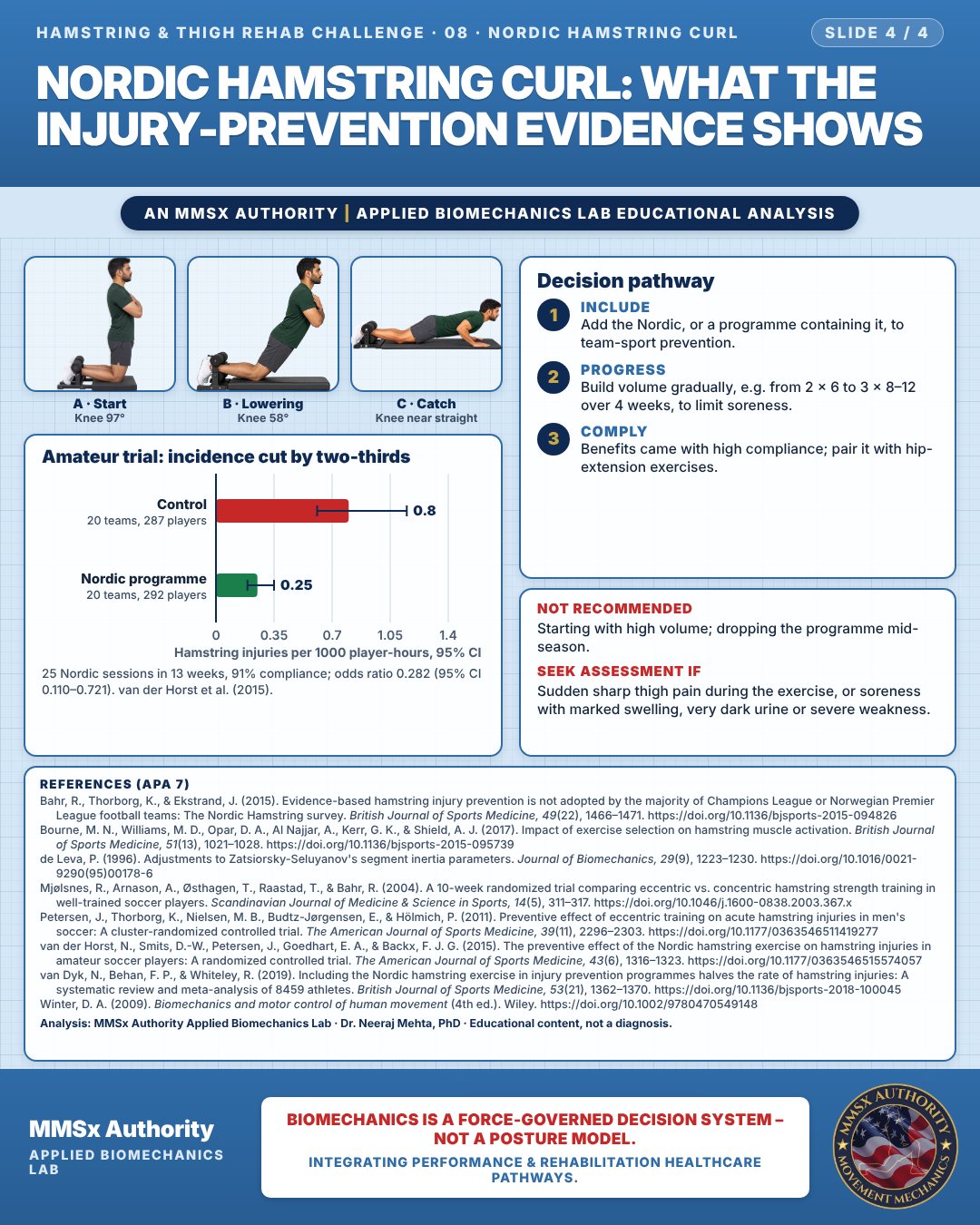
Amateur trial: incidence cut by two-thirds
Include
Add the Nordic, or a programme containing it, to team-sport prevention.
Progress
Build volume gradually, e.g. from 2 × 6 to 3 × 8–12 over 4 weeks, to limit soreness.
Comply
Benefits came with high compliance; pair it with hip-extension exercises.
What the evidence supports
- Include the NHE (or a programme containing it) in team-sport injury prevention; the strongest effects are in trials with high compliance (van der Horst et al., 2015: 91% compliance) and on recurrent injuries (Petersen et al., 2011).
Myth and evidence
Myth“The Nordic only works if you are strong enough to control the whole range.”
EvidenceThe trials used progressive, partner-assisted programmes in ordinary amateur and professional players, and the pooled effect was about halving injury risk (van Dyk et al., 2019). The bigger real-world problem is not doing it: only about one in ten elite club-seasons completed the programme (Bahr et al., 2015).
Cautions
Not recommended
Starting with high volume; dropping the programme mid-season.
Seek assessment if
Sudden sharp thigh pain during the exercise, or soreness with marked swelling, very dark urine or severe weakness.
Methods note
2-D estimates from pose landmarks on an illustrated figure; CoM from de Leva (1996) segment parameters; cm for a 1.70 m adult (Winter, 2009). Hip and knee angles from pose landmarks in the side view. Near-prone pose: skeleton only; joint angles not reported. These are educational estimates, not a diagnosis.
References
- Bahr, R., Thorborg, K., & Ekstrand, J. (2015). Evidence-based hamstring injury prevention is not adopted by the majority of Champions League or Norwegian Premier League football teams: The Nordic Hamstring survey. British Journal of Sports Medicine, 49(22), 1466–1471. https://doi.org/10.1136/bjsports-2015-094826
- Bourne, M. N., Williams, M. D., Opar, D. A., Al Najjar, A., Kerr, G. K., & Shield, A. J. (2017). Impact of exercise selection on hamstring muscle activation. British Journal of Sports Medicine, 51(13), 1021–1028. https://doi.org/10.1136/bjsports-2015-095739
- de Leva, P. (1996). Adjustments to Zatsiorsky-Seluyanov's segment inertia parameters. Journal of Biomechanics, 29(9), 1223–1230. https://doi.org/10.1016/0021-9290(95)00178-6
- Mjølsnes, R., Arnason, A., Østhagen, T., Raastad, T., & Bahr, R. (2004). A 10-week randomized trial comparing eccentric vs. concentric hamstring strength training in well-trained soccer players. Scandinavian Journal of Medicine & Science in Sports, 14(5), 311–317. https://doi.org/10.1046/j.1600-0838.2003.367.x
- Petersen, J., Thorborg, K., Nielsen, M. B., Budtz-Jørgensen, E., & Hölmich, P. (2011). Preventive effect of eccentric training on acute hamstring injuries in men's soccer: A cluster-randomized controlled trial. The American Journal of Sports Medicine, 39(11), 2296–2303. https://doi.org/10.1177/0363546511419277
- van der Horst, N., Smits, D.-W., Petersen, J., Goedhart, E. A., & Backx, F. J. G. (2015). The preventive effect of the Nordic hamstring exercise on hamstring injuries in amateur soccer players: A randomized controlled trial. The American Journal of Sports Medicine, 43(6), 1316–1323. https://doi.org/10.1177/0363546515574057
- van Dyk, N., Behan, F. P., & Whiteley, R. (2019). Including the Nordic hamstring exercise in injury prevention programmes halves the rate of hamstring injuries: A systematic review and meta-analysis of 8459 athletes. British Journal of Sports Medicine, 53(21), 1362–1370. https://doi.org/10.1136/bjsports-2018-100045
- Winter, D. A. (2009). Biomechanics and motor control of human movement (4th ed.). Wiley. https://doi.org/10.1002/9780470549148
Cite this article
Mehta, N. (2026, October 26). Nordic hamstring curl: what the injury-prevention evidence shows. MMSx Authority Applied Biomechanics Lab. https://mmsxauthority.org/edu/analysis/hamstring-thigh/08-nordic-hamstring-curl-what-the-injury-prevention-evidence-shows/
Part of the collection
Mehta, N. (2026). Hamstring and Thigh Rehabilitation: 50 Evidence-Based Biomechanics Analyses [Collection]. MMSx Authority Applied Biomechanics Lab. Zenodo. https://doi.org/10.5281/zenodo.23735792
All Hamstring & Thigh Rehab Challenge articles · Rehabilitation Library