Hamstring & Thigh Rehab Challenge · 07
Hamstring re-injury: why it comes back and how to lower the risk
A hamstring re-injury (recurrence) is a further hamstring strain in the same leg after return to sport from an index injury.
Key points
- Criteria. Clear return on strength and sprint criteria, not on the absence of pain.
- Grade speed. Rebuild acceleration and match-speed running in steps before full matches.
- Keep loading. Continue eccentric work after return; the first 2 months carry the most risk.
What it is
A hamstring re-injury (recurrence) is a further hamstring strain in the same leg after return to sport from an index injury. An "early recurrence" is one within 2 months of return (Ekstrand et al., 2023). The most consistent risk factor for a hamstring strain is a previous one, especially a recent one (Green et al., 2020).
How we analysed the movement
Three movements relevant to this topic were analysed from illustrated reference figures. Joint centres were located with two-dimensional pose estimation; hip and knee angles, pelvis level, the whole-body centre of mass and, where relevant, the hip lever (the horizontal distance from the hip joint to the upper-body centre of mass) and the resulting static hip moment were then calculated from standard segment parameters. The figures are educational estimates that show how position changes mechanical demand; they are not measurements of a patient. Every research value quoted below comes from the published source cited beside it.
Movement A: Sprint acceleration (side view)
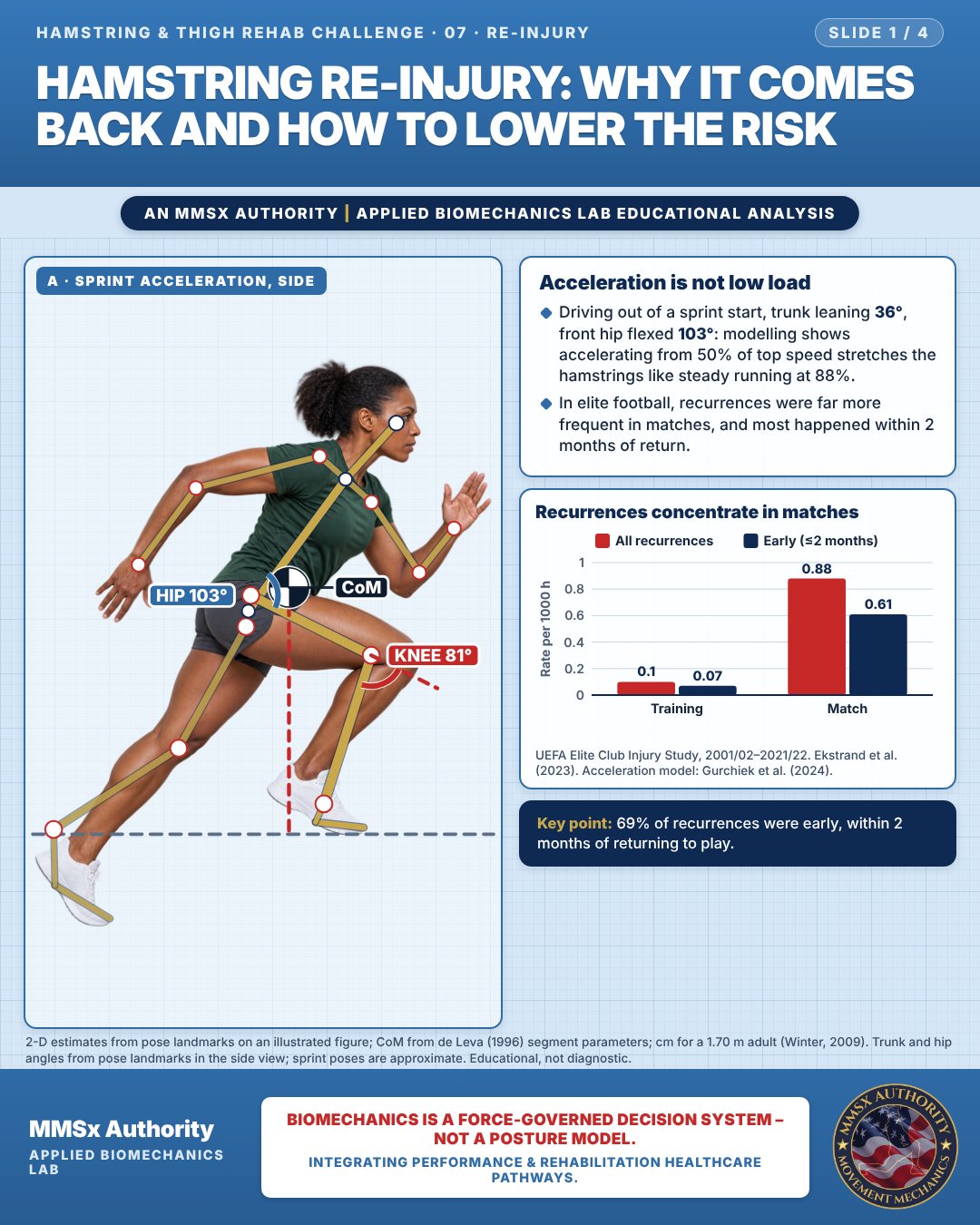
Acceleration is not low load
Driving out of a sprint start, trunk leaning 36°, front hip flexed 103°: modelling shows accelerating from 50% of top speed stretches the hamstrings like steady running at 88%.
In elite football, recurrences were far more frequent in matches, and most happened within 2 months of return.
Recurrences concentrate in matches
Movement B: Single-leg rdl (side view)
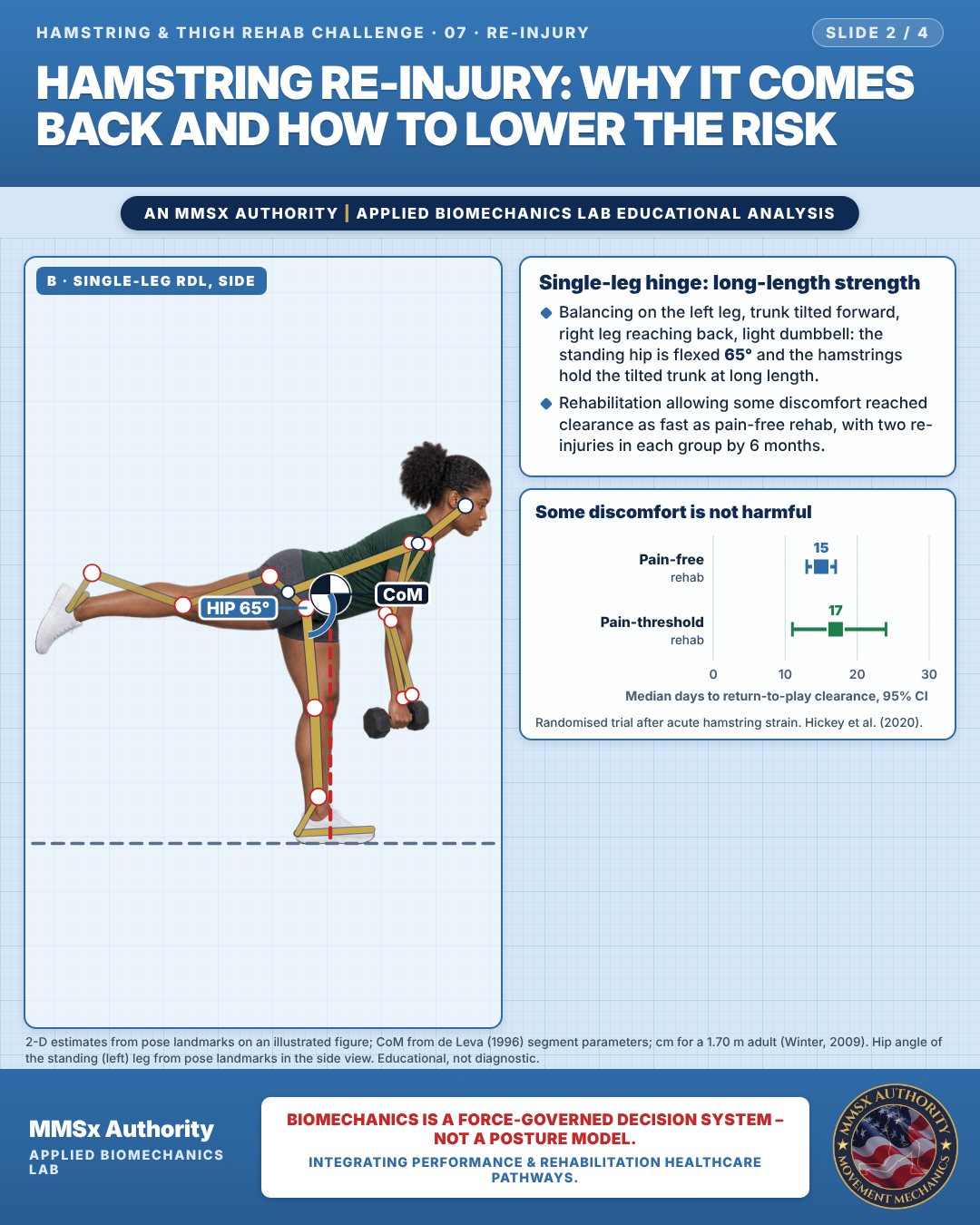
Single-leg hinge: long-length strength
Balancing on the left leg, trunk tilted forward, right leg reaching back, light dumbbell: the standing hip is flexed 65° and the hamstrings hold the tilted trunk at long length.
Rehabilitation allowing some discomfort reached clearance as fast as pain-free rehab, with two re-injuries in each group by 6 months.
Some discomfort is not harmful
Movement C: Easy jog (side view)
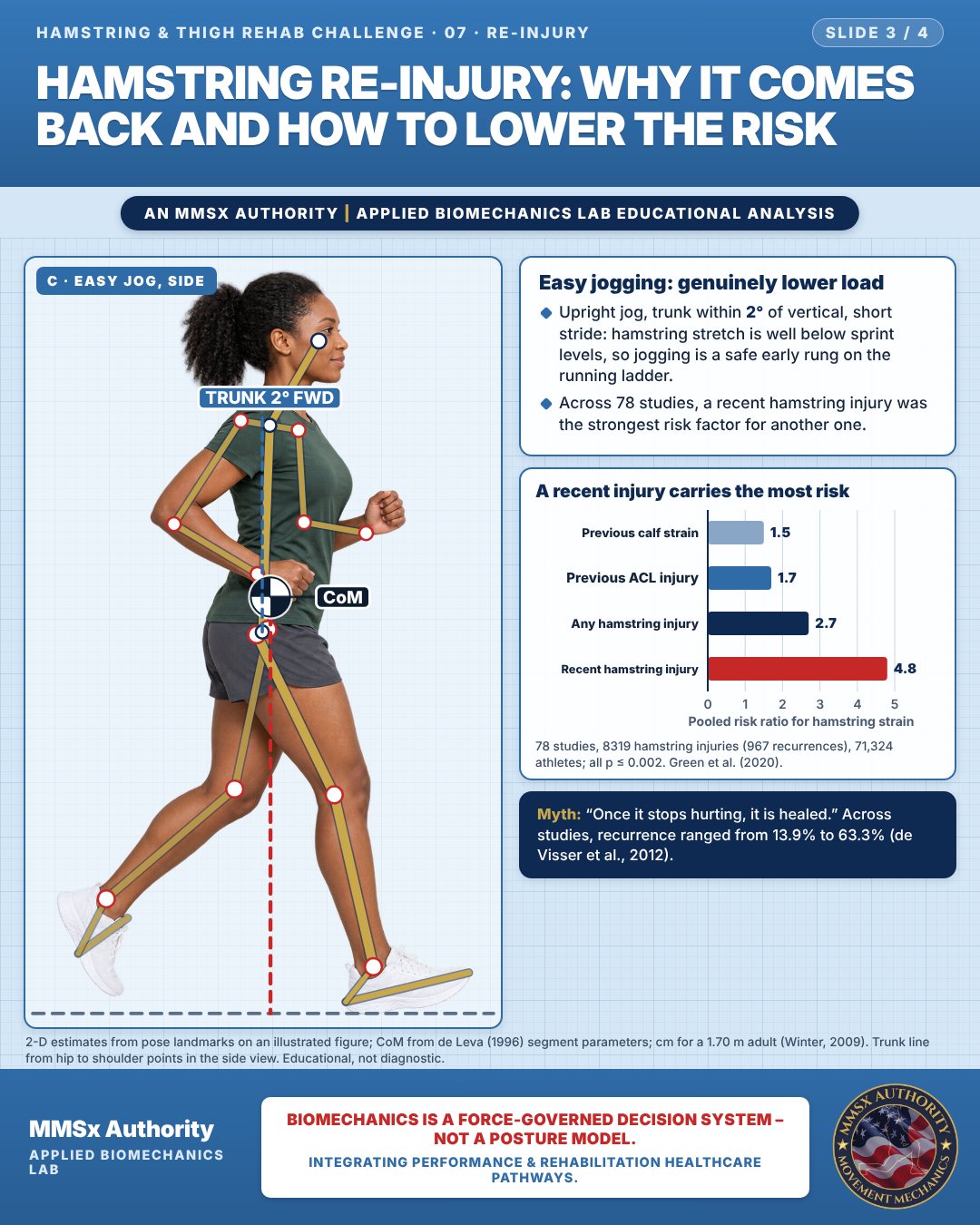
Easy jogging: genuinely lower load
Upright jog, trunk within 2° of vertical, short stride: hamstring stretch is well below sprint levels, so jogging is a safe early rung on the running ladder.
Across 78 studies, a recent hamstring injury was the strongest risk factor for another one.
A recent injury carries the most risk
Decision pathway
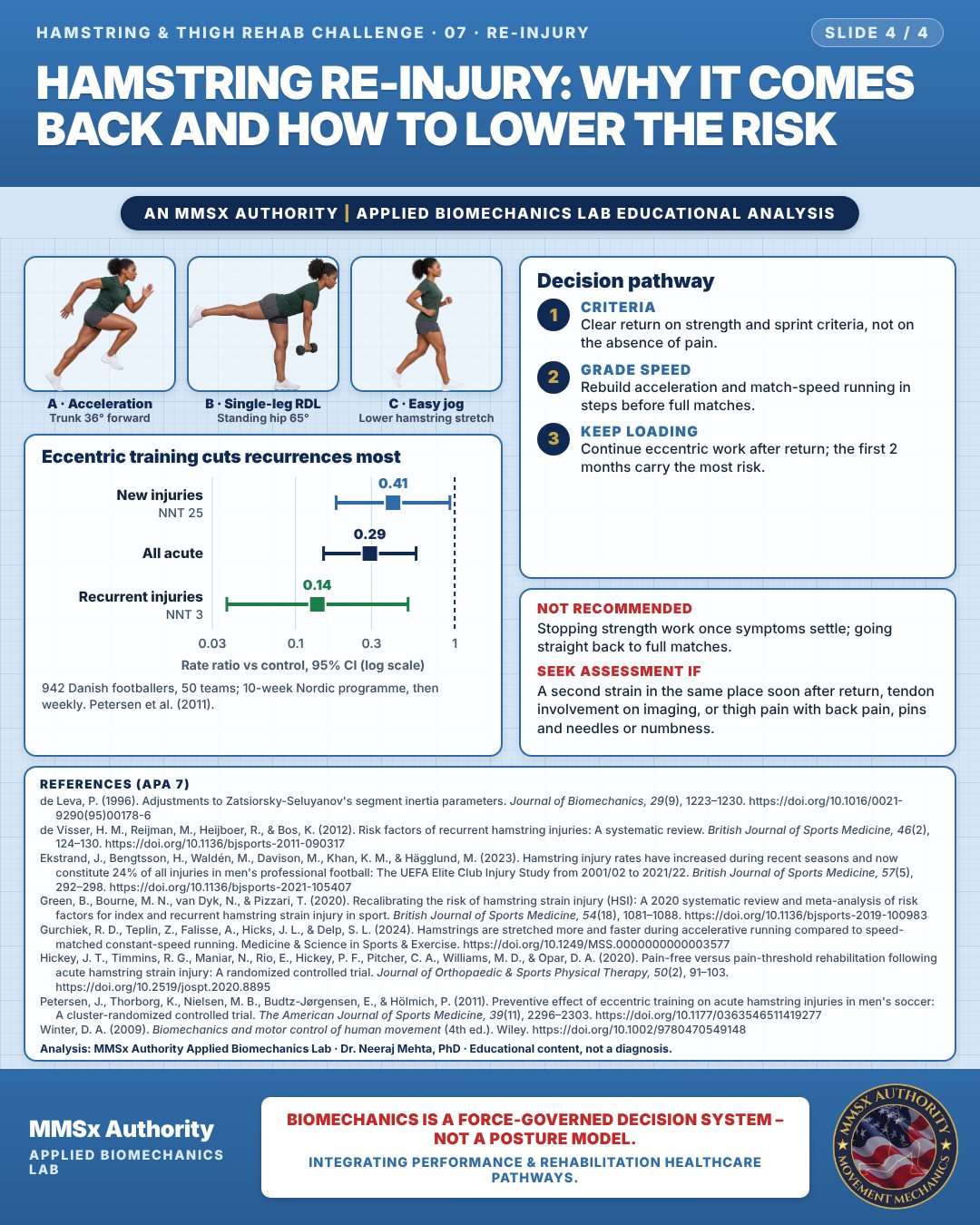
Eccentric training cuts recurrences most
Criteria
Clear return on strength and sprint criteria, not on the absence of pain.
Grade speed
Rebuild acceleration and match-speed running in steps before full matches.
Keep loading
Continue eccentric work after return; the first 2 months carry the most risk.
What the evidence supports
- Include eccentric hamstring training (for example Nordic programmes); the largest preventive effect in a randomised trial was on recurrent injuries (Petersen et al., 2011).
Cautions
Not recommended
Stopping strength work once symptoms settle; going straight back to full matches.
Seek assessment if
A second strain in the same place soon after return, tendon involvement on imaging, or thigh pain with back pain, pins and needles or numbness.
Methods note
2-D estimates from pose landmarks on an illustrated figure; CoM from de Leva (1996) segment parameters; cm for a 1.70 m adult (Winter, 2009). Trunk and hip angles from pose landmarks in the side view; sprint poses are approximate. Hip angle of the standing (left) leg from pose landmarks in the side view. Trunk line from hip to shoulder points in the side view. These are educational estimates, not a diagnosis.
References
- de Leva, P. (1996). Adjustments to Zatsiorsky-Seluyanov's segment inertia parameters. Journal of Biomechanics, 29(9), 1223–1230. https://doi.org/10.1016/0021-9290(95)00178-6
- de Visser, H. M., Reijman, M., Heijboer, R., & Bos, K. (2012). Risk factors of recurrent hamstring injuries: A systematic review. British Journal of Sports Medicine, 46(2), 124–130. https://doi.org/10.1136/bjsports-2011-090317
- Ekstrand, J., Bengtsson, H., Waldén, M., Davison, M., Khan, K. M., & Hägglund, M. (2023). Hamstring injury rates have increased during recent seasons and now constitute 24% of all injuries in men's professional football: The UEFA Elite Club Injury Study from 2001/02 to 2021/22. British Journal of Sports Medicine, 57(5), 292–298. https://doi.org/10.1136/bjsports-2021-105407
- Green, B., Bourne, M. N., van Dyk, N., & Pizzari, T. (2020). Recalibrating the risk of hamstring strain injury (HSI): A 2020 systematic review and meta-analysis of risk factors for index and recurrent hamstring strain injury in sport. British Journal of Sports Medicine, 54(18), 1081–1088. https://doi.org/10.1136/bjsports-2019-100983
- Gurchiek, R. D., Teplin, Z., Falisse, A., Hicks, J. L., & Delp, S. L. (2024). Hamstrings are stretched more and faster during accelerative running compared to speed-matched constant-speed running. Medicine & Science in Sports & Exercise. https://doi.org/10.1249/MSS.0000000000003577
- Hickey, J. T., Timmins, R. G., Maniar, N., Rio, E., Hickey, P. F., Pitcher, C. A., Williams, M. D., & Opar, D. A. (2020). Pain-free versus pain-threshold rehabilitation following acute hamstring strain injury: A randomized controlled trial. Journal of Orthopaedic & Sports Physical Therapy, 50(2), 91–103. https://doi.org/10.2519/jospt.2020.8895
- Petersen, J., Thorborg, K., Nielsen, M. B., Budtz-Jørgensen, E., & Hölmich, P. (2011). Preventive effect of eccentric training on acute hamstring injuries in men's soccer: A cluster-randomized controlled trial. The American Journal of Sports Medicine, 39(11), 2296–2303. https://doi.org/10.1177/0363546511419277
- Winter, D. A. (2009). Biomechanics and motor control of human movement (4th ed.). Wiley. https://doi.org/10.1002/9780470549148
Cite this article
Mehta, N. (2026, October 26). Hamstring re-injury: why it comes back and how to lower the risk. MMSx Authority Applied Biomechanics Lab. https://mmsxauthority.org/edu/analysis/hamstring-thigh/07-hamstring-re-injury-why-it-comes-back-and-how-to-lower-the-risk/
Part of the collection
Mehta, N. (2026). Hamstring and Thigh Rehabilitation: 50 Evidence-Based Biomechanics Analyses [Collection]. MMSx Authority Applied Biomechanics Lab. Zenodo. https://doi.org/10.5281/zenodo.23735792
All Hamstring & Thigh Rehab Challenge articles · Rehabilitation Library