Hamstring & Thigh Rehab Challenge · 06
Pain when sitting: when the hamstring tendon is the source
Sitting pain at the ischial tuberosity is a hallmark of proximal hamstring tendinopathy: "local pain during sitting and driving is typical".
Key points
- Test. Typical sitting pain plus a positive modified bent-knee stretch test makes a tendon source more likely.
- Modify. Use firmer cushions, breaks from sitting and less slumping while the tendon settles.
- Load. Progress tendon loading over weeks; consider shockwave only as an adjunct.
What it is
Sitting pain at the ischial tuberosity is a hallmark of proximal hamstring tendinopathy: "local pain during sitting and driving is typical". Sitting (especially slumped or with the hip flexed and knee straightened, as when driving) compresses the tendon against the bone. Not all buttock pain in sitting is tendon pain; lumbar, sacroiliac and neural sources must be considered.
How we analysed the movement
Three movements relevant to this topic were analysed from illustrated reference figures. Joint centres were located with two-dimensional pose estimation; hip and knee angles, pelvis level, the whole-body centre of mass and, where relevant, the hip lever (the horizontal distance from the hip joint to the upper-body centre of mass) and the resulting static hip moment were then calculated from standard segment parameters. The figures are educational estimates that show how position changes mechanical demand; they are not measurements of a patient. Every research value quoted below comes from the published source cited beside it.
Movement A: Slumped sitting (side view)
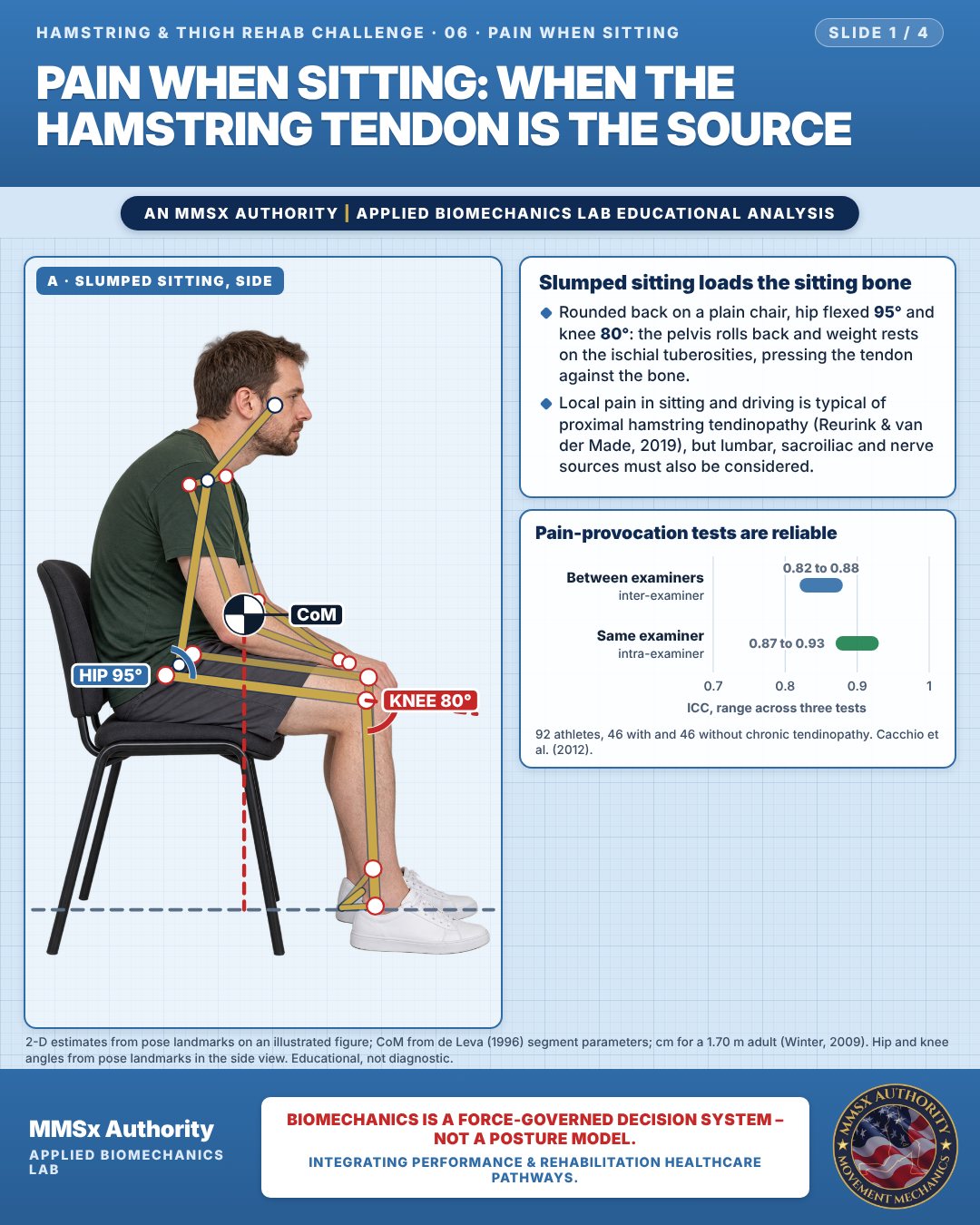
Slumped sitting loads the sitting bone
Rounded back on a plain chair, hip flexed 95° and knee 80°: the pelvis rolls back and weight rests on the ischial tuberosities, pressing the tendon against the bone.
Local pain in sitting and driving is typical of proximal hamstring tendinopathy (Reurink & van der Made, 2019), but lumbar, sacroiliac and nerve sources must also be considered.
Pain-provocation tests are reliable
Movement B: Driving position (side view)
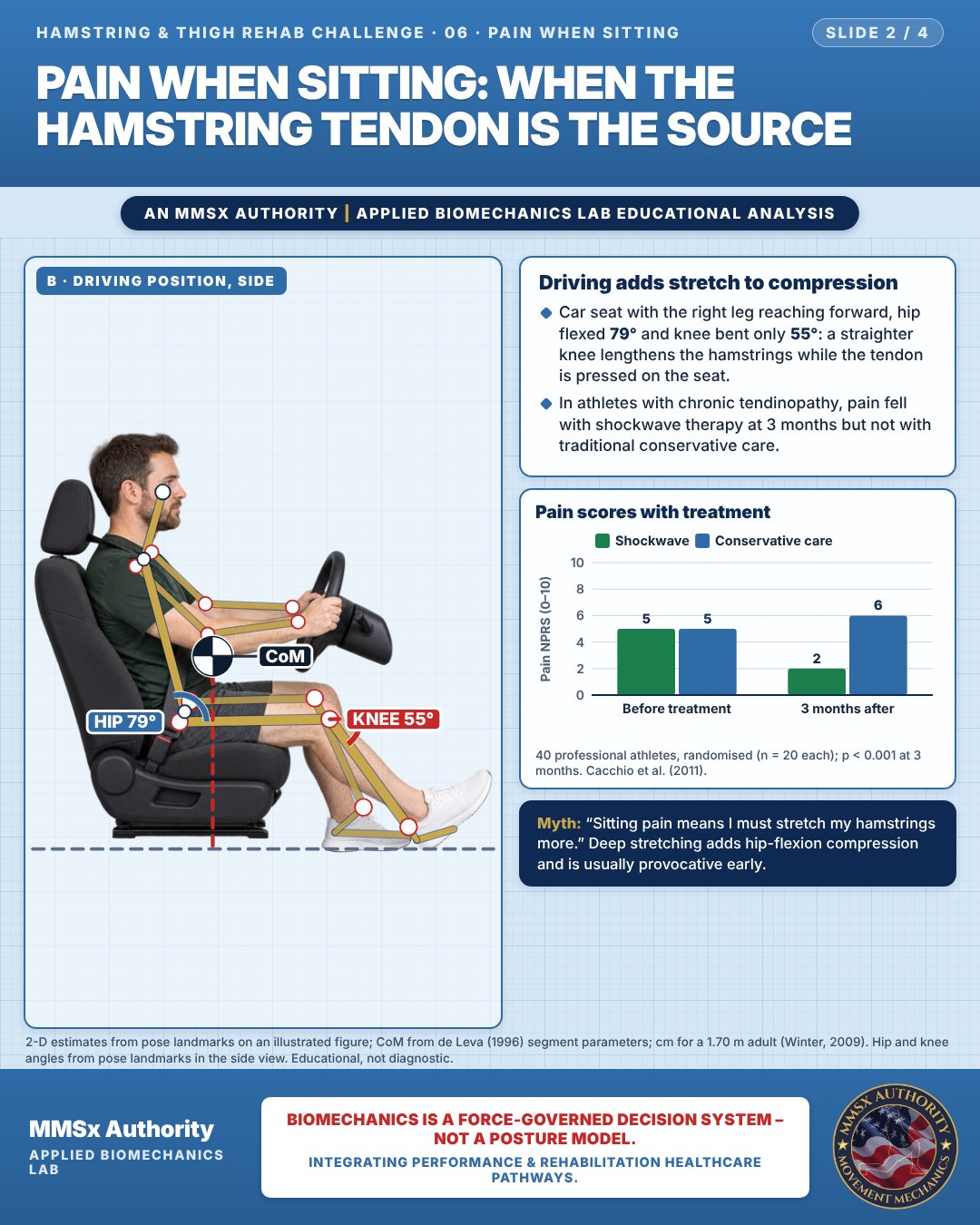
Driving adds stretch to compression
Car seat with the right leg reaching forward, hip flexed 79° and knee bent only 55°: a straighter knee lengthens the hamstrings while the tendon is pressed on the seat.
In athletes with chronic tendinopathy, pain fell with shockwave therapy at 3 months but not with traditional conservative care.
Pain scores with treatment
Movement C: Sitting on cushion (side view)
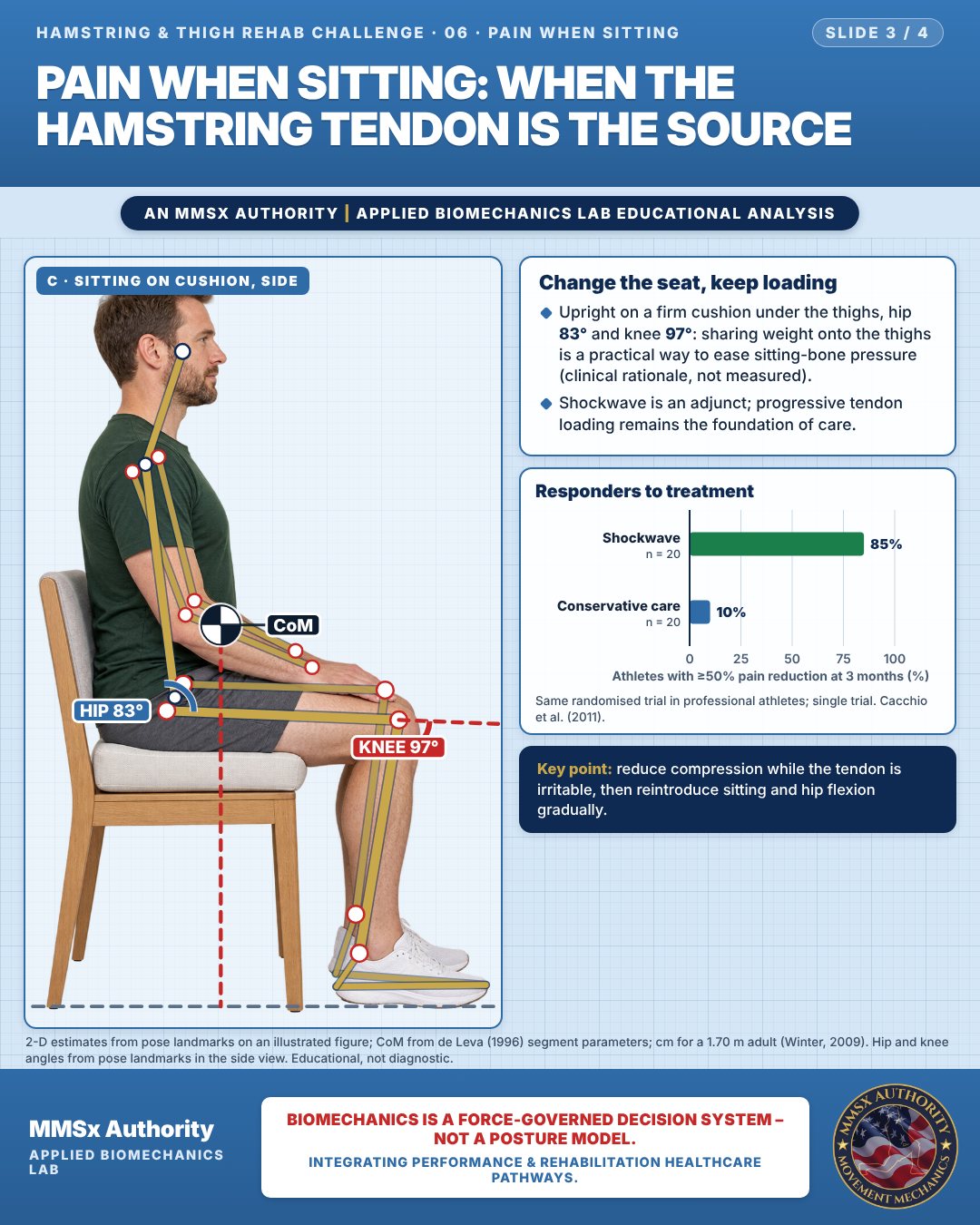
Change the seat, keep loading
Upright on a firm cushion under the thighs, hip 83° and knee 97°: sharing weight onto the thighs is a practical way to ease sitting-bone pressure (clinical rationale, not measured).
Shockwave is an adjunct; progressive tendon loading remains the foundation of care.
Responders to treatment
Decision pathway
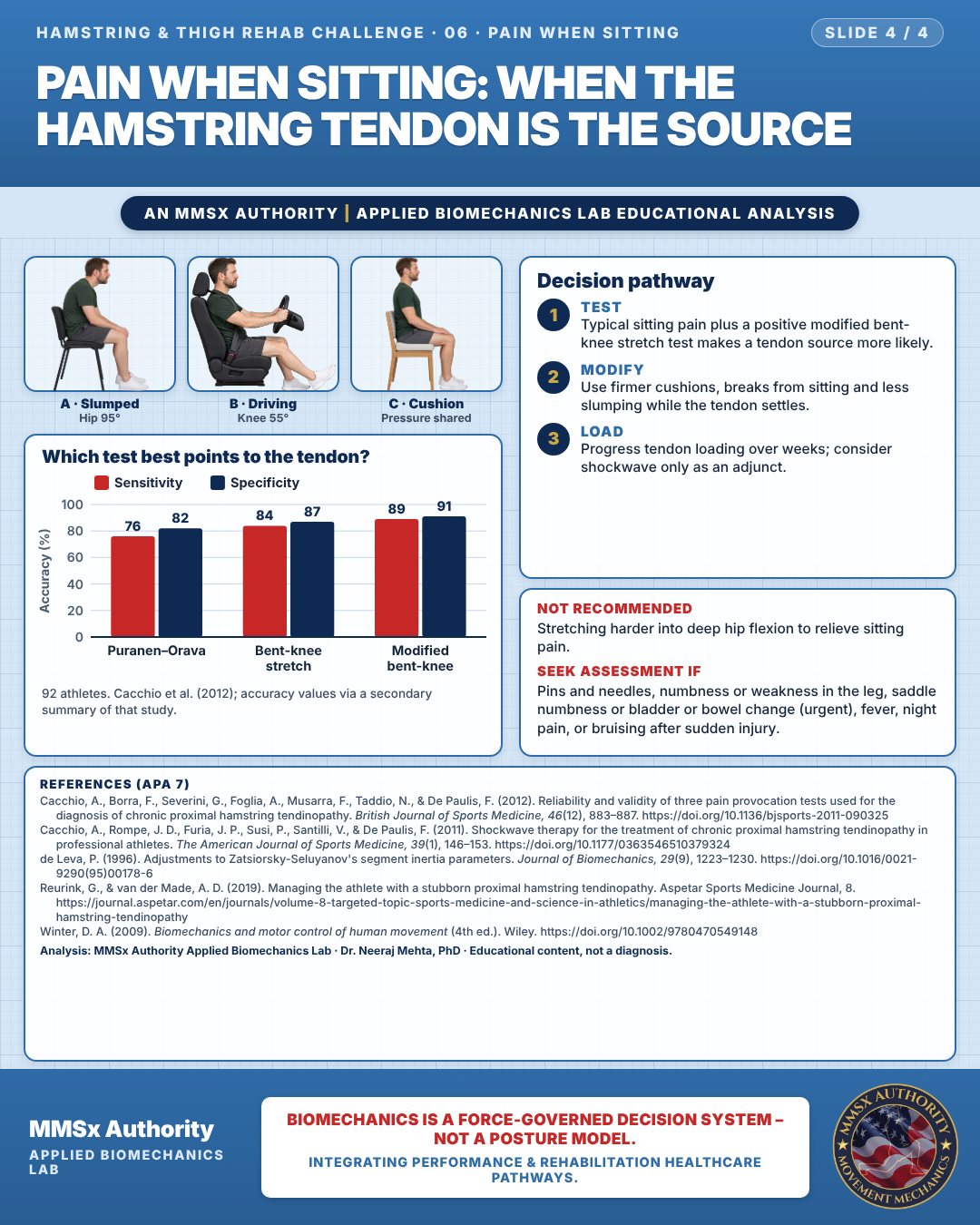
Which test best points to the tendon?
Test
Typical sitting pain plus a positive modified bent-knee stretch test makes a tendon source more likely.
Modify
Use firmer cushions, breaks from sitting and less slumping while the tendon settles.
Load
Progress tendon loading over weeks; consider shockwave only as an adjunct.
Cautions
Not recommended
Stretching harder into deep hip flexion to relieve sitting pain.
Seek assessment if
Pins and needles, numbness or weakness in the leg, saddle numbness or bladder or bowel change (urgent), fever, night pain, or bruising after sudden injury.
Methods note
2-D estimates from pose landmarks on an illustrated figure; CoM from de Leva (1996) segment parameters; cm for a 1.70 m adult (Winter, 2009). Hip and knee angles from pose landmarks in the side view. These are educational estimates, not a diagnosis.
References
- Cacchio, A., Borra, F., Severini, G., Foglia, A., Musarra, F., Taddio, N., & De Paulis, F. (2012). Reliability and validity of three pain provocation tests used for the diagnosis of chronic proximal hamstring tendinopathy. British Journal of Sports Medicine, 46(12), 883–887. https://doi.org/10.1136/bjsports-2011-090325
- Cacchio, A., Rompe, J. D., Furia, J. P., Susi, P., Santilli, V., & De Paulis, F. (2011). Shockwave therapy for the treatment of chronic proximal hamstring tendinopathy in professional athletes. The American Journal of Sports Medicine, 39(1), 146–153. https://doi.org/10.1177/0363546510379324
- de Leva, P. (1996). Adjustments to Zatsiorsky-Seluyanov's segment inertia parameters. Journal of Biomechanics, 29(9), 1223–1230. https://doi.org/10.1016/0021-9290(95)00178-6
- Reurink, G., & van der Made, A. D. (2019). Managing the athlete with a stubborn proximal hamstring tendinopathy. Aspetar Sports Medicine Journal, 8. https://journal.aspetar.com/en/journals/volume-8-targeted-topic-sports-medicine-and-science-in-athletics/managing-the-athlete-with-a-stubborn-proximal-hamstring-tendinopathy
- Winter, D. A. (2009). Biomechanics and motor control of human movement (4th ed.). Wiley. https://doi.org/10.1002/9780470549148
Cite this article
Mehta, N. (2026, October 26). Pain when sitting: when the hamstring tendon is the source. MMSx Authority Applied Biomechanics Lab. https://mmsxauthority.org/edu/analysis/hamstring-thigh/06-pain-when-sitting-when-the-hamstring-tendon-is-the-source/
Part of the collection
Mehta, N. (2026). Hamstring and Thigh Rehabilitation: 50 Evidence-Based Biomechanics Analyses [Collection]. MMSx Authority Applied Biomechanics Lab. Zenodo. https://doi.org/10.5281/zenodo.23735792
All Hamstring & Thigh Rehab Challenge articles · Rehabilitation Library