Hamstring & Thigh Rehab Challenge · 05
Proximal hamstring tendinopathy: pain at the sitting bone
Proximal hamstring tendinopathy (PHT) is a painful, load-related disorder of the common hamstring origin at the ischial tuberosity.
Key points
- Load. Begin with low-compression isometrics and progress tendon load over weeks; short cuts are counterproductive.
- Modify. Reduce long sitting on hard surfaces and deep hip flexion while the tendon is irritable.
- Escalate. Consider shockwave as an adjunct, and surgery only after conservative care fails.
What it is
Proximal hamstring tendinopathy (PHT) is a painful, load-related disorder of the common hamstring origin at the ischial tuberosity. It typically manifests as deep buttock pain at the hamstring origin, is often long-standing, and limits sporting and daily function. Pain is commonly provoked by sitting and by hip-flexed positions that compress the tendon against the bone.
How we analysed the movement
Three movements relevant to this topic were analysed from illustrated reference figures. Joint centres were located with two-dimensional pose estimation; hip and knee angles, pelvis level, the whole-body centre of mass and, where relevant, the hip lever (the horizontal distance from the hip joint to the upper-body centre of mass) and the resulting static hip moment were then calculated from standard segment parameters. The figures are educational estimates that show how position changes mechanical demand; they are not measurements of a patient. Every research value quoted below comes from the published source cited beside it.
Movement A: Sitting upright (side view)
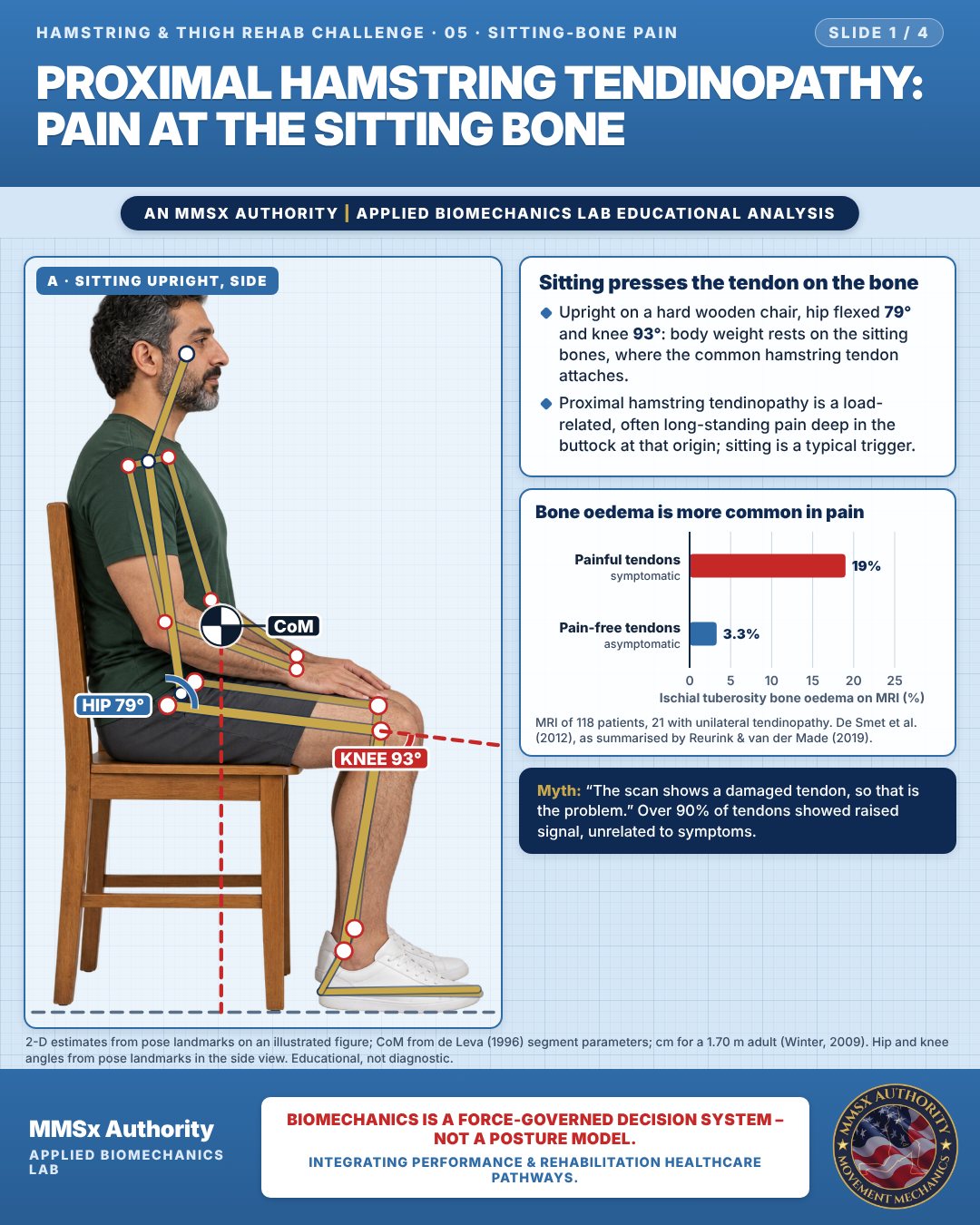
Sitting presses the tendon on the bone
Upright on a hard wooden chair, hip flexed 79° and knee 93°: body weight rests on the sitting bones, where the common hamstring tendon attaches.
Proximal hamstring tendinopathy is a load-related, often long-standing pain deep in the buttock at that origin; sitting is a typical trigger.
Bone oedema is more common in pain
Movement B: Seated forward reach (side view)
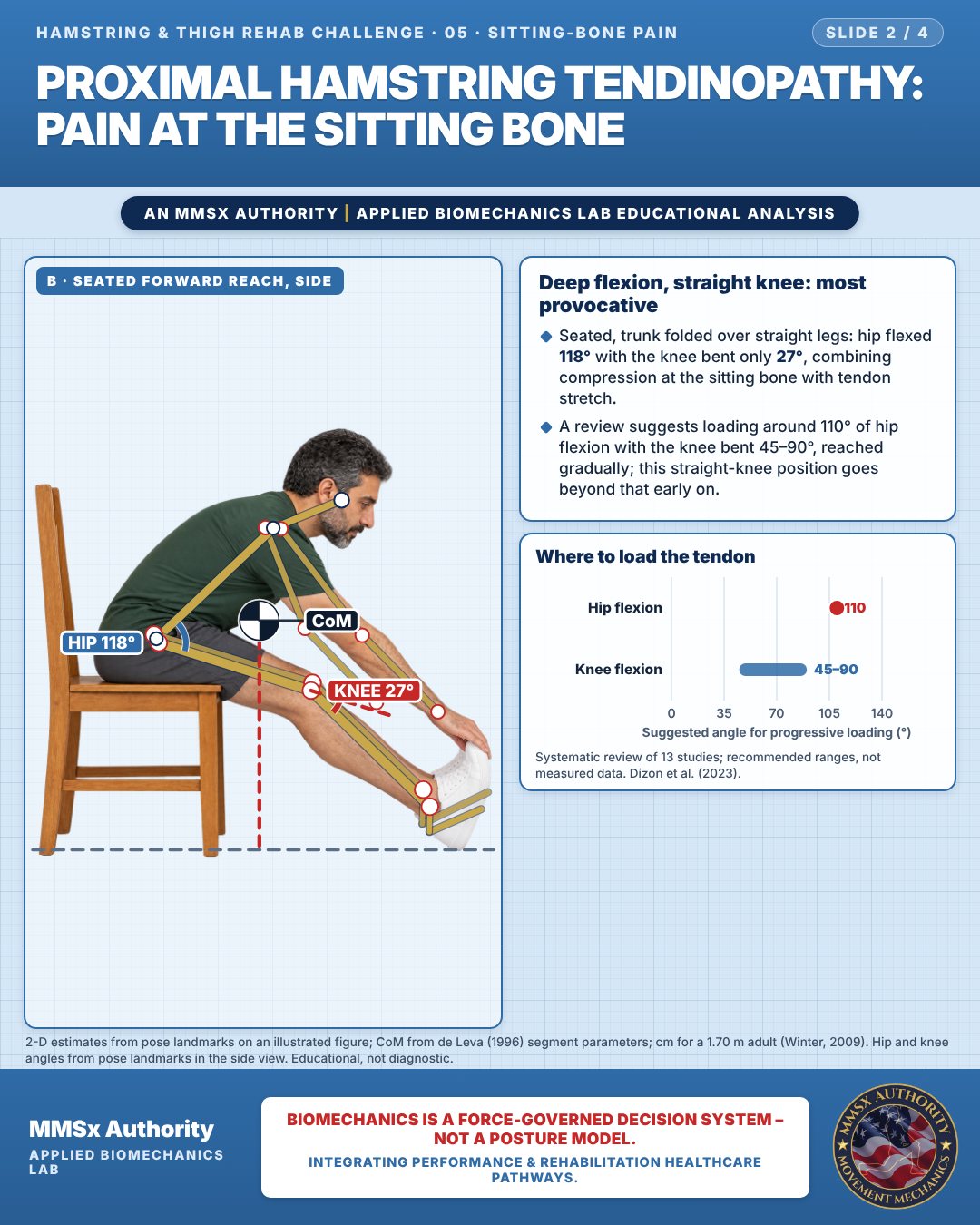
Deep flexion, straight knee: most provocative
Seated, trunk folded over straight legs: hip flexed 118° with the knee bent only 27°, combining compression at the sitting bone with tendon stretch.
A review suggests loading around 110° of hip flexion with the knee bent 45–90°, reached gradually; this straight-knee position goes beyond that early on.
Where to load the tendon
Movement C: Long-lever bridge (side view)
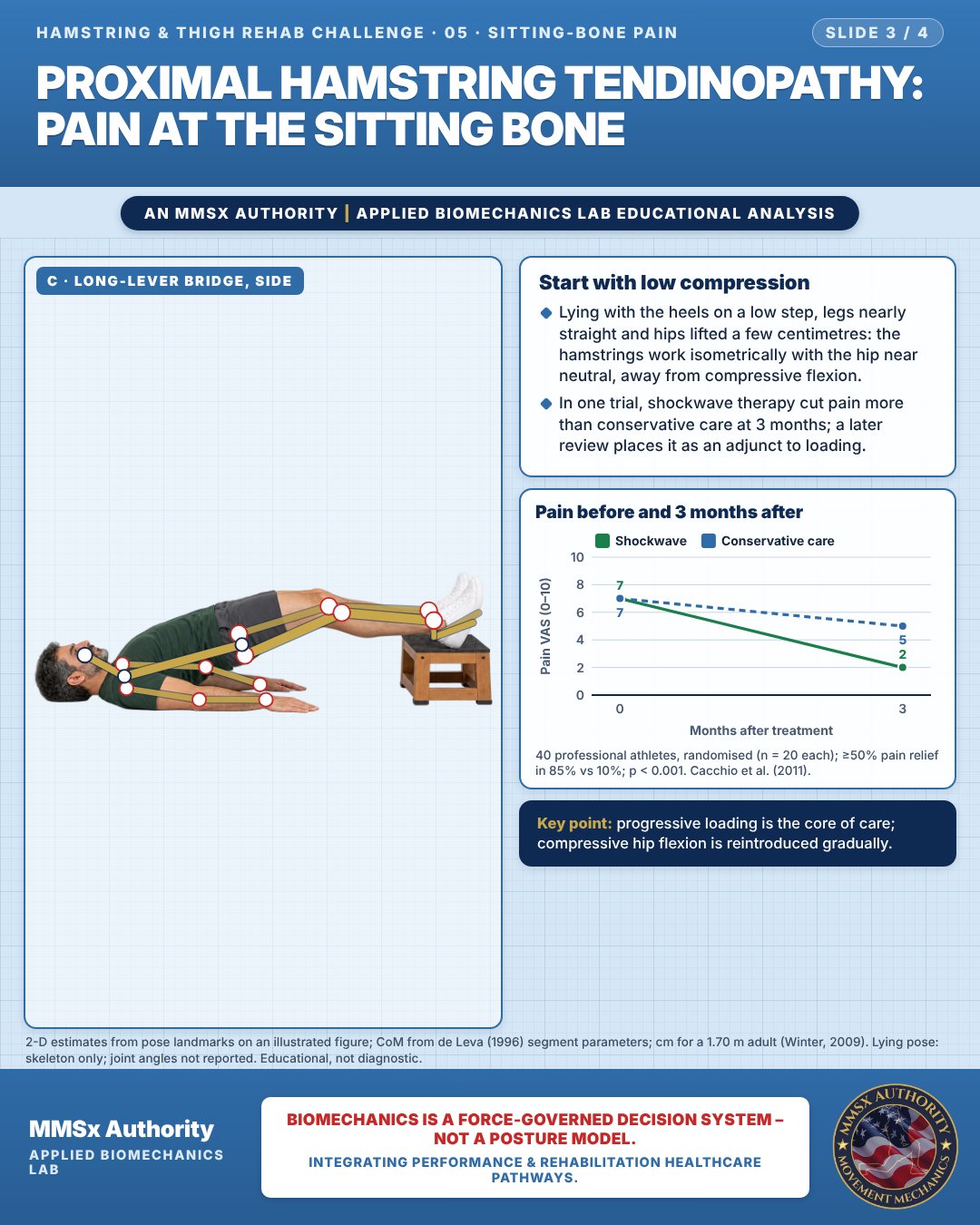
Start with low compression
Lying with the heels on a low step, legs nearly straight and hips lifted a few centimetres: the hamstrings work isometrically with the hip near neutral, away from compressive flexion.
In one trial, shockwave therapy cut pain more than conservative care at 3 months; a later review places it as an adjunct to loading.
Pain before and 3 months after
Decision pathway
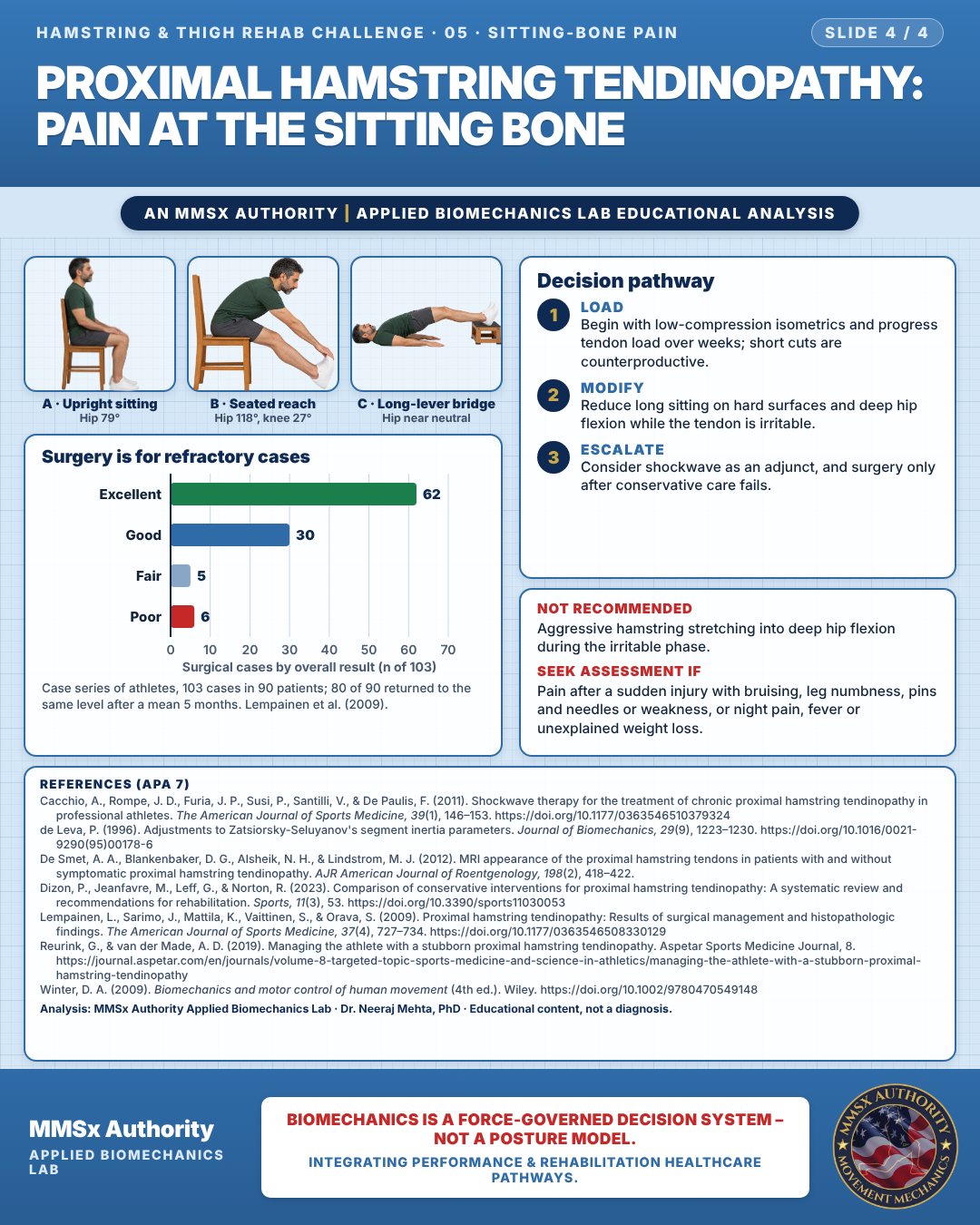
Surgery is for refractory cases
Load
Begin with low-compression isometrics and progress tendon load over weeks; short cuts are counterproductive.
Modify
Reduce long sitting on hard surfaces and deep hip flexion while the tendon is irritable.
Escalate
Consider shockwave as an adjunct, and surgery only after conservative care fails.
What the evidence supports
- Shockwave therapy may be considered as an adjunct to exercise (Cacchio et al., 2011; Dizon et al., 2023).
- Surgery is considered only for refractory cases (Lempainen et al., 2009).
Myth and evidence
Myth“The MRI shows a damaged tendon, so that must be the problem.”
EvidenceMore than 90% of proximal hamstring tendons showed increased signal on MRI, and this was not associated with symptoms (De Smet et al., 2012). Diagnosis rests on clinical features (local sitting-bone pain with loading and sitting) supported, not replaced, by imaging.
Cautions
Not recommended
Aggressive hamstring stretching into deep hip flexion during the irritable phase.
Seek assessment if
Pain after a sudden injury with bruising, leg numbness, pins and needles or weakness, or night pain, fever or unexplained weight loss.
Methods note
2-D estimates from pose landmarks on an illustrated figure; CoM from de Leva (1996) segment parameters; cm for a 1.70 m adult (Winter, 2009). Hip and knee angles from pose landmarks in the side view. Lying pose: skeleton only; joint angles not reported. These are educational estimates, not a diagnosis.
References
- Cacchio, A., Rompe, J. D., Furia, J. P., Susi, P., Santilli, V., & De Paulis, F. (2011). Shockwave therapy for the treatment of chronic proximal hamstring tendinopathy in professional athletes. The American Journal of Sports Medicine, 39(1), 146–153. https://doi.org/10.1177/0363546510379324
- de Leva, P. (1996). Adjustments to Zatsiorsky-Seluyanov's segment inertia parameters. Journal of Biomechanics, 29(9), 1223–1230. https://doi.org/10.1016/0021-9290(95)00178-6
- De Smet, A. A., Blankenbaker, D. G., Alsheik, N. H., & Lindstrom, M. J. (2012). MRI appearance of the proximal hamstring tendons in patients with and without symptomatic proximal hamstring tendinopathy. AJR American Journal of Roentgenology, 198(2), 418–422.
- Dizon, P., Jeanfavre, M., Leff, G., & Norton, R. (2023). Comparison of conservative interventions for proximal hamstring tendinopathy: A systematic review and recommendations for rehabilitation. Sports, 11(3), 53. https://doi.org/10.3390/sports11030053
- Lempainen, L., Sarimo, J., Mattila, K., Vaittinen, S., & Orava, S. (2009). Proximal hamstring tendinopathy: Results of surgical management and histopathologic findings. The American Journal of Sports Medicine, 37(4), 727–734. https://doi.org/10.1177/0363546508330129
- Reurink, G., & van der Made, A. D. (2019). Managing the athlete with a stubborn proximal hamstring tendinopathy. Aspetar Sports Medicine Journal, 8. https://journal.aspetar.com/en/journals/volume-8-targeted-topic-sports-medicine-and-science-in-athletics/managing-the-athlete-with-a-stubborn-proximal-hamstring-tendinopathy
- Winter, D. A. (2009). Biomechanics and motor control of human movement (4th ed.). Wiley. https://doi.org/10.1002/9780470549148
Cite this article
Mehta, N. (2026, October 26). Proximal hamstring tendinopathy: pain at the sitting bone. MMSx Authority Applied Biomechanics Lab. https://mmsxauthority.org/edu/analysis/hamstring-thigh/05-proximal-hamstring-tendinopathy-pain-at-the-sitting-bone/
Part of the collection
Mehta, N. (2026). Hamstring and Thigh Rehabilitation: 50 Evidence-Based Biomechanics Analyses [Collection]. MMSx Authority Applied Biomechanics Lab. Zenodo. https://doi.org/10.5281/zenodo.23735792
All Hamstring & Thigh Rehab Challenge articles · Rehabilitation Library