Hamstring & Thigh Rehab Challenge · 04
Hamstring tear: when a tendon injury needs a surgical opinion
A proximal hamstring tendon avulsion is a partial or complete detachment of the hamstring tendons from their origin on the ischial tuberosity (sitting bone).
Key points
- Recognise. Forced stretch, rapid severe pain and bruising high in the thigh suggest a tendon avulsion.
- Refer early. An expert review advocates surgery for two-tendon tears retracted >2 cm and all three-tendon tears, ideally within 4 weeks.
- Decide together. Smaller tears with little retraction are often managed without surgery, guided by goals.
What it is
A proximal hamstring tendon avulsion is a partial or complete detachment of the hamstring tendons from their origin on the ischial tuberosity (sitting bone). It usually follows a forceful hip-flexion/knee-extension stretch (for example a slip or water-skiing fall) and typically presents with rapid severe pain and marked bruising (Atwal et al., 2019). It differs from a muscle strain because a retracted tendon may not heal back to bone without surgery.
How we analysed the movement
Three movements relevant to this topic were analysed from illustrated reference figures. Joint centres were located with two-dimensional pose estimation; hip and knee angles, pelvis level, the whole-body centre of mass and, where relevant, the hip lever (the horizontal distance from the hip joint to the upper-body centre of mass) and the resulting static hip moment were then calculated from standard segment parameters. The figures are educational estimates that show how position changes mechanical demand; they are not measurements of a patient. Every research value quoted below comes from the published source cited beside it.
Movement A: Hip hinge reach (side view)
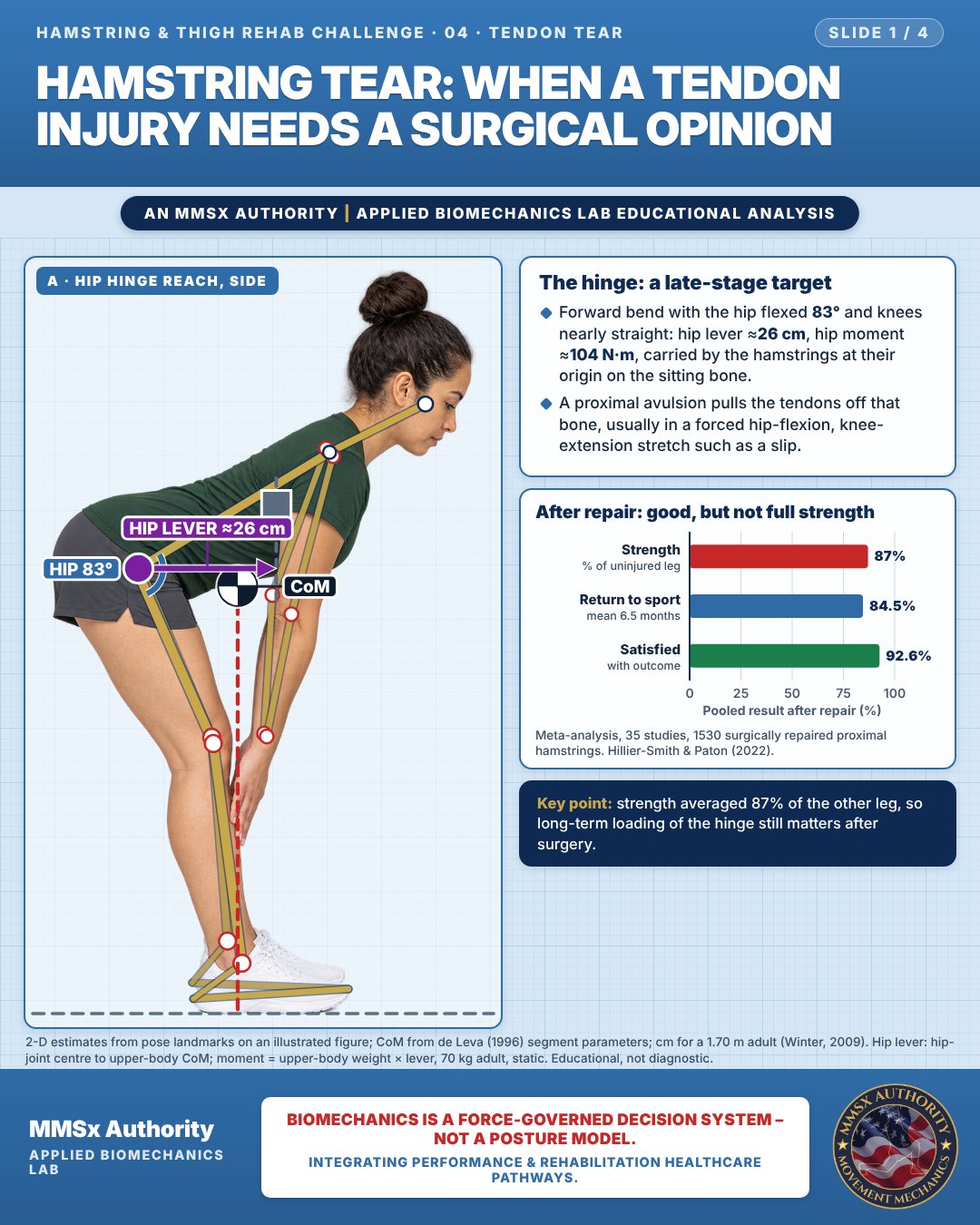
The hinge: a late-stage target
Forward bend with the hip flexed 83° and knees nearly straight: hip lever ≈26 cm, hip moment ≈104 N·m, carried by the hamstrings at their origin on the sitting bone.
A proximal avulsion pulls the tendons off that bone, usually in a forced hip-flexion, knee-extension stretch such as a slip.
After repair: good, but not full strength
Movement B: Standing (rear view)
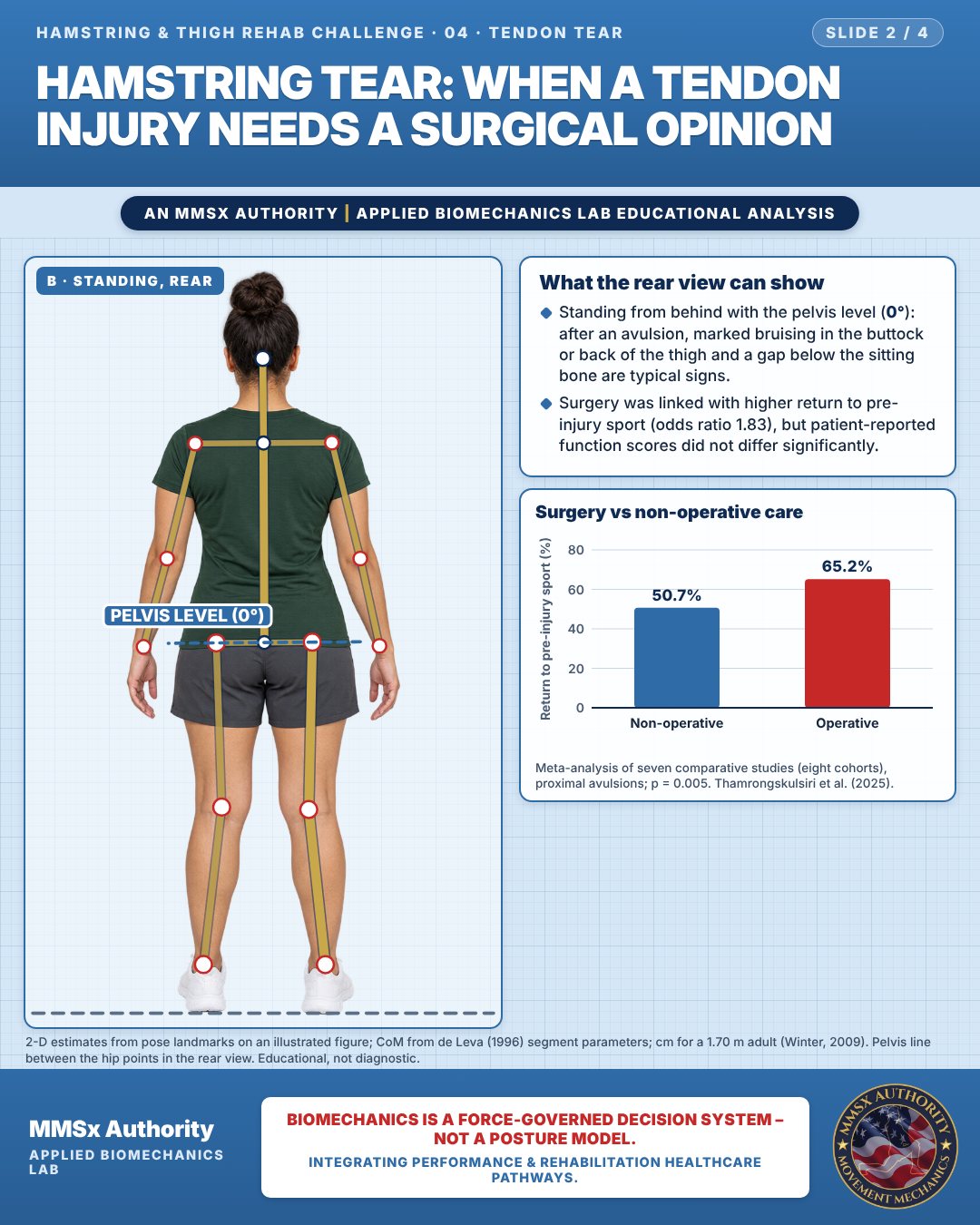
What the rear view can show
Standing from behind with the pelvis level (0°): after an avulsion, marked bruising in the buttock or back of the thigh and a gap below the sitting bone are typical signs.
Surgery was linked with higher return to pre-injury sport (odds ratio 1.83), but patient-reported function scores did not differ significantly.
Surgery vs non-operative care
Movement C: Crutch walking (side view)
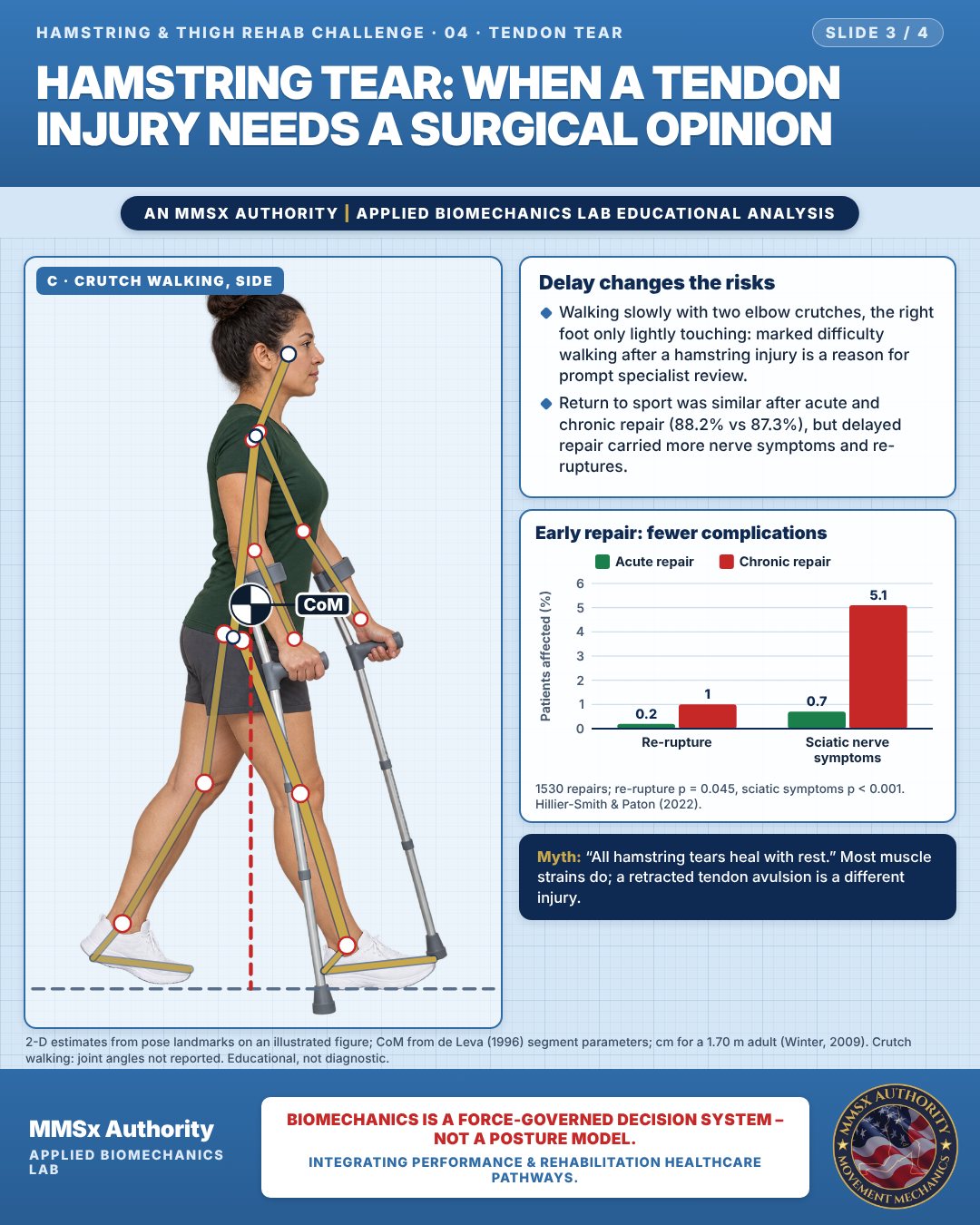
Delay changes the risks
Walking slowly with two elbow crutches, the right foot only lightly touching: marked difficulty walking after a hamstring injury is a reason for prompt specialist review.
Return to sport was similar after acute and chronic repair (88.2% vs 87.3%), but delayed repair carried more nerve symptoms and re-ruptures.
Early repair: fewer complications
Decision pathway
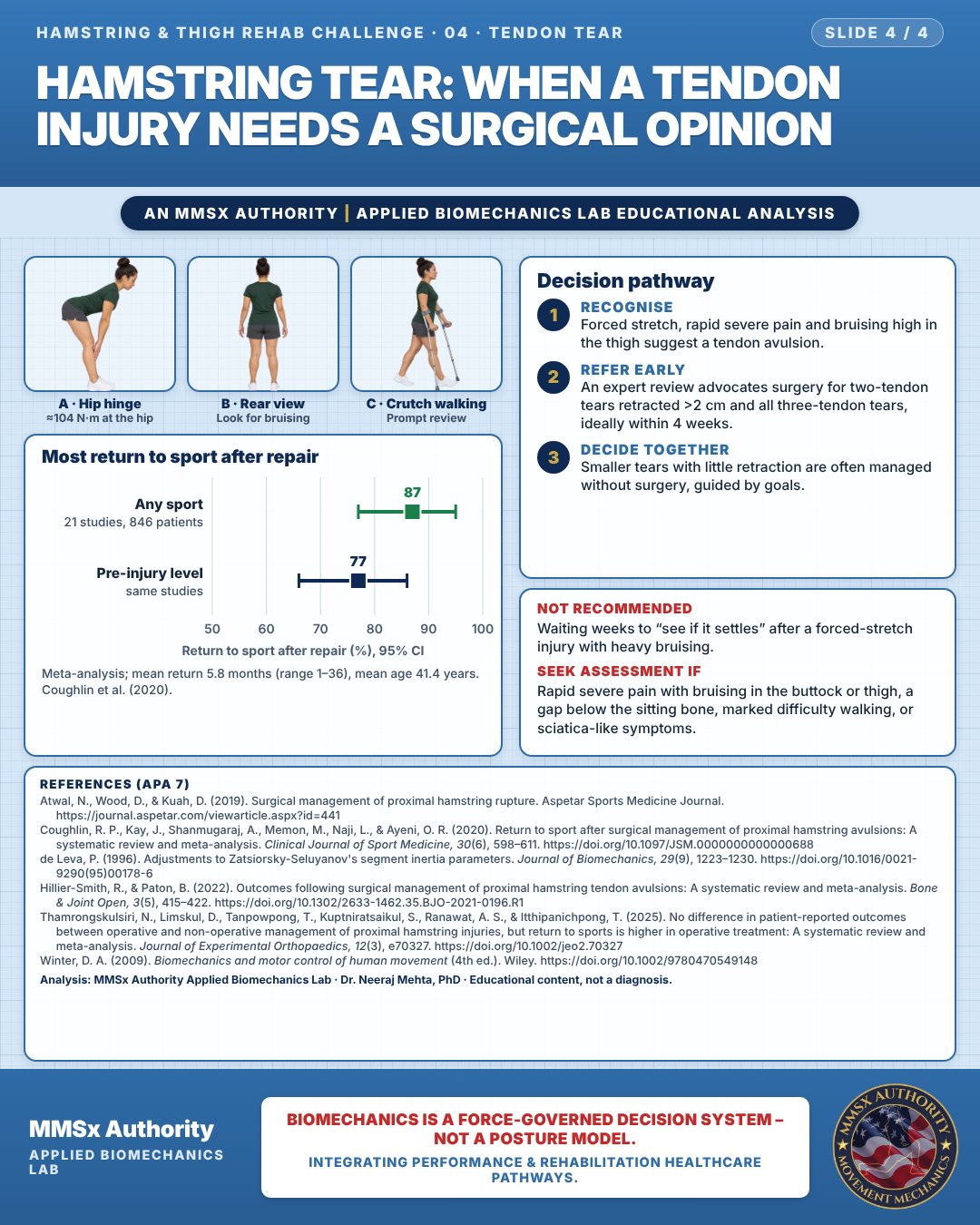
Most return to sport after repair
Recognise
Forced stretch, rapid severe pain and bruising high in the thigh suggest a tendon avulsion.
Refer early
An expert review advocates surgery for two-tendon tears retracted >2 cm and all three-tendon tears, ideally within 4 weeks.
Decide together
Smaller tears with little retraction are often managed without surgery, guided by goals.
What the evidence supports
- A sports-medicine review states that 1- or 2-tendon ruptures with ≤2 cm retraction have been proposed for non-operative management, whereas surgery is advocated for 2-tendon avulsions with >2 cm retraction and all complete 3-tendon tears. Acute surgical repair within 4 weeks is recommended for complete tears in all athletes (Atwal et al., 2019; expert review, not a guideline).
Myth and evidence
Myth“All hamstring tears heal with rest.”
EvidenceMost muscle strains do, but a retracted proximal tendon avulsion is a different injury. The window for the best surgical result is early: one review reports that the risk of a moderate or poor result is 28-fold when surgery is delayed beyond 6 months (Atwal et al., 2019; secondary summary within a review). Equally, not every tendon injury needs surgery: smaller 1–2-tendon injuries with little retraction are often managed non-operatively.
Cautions
Not recommended
Waiting weeks to “see if it settles” after a forced-stretch injury with heavy bruising.
Seek assessment if
Rapid severe pain with bruising in the buttock or thigh, a gap below the sitting bone, marked difficulty walking, or sciatica-like symptoms.
Methods note
2-D estimates from pose landmarks on an illustrated figure; CoM from de Leva (1996) segment parameters; cm for a 1.70 m adult (Winter, 2009). Hip lever: hip-joint centre to upper-body CoM; moment = upper-body weight × lever, 70 kg adult, static. Pelvis line between the hip points in the rear view. Crutch walking: joint angles not reported. These are educational estimates, not a diagnosis.
References
- Atwal, N., Wood, D., & Kuah, D. (2019). Surgical management of proximal hamstring rupture. Aspetar Sports Medicine Journal. https://journal.aspetar.com/viewarticle.aspx?id=441
- Coughlin, R. P., Kay, J., Shanmugaraj, A., Memon, M., Naji, L., & Ayeni, O. R. (2020). Return to sport after surgical management of proximal hamstring avulsions: A systematic review and meta-analysis. Clinical Journal of Sport Medicine, 30(6), 598–611. https://doi.org/10.1097/JSM.0000000000000688
- de Leva, P. (1996). Adjustments to Zatsiorsky-Seluyanov's segment inertia parameters. Journal of Biomechanics, 29(9), 1223–1230. https://doi.org/10.1016/0021-9290(95)00178-6
- Hillier-Smith, R., & Paton, B. (2022). Outcomes following surgical management of proximal hamstring tendon avulsions: A systematic review and meta-analysis. Bone & Joint Open, 3(5), 415–422. https://doi.org/10.1302/2633-1462.35.BJO-2021-0196.R1
- Thamrongskulsiri, N., Limskul, D., Tanpowpong, T., Kuptniratsaikul, S., Ranawat, A. S., & Itthipanichpong, T. (2025). No difference in patient-reported outcomes between operative and non-operative management of proximal hamstring injuries, but return to sports is higher in operative treatment: A systematic review and meta-analysis. Journal of Experimental Orthopaedics, 12(3), e70327. https://doi.org/10.1002/jeo2.70327
- Winter, D. A. (2009). Biomechanics and motor control of human movement (4th ed.). Wiley. https://doi.org/10.1002/9780470549148
Cite this article
Mehta, N. (2026, October 26). Hamstring tear: when a tendon injury needs a surgical opinion. MMSx Authority Applied Biomechanics Lab. https://mmsxauthority.org/edu/analysis/hamstring-thigh/04-hamstring-tear-when-a-tendon-injury-needs-a-surgical-opinion/
Part of the collection
Mehta, N. (2026). Hamstring and Thigh Rehabilitation: 50 Evidence-Based Biomechanics Analyses [Collection]. MMSx Authority Applied Biomechanics Lab. Zenodo. https://doi.org/10.5281/zenodo.23735792
All Hamstring & Thigh Rehab Challenge articles · Rehabilitation Library