Hamstring & Thigh Rehab Challenge · 03
Pulled hamstring: grade 1, 2 or 3, and what each means for recovery
"Grade" describes how much structural damage a hamstring strain shows on clinical or MRI assessment.
Key points
- Grade and site. Use the grade and whether the tendon is involved to estimate the likely range, not a fixed date.
- Load early. Start with pain-guided isometrics, then progress to lengthened-position loading.
- Review. Imaging helps most when tendon involvement or a high-grade tear is suspected.
What it is
"Grade" describes how much structural damage a hamstring strain shows on clinical or MRI assessment. Traditional radiological grades run from 0 (no visible injury) and 1 (oedema without fibre disruption), through 2 (partial tear), to 3 (complete muscle or tendon rupture) (Ekstrand et al., 2012). The British Athletics Muscle Injury Classification grades injuries from 0 to 4 and adds a letter for the anatomical site, with "c" denoting an intratendinous injury.
How we analysed the movement
Three movements relevant to this topic were analysed from illustrated reference figures. Joint centres were located with two-dimensional pose estimation; hip and knee angles, pelvis level, the whole-body centre of mass and, where relevant, the hip lever (the horizontal distance from the hip joint to the upper-body centre of mass) and the resulting static hip moment were then calculated from standard segment parameters. The figures are educational estimates that show how position changes mechanical demand; they are not measurements of a patient. Every research value quoted below comes from the published source cited beside it.
Movement A: Hand on thigh (side view)
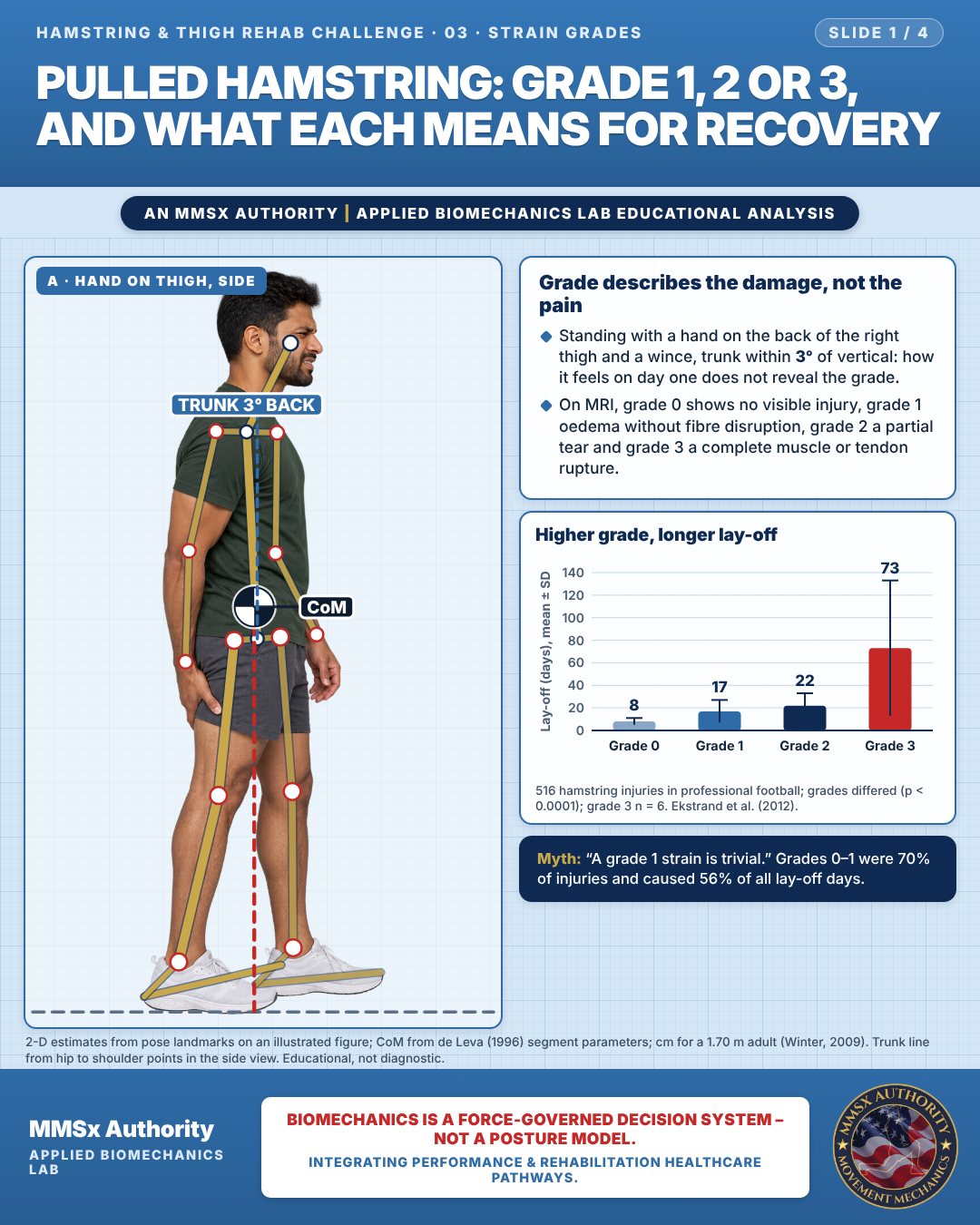
Grade describes the damage, not the pain
Standing with a hand on the back of the right thigh and a wince, trunk within 3° of vertical: how it feels on day one does not reveal the grade.
On MRI, grade 0 shows no visible injury, grade 1 oedema without fibre disruption, grade 2 a partial tear and grade 3 a complete muscle or tendon rupture.
Higher grade, longer lay-off
Movement B: Walking stride (side view)
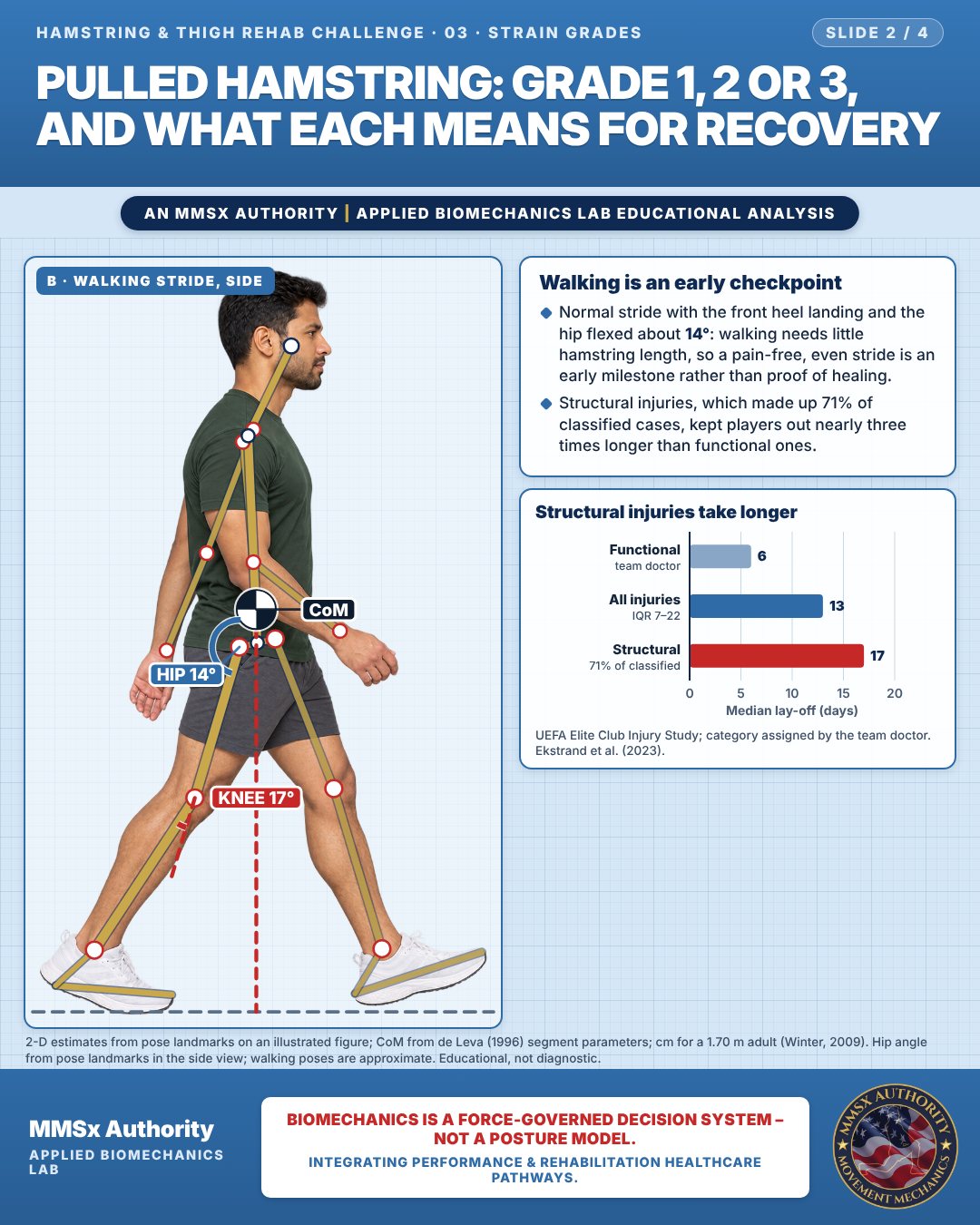
Walking is an early checkpoint
Normal stride with the front heel landing and the hip flexed about 14°: walking needs little hamstring length, so a pain-free, even stride is an early milestone rather than proof of healing.
Structural injuries, which made up 71% of classified cases, kept players out nearly three times longer than functional ones.
Structural injuries take longer
Movement C: Heel-dig bridge (side view)
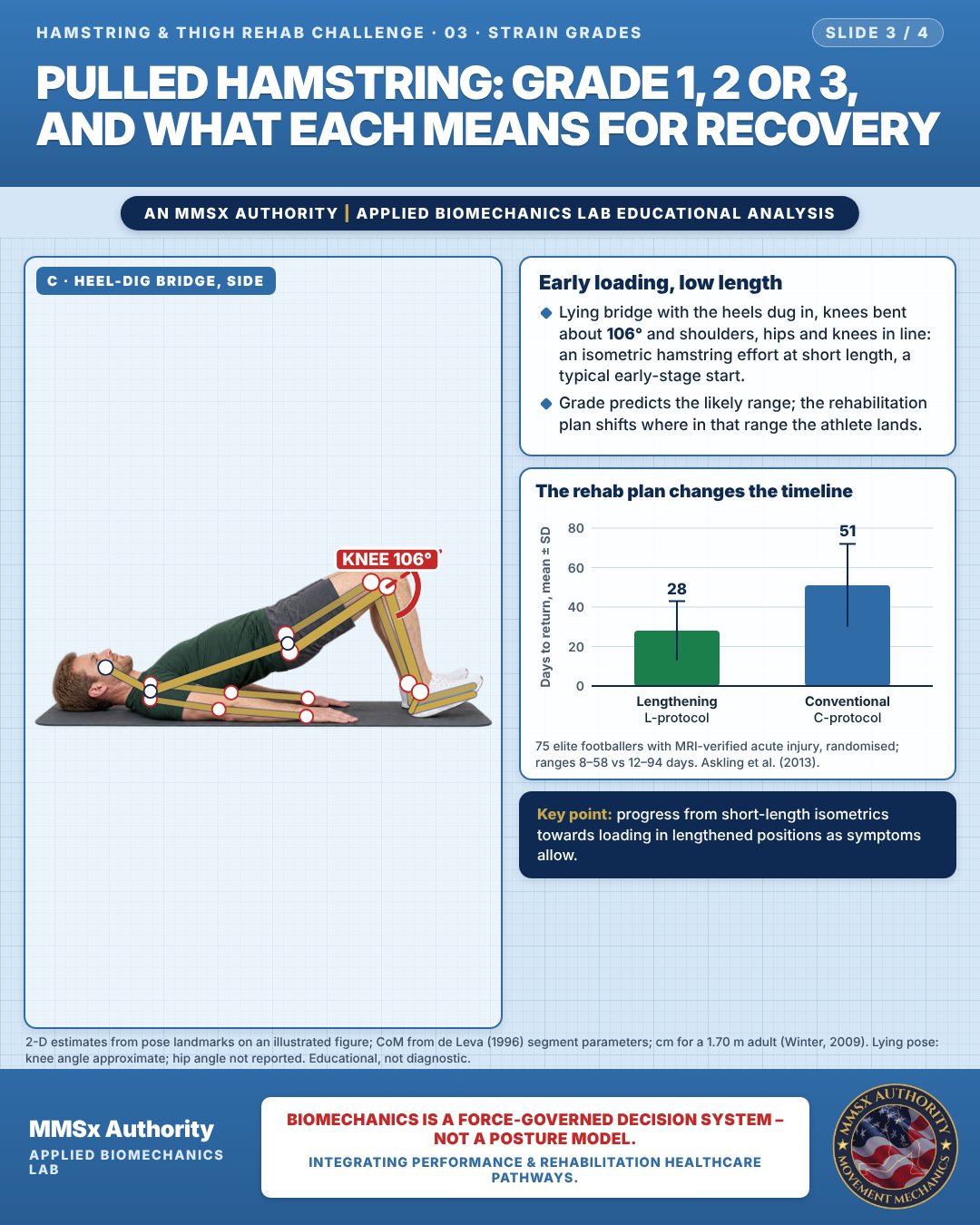
Early loading, low length
Lying bridge with the heels dug in, knees bent about 106° and shoulders, hips and knees in line: an isometric hamstring effort at short length, a typical early-stage start.
Grade predicts the likely range; the rehabilitation plan shifts where in that range the athlete lands.
The rehab plan changes the timeline
Decision pathway
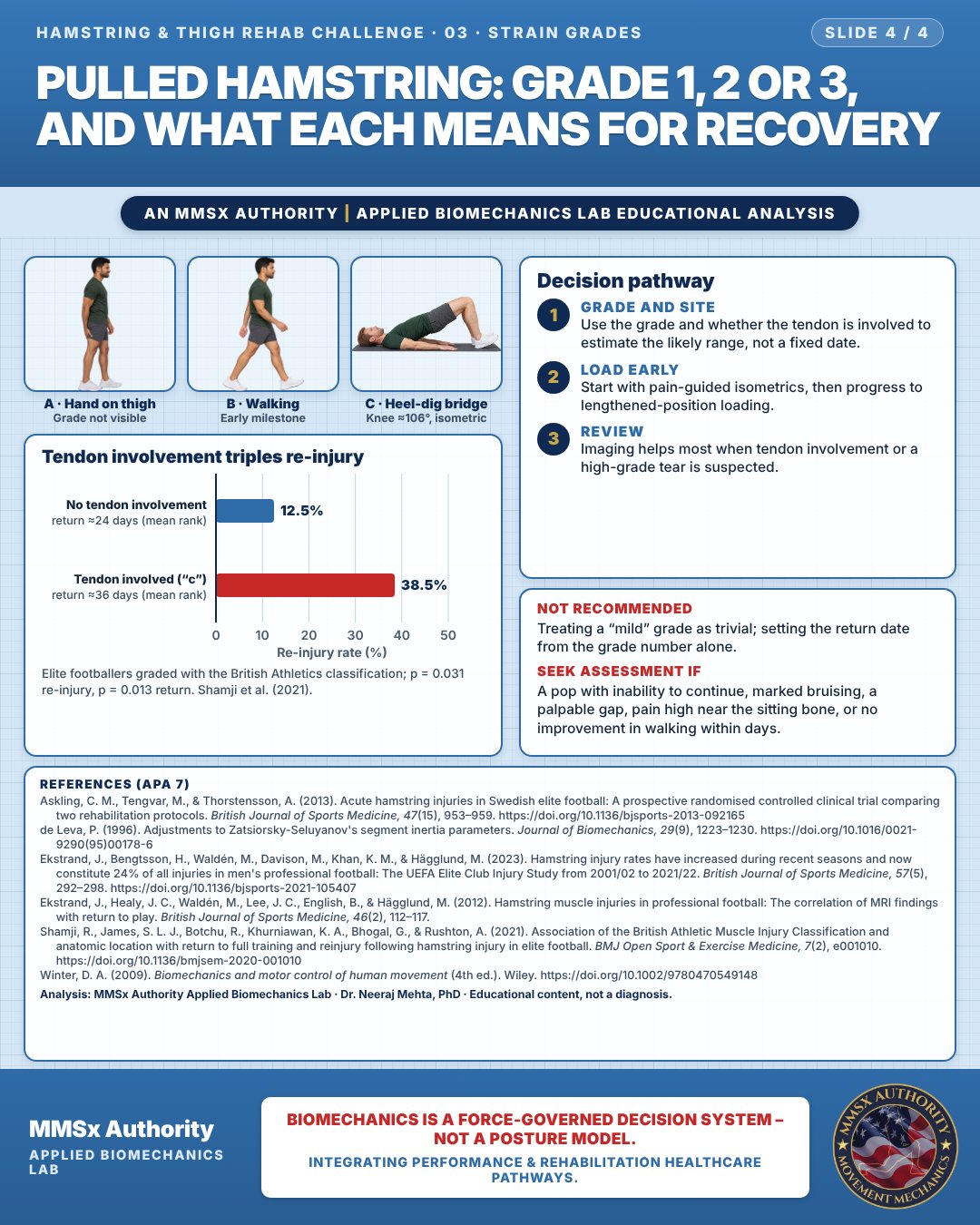
Tendon involvement triples re-injury
Grade and site
Use the grade and whether the tendon is involved to estimate the likely range, not a fixed date.
Load early
Start with pain-guided isometrics, then progress to lengthened-position loading.
Review
Imaging helps most when tendon involvement or a high-grade tear is suspected.
What the evidence supports
- Progressive rehabilitation emphasising lengthened loading is supported by randomised evidence (Askling et al., 2013).
Myth and evidence
Myth“A grade 1 strain is trivial.”
EvidenceGrade 0–1 injuries are the majority (70%) and together caused 56% of total lay-off days in professional football (Ekstrand et al., 2012). Conversely, a bigger number grade is not the only issue: intratendinous involvement predicts longer return and more re-injury (Shamji et al., 2021).
Cautions
Not recommended
Treating a “mild” grade as trivial; setting the return date from the grade number alone.
Seek assessment if
A pop with inability to continue, marked bruising, a palpable gap, pain high near the sitting bone, or no improvement in walking within days.
Methods note
2-D estimates from pose landmarks on an illustrated figure; CoM from de Leva (1996) segment parameters; cm for a 1.70 m adult (Winter, 2009). Trunk line from hip to shoulder points in the side view. Hip angle from pose landmarks in the side view; walking poses are approximate. Lying pose: knee angle approximate; hip angle not reported. These are educational estimates, not a diagnosis.
References
- Askling, C. M., Tengvar, M., & Thorstensson, A. (2013). Acute hamstring injuries in Swedish elite football: A prospective randomised controlled clinical trial comparing two rehabilitation protocols. British Journal of Sports Medicine, 47(15), 953–959. https://doi.org/10.1136/bjsports-2013-092165
- de Leva, P. (1996). Adjustments to Zatsiorsky-Seluyanov's segment inertia parameters. Journal of Biomechanics, 29(9), 1223–1230. https://doi.org/10.1016/0021-9290(95)00178-6
- Ekstrand, J., Bengtsson, H., Waldén, M., Davison, M., Khan, K. M., & Hägglund, M. (2023). Hamstring injury rates have increased during recent seasons and now constitute 24% of all injuries in men's professional football: The UEFA Elite Club Injury Study from 2001/02 to 2021/22. British Journal of Sports Medicine, 57(5), 292–298. https://doi.org/10.1136/bjsports-2021-105407
- Ekstrand, J., Healy, J. C., Waldén, M., Lee, J. C., English, B., & Hägglund, M. (2012). Hamstring muscle injuries in professional football: The correlation of MRI findings with return to play. British Journal of Sports Medicine, 46(2), 112–117.
- Shamji, R., James, S. L. J., Botchu, R., Khurniawan, K. A., Bhogal, G., & Rushton, A. (2021). Association of the British Athletic Muscle Injury Classification and anatomic location with return to full training and reinjury following hamstring injury in elite football. BMJ Open Sport & Exercise Medicine, 7(2), e001010. https://doi.org/10.1136/bmjsem-2020-001010
- Winter, D. A. (2009). Biomechanics and motor control of human movement (4th ed.). Wiley. https://doi.org/10.1002/9780470549148
Cite this article
Mehta, N. (2026, October 26). Pulled hamstring: grade 1, 2 or 3, and what each means for recovery. MMSx Authority Applied Biomechanics Lab. https://mmsxauthority.org/edu/analysis/hamstring-thigh/03-pulled-hamstring-grade-1-2-or-3-and-what-each-means-for-recovery/
Part of the collection
Mehta, N. (2026). Hamstring and Thigh Rehabilitation: 50 Evidence-Based Biomechanics Analyses [Collection]. MMSx Authority Applied Biomechanics Lab. Zenodo. https://doi.org/10.5281/zenodo.23735792
All Hamstring & Thigh Rehab Challenge articles · Rehabilitation Library