Hamstring & Thigh Rehab Challenge · 02
Hamstring pain when sprinting: what happens in the late swing phase
Late swing is the final part of the swing phase of sprinting, as the thigh decelerates and the knee extends just before foot strike.
Key points
- Recognise. Sudden posterior-thigh pain late in the stride, as the leg reaches forward, fits a sprinting-type strain.
- Load long. Rehab and prevention should include eccentric, high-load work at long hamstring lengths.
- Re-expose. Rebuild sprint speed step by step, because late-swing demand rises with speed.
What it is
Late swing is the final part of the swing phase of sprinting, as the thigh decelerates and the knee extends just before foot strike. The hamstrings lengthen while active (eccentric action) to brake the shank. Posterior-thigh pain that starts suddenly at this point in a sprint is the typical sprinting-type hamstring strain (Chumanov et al., 2011; Askling et al., 2013).
How we analysed the movement
Three movements relevant to this topic were analysed from illustrated reference figures. Joint centres were located with two-dimensional pose estimation; hip and knee angles, pelvis level, the whole-body centre of mass and, where relevant, the hip lever (the horizontal distance from the hip joint to the upper-body centre of mass) and the resulting static hip moment were then calculated from standard segment parameters. The figures are educational estimates that show how position changes mechanical demand; they are not measurements of a patient. Every research value quoted below comes from the published source cited beside it.
Movement A: Sprint late swing (side view)
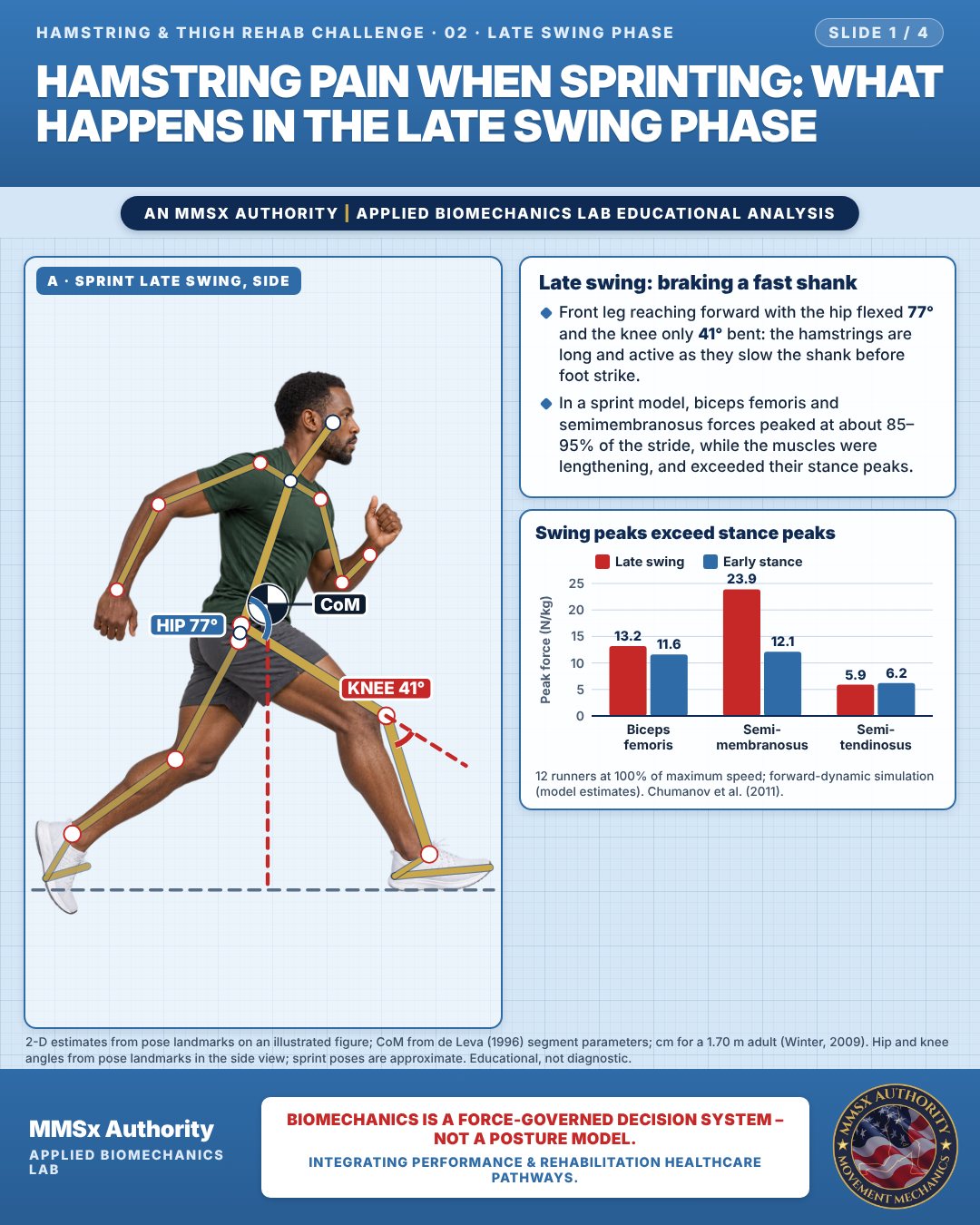
Late swing: braking a fast shank
Front leg reaching forward with the hip flexed 77° and the knee only 41° bent: the hamstrings are long and active as they slow the shank before foot strike.
In a sprint model, biceps femoris and semimembranosus forces peaked at about 85–95% of the stride, while the muscles were lengthening, and exceeded their stance peaks.
Swing peaks exceed stance peaks
Movement B: Sprint foot strike (side view)
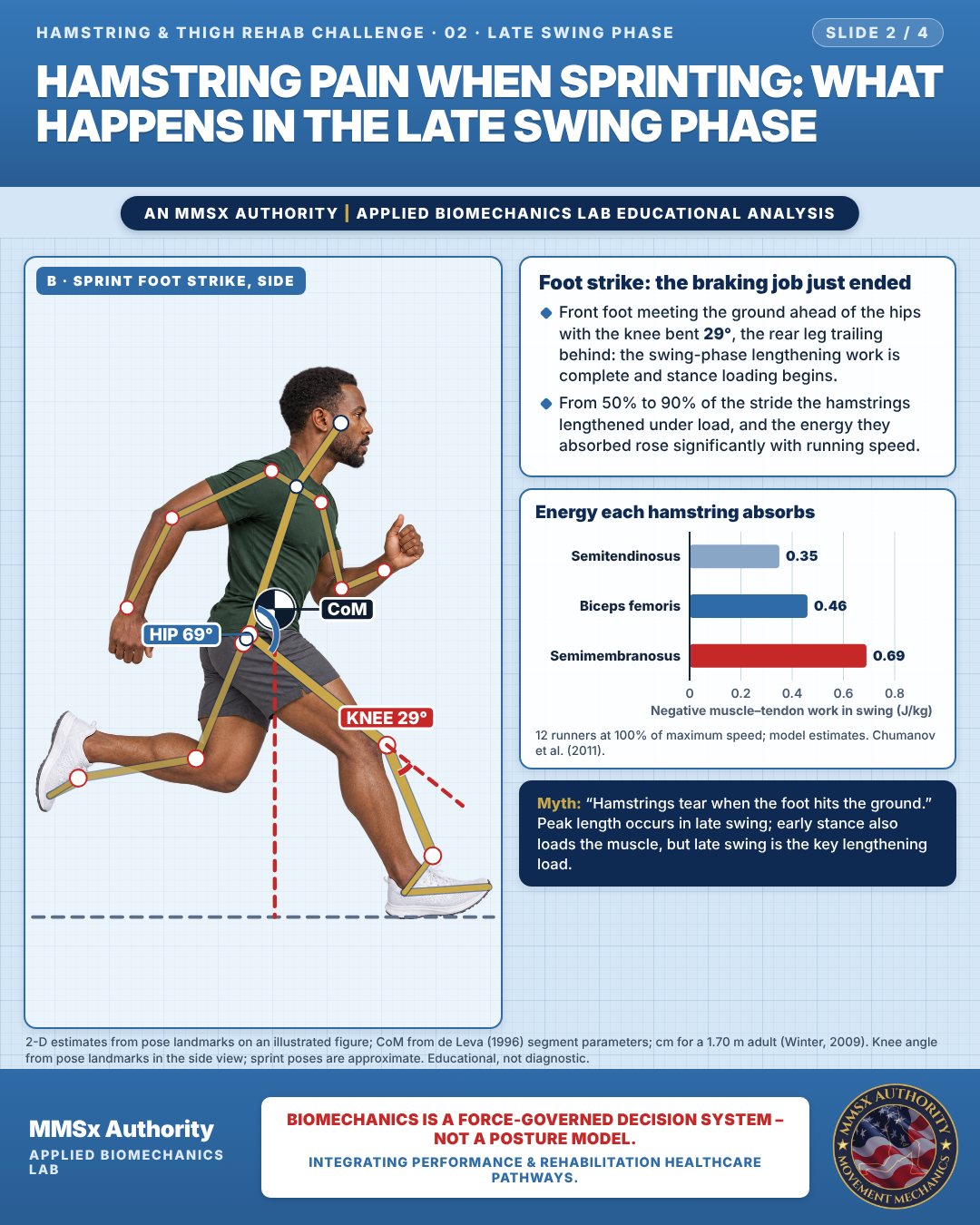
Foot strike: the braking job just ended
Front foot meeting the ground ahead of the hips with the knee bent 29°, the rear leg trailing behind: the swing-phase lengthening work is complete and stance loading begins.
From 50% to 90% of the stride the hamstrings lengthened under load, and the energy they absorbed rose significantly with running speed.
Energy each hamstring absorbs
Movement C: High-knee march (side view)
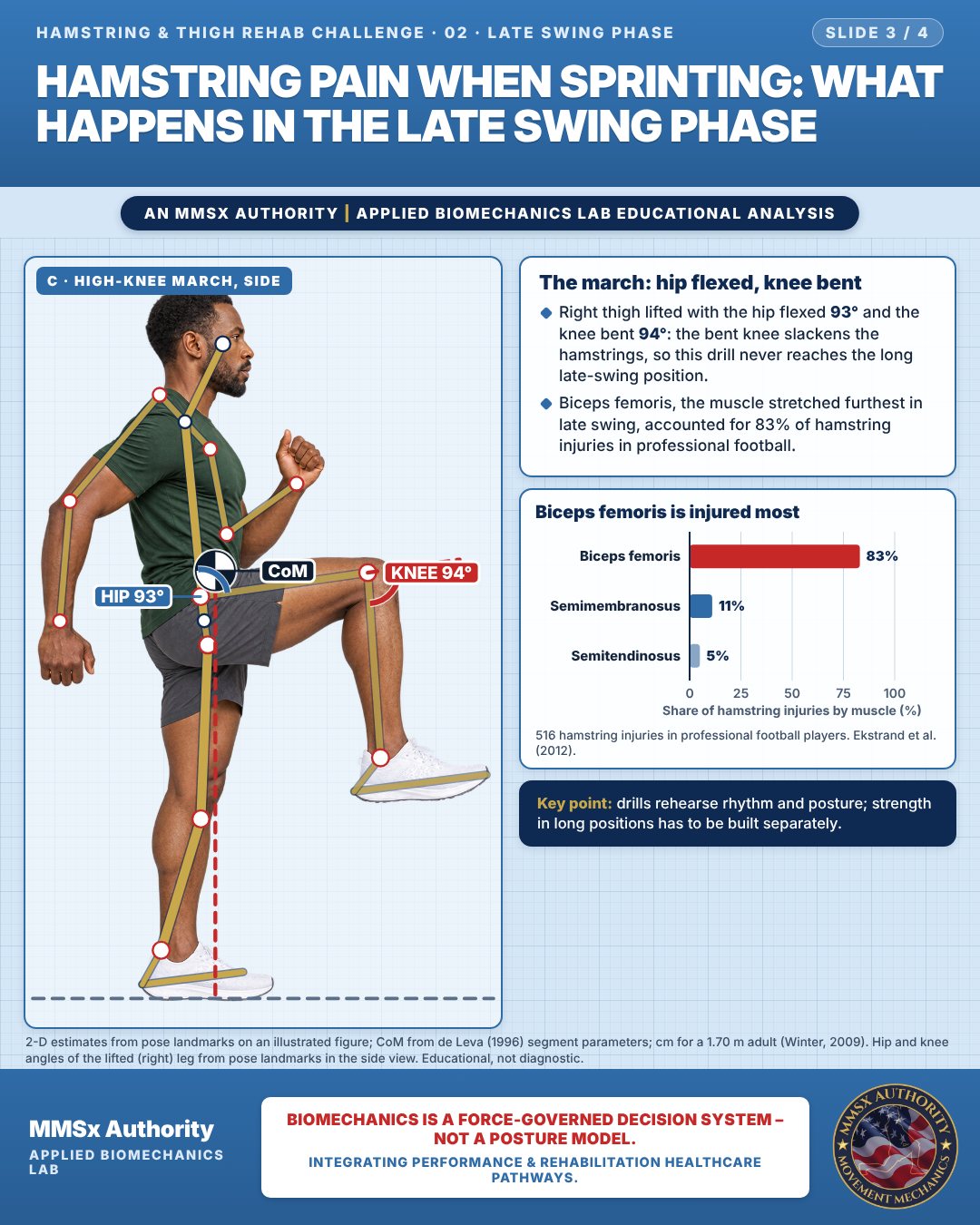
The march: hip flexed, knee bent
Right thigh lifted with the hip flexed 93° and the knee bent 94°: the bent knee slackens the hamstrings, so this drill never reaches the long late-swing position.
Biceps femoris, the muscle stretched furthest in late swing, accounted for 83% of hamstring injuries in professional football.
Biceps femoris is injured most
Decision pathway
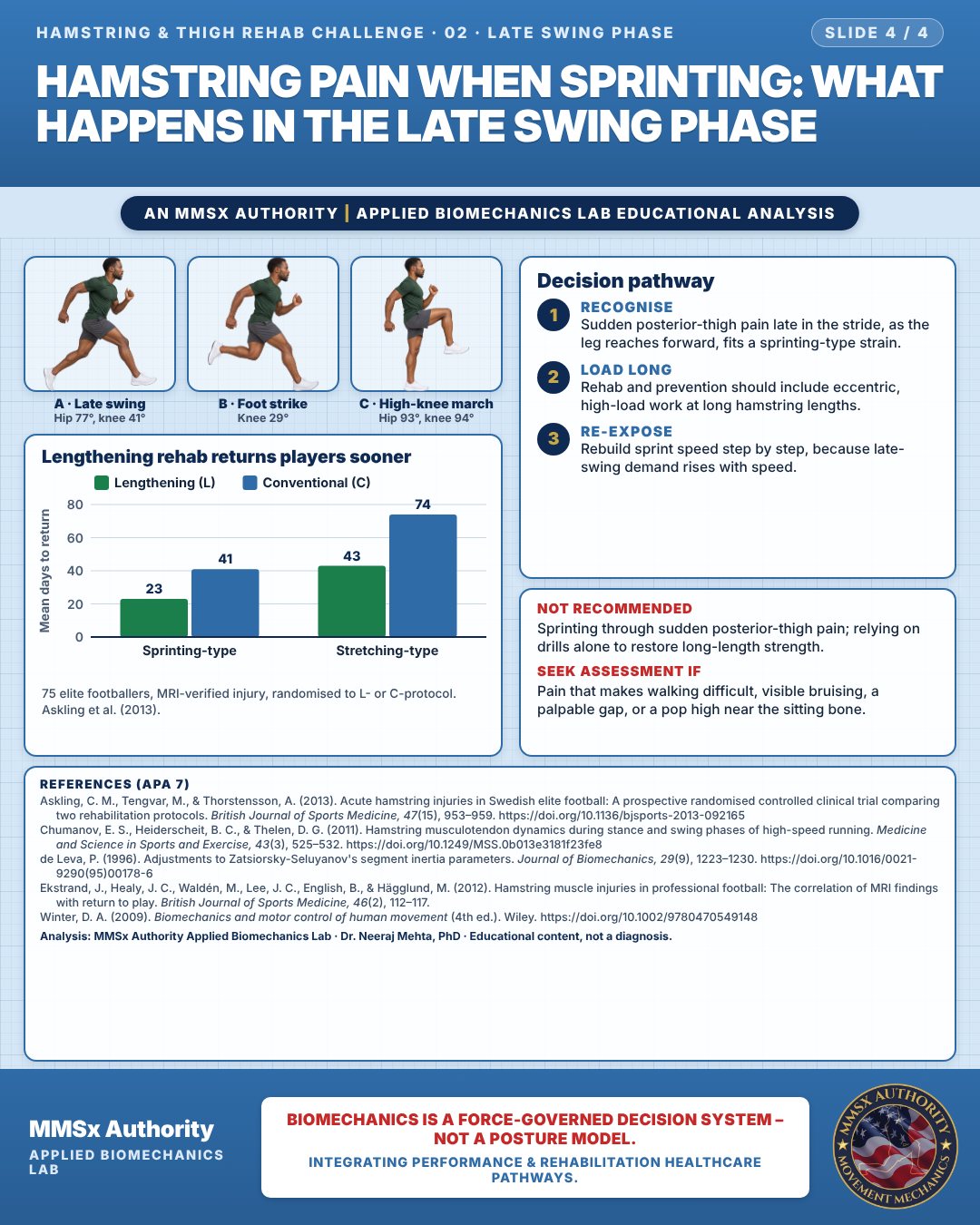
Lengthening rehab returns players sooner
Recognise
Sudden posterior-thigh pain late in the stride, as the leg reaches forward, fits a sprinting-type strain.
Load long
Rehab and prevention should include eccentric, high-load work at long hamstring lengths.
Re-expose
Rebuild sprint speed step by step, because late-swing demand rises with speed.
What the evidence supports
- Rehabilitation that emphasises loading in lengthened positions shortened return to play compared with conventional exercises (mean 28 vs 51 days) (Askling et al., 2013).
Cautions
Not recommended
Sprinting through sudden posterior-thigh pain; relying on drills alone to restore long-length strength.
Seek assessment if
Pain that makes walking difficult, visible bruising, a palpable gap, or a pop high near the sitting bone.
Methods note
2-D estimates from pose landmarks on an illustrated figure; CoM from de Leva (1996) segment parameters; cm for a 1.70 m adult (Winter, 2009). Hip and knee angles from pose landmarks in the side view; sprint poses are approximate. Knee angle from pose landmarks in the side view; sprint poses are approximate. Hip and knee angles of the lifted (right) leg from pose landmarks in the side view. These are educational estimates, not a diagnosis.
References
- Askling, C. M., Tengvar, M., & Thorstensson, A. (2013). Acute hamstring injuries in Swedish elite football: A prospective randomised controlled clinical trial comparing two rehabilitation protocols. British Journal of Sports Medicine, 47(15), 953–959. https://doi.org/10.1136/bjsports-2013-092165
- Chumanov, E. S., Heiderscheit, B. C., & Thelen, D. G. (2011). Hamstring musculotendon dynamics during stance and swing phases of high-speed running. Medicine and Science in Sports and Exercise, 43(3), 525–532. https://doi.org/10.1249/MSS.0b013e3181f23fe8
- de Leva, P. (1996). Adjustments to Zatsiorsky-Seluyanov's segment inertia parameters. Journal of Biomechanics, 29(9), 1223–1230. https://doi.org/10.1016/0021-9290(95)00178-6
- Ekstrand, J., Healy, J. C., Waldén, M., Lee, J. C., English, B., & Hägglund, M. (2012). Hamstring muscle injuries in professional football: The correlation of MRI findings with return to play. British Journal of Sports Medicine, 46(2), 112–117.
- Winter, D. A. (2009). Biomechanics and motor control of human movement (4th ed.). Wiley. https://doi.org/10.1002/9780470549148
Cite this article
Mehta, N. (2026, October 26). Hamstring pain when sprinting: what happens in the late swing phase. MMSx Authority Applied Biomechanics Lab. https://mmsxauthority.org/edu/analysis/hamstring-thigh/02-hamstring-pain-when-sprinting-what-happens-in-the-late-swing-phase/
Part of the collection
Mehta, N. (2026). Hamstring and Thigh Rehabilitation: 50 Evidence-Based Biomechanics Analyses [Collection]. MMSx Authority Applied Biomechanics Lab. Zenodo. https://doi.org/10.5281/zenodo.23735792
All Hamstring & Thigh Rehab Challenge articles · Rehabilitation Library