Hamstring & Thigh Rehab Challenge · 01
Hamstring strain: why it is the most common injury in running sports
A hamstring strain is an acute injury to the muscle fibres, the muscle–tendon junction or the intramuscular tendon of one or more of the hamstring…
Key points
- Prevent. Include eccentric hamstring work such as the Nordic exercise and build sprint exposure gradually.
- Rehab. After a strain, progress active loading in lengthened positions rather than resting.
- Return. Return to sprinting step by step; lengthened-position rehab returned footballers in 28 vs 51 days.
What it is
A hamstring strain is an acute injury to the muscle fibres, the muscle–tendon junction or the intramuscular tendon of one or more of the hamstring muscles (biceps femoris, semitendinosus, semimembranosus). It typically occurs during high-speed running or extreme stretching and causes sudden posterior-thigh pain. Most involve the long head of biceps femoris (Ekstrand et al., 2023; Askling et al., 2013).
How we analysed the movement
Three movements relevant to this topic were analysed from illustrated reference figures. Joint centres were located with two-dimensional pose estimation; hip and knee angles, pelvis level, the whole-body centre of mass and, where relevant, the hip lever (the horizontal distance from the hip joint to the upper-body centre of mass) and the resulting static hip moment were then calculated from standard segment parameters. The figures are educational estimates that show how position changes mechanical demand; they are not measurements of a patient. Every research value quoted below comes from the published source cited beside it.
Movement A: Sprint late swing (side view)
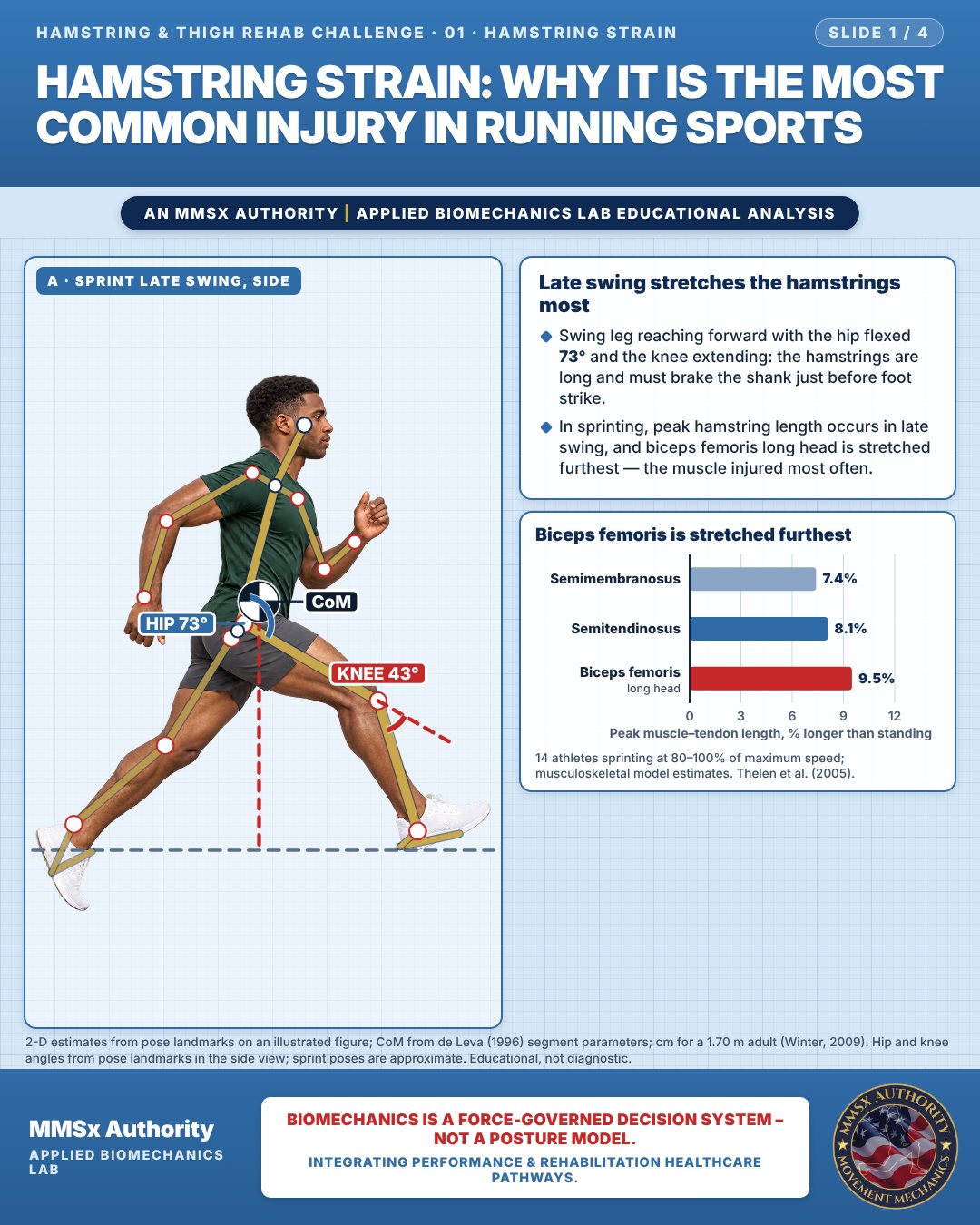
Late swing stretches the hamstrings most
Swing leg reaching forward with the hip flexed 73° and the knee extending: the hamstrings are long and must brake the shank just before foot strike.
In sprinting, peak hamstring length occurs in late swing, and biceps femoris long head is stretched furthest — the muscle injured most often.
Biceps femoris is stretched furthest
Movement B: Standing (side view)
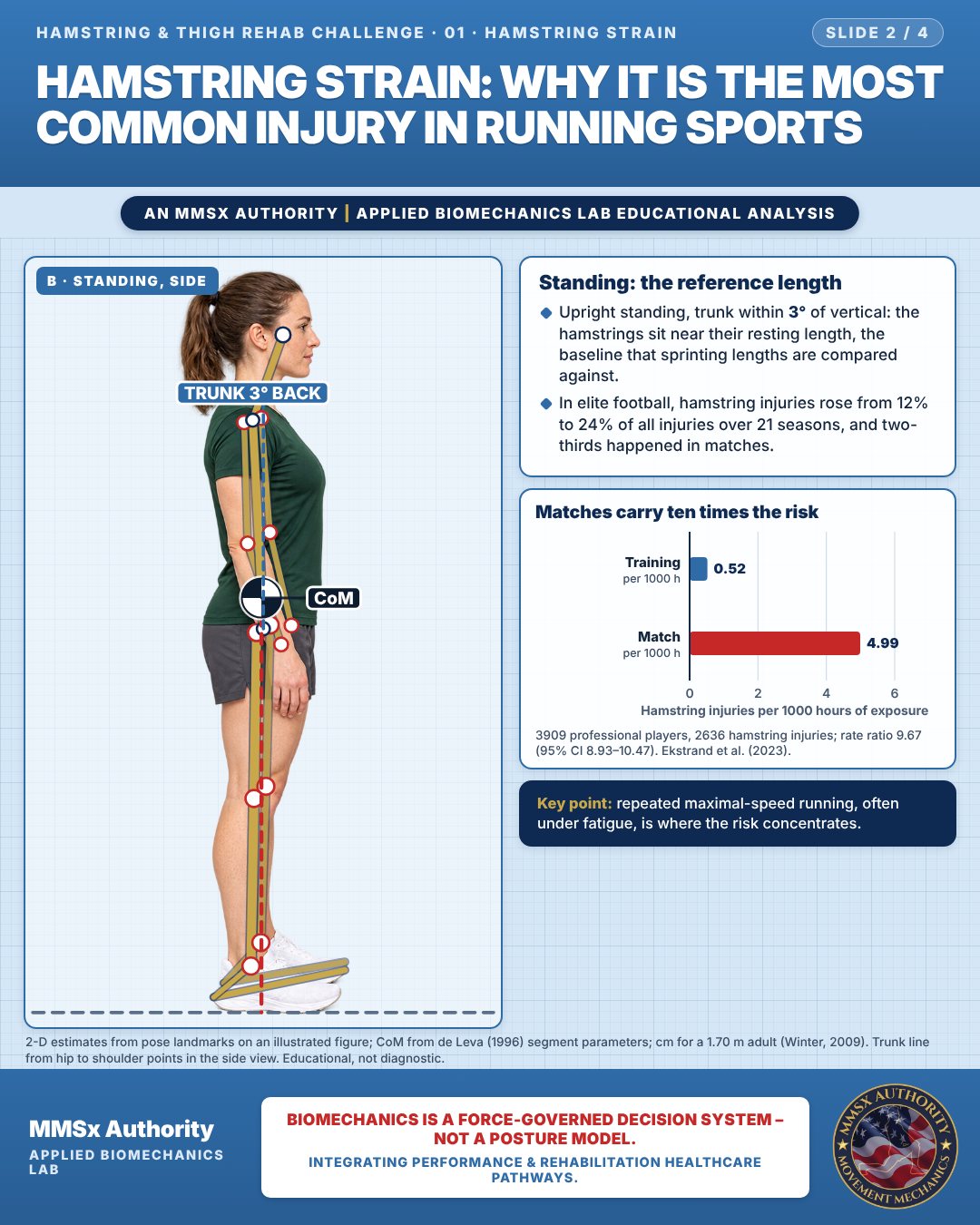
Standing: the reference length
Upright standing, trunk within 3° of vertical: the hamstrings sit near their resting length, the baseline that sprinting lengths are compared against.
In elite football, hamstring injuries rose from 12% to 24% of all injuries over 21 seasons, and two-thirds happened in matches.
Matches carry ten times the risk
Movement C: Romanian deadlift (side view)
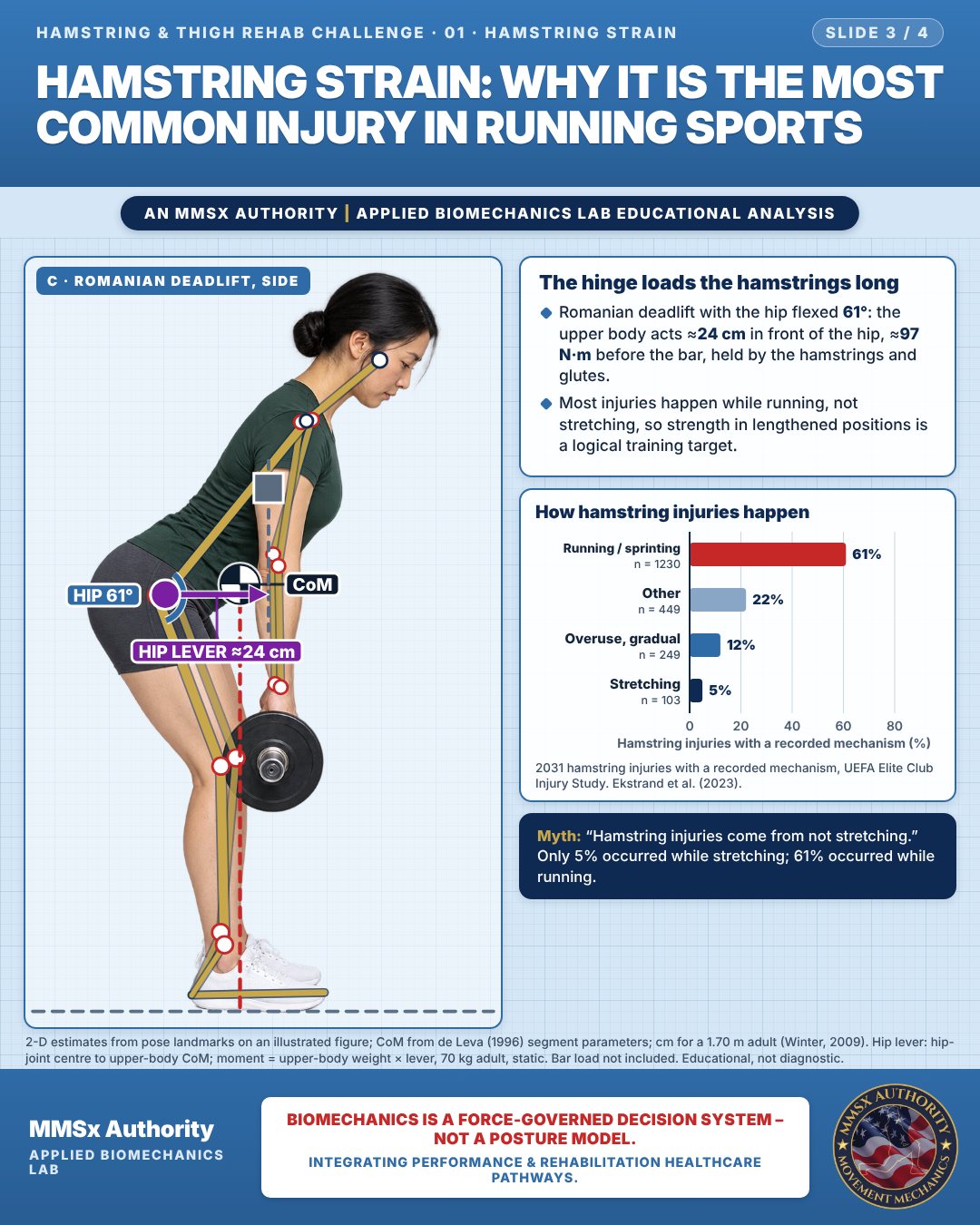
The hinge loads the hamstrings long
Romanian deadlift with the hip flexed 61°: the upper body acts ≈24 cm in front of the hip, ≈97 N·m before the bar, held by the hamstrings and glutes.
Most injuries happen while running, not stretching, so strength in lengthened positions is a logical training target.
How hamstring injuries happen
Decision pathway
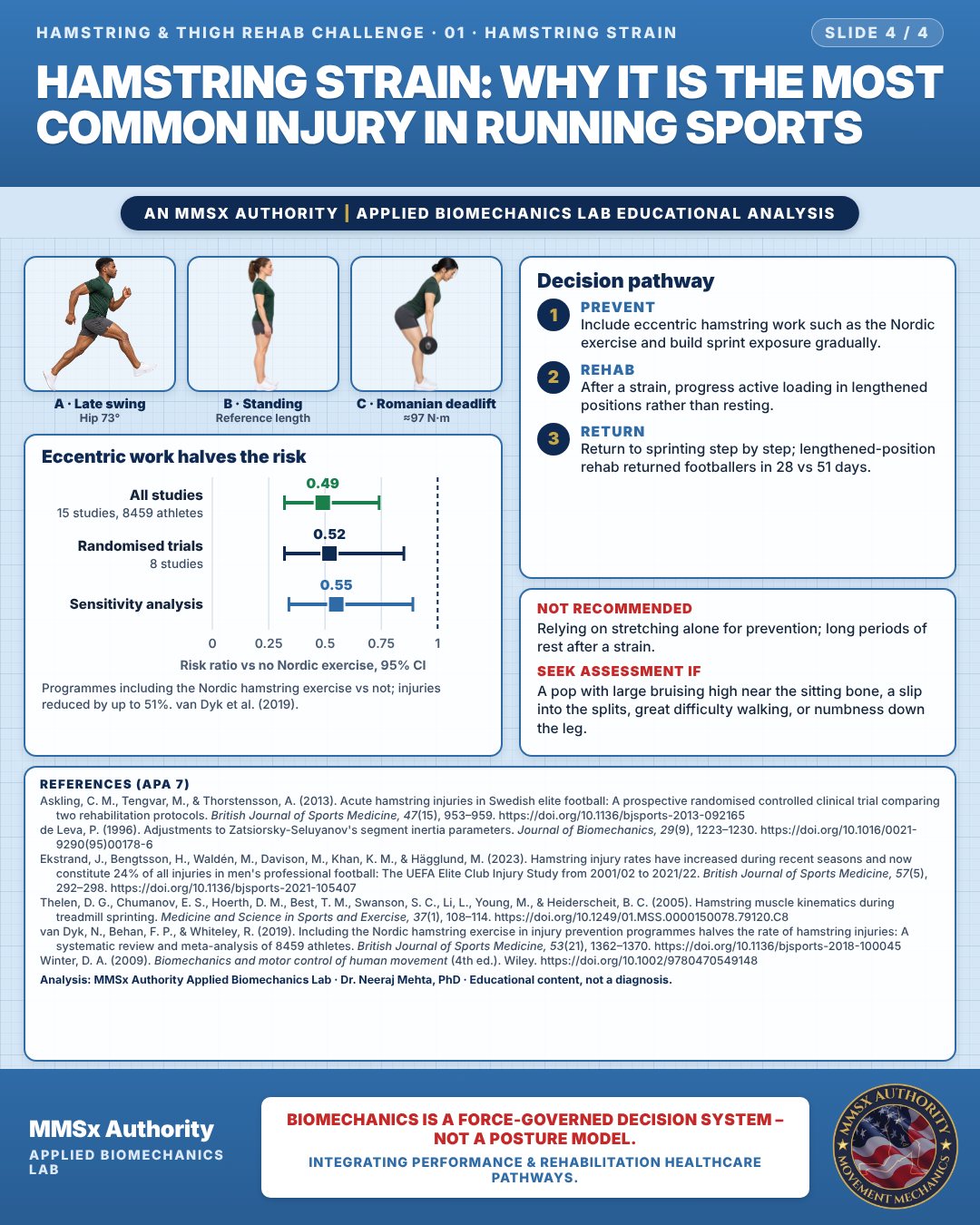
Eccentric work halves the risk
Prevent
Include eccentric hamstring work such as the Nordic exercise and build sprint exposure gradually.
Rehab
After a strain, progress active loading in lengthened positions rather than resting.
Return
Return to sprinting step by step; lengthened-position rehab returned footballers in 28 vs 51 days.
What the evidence supports
- Programmes that include the Nordic hamstring exercise are recommended for prevention; they reduce hamstring injuries by up to 51% (van Dyk et al., 2019).
Myth and evidence
Myth“Hamstring injuries are rare and mainly happen in people who do not stretch.”
EvidenceIn elite football they are now about one in four of all injuries (24% in 2021/22), and most happen during running and sprinting (61%), not during stretching (5%) (Ekstrand et al., 2023). Prevention evidence is strongest for eccentric strengthening, not stretching (van Dyk et al., 2019).
Cautions
Not recommended
Relying on stretching alone for prevention; long periods of rest after a strain.
Seek assessment if
A pop with large bruising high near the sitting bone, a slip into the splits, great difficulty walking, or numbness down the leg.
Methods note
2-D estimates from pose landmarks on an illustrated figure; CoM from de Leva (1996) segment parameters; cm for a 1.70 m adult (Winter, 2009). Hip and knee angles from pose landmarks in the side view; sprint poses are approximate. Trunk line from hip to shoulder points in the side view. Hip lever: hip-joint centre to upper-body CoM; moment = upper-body weight × lever, 70 kg adult, static. Bar load not included. These are educational estimates, not a diagnosis.
References
- Askling, C. M., Tengvar, M., & Thorstensson, A. (2013). Acute hamstring injuries in Swedish elite football: A prospective randomised controlled clinical trial comparing two rehabilitation protocols. British Journal of Sports Medicine, 47(15), 953–959. https://doi.org/10.1136/bjsports-2013-092165
- de Leva, P. (1996). Adjustments to Zatsiorsky-Seluyanov's segment inertia parameters. Journal of Biomechanics, 29(9), 1223–1230. https://doi.org/10.1016/0021-9290(95)00178-6
- Ekstrand, J., Bengtsson, H., Waldén, M., Davison, M., Khan, K. M., & Hägglund, M. (2023). Hamstring injury rates have increased during recent seasons and now constitute 24% of all injuries in men's professional football: The UEFA Elite Club Injury Study from 2001/02 to 2021/22. British Journal of Sports Medicine, 57(5), 292–298. https://doi.org/10.1136/bjsports-2021-105407
- Thelen, D. G., Chumanov, E. S., Hoerth, D. M., Best, T. M., Swanson, S. C., Li, L., Young, M., & Heiderscheit, B. C. (2005). Hamstring muscle kinematics during treadmill sprinting. Medicine and Science in Sports and Exercise, 37(1), 108–114. https://doi.org/10.1249/01.MSS.0000150078.79120.C8
- van Dyk, N., Behan, F. P., & Whiteley, R. (2019). Including the Nordic hamstring exercise in injury prevention programmes halves the rate of hamstring injuries: A systematic review and meta-analysis of 8459 athletes. British Journal of Sports Medicine, 53(21), 1362–1370. https://doi.org/10.1136/bjsports-2018-100045
- Winter, D. A. (2009). Biomechanics and motor control of human movement (4th ed.). Wiley. https://doi.org/10.1002/9780470549148
Cite this article
Mehta, N. (2026, October 26). Hamstring strain: why it is the most common injury in running sports. MMSx Authority Applied Biomechanics Lab. https://mmsxauthority.org/edu/analysis/hamstring-thigh/01-hamstring-strain-why-it-is-the-most-common-injury-in-running-sports/
Part of the collection
Mehta, N. (2026). Hamstring and Thigh Rehabilitation: 50 Evidence-Based Biomechanics Analyses [Collection]. MMSx Authority Applied Biomechanics Lab. Zenodo. https://doi.org/10.5281/zenodo.23735792
All Hamstring & Thigh Rehab Challenge articles · Rehabilitation Library