Arm Pain Rehab Challenge · 49
Rheumatoid arthritis signs in the hand: swelling, morning stiffness and symmetry
Rheumatoid arthritis (RA) is a chronic autoimmune inflammatory arthritis that typically causes symmetrical, soft (synovial) swelling of the small…
Key points
- Spot. Soft, symmetrical swelling of MCP, PIP or wrist joints with long morning stiffness that eases with use.
- Refer. Suspected inflammatory arthritis goes early to rheumatology; drug treatment is specialist-led.
- Support. Hand therapy, joint protection and exercise as adjuncts, adjusted to joint swelling and pain.
What it is
Rheumatoid arthritis (RA) is a chronic autoimmune inflammatory arthritis that typically causes symmetrical, soft (synovial) swelling of the small joints of the hands and feet — especially the MCP and PIP joints and wrists — with prolonged morning stiffness; early recognition and specialist treatment limit joint damage.
How we analysed the movement
Three movements relevant to this topic were analysed from illustrated reference figures. Joint centres were located with two-dimensional pose estimation where the whole arm was visible; elbow and wrist angles, and the directions of external load and tendon pull, were then drawn on the figure; on hand close-ups, where pose estimation does not apply, the landmarks were placed manually. The figures are educational estimates that show how position changes mechanical demand; they are not measurements of a patient. Every research value quoted below comes from the published source cited beside it.
Movement A: Both hands flat, top
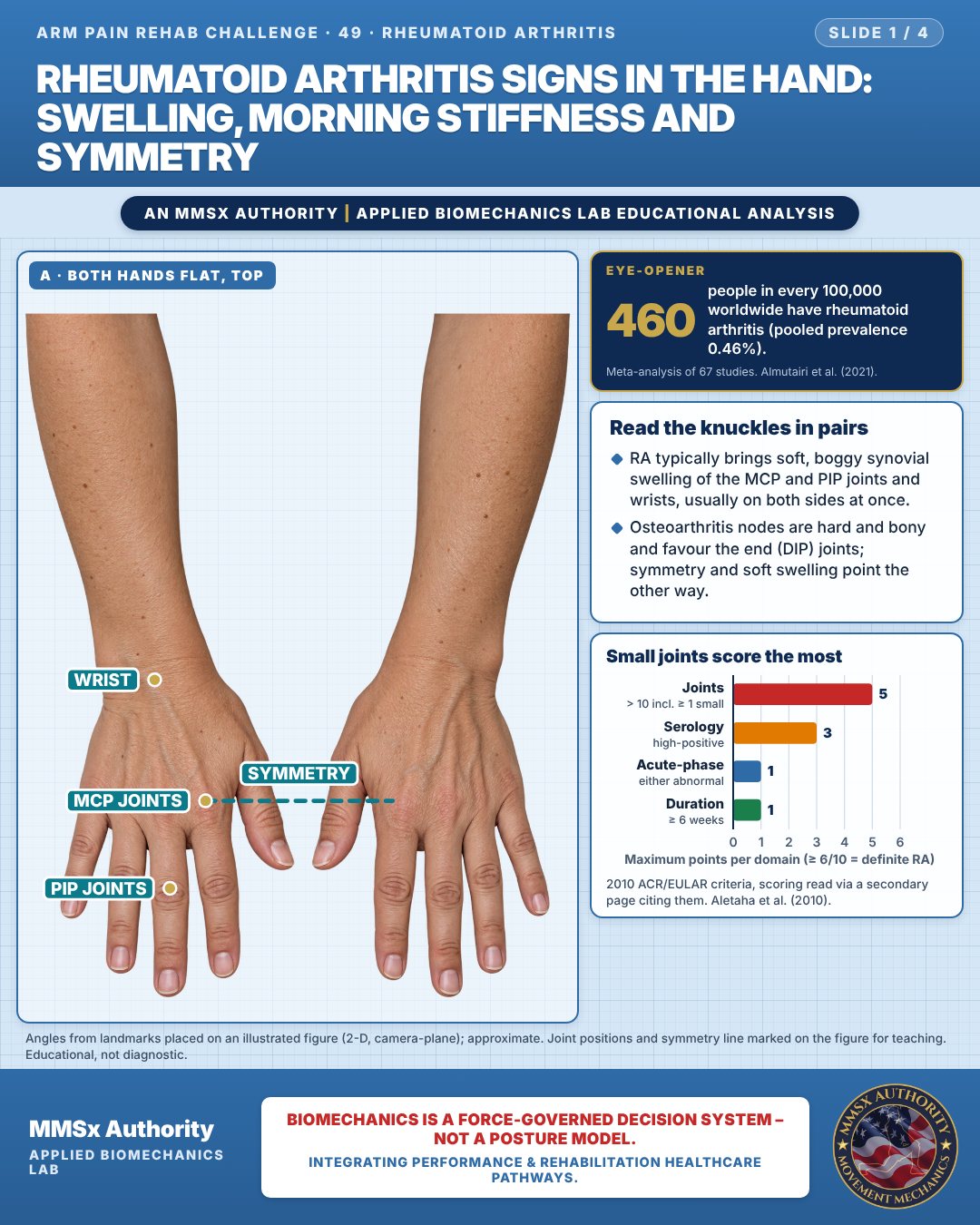
Read the knuckles in pairs
RA typically brings soft, boggy synovial swelling of the MCP and PIP joints and wrists, usually on both sides at once.
Osteoarthritis nodes are hard and bony and favour the end (DIP) joints; symmetry and soft swelling point the other way.
Small joints score the most
Movement B: Buttoning (front view)
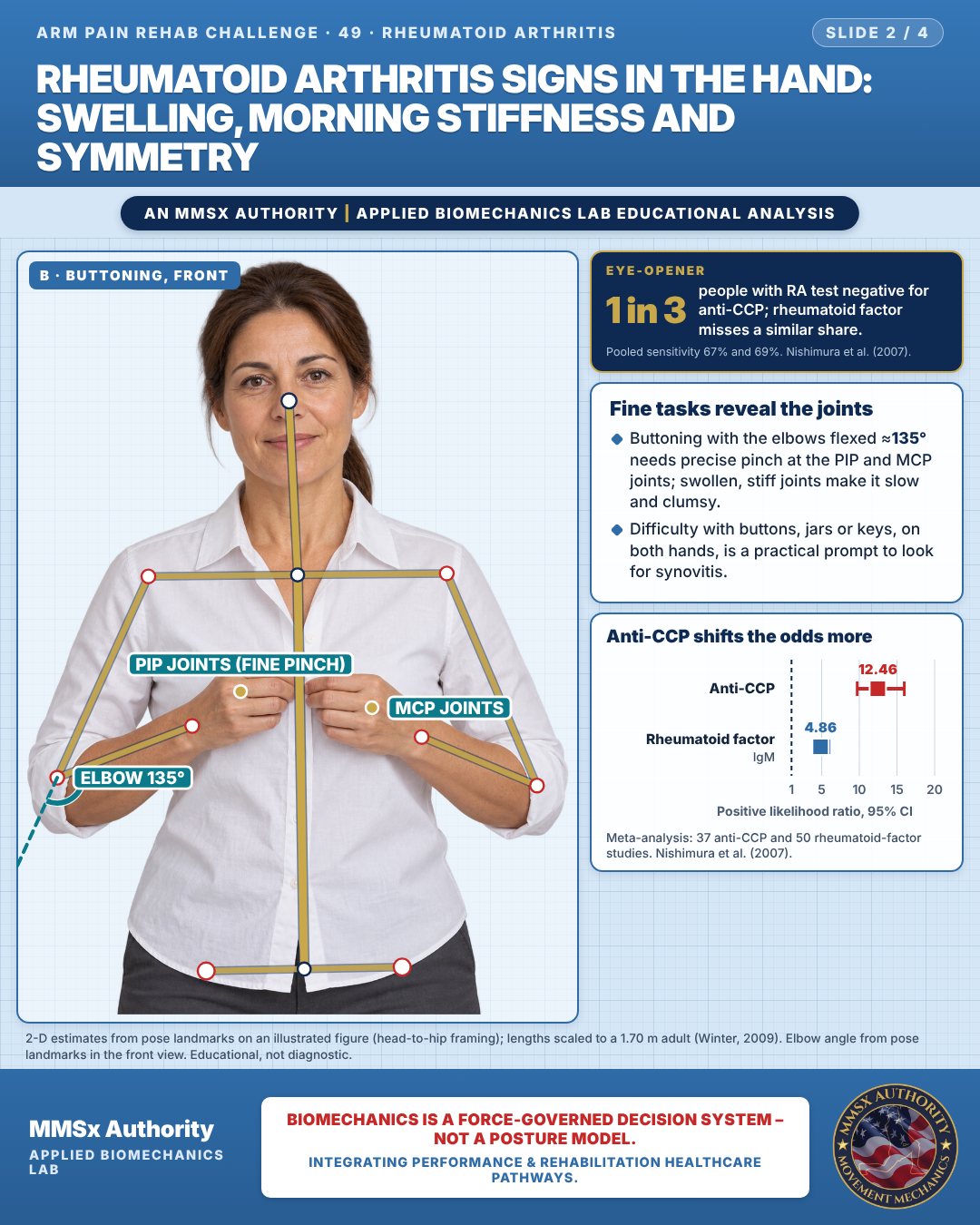
Fine tasks reveal the joints
Buttoning with the elbows flexed ≈135° needs precise pinch at the PIP and MCP joints; swollen, stiff joints make it slow and clumsy.
Difficulty with buttons, jars or keys, on both hands, is a practical prompt to look for synovitis.
Anti-CCP shifts the odds more
Movement C: Morning hand rub (side view)
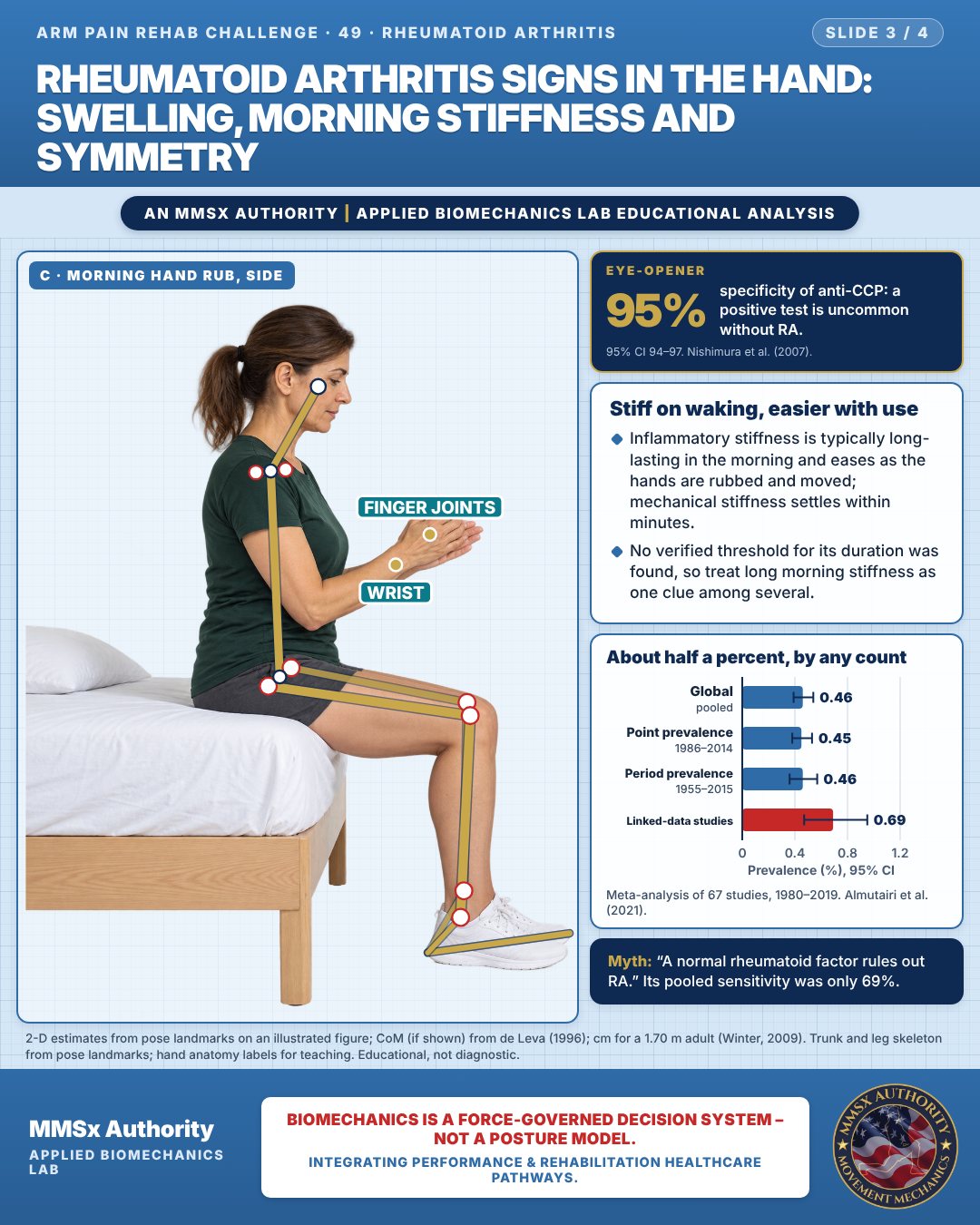
Stiff on waking, easier with use
Inflammatory stiffness is typically long-lasting in the morning and eases as the hands are rubbed and moved; mechanical stiffness settles within minutes.
No verified threshold for its duration was found, so treat long morning stiffness as one clue among several.
About half a percent, by any count
Decision pathway
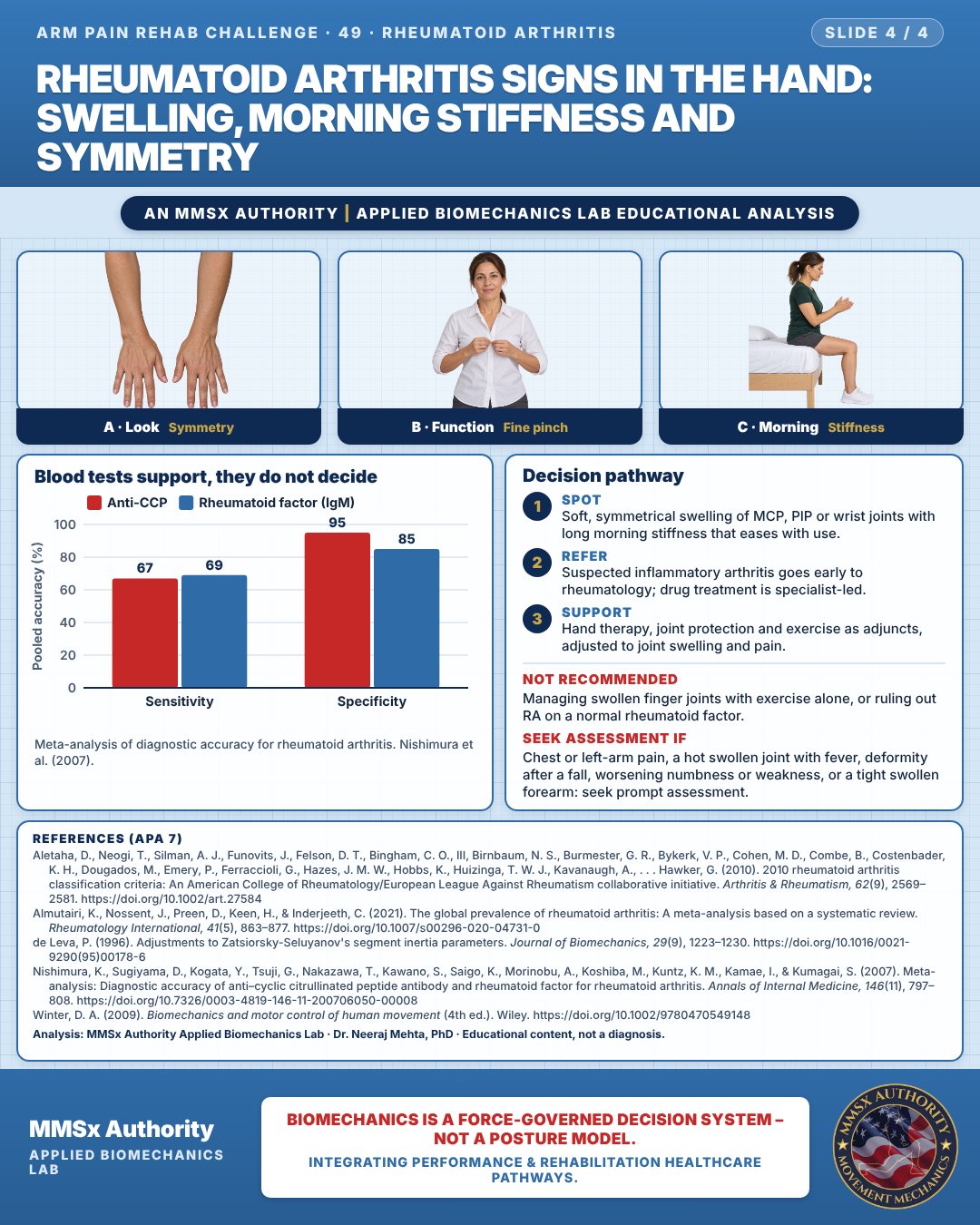
Blood tests support, they do not decide
Spot
Soft, symmetrical swelling of MCP, PIP or wrist joints with long morning stiffness that eases with use.
Refer
Suspected inflammatory arthritis goes early to rheumatology; drug treatment is specialist-led.
Support
Hand therapy, joint protection and exercise as adjuncts, adjusted to joint swelling and pain.
Myth and evidence
Myth“A normal rheumatoid factor rules out RA.”
EvidencePooled sensitivity was only 69% for RF and 67% for anti-CCP (Nishimura et al., 2007); classification also depends on joint count, duration and inflammatory markers (Aletaha et al., 2010).
Cautions
Not recommended
Managing swollen finger joints with exercise alone, or ruling out RA on a normal rheumatoid factor.
Seek assessment if
Chest or left-arm pain, a hot swollen joint with fever, deformity after a fall, worsening numbness or weakness, or a tight swollen forearm: seek prompt assessment.
Methods note
Angles from landmarks placed on an illustrated figure (2-D, camera-plane); approximate. Joint positions and symmetry line marked on the figure for teaching. 2-D estimates from pose landmarks on an illustrated figure (head-to-hip framing); lengths scaled to a 1.70 m adult (Winter, 2009). Elbow angle from pose landmarks in the front view. 2-D estimates from pose landmarks on an illustrated figure; CoM (if shown) from de Leva (1996); cm for a 1.70 m adult (Winter, 2009). Trunk and leg skeleton from pose landmarks; hand anatomy labels for teaching. These are educational estimates, not a diagnosis.
References
- Aletaha, D., Neogi, T., Silman, A. J., Funovits, J., Felson, D. T., Bingham, C. O., III, Birnbaum, N. S., Burmester, G. R., Bykerk, V. P., Cohen, M. D., Combe, B., Costenbader, K. H., Dougados, M., Emery, P., Ferraccioli, G., Hazes, J. M. W., Hobbs, K., Huizinga, T. W. J., Kavanaugh, A., . . . Hawker, G. (2010). 2010 rheumatoid arthritis classification criteria: An American College of Rheumatology/European League Against Rheumatism collaborative initiative. Arthritis & Rheumatism, 62(9), 2569–2581. https://doi.org/10.1002/art.27584
- Almutairi, K., Nossent, J., Preen, D., Keen, H., & Inderjeeth, C. (2021). The global prevalence of rheumatoid arthritis: A meta-analysis based on a systematic review. Rheumatology International, 41(5), 863–877. https://doi.org/10.1007/s00296-020-04731-0
- de Leva, P. (1996). Adjustments to Zatsiorsky-Seluyanov's segment inertia parameters. Journal of Biomechanics, 29(9), 1223–1230. https://doi.org/10.1016/0021-9290(95)00178-6
- Nishimura, K., Sugiyama, D., Kogata, Y., Tsuji, G., Nakazawa, T., Kawano, S., Saigo, K., Morinobu, A., Koshiba, M., Kuntz, K. M., Kamae, I., & Kumagai, S. (2007). Meta-analysis: Diagnostic accuracy of anti–cyclic citrullinated peptide antibody and rheumatoid factor for rheumatoid arthritis. Annals of Internal Medicine, 146(11), 797–808. https://doi.org/10.7326/0003-4819-146-11-200706050-00008
- Winter, D. A. (2009). Biomechanics and motor control of human movement (4th ed.). Wiley. https://doi.org/10.1002/9780470549148
Cite this article
Mehta, N. (2026, October 28). Rheumatoid arthritis signs in the hand: swelling, morning stiffness and symmetry. MMSx Authority Applied Biomechanics Lab. https://mmsxauthority.org/edu/analysis/arm/49-rheumatoid-arthritis-signs-in-the-hand-swelling-morning-stiffness-and/
Part of the collection
Mehta, N. (2026). Elbow, Forearm, Wrist and Hand Rehabilitation: 50 Evidence-Based Biomechanics Analyses [Collection]. MMSx Authority Applied Biomechanics Lab. Zenodo. https://doi.org/10.5281/zenodo.23735910
All Arm Pain Rehab Challenge articles · Rehabilitation Library