Arm Pain Rehab Challenge · 48
Return to sport after elbow or wrist injury: strength and grip benchmarks
Return to sport (RTS) after an elbow or wrist injury is a staged, criteria-based decision combining time since injury/surgery, pain-free range of…
Key points
- Range. Restore full, pain-free elbow and wrist motion before loading the throw or swing.
- Strength. Compare grip and forearm strength with the other side, reading the 10% rule by hand dominance.
- Progress. Graded plyometric throws, then interval throwing or hitting, then sport volume before competition.
What it is
Return to sport (RTS) after an elbow or wrist injury is a staged, criteria-based decision combining time since injury/surgery, pain-free range of motion, strength (including grip) compared with the other side and norms, and completion of a sport-specific progression (e.g. interval throwing).
How we analysed the movement
Three movements relevant to this topic were analysed from illustrated reference figures. Joint centres were located with two-dimensional pose estimation where the whole arm was visible; elbow and wrist angles, and the directions of external load and tendon pull, were then drawn on the figure; on hand close-ups, where pose estimation does not apply, the landmarks were placed manually. The figures are educational estimates that show how position changes mechanical demand; they are not measurements of a patient. Every research value quoted below comes from the published source cited beside it.
Movement A: Grip dynamometer (front view)
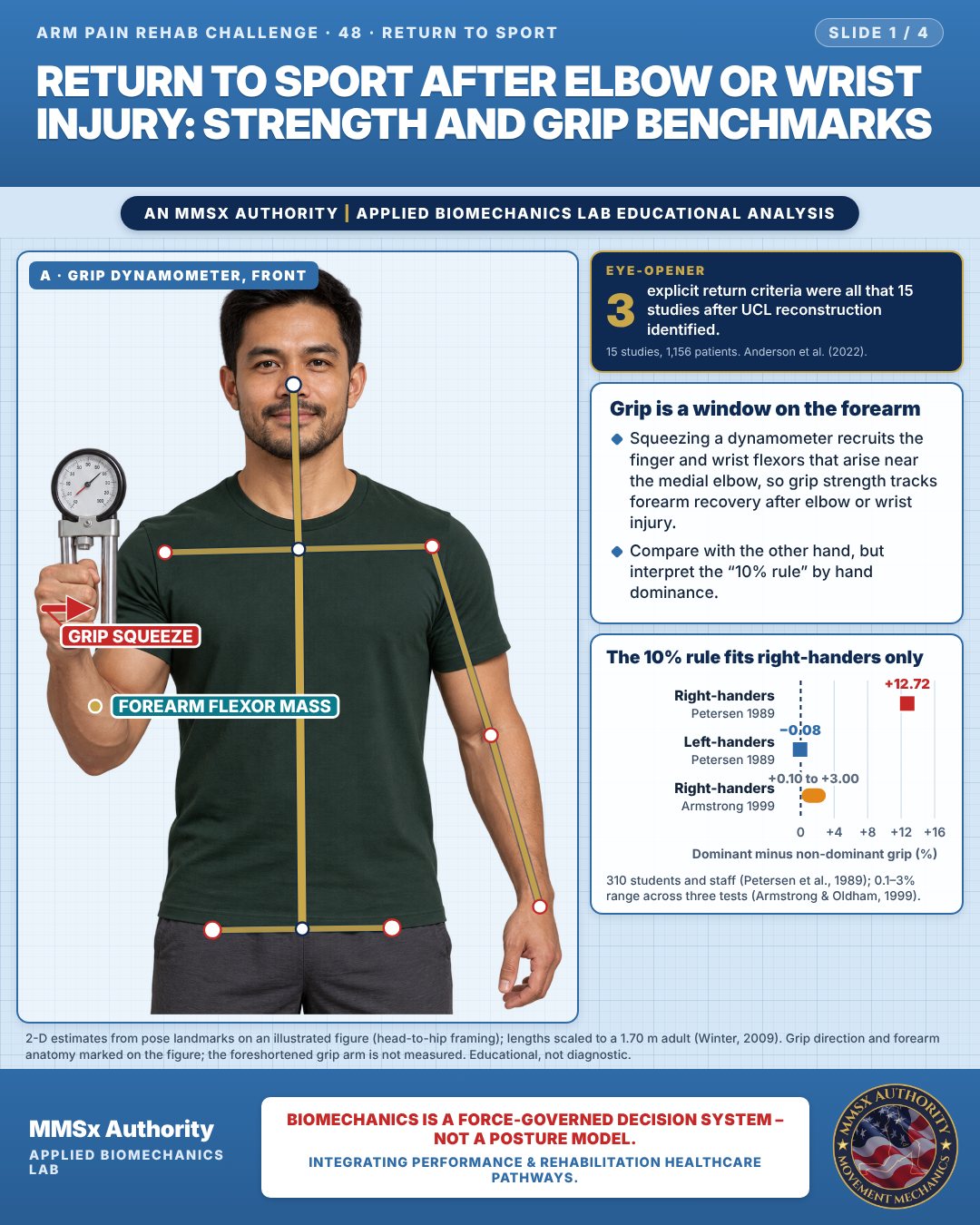
Grip is a window on the forearm
Squeezing a dynamometer recruits the finger and wrist flexors that arise near the medial elbow, so grip strength tracks forearm recovery after elbow or wrist injury.
Compare with the other hand, but interpret the “10% rule” by hand dominance.
The 10% rule fits right-handers only
Movement B: Med-ball throw (side view)
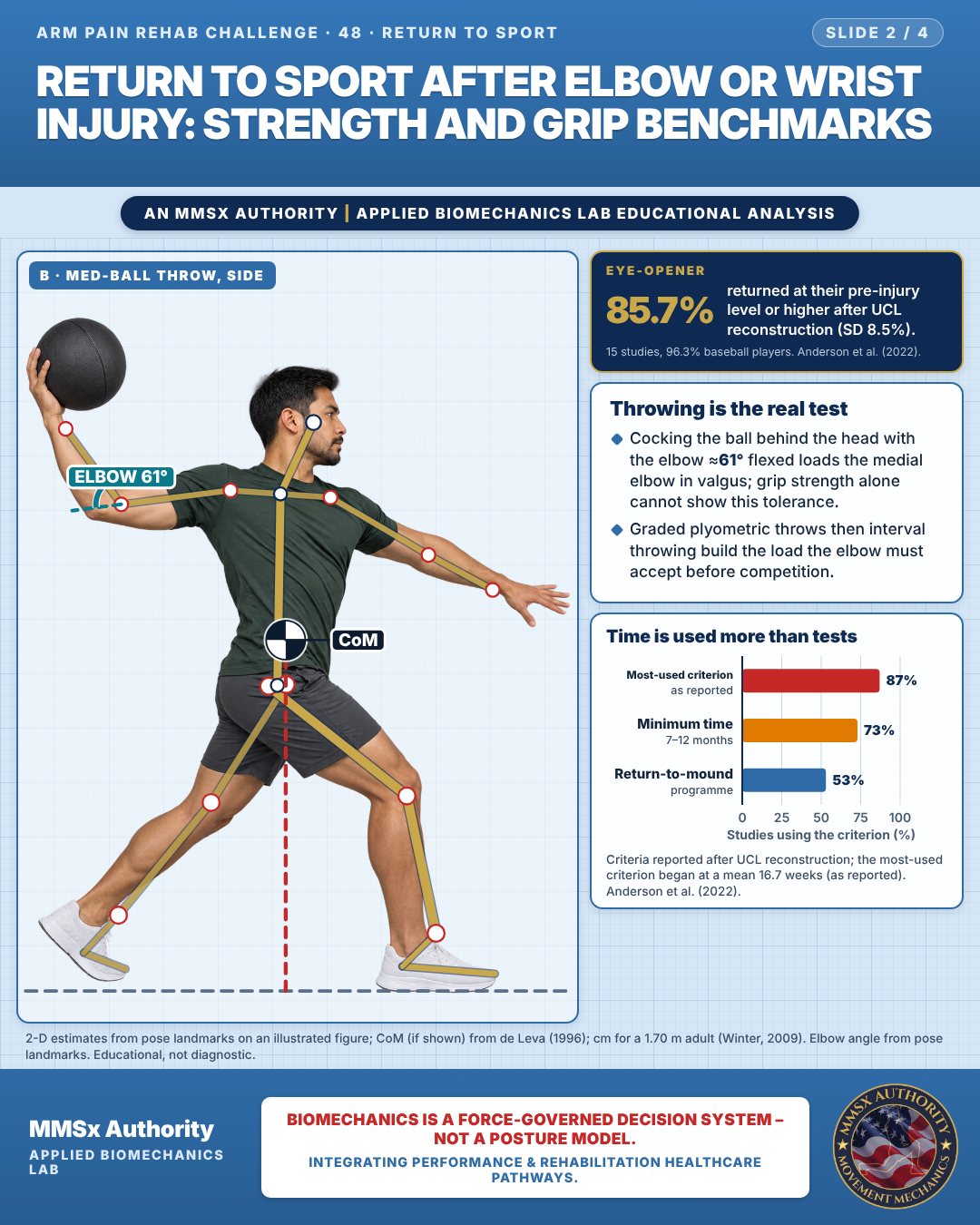
Throwing is the real test
Cocking the ball behind the head with the elbow ≈61° flexed loads the medial elbow in valgus; grip strength alone cannot show this tolerance.
Graded plyometric throws then interval throwing build the load the elbow must accept before competition.
Time is used more than tests
Movement C: Tennis serve (side view)
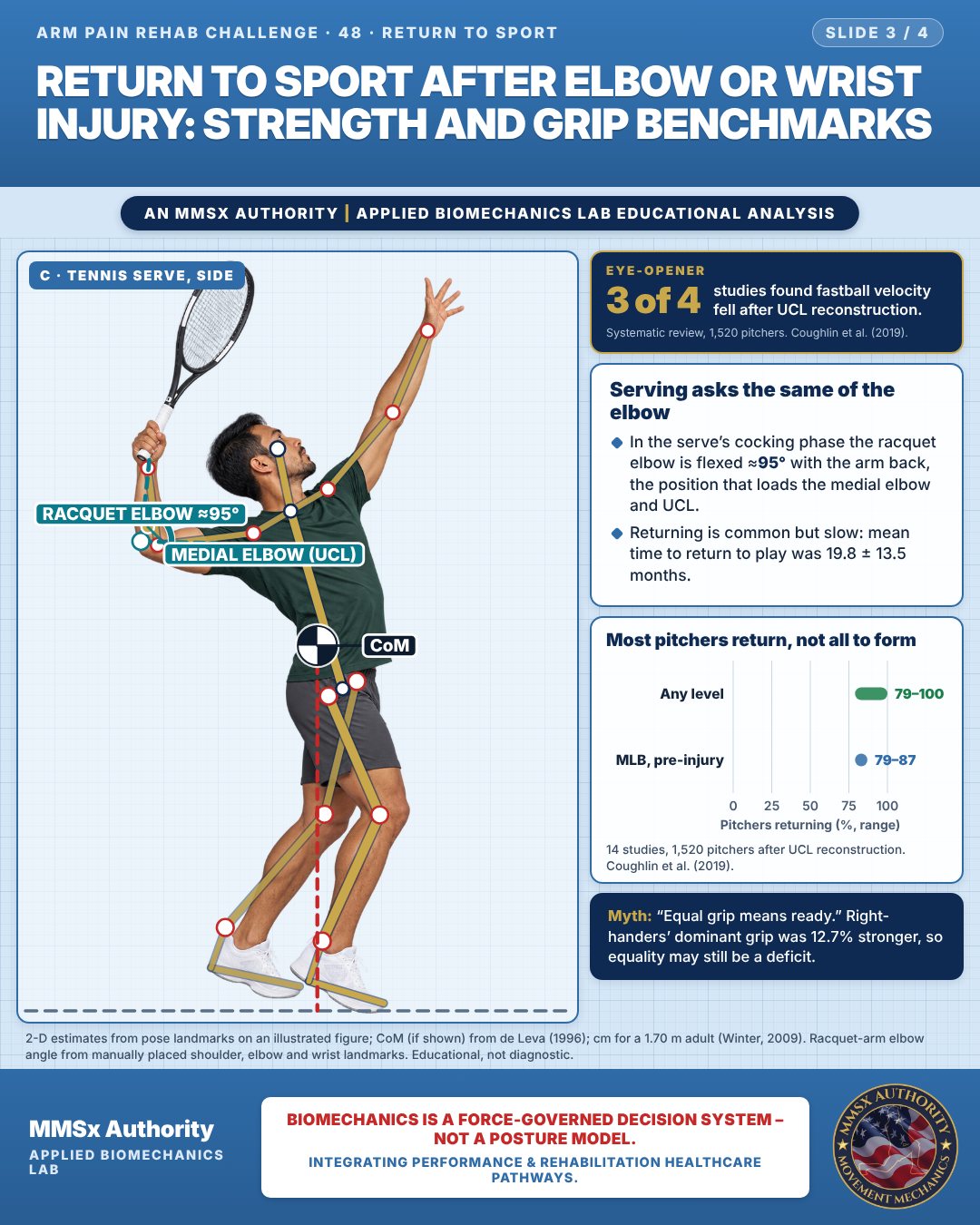
Serving asks the same of the elbow
In the serve’s cocking phase the racquet elbow is flexed ≈95° with the arm back, the position that loads the medial elbow and UCL.
Returning is common but slow: mean time to return to play was 19.8 ± 13.5 months.
Most pitchers return, not all to form
Decision pathway
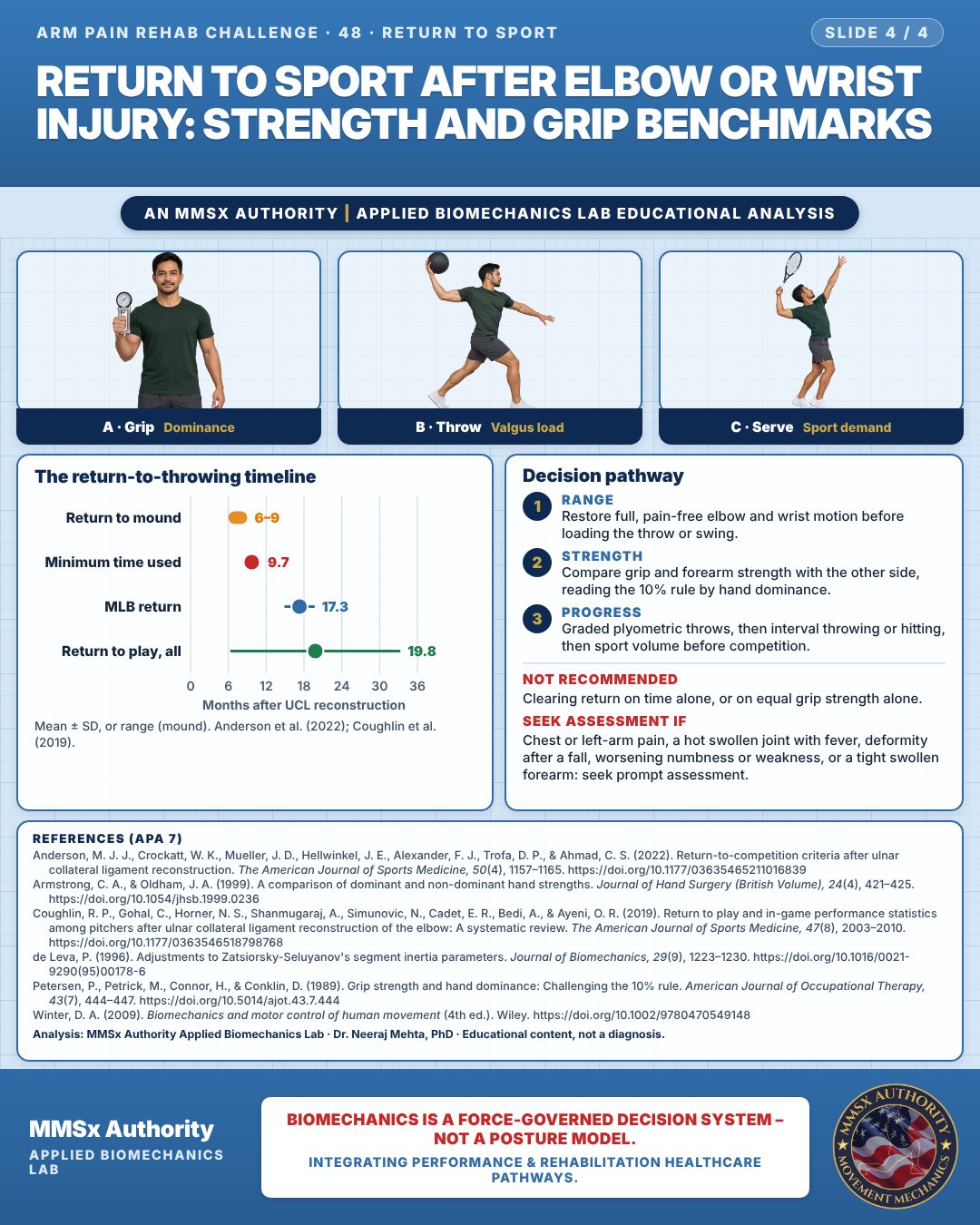
The return-to-throwing timeline
Range
Restore full, pain-free elbow and wrist motion before loading the throw or swing.
Strength
Compare grip and forearm strength with the other side, reading the 10% rule by hand dominance.
Progress
Graded plyometric throws, then interval throwing or hitting, then sport volume before competition.
Myth and evidence
Myth“Once the grip is equal to the other hand, you are ready.”
EvidenceFor left-handers the hands are normally almost equal (−0.08%), and for right-handers the dominant hand is about 12.7% stronger (Petersen et al., 1989), so equality may still be a deficit in a right-handed athlete's dominant hand; and grip is only one of several criteria (Anderson et al., 2022).
Cautions
Not recommended
Clearing return on time alone, or on equal grip strength alone.
Seek assessment if
Chest or left-arm pain, a hot swollen joint with fever, deformity after a fall, worsening numbness or weakness, or a tight swollen forearm: seek prompt assessment.
Methods note
2-D estimates from pose landmarks on an illustrated figure (head-to-hip framing); lengths scaled to a 1.70 m adult (Winter, 2009). Grip direction and forearm anatomy marked on the figure; the foreshortened grip arm is not measured. 2-D estimates from pose landmarks on an illustrated figure; CoM (if shown) from de Leva (1996); cm for a 1.70 m adult (Winter, 2009). Elbow angle from pose landmarks. Racquet-arm elbow angle from manually placed shoulder, elbow and wrist landmarks. These are educational estimates, not a diagnosis.
References
- Anderson, M. J. J., Crockatt, W. K., Mueller, J. D., Hellwinkel, J. E., Alexander, F. J., Trofa, D. P., & Ahmad, C. S. (2022). Return-to-competition criteria after ulnar collateral ligament reconstruction. The American Journal of Sports Medicine, 50(4), 1157–1165. https://doi.org/10.1177/03635465211016839
- Armstrong, C. A., & Oldham, J. A. (1999). A comparison of dominant and non-dominant hand strengths. Journal of Hand Surgery (British Volume), 24(4), 421–425. https://doi.org/10.1054/jhsb.1999.0236
- Coughlin, R. P., Gohal, C., Horner, N. S., Shanmugaraj, A., Simunovic, N., Cadet, E. R., Bedi, A., & Ayeni, O. R. (2019). Return to play and in-game performance statistics among pitchers after ulnar collateral ligament reconstruction of the elbow: A systematic review. The American Journal of Sports Medicine, 47(8), 2003–2010. https://doi.org/10.1177/0363546518798768
- de Leva, P. (1996). Adjustments to Zatsiorsky-Seluyanov's segment inertia parameters. Journal of Biomechanics, 29(9), 1223–1230. https://doi.org/10.1016/0021-9290(95)00178-6
- Petersen, P., Petrick, M., Connor, H., & Conklin, D. (1989). Grip strength and hand dominance: Challenging the 10% rule. American Journal of Occupational Therapy, 43(7), 444–447. https://doi.org/10.5014/ajot.43.7.444
- Winter, D. A. (2009). Biomechanics and motor control of human movement (4th ed.). Wiley. https://doi.org/10.1002/9780470549148
Cite this article
Mehta, N. (2026, October 28). Return to sport after elbow or wrist injury: strength and grip benchmarks. MMSx Authority Applied Biomechanics Lab. https://mmsxauthority.org/edu/analysis/arm/48-return-to-sport-after-elbow-or-wrist-injury-strength-and-grip/
Part of the collection
Mehta, N. (2026). Elbow, Forearm, Wrist and Hand Rehabilitation: 50 Evidence-Based Biomechanics Analyses [Collection]. MMSx Authority Applied Biomechanics Lab. Zenodo. https://doi.org/10.5281/zenodo.23735910
All Arm Pain Rehab Challenge articles · Rehabilitation Library