Arm Pain Rehab Challenge · 50
Arm, wrist and hand red flags: when pain needs urgent medical care
A red flag is a sign or symptom suggesting serious pathology — cardiac, vascular, infective, traumatic or neurological — that needs urgent medical…
Key points
- Call now. Chest discomfort with arm, jaw or shoulder pain, sweating, nausea or breathlessness: call emergency services.
- Same day. Escalating forearm pain after injury or a cast, pain on passive finger stretch, a hot bent finger, a cold pale hand.
- Within days. Thumb-side wrist pain after a fall: splint and further imaging even if the first X-ray is normal.
What it is
A red flag is a sign or symptom suggesting serious pathology — cardiac, vascular, infective, traumatic or neurological — that needs urgent medical assessment rather than exercise or self-management. Red flags raise probability; they do not diagnose.
How we analysed the movement
Three movements relevant to this topic were analysed from illustrated reference figures. Joint centres were located with two-dimensional pose estimation where the whole arm was visible; elbow and wrist angles, and the directions of external load and tendon pull, were then drawn on the figure; on hand close-ups, where pose estimation does not apply, the landmarks were placed manually. The figures are educational estimates that show how position changes mechanical demand; they are not measurements of a patient. Every research value quoted below comes from the published source cited beside it.
Movement A: Chest and arm pain (front view)
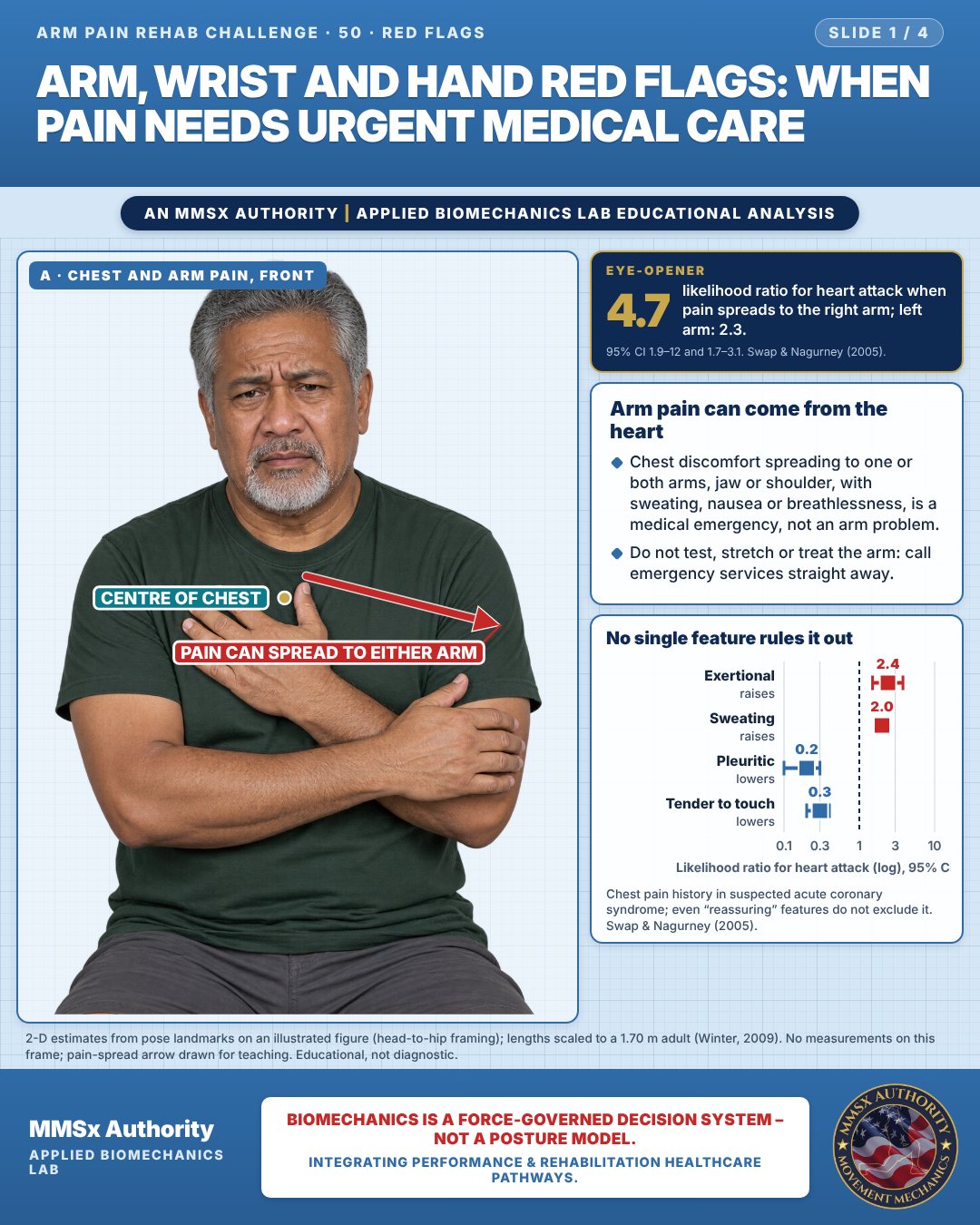
Arm pain can come from the heart
Chest discomfort spreading to one or both arms, jaw or shoulder, with sweating, nausea or breathlessness, is a medical emergency, not an arm problem.
Do not test, stretch or treat the arm: call emergency services straight away.
No single feature rules it out
Movement B: After a fall (side view)
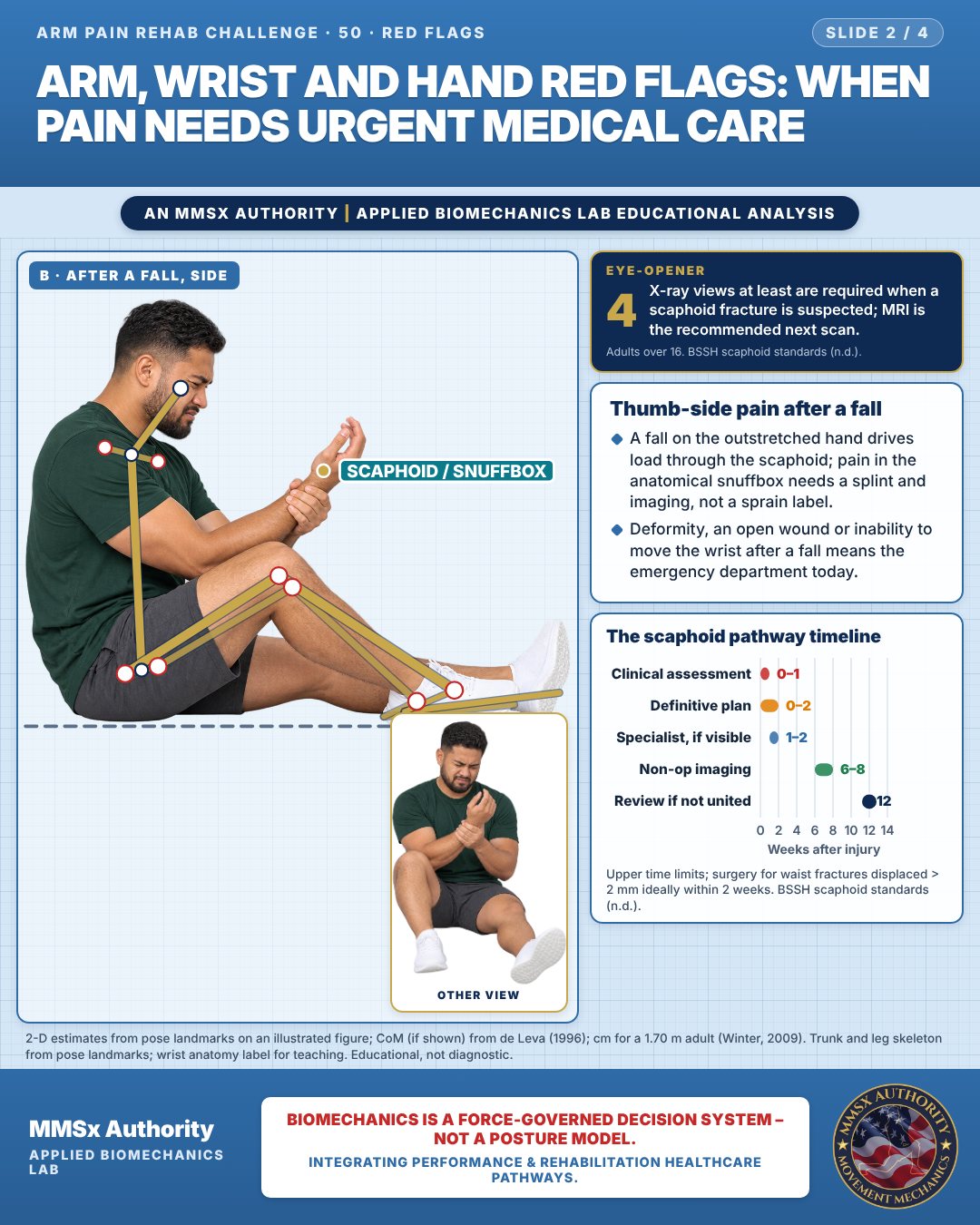
Thumb-side pain after a fall
A fall on the outstretched hand drives load through the scaphoid; pain in the anatomical snuffbox needs a splint and imaging, not a sprain label.
Deformity, an open wound or inability to move the wrist after a fall means the emergency department today.
The scaphoid pathway timeline
Movement C: Forearm and hand, top
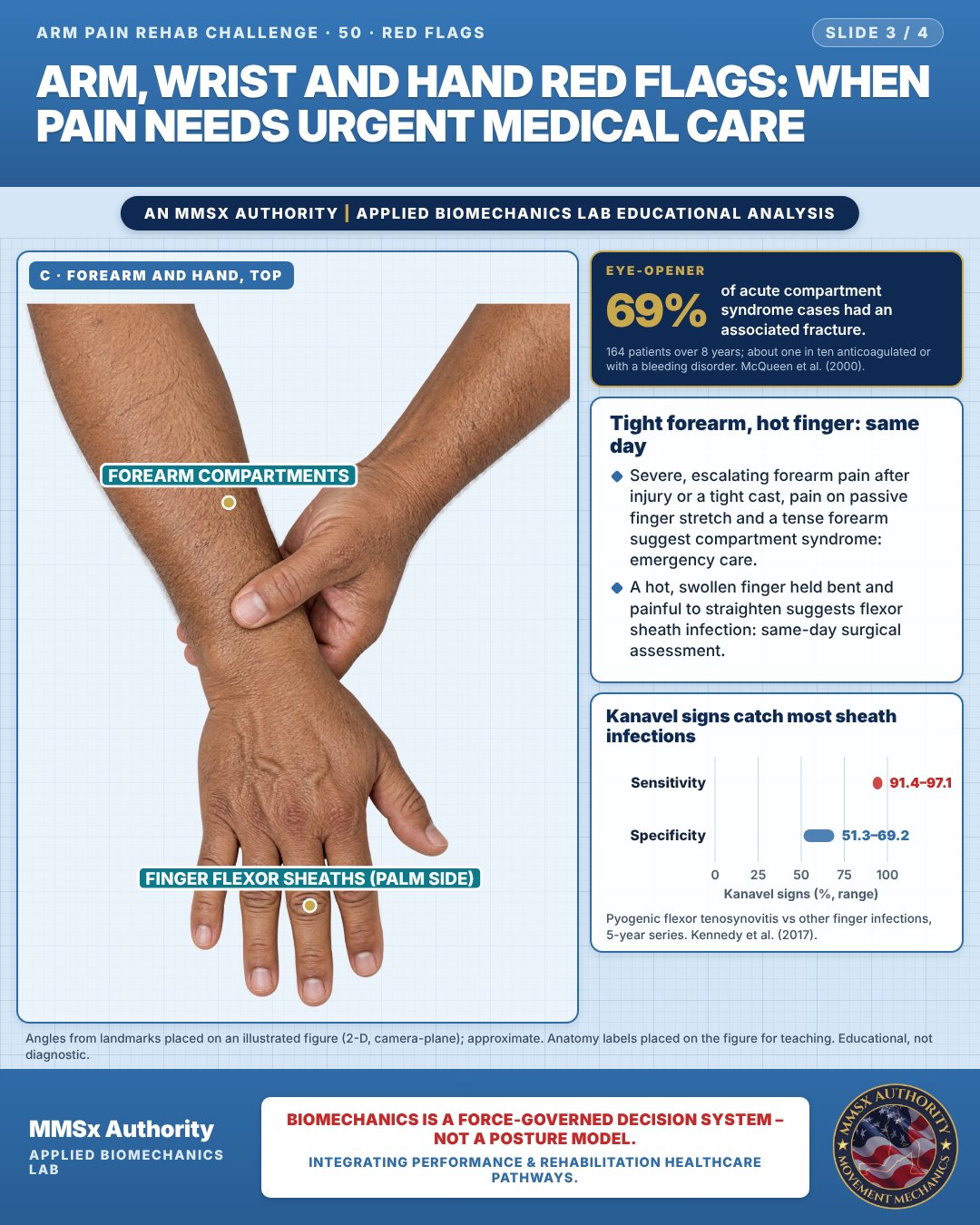
Tight forearm, hot finger: same day
Severe, escalating forearm pain after injury or a tight cast, pain on passive finger stretch and a tense forearm suggest compartment syndrome: emergency care.
A hot, swollen finger held bent and painful to straighten suggests flexor sheath infection: same-day surgical assessment.
Kanavel signs catch most sheath infections
Decision pathway
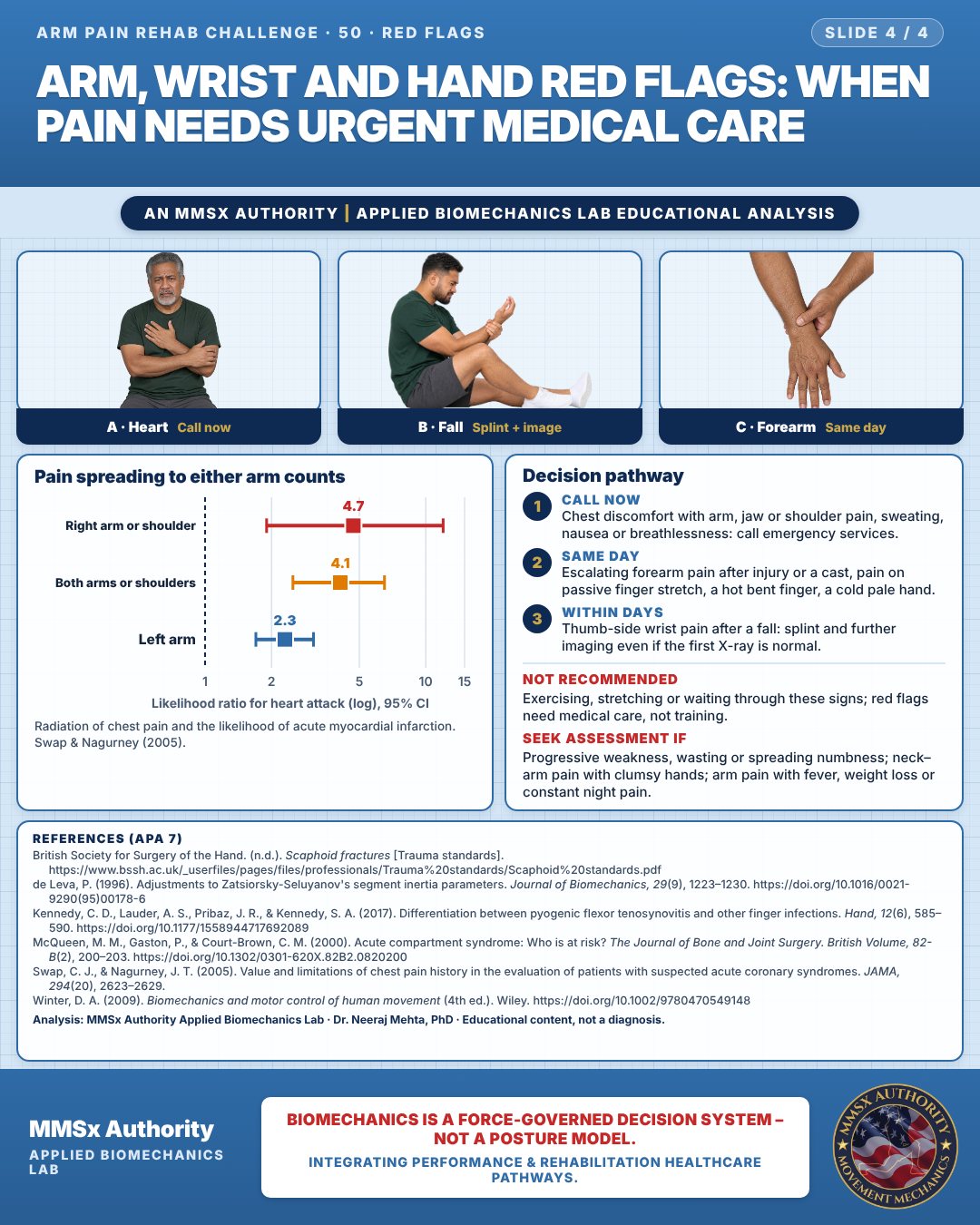
Pain spreading to either arm counts
Call now
Chest discomfort with arm, jaw or shoulder pain, sweating, nausea or breathlessness: call emergency services.
Same day
Escalating forearm pain after injury or a cast, pain on passive finger stretch, a hot bent finger, a cold pale hand.
Within days
Thumb-side wrist pain after a fall: splint and further imaging even if the first X-ray is normal.
Myth and evidence
Myth“Heart pain only goes down the left arm.”
EvidenceRadiation to the right arm (LR 4.7) or both arms (LR 4.1) was more strongly associated with AMI than left-arm radiation (LR 2.3) (Swap & Nagurney, 2005). Also: "A normal wrist X-ray after a fall means it's a sprain" — the BSSH standards require splinting and further imaging (MRI preferred) when a scaphoid fracture is suspected despite normal radiographs.
Cautions
Not recommended
Exercising, stretching or waiting through these signs; red flags need medical care, not training.
Seek assessment if
Progressive weakness, wasting or spreading numbness; neck–arm pain with clumsy hands; arm pain with fever, weight loss or constant night pain.
Methods note
2-D estimates from pose landmarks on an illustrated figure (head-to-hip framing); lengths scaled to a 1.70 m adult (Winter, 2009). No measurements on this frame; pain-spread arrow drawn for teaching. 2-D estimates from pose landmarks on an illustrated figure; CoM (if shown) from de Leva (1996); cm for a 1.70 m adult (Winter, 2009). Trunk and leg skeleton from pose landmarks; wrist anatomy label for teaching. Angles from landmarks placed on an illustrated figure (2-D, camera-plane); approximate. Anatomy labels placed on the figure for teaching. These are educational estimates, not a diagnosis.
References
- British Society for Surgery of the Hand. (n.d.). Scaphoid fractures [Trauma standards]. https://www.bssh.ac.uk/_userfiles/pages/files/professionals/Trauma%20standards/Scaphoid%20standards.pdf
- de Leva, P. (1996). Adjustments to Zatsiorsky-Seluyanov's segment inertia parameters. Journal of Biomechanics, 29(9), 1223–1230. https://doi.org/10.1016/0021-9290(95)00178-6
- Kennedy, C. D., Lauder, A. S., Pribaz, J. R., & Kennedy, S. A. (2017). Differentiation between pyogenic flexor tenosynovitis and other finger infections. Hand, 12(6), 585–590. https://doi.org/10.1177/1558944717692089
- McQueen, M. M., Gaston, P., & Court-Brown, C. M. (2000). Acute compartment syndrome: Who is at risk? The Journal of Bone and Joint Surgery. British Volume, 82-B(2), 200–203. https://doi.org/10.1302/0301-620X.82B2.0820200
- Swap, C. J., & Nagurney, J. T. (2005). Value and limitations of chest pain history in the evaluation of patients with suspected acute coronary syndromes. JAMA, 294(20), 2623–2629.
- Winter, D. A. (2009). Biomechanics and motor control of human movement (4th ed.). Wiley. https://doi.org/10.1002/9780470549148
Cite this article
Mehta, N. (2026, October 28). Arm, wrist and hand red flags: when pain needs urgent medical care. MMSx Authority Applied Biomechanics Lab. https://mmsxauthority.org/edu/analysis/arm/50-arm-wrist-and-hand-red-flags-when-pain-needs-urgent-medical-care/
Part of the collection
Mehta, N. (2026). Elbow, Forearm, Wrist and Hand Rehabilitation: 50 Evidence-Based Biomechanics Analyses [Collection]. MMSx Authority Applied Biomechanics Lab. Zenodo. https://doi.org/10.5281/zenodo.23735910
All Arm Pain Rehab Challenge articles · Rehabilitation Library