Arm Pain Rehab Challenge · 47
Repetitive strain injury at work: a mechanical approach to RSI
"Repetitive strain injury" (RSI) is an umbrella, non-diagnostic term for work-related upper-limb pain conditions (e.g.
Key points
- Identify. Find the dominant exposure: hand force, repetition, wrist posture or vibration.
- Reduce. Lower grip force, rotate tasks, keep wrists near neutral, limit vibration time and support the forearms.
- Break. Add short breaks; do not rely on ergonomic training alone, which did not reduce upper-limb pain.
What it is
"Repetitive strain injury" (RSI) is an umbrella, non-diagnostic term for work-related upper-limb pain conditions (e.g. carpal tunnel syndrome, tendinopathies, non-specific forearm pain) associated with force, repetition, awkward wrist posture, vibration and insufficient recovery time. A mechanical approach identifies which exposure dominates and changes that dose.
How we analysed the movement
Three movements relevant to this topic were analysed from illustrated reference figures. Joint centres were located with two-dimensional pose estimation where the whole arm was visible; elbow and wrist angles, and the directions of external load and tendon pull, were then drawn on the figure; on hand close-ups, where pose estimation does not apply, the landmarks were placed manually. The figures are educational estimates that show how position changes mechanical demand; they are not measurements of a patient. Every research value quoted below comes from the published source cited beside it.
Movement A: Bench assembly (side view)
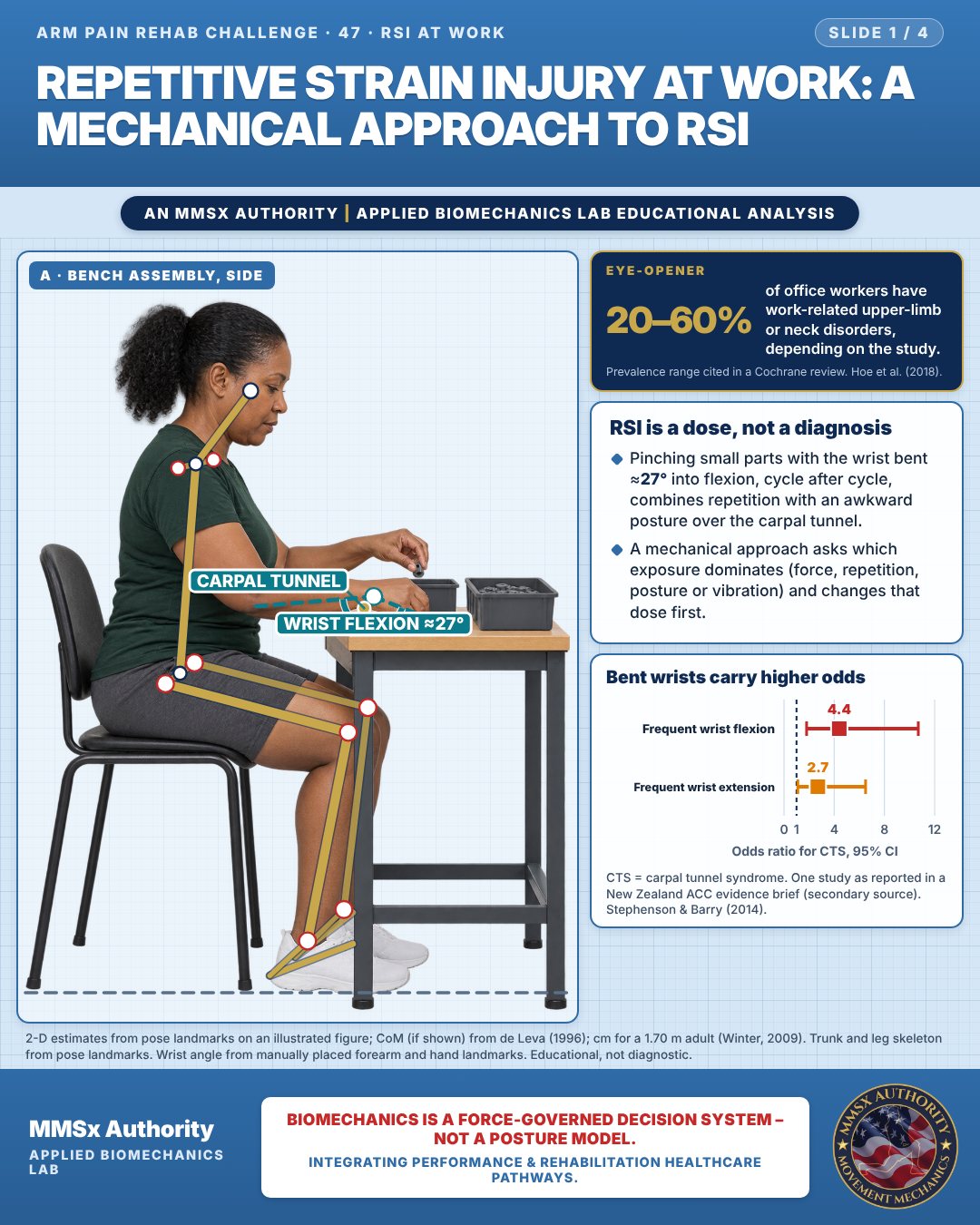
RSI is a dose, not a diagnosis
Pinching small parts with the wrist bent ≈27° into flexion, cycle after cycle, combines repetition with an awkward posture over the carpal tunnel.
A mechanical approach asks which exposure dominates (force, repetition, posture or vibration) and changes that dose first.
Bent wrists carry higher odds
Movement B: Drill at chest (side view)
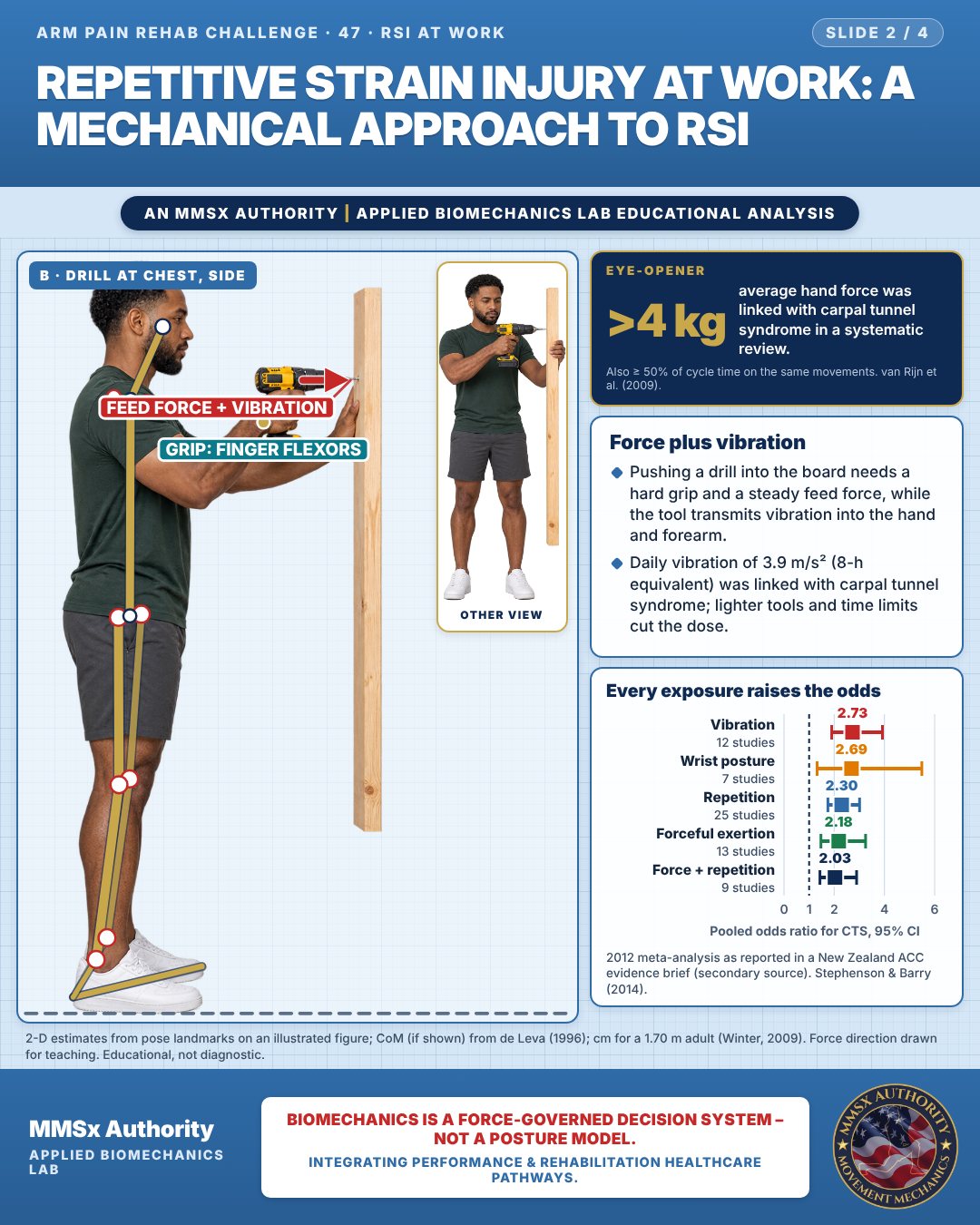
Force plus vibration
Pushing a drill into the board needs a hard grip and a steady feed force, while the tool transmits vibration into the hand and forearm.
Daily vibration of 3.9 m/s² (8-h equivalent) was linked with carpal tunnel syndrome; lighter tools and time limits cut the dose.
Every exposure raises the odds
Movement C: Wrist stretch break (side view)
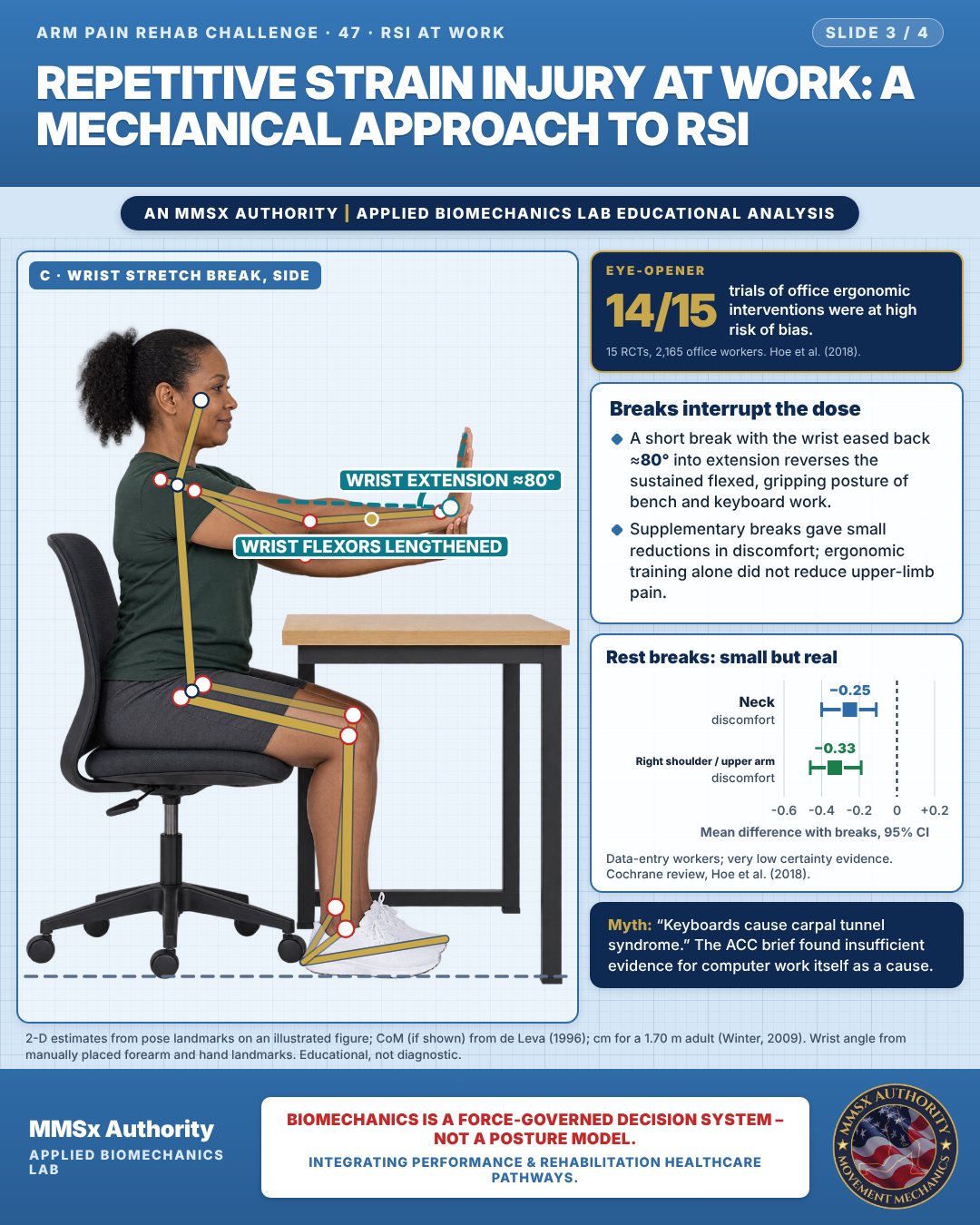
Breaks interrupt the dose
A short break with the wrist eased back ≈80° into extension reverses the sustained flexed, gripping posture of bench and keyboard work.
Supplementary breaks gave small reductions in discomfort; ergonomic training alone did not reduce upper-limb pain.
Rest breaks: small but real
Decision pathway
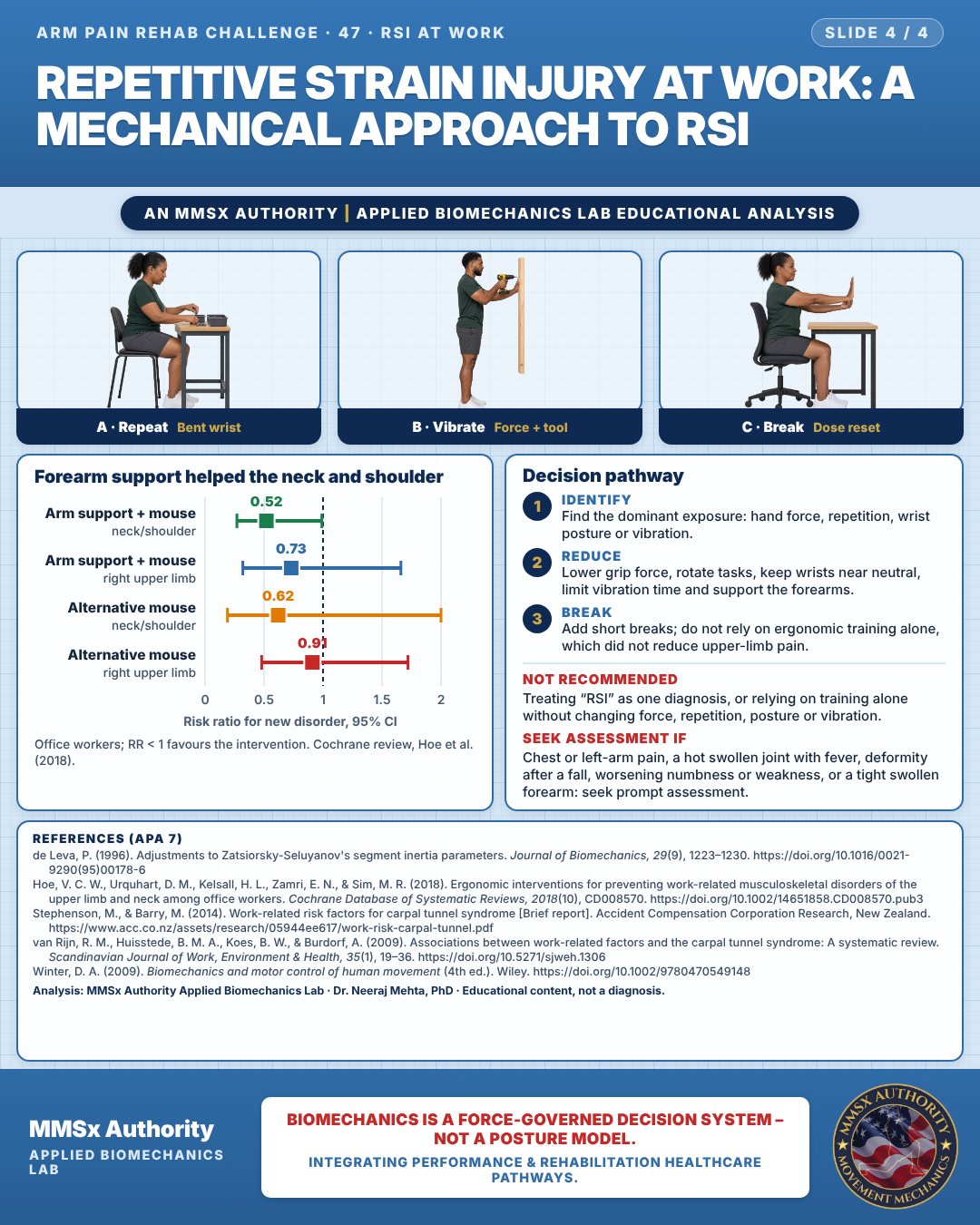
Forearm support helped the neck and shoulder
Identify
Find the dominant exposure: hand force, repetition, wrist posture or vibration.
Reduce
Lower grip force, rotate tasks, keep wrists near neutral, limit vibration time and support the forearms.
Break
Add short breaks; do not rely on ergonomic training alone, which did not reduce upper-limb pain.
Cautions
Not recommended
Treating “RSI” as one diagnosis, or relying on training alone without changing force, repetition, posture or vibration.
Seek assessment if
Chest or left-arm pain, a hot swollen joint with fever, deformity after a fall, worsening numbness or weakness, or a tight swollen forearm: seek prompt assessment.
Methods note
2-D estimates from pose landmarks on an illustrated figure; CoM (if shown) from de Leva (1996); cm for a 1.70 m adult (Winter, 2009). Trunk and leg skeleton from pose landmarks. Wrist angle from manually placed forearm and hand landmarks. Force direction drawn for teaching. These are educational estimates, not a diagnosis.
References
- de Leva, P. (1996). Adjustments to Zatsiorsky-Seluyanov's segment inertia parameters. Journal of Biomechanics, 29(9), 1223–1230. https://doi.org/10.1016/0021-9290(95)00178-6
- Hoe, V. C. W., Urquhart, D. M., Kelsall, H. L., Zamri, E. N., & Sim, M. R. (2018). Ergonomic interventions for preventing work-related musculoskeletal disorders of the upper limb and neck among office workers. Cochrane Database of Systematic Reviews, 2018(10), CD008570. https://doi.org/10.1002/14651858.CD008570.pub3
- Stephenson, M., & Barry, M. (2014). Work-related risk factors for carpal tunnel syndrome [Brief report]. Accident Compensation Corporation Research, New Zealand. https://www.acc.co.nz/assets/research/05944ee617/work-risk-carpal-tunnel.pdf
- van Rijn, R. M., Huisstede, B. M. A., Koes, B. W., & Burdorf, A. (2009). Associations between work-related factors and the carpal tunnel syndrome: A systematic review. Scandinavian Journal of Work, Environment & Health, 35(1), 19–36. https://doi.org/10.5271/sjweh.1306
- Winter, D. A. (2009). Biomechanics and motor control of human movement (4th ed.). Wiley. https://doi.org/10.1002/9780470549148
Cite this article
Mehta, N. (2026, October 28). Repetitive strain injury at work: a mechanical approach to RSI. MMSx Authority Applied Biomechanics Lab. https://mmsxauthority.org/edu/analysis/arm/47-repetitive-strain-injury-at-work-a-mechanical-approach-to-rsi/
Part of the collection
Mehta, N. (2026). Elbow, Forearm, Wrist and Hand Rehabilitation: 50 Evidence-Based Biomechanics Analyses [Collection]. MMSx Authority Applied Biomechanics Lab. Zenodo. https://doi.org/10.5281/zenodo.23735910
All Arm Pain Rehab Challenge articles · Rehabilitation Library