Arm Pain Rehab Challenge · 46
Arm tendon pain and load: the stress-shielding and overload balance
Tendons adapt to the loads they receive: too little load (rest, slings, immobilisation — "stress shielding") lowers stiffness and strength, while…
Key points
- Unload briefly. Use a sling or rest only as prescribed after acute injury or surgery, then reintroduce load.
- Load. Progress isometric, then slow heavy, then functional work such as wrist roller and hammer curl.
- Monitor. Check pain the next day; if it escalates, reduce dose and allow 48–72 h before the next heavy session.
What it is
Tendons adapt to the loads they receive: too little load (rest, slings, immobilisation — "stress shielding") lowers stiffness and strength, while load that rises faster than the tendon can adapt provokes pain and tendinopathy. Rehabilitation aims for the middle — progressive, tolerable loading.
How we analysed the movement
Three movements relevant to this topic were analysed from illustrated reference figures. Joint centres were located with two-dimensional pose estimation where the whole arm was visible; elbow and wrist angles, and the directions of external load and tendon pull, were then drawn on the figure; on hand close-ups, where pose estimation does not apply, the landmarks were placed manually. The figures are educational estimates that show how position changes mechanical demand; they are not measurements of a patient. Every research value quoted below comes from the published source cited beside it.
Movement A: Wrist roller (side view)
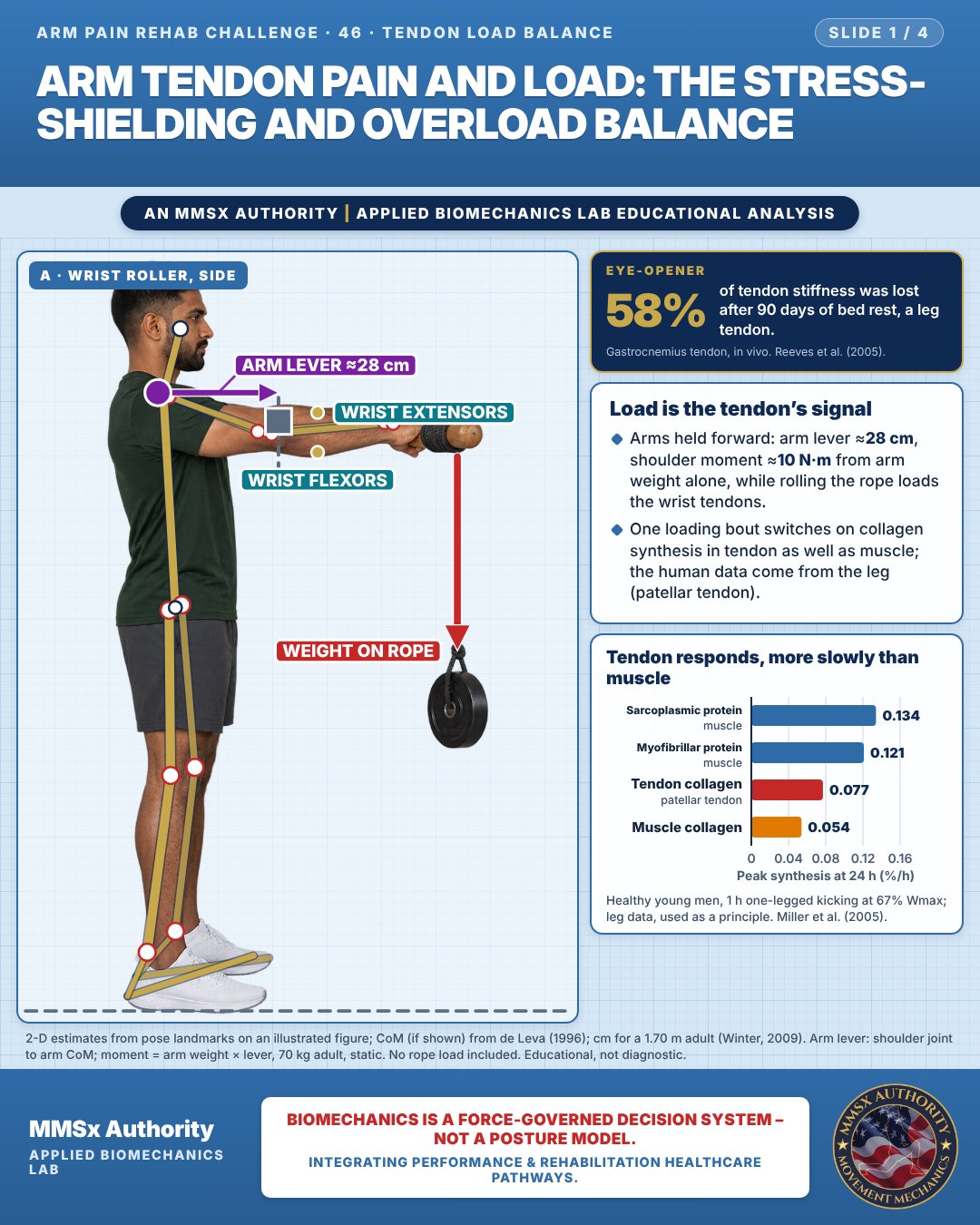
Load is the tendon’s signal
Arms held forward: arm lever ≈28 cm, shoulder moment ≈10 N·m from arm weight alone, while rolling the rope loads the wrist tendons.
One loading bout switches on collagen synthesis in tendon as well as muscle; the human data come from the leg (patellar tendon).
Tendon responds, more slowly than muscle
Movement B: Arm in sling (front view)
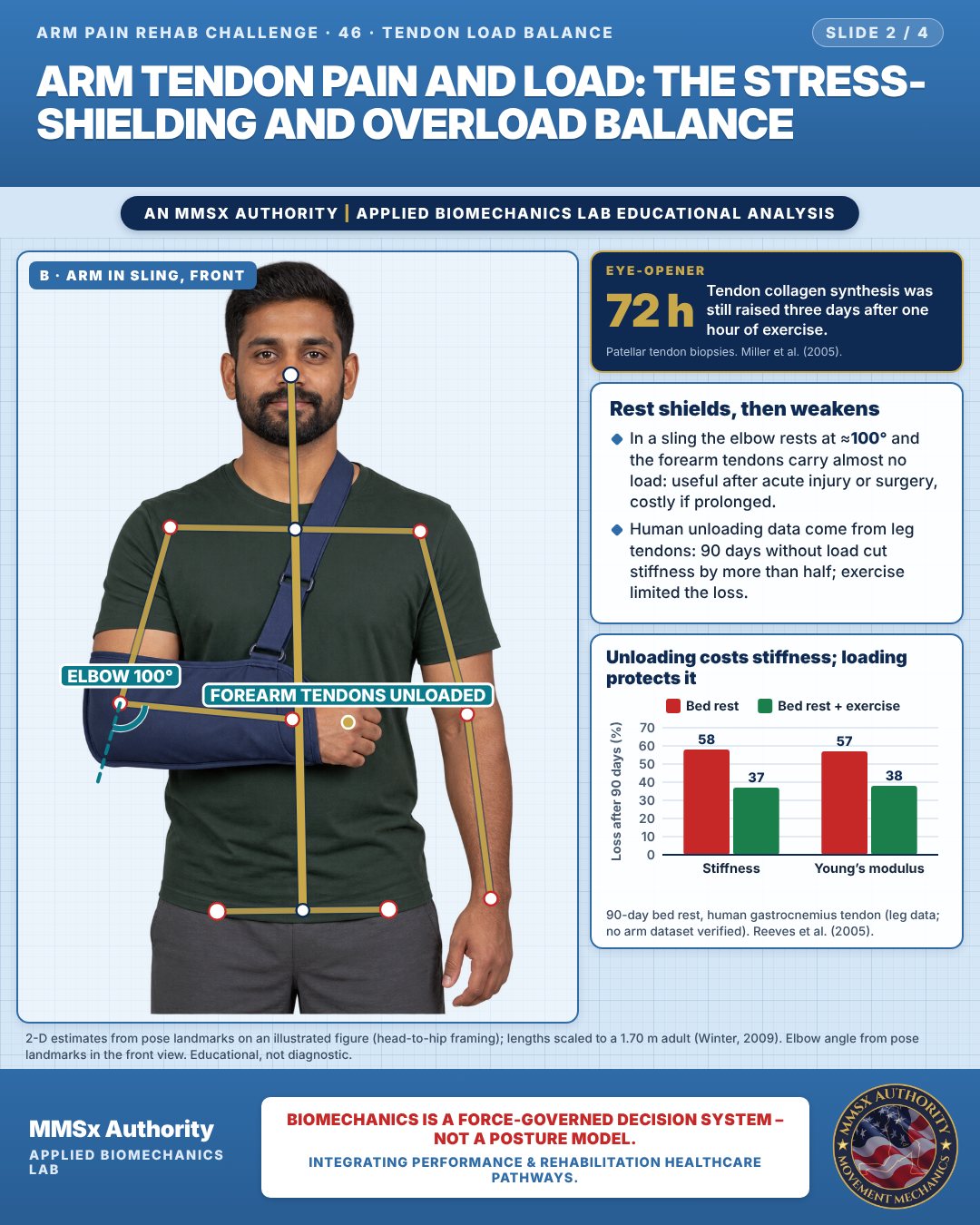
Rest shields, then weakens
In a sling the elbow rests at ≈100° and the forearm tendons carry almost no load: useful after acute injury or surgery, costly if prolonged.
Human unloading data come from leg tendons: 90 days without load cut stiffness by more than half; exercise limited the loss.
Unloading costs stiffness; loading protects it
Movement C: Hammer curl (side view)
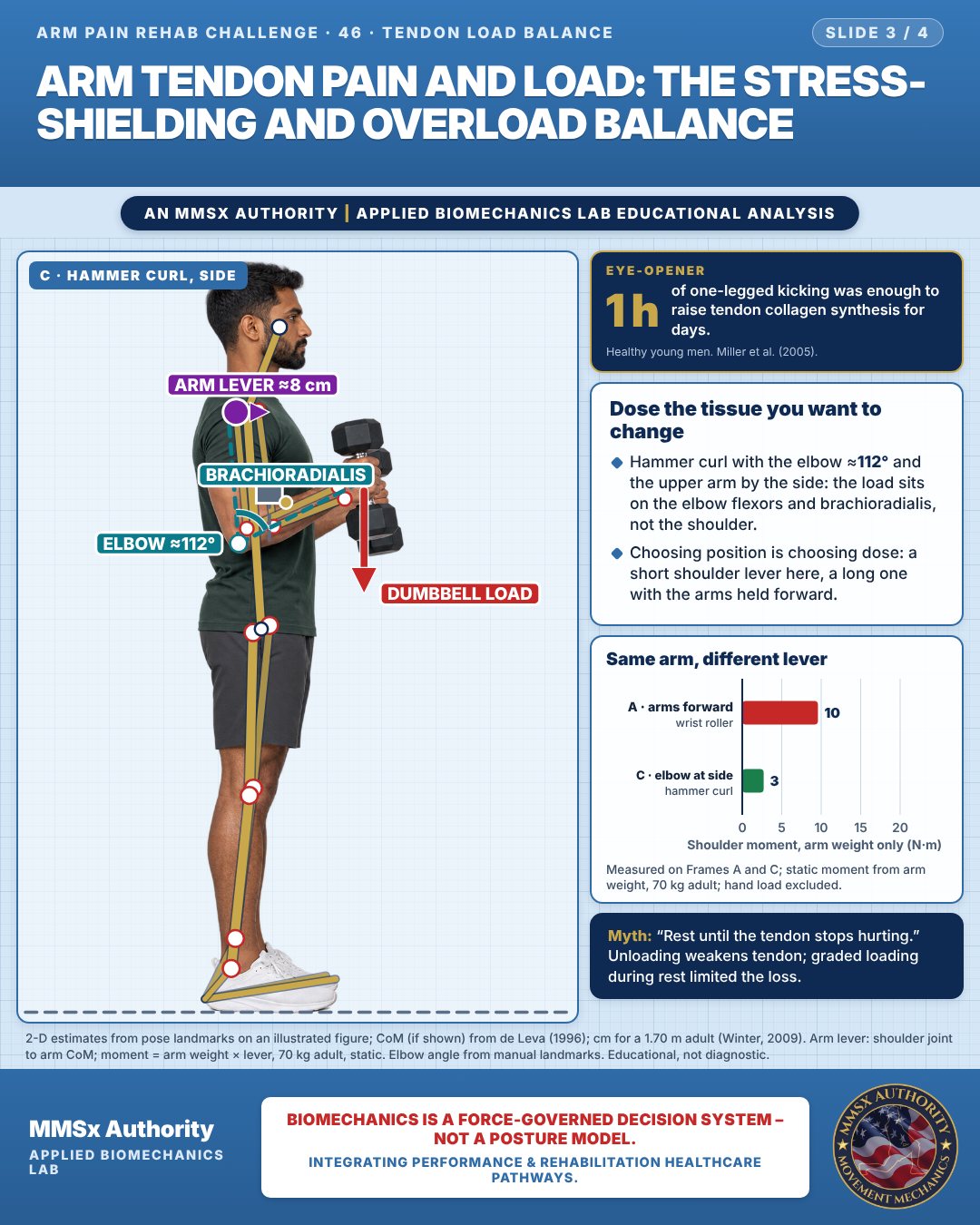
Dose the tissue you want to change
Hammer curl with the elbow ≈112° and the upper arm by the side: the load sits on the elbow flexors and brachioradialis, not the shoulder.
Choosing position is choosing dose: a short shoulder lever here, a long one with the arms held forward.
Same arm, different lever
Decision pathway
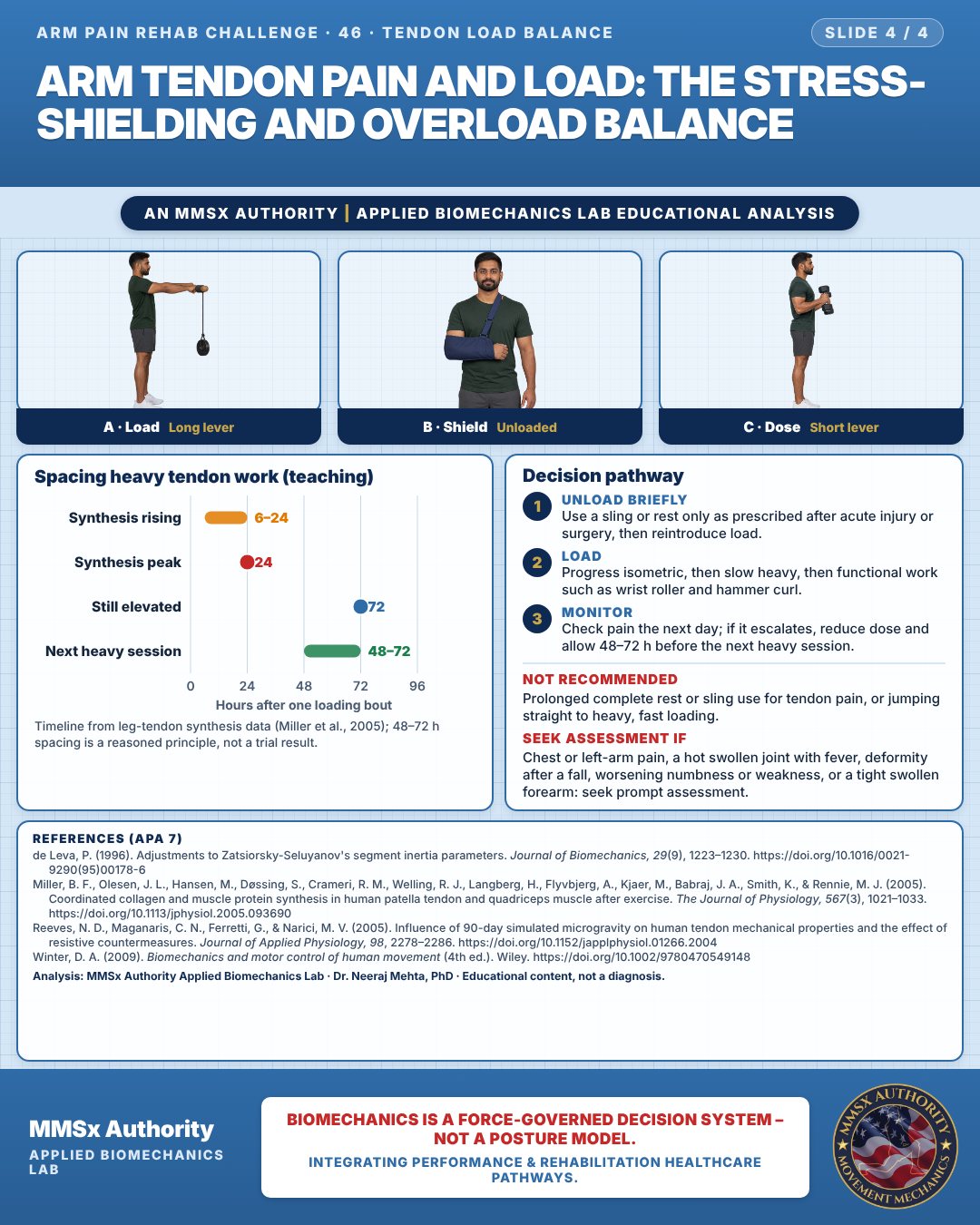
Spacing heavy tendon work (teaching)
Unload briefly
Use a sling or rest only as prescribed after acute injury or surgery, then reintroduce load.
Load
Progress isometric, then slow heavy, then functional work such as wrist roller and hammer curl.
Monitor
Check pain the next day; if it escalates, reduce dose and allow 48–72 h before the next heavy session.
Myth and evidence
Myth“Rest until the tendon stops hurting.”
EvidenceUnloading reduced tendon stiffness by 58% in 90 days, while loading during the same period limited the loss to 37% (Reeves et al., 2005); tendons respond to a loading bout with increased collagen synthesis for up to 72 h (Miller et al., 2005).
Cautions
Not recommended
Prolonged complete rest or sling use for tendon pain, or jumping straight to heavy, fast loading.
Seek assessment if
Chest or left-arm pain, a hot swollen joint with fever, deformity after a fall, worsening numbness or weakness, or a tight swollen forearm: seek prompt assessment.
Methods note
2-D estimates from pose landmarks on an illustrated figure; CoM (if shown) from de Leva (1996); cm for a 1.70 m adult (Winter, 2009). Arm lever: shoulder joint to arm CoM; moment = arm weight × lever, 70 kg adult, static. No rope load included. 2-D estimates from pose landmarks on an illustrated figure (head-to-hip framing); lengths scaled to a 1.70 m adult (Winter, 2009). Elbow angle from pose landmarks in the front view. Elbow angle from manual landmarks. These are educational estimates, not a diagnosis.
References
- de Leva, P. (1996). Adjustments to Zatsiorsky-Seluyanov's segment inertia parameters. Journal of Biomechanics, 29(9), 1223–1230. https://doi.org/10.1016/0021-9290(95)00178-6
- Miller, B. F., Olesen, J. L., Hansen, M., Døssing, S., Crameri, R. M., Welling, R. J., Langberg, H., Flyvbjerg, A., Kjaer, M., Babraj, J. A., Smith, K., & Rennie, M. J. (2005). Coordinated collagen and muscle protein synthesis in human patella tendon and quadriceps muscle after exercise. The Journal of Physiology, 567(3), 1021–1033. https://doi.org/10.1113/jphysiol.2005.093690
- Reeves, N. D., Maganaris, C. N., Ferretti, G., & Narici, M. V. (2005). Influence of 90-day simulated microgravity on human tendon mechanical properties and the effect of resistive countermeasures. Journal of Applied Physiology, 98, 2278–2286. https://doi.org/10.1152/japplphysiol.01266.2004
- Winter, D. A. (2009). Biomechanics and motor control of human movement (4th ed.). Wiley. https://doi.org/10.1002/9780470549148
Cite this article
Mehta, N. (2026, October 28). Arm tendon pain and load: the stress-shielding and overload balance. MMSx Authority Applied Biomechanics Lab. https://mmsxauthority.org/edu/analysis/arm/46-arm-tendon-pain-and-load-the-stress-shielding-and-overload-balance/
Part of the collection
Mehta, N. (2026). Elbow, Forearm, Wrist and Hand Rehabilitation: 50 Evidence-Based Biomechanics Analyses [Collection]. MMSx Authority Applied Biomechanics Lab. Zenodo. https://doi.org/10.5281/zenodo.23735910
All Arm Pain Rehab Challenge articles · Rehabilitation Library