Arm Pain Rehab Challenge · 45
Thoracic outlet syndrome: arm heaviness with overhead work
Thoracic outlet syndrome (TOS) is compression of the brachial plexus (neurogenic TOS), subclavian vein (venous) or subclavian artery (arterial) as…
Key points
- Modify. Cut sustained overhead work and heavy one-strap carrying; break up reaching with arm-down rests.
- Load. Physiotherapy for 8–12 weeks: scapular control, scalene and pectoral mobility, nerve gliding.
- Refer. Disabling symptoms after 8–12 weeks of conservative care: specialist review and investigations.
What it is
Thoracic outlet syndrome (TOS) is compression of the brachial plexus (neurogenic TOS), subclavian vein (venous) or subclavian artery (arterial) as they pass between the scalene muscles, first rib, clavicle and pectoralis minor; neurogenic TOS causes arm heaviness, paraesthesia and fatigue, typically worse with sustained overhead or loaded-shoulder positions.
How we analysed the movement
Three movements relevant to this topic were analysed from illustrated reference figures. Joint centres were located with two-dimensional pose estimation where the whole arm was visible; elbow and wrist angles, and the directions of external load and tendon pull, were then drawn on the figure; on hand close-ups, where pose estimation does not apply, the landmarks were placed manually. The figures are educational estimates that show how position changes mechanical demand; they are not measurements of a patient. Every research value quoted below comes from the published source cited beside it.
Movement A: Overhead shelf reach (front view)
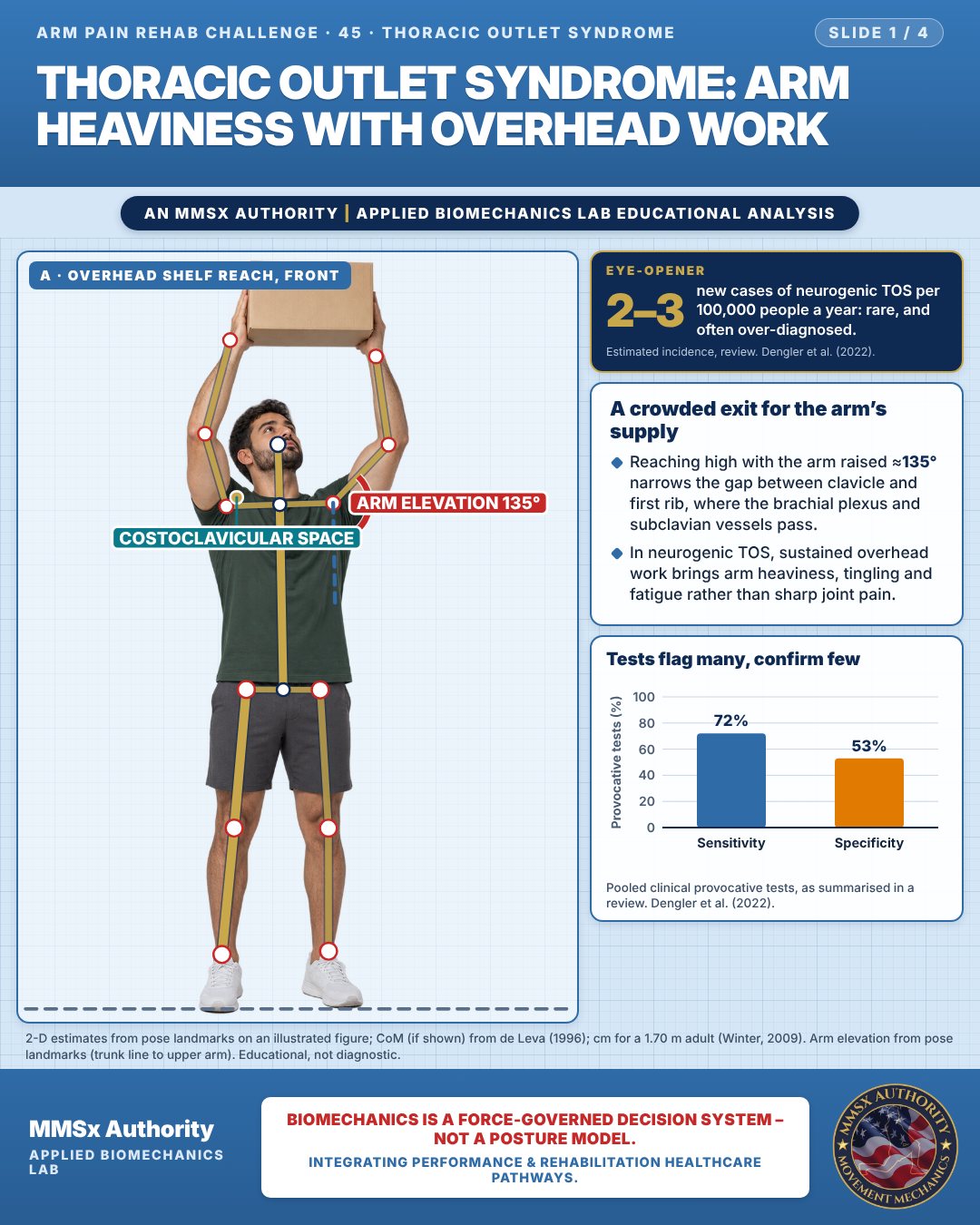
A crowded exit for the arm’s supply
Reaching high with the arm raised ≈135° narrows the gap between clavicle and first rib, where the brachial plexus and subclavian vessels pass.
In neurogenic TOS, sustained overhead work brings arm heaviness, tingling and fatigue rather than sharp joint pain.
Tests flag many, confirm few
Movement B: Hands-up position (front view)
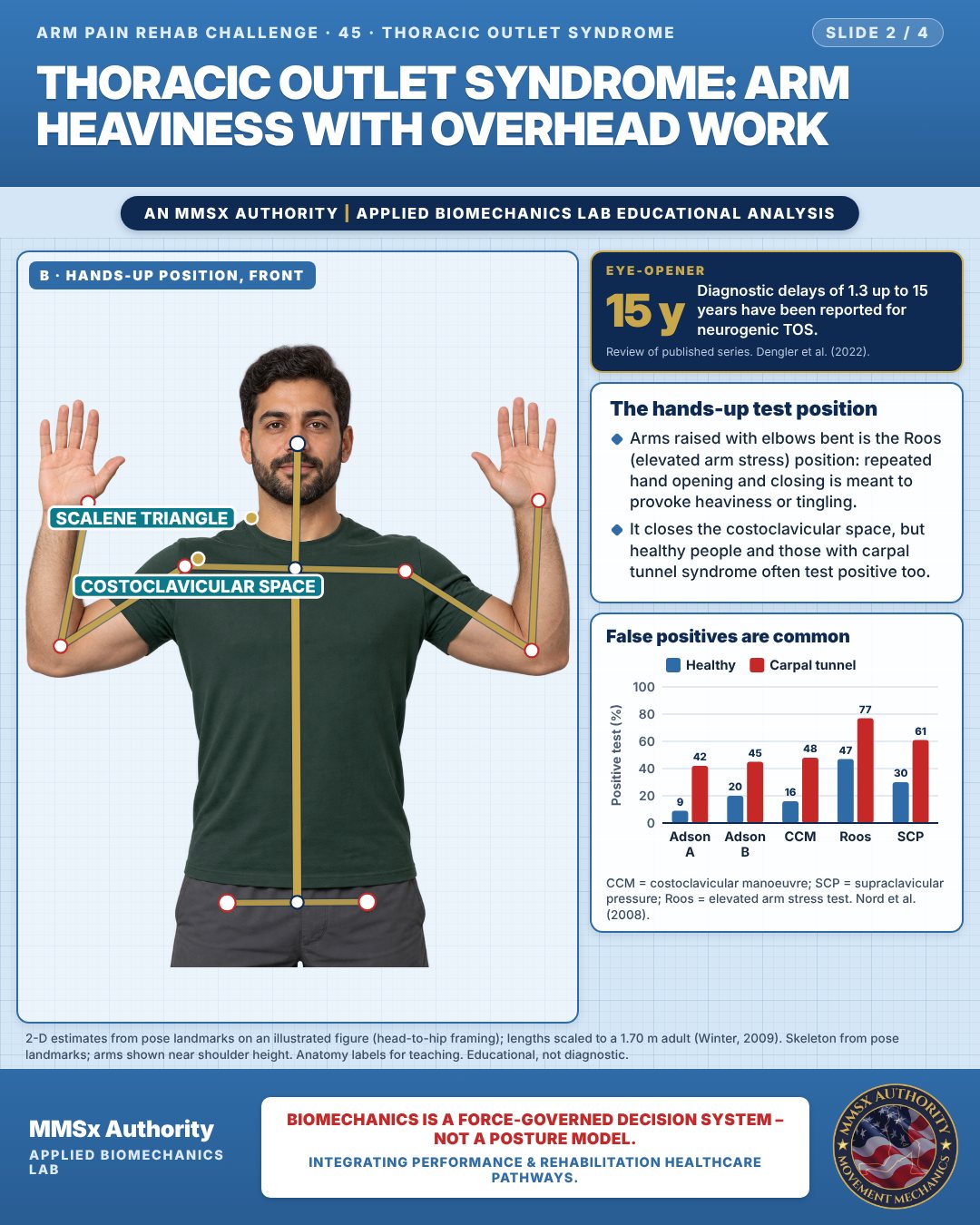
The hands-up test position
Arms raised with elbows bent is the Roos (elevated arm stress) position: repeated hand opening and closing is meant to provoke heaviness or tingling.
It closes the costoclavicular space, but healthy people and those with carpal tunnel syndrome often test positive too.
False positives are common
Movement C: Heavy shoulder bag (side view)
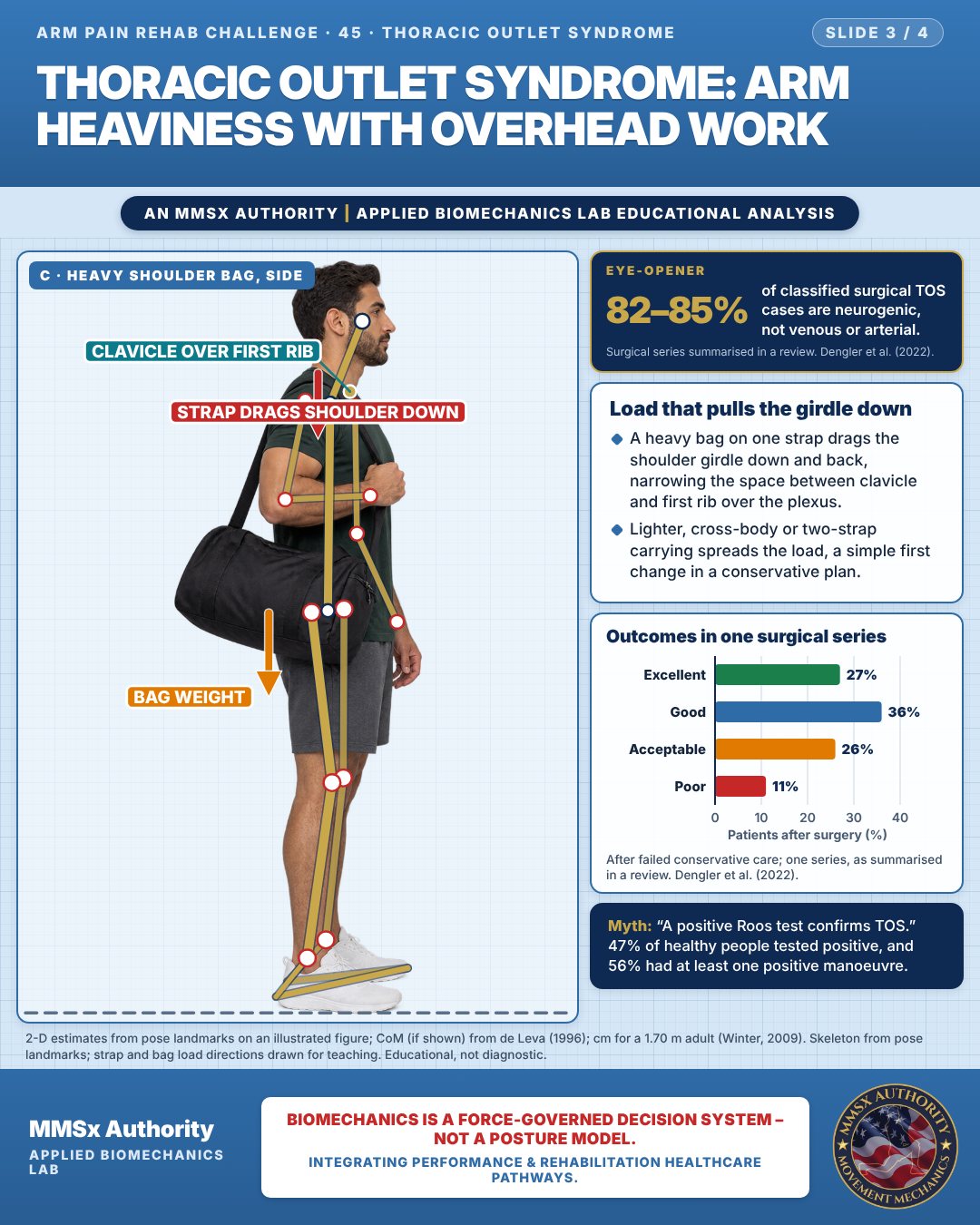
Load that pulls the girdle down
A heavy bag on one strap drags the shoulder girdle down and back, narrowing the space between clavicle and first rib over the plexus.
Lighter, cross-body or two-strap carrying spreads the load, a simple first change in a conservative plan.
Outcomes in one surgical series
Decision pathway
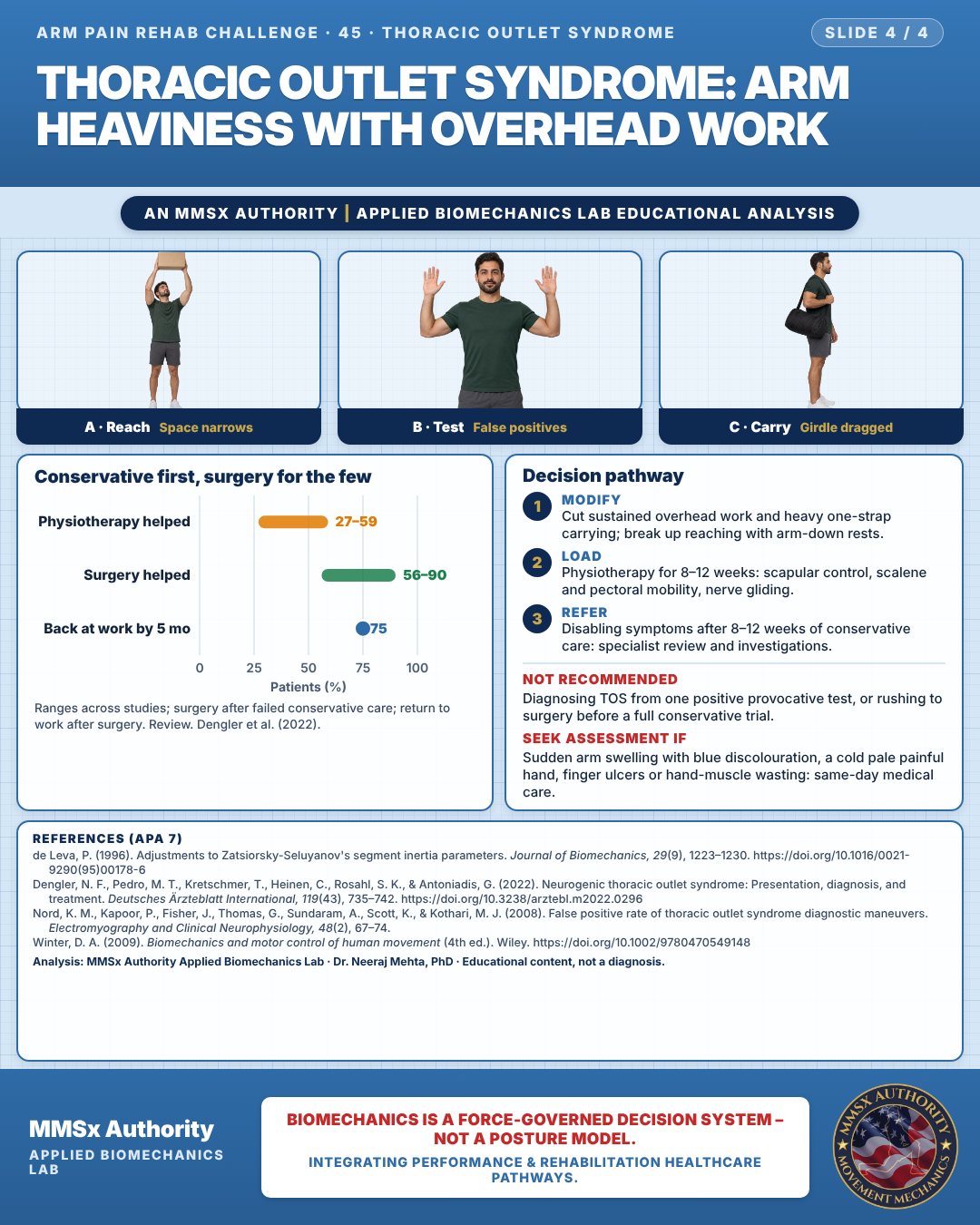
Conservative first, surgery for the few
Modify
Cut sustained overhead work and heavy one-strap carrying; break up reaching with arm-down rests.
Load
Physiotherapy for 8–12 weeks: scapular control, scalene and pectoral mobility, nerve gliding.
Refer
Disabling symptoms after 8–12 weeks of conservative care: specialist review and investigations.
What the evidence supports
- First-line: education, posture and load modification, and physiotherapy programmes (scapular control, scalene/pectoral mobility, nerve gliding) for 8–12 weeks; surgical decompression (first-rib resection/scalenectomy) only for persistent disabling nTOS after conservative care, or promptly for venous/arterial TOS (Dengler et al., 2022). Specific exercise prescriptions are not evidence-graded in the source read.
Cautions
Not recommended
Diagnosing TOS from one positive provocative test, or rushing to surgery before a full conservative trial.
Seek assessment if
Sudden arm swelling with blue discolouration, a cold pale painful hand, finger ulcers or hand-muscle wasting: same-day medical care.
Methods note
2-D estimates from pose landmarks on an illustrated figure; CoM (if shown) from de Leva (1996); cm for a 1.70 m adult (Winter, 2009). Arm elevation from pose landmarks (trunk line to upper arm). 2-D estimates from pose landmarks on an illustrated figure (head-to-hip framing); lengths scaled to a 1.70 m adult (Winter, 2009). Skeleton from pose landmarks; arms shown near shoulder height. Anatomy labels for teaching. Skeleton from pose landmarks; strap and bag load directions drawn for teaching. These are educational estimates, not a diagnosis.
References
- de Leva, P. (1996). Adjustments to Zatsiorsky-Seluyanov's segment inertia parameters. Journal of Biomechanics, 29(9), 1223–1230. https://doi.org/10.1016/0021-9290(95)00178-6
- Dengler, N. F., Pedro, M. T., Kretschmer, T., Heinen, C., Rosahl, S. K., & Antoniadis, G. (2022). Neurogenic thoracic outlet syndrome: Presentation, diagnosis, and treatment. Deutsches Ärzteblatt International, 119(43), 735–742. https://doi.org/10.3238/arztebl.m2022.0296
- Nord, K. M., Kapoor, P., Fisher, J., Thomas, G., Sundaram, A., Scott, K., & Kothari, M. J. (2008). False positive rate of thoracic outlet syndrome diagnostic maneuvers. Electromyography and Clinical Neurophysiology, 48(2), 67–74.
- Winter, D. A. (2009). Biomechanics and motor control of human movement (4th ed.). Wiley. https://doi.org/10.1002/9780470549148
Cite this article
Mehta, N. (2026, October 28). Thoracic outlet syndrome: arm heaviness with overhead work. MMSx Authority Applied Biomechanics Lab. https://mmsxauthority.org/edu/analysis/arm/45-thoracic-outlet-syndrome-arm-heaviness-with-overhead-work/
Part of the collection
Mehta, N. (2026). Elbow, Forearm, Wrist and Hand Rehabilitation: 50 Evidence-Based Biomechanics Analyses [Collection]. MMSx Authority Applied Biomechanics Lab. Zenodo. https://doi.org/10.5281/zenodo.23735910
All Arm Pain Rehab Challenge articles · Rehabilitation Library